
The chapter Surface Areas and Volume is an important part of the CBSE Class 10 Maths syllabus. In this chapter, students learn how to find the surface area and volume of different three-dimensional shapes such as cubes, cuboids, cylinders, cones, and spheres. These shapes are commonly used in real life objects like boxes, tanks, balls, and containers. So understanding this topic helps students connect mathematics with practical examples.
These Surface Areas and Volume Chapter 12 Class 10 Maths notes are designed to help students quickly revise the important concepts and formulas. In these revision notes, students will learn the meaning of surface area, curved surface area, total surface area, and volume of solid shapes. The notes also include all formulas of surface area and volume class 10, short explanations, and easy examples so that students can understand the topic in a simple way.
The surface areas and volumes class 10 topic is very important for board exams because many numerical questions are asked from this chapter. With the help of these surface area and volume class 10 notes, students can revise key formulas, concepts, and problem-solving methods before exams. These CBSE Class 10 maths Notes are prepared according to the latest CBSE class 10 syllabus and exam pattern, making them useful for quick revision and better practice.
Surface Areas and Volume
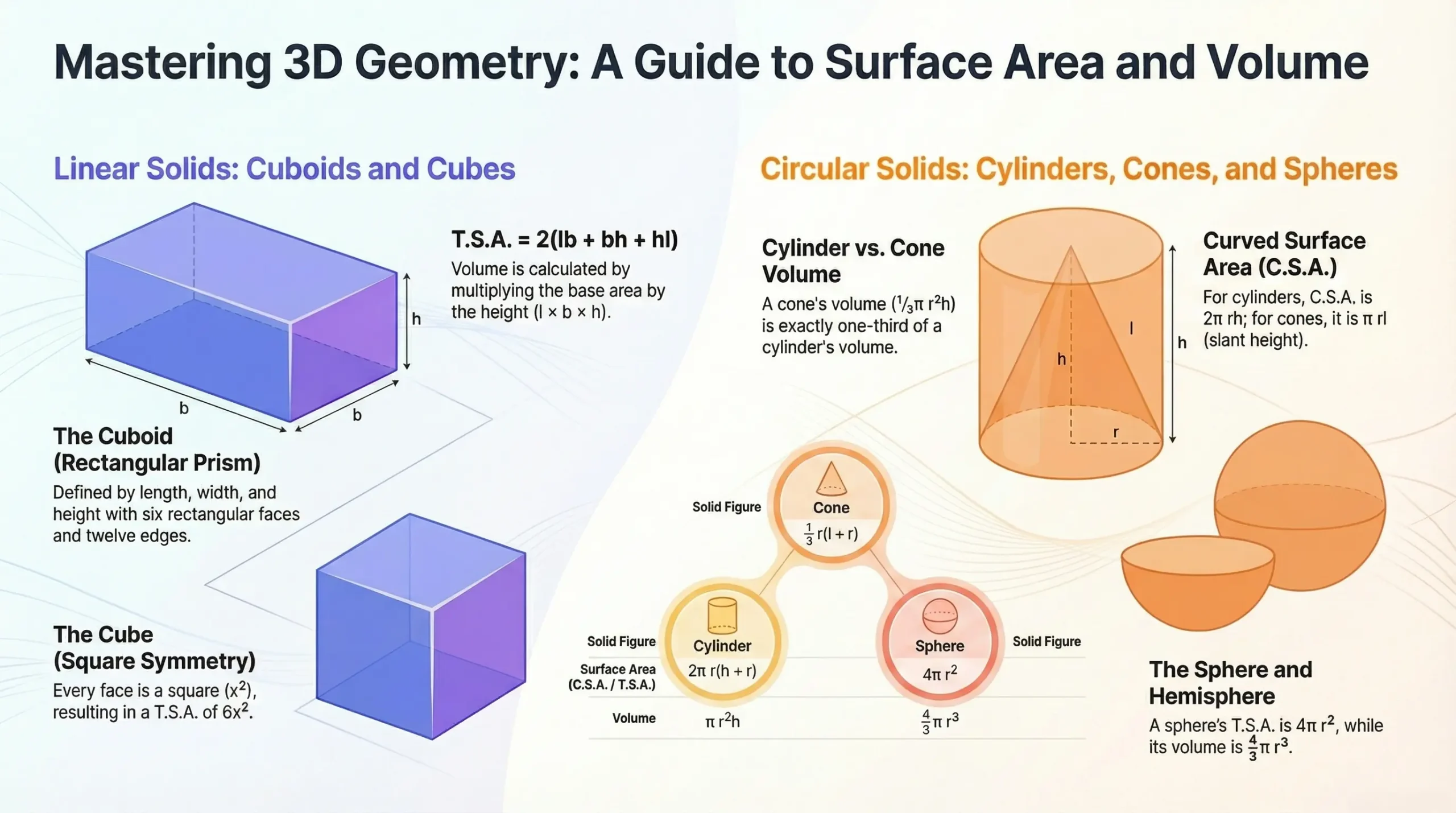
Understanding three-dimensional shapes is fundamental to geometry and has practical applications in engineering, architecture, and everyday problem-solving. Unlike two-dimensional figures that only have length and width, solid figures possess three dimensions: length, width, and height. This comprehensive guide explores the surface areas and volumes of various solid figures, providing you with the knowledge and tools to solve complex mensuration problems.
Surface Areas and Volume Class 10 Maths Revision Notes PDF Download
Fill the form to download this PDF
What are Solid Figures?
Solid figures are three-dimensional objects that occupy space and have volume in addition to surface area. Examples include cuboids, cubes, cylinders, cones, spheres, and hemispheres. These shapes are defined by:
- Three dimensions: length, breadth (width), and height
- Surface area: the total area of all faces forming the solid
- Volume: the amount of space enclosed within the solid
1. Cuboid
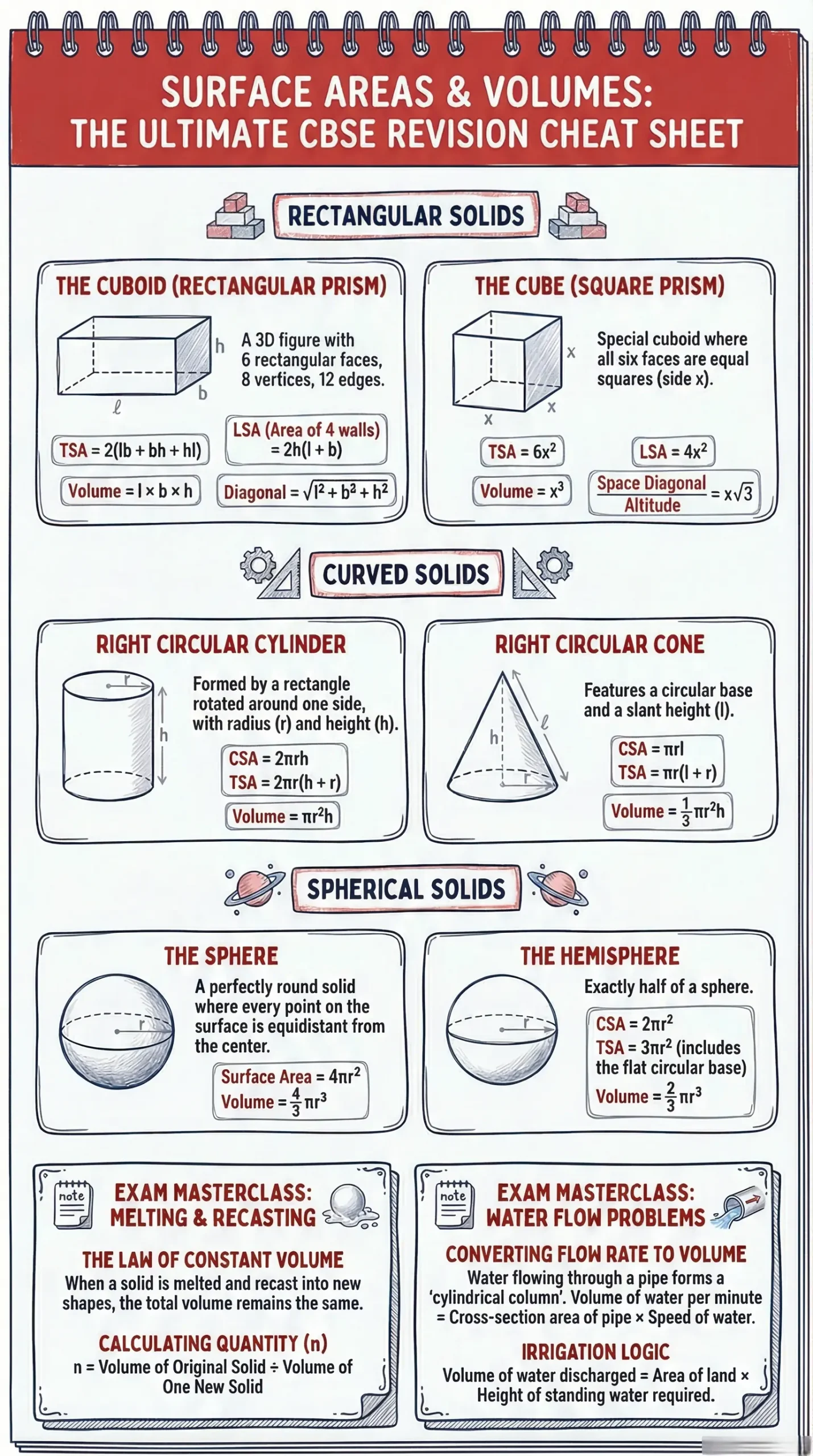
A cuboid is a three-dimensional rectangular box with six rectangular faces, eight vertices, and twelve edges.
Important Dimensions
- Length (ℓ)
- Breadth (b)
- Height (h)
Formulas for Cuboid
| Property | Formula |
|---|---|
| Total Surface Area (T.S.A.) | 2(ℓb + bh + hℓ) sq. units |
| Lateral Surface Area (L.S.A.) | 2h(ℓ + b) sq. units |
| Volume | ℓ × b × h cubic units |
| Length of Diagonal | √(ℓ² + b² + h²) units |
Real-World Applications
- Calculating the amount of paint needed for a room
- Determining storage capacity of boxes
- Estimating material required for construction
2. Cube
A cube is a special type of cuboid where all edges are equal in length. It has six square faces, eight vertices, and twelve equal edges.
Important Dimension
- Edge length (x)
Formulas for Cube
| Property | Formula |
|---|---|
| Total Surface Area (T.S.A.) | 6x² sq. units |
| Lateral Surface Area (L.S.A.) | 4x² sq. units |
| Volume | x³ cubic units |
| Length of Diagonal | x√3 units |
Derivation of Surface Area
For a cube with edge x:
- Each face area = x²
- Total faces = 6
- T.S.A. = 6 × x² = 6x²
3. Cylinder
A cylinder is a solid figure with two parallel circular bases connected by a curved surface.
Dimensions
- Radius of base (r)
- Height (h)
Formulas for Cylinder
| Property | Formula |
|---|---|
| Curved Surface Area (C.S.A.) | 2πrh sq. units |
| Total Surface Area (T.S.A.) | 2πr(h + r) sq. units |
| Volume | πr²h cubic units |
Understanding Curved Surface Area
When a cylinder is "unrolled," the curved surface forms a rectangle with:
- Length = circumference of base = 2πr
- Width = height = h
- Therefore, C.S.A. = 2πrh
4. Cone
A cone is a solid figure with a circular base that tapers smoothly to a point called the apex or vertex.
Dimensions
- Radius of base (r)
- Height (h)
- Slant height (ℓ), where ℓ = √(r² + h²)
Formulas for Cone
| Property | Formula |
|---|---|
| Curved Surface Area (C.S.A.) | πrℓ sq. units |
| Total Surface Area (T.S.A.) | πr(ℓ + r) sq. units |
| Volume | (1/3)πr²h cubic units |
Important Relationship
The slant height, radius, and height form a right triangle: ℓ² = r² + h²
5. Sphere
A sphere is a perfectly round three-dimensional object where every point on the surface is equidistant from the center.
Dimension
- Radius (r)
Formulas for Sphere
| Property | Formula |
|---|---|
| Surface Area | 4πr² sq. units |
| Volume | (4/3)πr³ cubic units |
Interesting Fact
A sphere has the smallest surface area for a given volume among all solid figures, making it the most efficient shape for containing volume.
6. Hemisphere
A hemisphere is exactly half of a sphere, cut through its center.
Dimension
- Radius (r)
Formulas for Hemisphere
| Property | Formula |
|---|---|
| Curved Surface Area (C.S.A.) | 2πr² sq. units |
| Total Surface Area (T.S.A.) | 3πr² sq. units |
| Volume | (2/3)πr³ cubic units |
Understanding Total Surface Area
T.S.A. = C.S.A. + Base Area = 2πr² + πr² = 3πr²
Surface Areas and Volume Solved Examples with Solutions
Problem: How many balls, each of radius 1 cm, can be made from a solid sphere of lead of radius 8 cm?
Solution:
- Volume of large sphere = (4/3)π(8)³ = (4/3)π × 512 cm³
- Volume of each small ball = (4/3)π(1)³ = (4/3)π cm³
- Number of balls = Volume of large sphere / Volume of small ball
- n = [(4/3)π × 512] / [(4/3)π × 1] = 512
512 balls
Problem: An iron rod of length 1 m and diameter 4 cm is melted and cast into thin wires of length 20 cm each. If the number of such wires is 2000, find the radius of each thin wire.
Solution:
- Radius of rod = 4/2 = 2 cm, Length = 100 cm
- Volume of rod = πr²h = π(2)² × 100 = 400π cm³
- Volume of each wire = πr² × 20 cm³
- Total volume of 2000 wires = 2000 × πr² × 20
- Equating: 400π = 2000 × πr² × 20
- 400 = 40,000r²
- r² = 1/100
- r = 0.1 cm or 1 mm
Radius = 0.1 cm
Problem: By melting a solid cylindrical metal, a few conical materials are to be made. If three times the radius of the cone is equal to twice the radius of the cylinder and the ratio of the height of the cylinder to the height of the cone is 4:3, find the number of cones which can be made.
Solution:
- Given: 3r = 2R → R = 3r/2
- H:h = 4:3 → H = 4h/3
- Volume of cylinder = πR²H
- Volume of each cone = (1/3)πr²h
- Number of cones = πR²H / [(1/3)πr²h] = 3R²H / r²h
- Substituting: n = 3(3r/2)²(4h/3) / r²h = 3 × (9r²/4) × (4h/3) / r²h
- n = (3 × 9 × 4) / (4 × 3) = 9
9 cones
Problem: The base diameter of a solid cone is 6 cm and the height is 10 cm. It is melted and recast into spherical balls of diameter 1 cm. Find the number of balls obtained.
Solution:
- Radius of cone = 3 cm, height = 10 cm
- Volume of cone = (1/3)π(3)² × 10 = 30π cm³
- Radius of each sphere = 0.5 cm
- Volume of each sphere = (4/3)π(0.5)³ = (4/3)π × (1/8) = π/6 cm³
- Number of balls = 30π / (π/6) = 30 × 6 = 180
180 balls
Problem: A conical vessel with radius 9 cm and height 72 cm is to be filled completely by pouring water with a cylindrical can of diameter 6 cm and height 12 cm. How many times must the can be filled?
Solution:
- Volume of conical vessel = (1/3)π(9)² × 72 = 1944π cm³
- Radius of cylindrical can = 3 cm
- Volume of can = π(3)² × 12 = 108π cm³
- Number of times = 1944π / 108π = 18
18 times
Problem: The height of a right circular cylinder is equal to its diameter. It is melted and recast into a sphere of radius equal to the radius of the cylinder. Find the fraction of material that remained unused.
Solution:
- Let radius = r, then height = 2r
- Volume of cylinder = πr² × 2r = 2πr³
- Volume of sphere = (4/3)πr³
- Unused material = 2πr³ - (4/3)πr³ = (6πr³ - 4πr³)/3 = (2πr³)/3
- Fraction unused = [(2πr³)/3] / [2πr³] = 1/3
1/3 of the material
Problem: Water flows at the rate of 10 m per minute through a cylindrical pipe having diameter 5 mm. How much time will it take to fill a conical vessel whose diameter is 40 cm and depth 24 cm?
Solution:
- Radius of pipe = 2.5 mm = 0.25 cm
- Volume flowing per minute = π(0.25)² × 1000 = 62.5π cm³
- Volume of cone = (1/3)π(20)² × 24 = 3200π cm³
- Time required = 3200π / 62.5π = 51.2 minutes
51.2 minutes
Problem: A hemispherical tank of radius 1¾ m is full of water. It is connected with a pipe which empties it at the rate of 7 liters per second. How much time will it take to empty the tank completely?
Solution:
- Radius = 7/4 m = 175 cm
- Volume of hemisphere = (2/3)π(175)³ cm³
- Emptying rate = 7000 cm³/sec
- Time = [(2/3)π(175)³] / 7000 seconds
- Time = [(2/3) × (22/7) × 175 × 175 × 175] / 7000
- Time ≈ 1605 seconds ≈ 26.75 minutes
Approximately 26.75 minutes
Problem: A well of diameter 2 m is dug 14 m deep. The earth taken out is spread evenly all around it to a width of 5 m to form an embankment. Find the height of the embankment.
Solution:
- Volume of earth dug = π(1)² × 14 = 14π m³
- The embankment is a hollow cylinder with inner radius 1 m and outer radius 6 m
- Volume of embankment = π(6² - 1²) × h = 35πh m³
- Equating: 35πh = 14π
- h = 14/35 = 2/5 = 0.4 m
0.4 m or 40 cm
Problem: Water in a canal, 30 dm wide and 12 dm deep, is flowing with a speed of 10 km/hr. How much area will it irrigate in 30 minutes if 8 cm of standing water is required?
Solution:
- Speed = 10 km/hr = 10,000 m/hr = 500/3 m/min
- Volume per minute = (500/3) × 3 × 1.2 = 600 m³
- Volume in 30 minutes = 600 × 30 = 18,000 m³
- If area = x m², then x × (8/100) = 18,000
- x = 18,000 × 100/8 = 225,000 m²
225,000 m² or 22.5 hectares
Problem: Find the total surface area of a cuboid with dimensions 8 cm × 6 cm × 4 cm.
Solution:
- T.S.A. = 2(ℓb + bh + hℓ)
- T.S.A. = 2(8×6 + 6×4 + 4×8)
- T.S.A. = 2(48 + 24 + 32) = 2(104) = 208 cm²
208 cm²
Problem: The total surface area of a cube is 294 cm². Find its volume.
Solution:
- T.S.A. = 6x² = 294
- x² = 49
- x = 7 cm
- Volume = x³ = 7³ = 343 cm³
343 cm³
Problem: A cylindrical pillar with radius 0.7 m and height 5 m needs to be painted. Find the cost at ₹25 per m².
Solution:
- C.S.A. = 2πrh = 2 × (22/7) × 0.7 × 5 = 22 m²
- Cost = 22 × 25 = ₹550
₹550
Problem: A cone has base radius 5 cm and height 12 cm. Find its slant height and curved surface area.
Solution:
- ℓ = √(r² + h²) = √(25 + 144) = √169 = 13 cm
- C.S.A. = πrℓ = (22/7) × 5 × 13 = 204.3 cm²
Slant height = 13 cm, C.S.A. = 204.3 cm²
Problem: Compare the volumes of a sphere and a cube if both have the same surface area of 216 cm².
Solution:
- For cube: 6x² = 216 → x = 6 cm → Volume = 216 cm³
- For sphere: 4πr² = 216 → r² = 54/π → r ≈ 4.14 cm
- Volume of sphere = (4/3)πr³ ≈ 297.5 cm³
- Sphere has larger volume
Sphere volume ≈ 297.5 cm³ > Cube volume = 216 cm³
Problem: Find the total surface area of a hemisphere with radius 14 cm.
Solution:
- T.S.A. = 3πr² = 3 × (22/7) × 14² = 3 × 22 × 2 × 14 = 1848 cm²
1848 cm²
Problem: A toy is in the form of a cone mounted on a hemisphere. The radius of the base is 3.5 cm and total height is 15.5 cm. Find its volume.
Solution:
- Radius = 3.5 cm
- Height of cone = 15.5 - 3.5 = 12 cm
- Volume of cone = (1/3)π(3.5)² × 12 = 154 cm³
- Volume of hemisphere = (2/3)π(3.5)³ = 89.8 cm³
- Total volume = 154 + 89.8 = 243.8 cm³
Approximately 244 cm³
Problem: A metallic sphere of radius 6 cm is melted and recast into the shape of a cylinder of radius 4 cm. Find the height of the cylinder.
Solution:
- Volume of sphere = (4/3)π(6)³ = 288π cm³
- Volume of cylinder = πr²h = π(4)²h = 16πh
- Equating: 16πh = 288π
- h = 18 cm
18 cm
Problem: A bucket is in the form of a frustum with top radius 20 cm, bottom radius 12 cm, and height 16 cm. Find its capacity.
Solution:
- Volume of frustum = (1/3)πh(r₁² + r₂² + r₁r₂)
- Volume = (1/3)π × 16 × (400 + 144 + 240)
- Volume = (1/3)π × 16 × 784 = 13,098.7 cm³
- Capacity ≈ 13.1 liters
Approximately 13.1 liters
Problem: Find the length of the longest rod that can fit in a cuboid room of dimensions 12 m × 9 m × 8 m.
Solution:
- Diagonal = √(ℓ² + b² + h²)
- Diagonal = √(144 + 81 + 64) = √289 = 17 m
17 m
Surface Areas and Volume Important Tips and Tricks
1. Unit Consistency
Always ensure all measurements are in the same units before calculation.
2. Volume Conservation
When a solid is melted and recast, the volume remains constant.
3. Common Mistakes to Avoid
- Confusing radius with diameter
- Forgetting to square or cube in formulas
- Mixing up surface area and volume formulas
4. Quick Checks
- Volume always has cubic units
- Surface area always has square units
- Diagonal of cube = edge × √3
5. Problem-Solving Strategy
- Identify the solid shape
- Write down known values
- Select appropriate formula
- Substitute and solve
- Check units in the answer