
CBSE Class 10 Maths Some Applications of Trigonometry Notes: In CBSE Class 10, Mathematics becomes more practical and useful in real life. One important topic in this syllabus is Class 10 Maths Chapter 9 Some Applications of Trigonometry. In this chapter, students learn how trigonometry is used to find the height and distance of objects such as buildings, towers, trees, and mountains without directly measuring them. These concepts help students understand how mathematics is applied in fields like engineering, architecture, navigation, and surveying.
These Class 10 Maths Some Applications of Trigonometry Notes are designed to explain the topic in a clear and simple way. The notes cover important concepts such as angle of elevation, angle of depression, line of sight, horizontal line, and trigonometric ratios. With the help of easy explanations, examples, and diagrams, students can quickly understand the practical use of trigonometry.
Students often search for Class 10 Maths Chapter 9 Some Applications of Trigonometry Notes or Some Applications of Trigonometry Class 10 Notes to revise the chapter before exams. These CBSE Class 10 Maths Notes provide step-by-step explanations, solved examples, and important formulas which help in better exam preparation. Many learners also prefer downloading the Class 10 Maths Some Applications of Trigonometry Notes PDF so they can study anytime.
Applications of Trigonometry
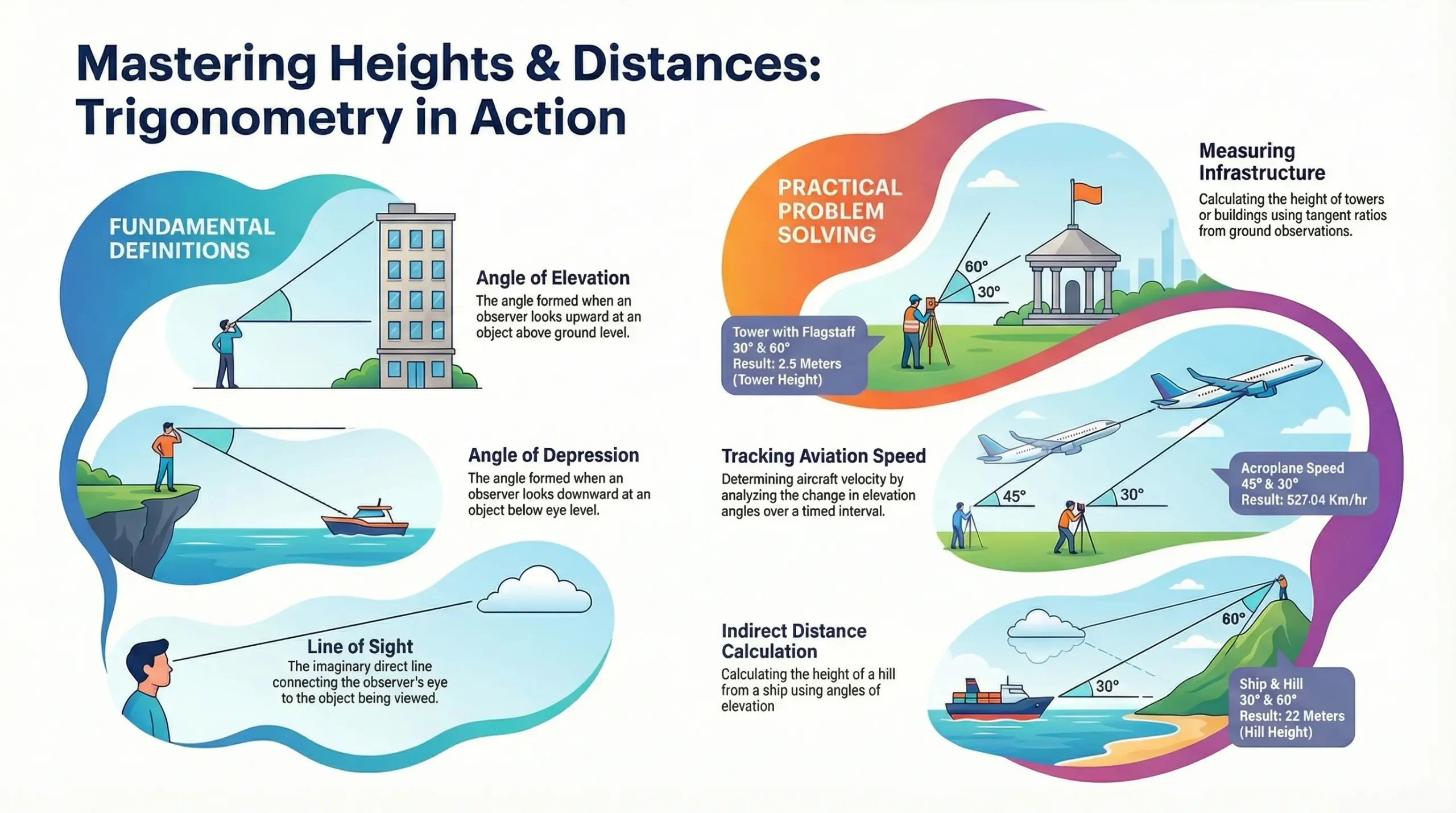
Trigonometry finds extensive applications in real-world scenarios, particularly in calculating heights and distances that cannot be measured directly. This chapter focuses on practical problems involving angles of elevation and depression, which are fundamental concepts used in architecture, navigation, surveying, and astronomy.
Understanding these applications helps students connect mathematical concepts with everyday observations, such as determining the height of a building, the distance of a ship from shore, or the altitude of an aircraft.
Applications of Trigonometry Class 10 Maths Revision Notes PDF Download
Fill the form to download this PDF
Core Concepts Applications of Trigonometry
1. Line of Sight
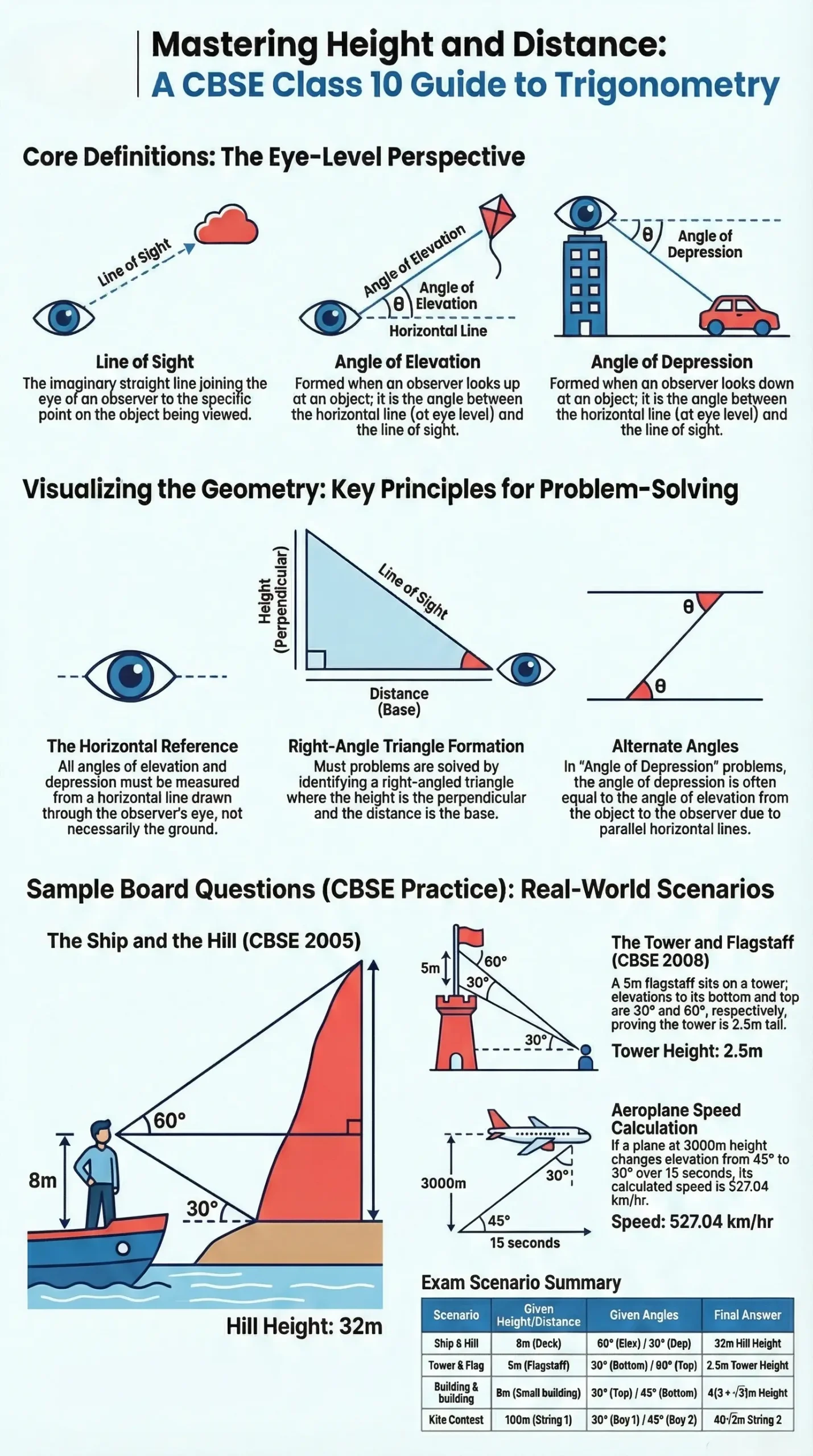
The line of sight is an imaginary straight line drawn from the observer's eye to the object being viewed. This line forms the basis for measuring angles of elevation and depression.
Points:
- Always originates from the observer's eye
- Extends directly to the point of interest on the object
- Forms angles with the horizontal plane
2. Angle of Elevation
The angle of elevation is formed when an observer looks upward at an object positioned above the horizontal level of their eyes.
Definition:
The angle of elevation is the angle between the horizontal line through the observer's eye and the line of sight when looking upward at an object.
- The object is at a higher level than the observer
- The observer must look upward
- Measured from the horizontal upward to the line of sight
- Always lies between 0° and 90°
Common Applications:
- Finding the height of buildings, towers, or mountains
- Determining the altitude of flying objects (kites, aircraft, birds)
- Calculating the height of trees or monuments
3. Angle of Depression
The angle of depression is formed when an observer looks downward at an object positioned below the horizontal level of their eyes.
Definition:
The angle of depression is the angle between the horizontal line through the observer's eye and the line of sight when looking downward at an object.
Characteristics:
- The object is at a lower level than the observer
- The observer must look downward
- Measured from the horizontal downward to the line of sight
- Always lies between 0° and 90°
Important Property: The angle of depression from point A to point B equals the angle of elevation from point B to point A (alternate angles formed by parallel horizontal lines).
Common Applications:
- Calculating depths of valleys or wells
- Finding distances from elevated positions (lighthouses, cliffs, towers)
- Navigation and surveying from elevated platforms
Essential Trigonometric Ratios
For solving height and distance problems, you must be proficient with these fundamental ratios:
| Ratio | Definition | Formula |
|---|---|---|
| Sine (sin θ) | Perpendicular/Hypotenuse | sin θ = Opposite/Hypotenuse |
| Cosine (cos θ) | Base/Hypotenuse | cos θ = Adjacent/Hypotenuse |
| Tangent (tan θ) | Perpendicular/Base | tan θ = Opposite/Adjacent |
Standard Angle Values
| Angle (θ) | sin θ | cos θ | tan θ |
|---|---|---|---|
| 0° | 0 | 1 | 0 |
| 30° | 1/2 | √3/2 | 1/√3 |
| 45° | 1/√2 | 1/√2 | 1 |
| 60° | √3/2 | 1/2 | √3 |
| 90° | 1 | 0 | ∞ |
How to solve Some Applications of Trigonometry Problems
Step-by-Step Approach
- Draw a clear diagram showing all given information
- Identify the angle (elevation or depression)
- Mark known and unknown quantities
- Form right-angled triangles from the given information
- Apply appropriate trigonometric ratios
- Solve the equations systematically
- Verify units and provide the final answer
Common Techniques
- Single Right Triangle: Use when one angle and one side are known
- Two Right Triangles: Required when dealing with two different angles or positions
- Alternate Angles: Remember that angle of depression equals corresponding angle of elevation
- Pythagorean Theorem: Useful when two sides are known and the third is required
Applications of Trigonometry Solved Examples
Q. A tower stands vertically on the ground. From a point 50 meters away from its base, the angle of elevation of the top is 30°. Find the height of the tower.
Solution:
Let AB be the tower of height h meters and C be the point of observation.
In △ABC:
- BC = 50 m (horizontal distance)
- ∠ACB = 30° (angle of elevation)
- AB = h (height to find)
Using tan ratio:
tan 30° = AB/BC = h/50 1/√3 = h/50 h = 50/√3 = 50√3/3 h ≈ 28.87 meters
The height of the tower is 50√3/3 meters or approximately 28.87 meters.
Q. A man is standing on the deck of a ship 8 m above water level. He observes the angle of elevation of the top of a hill as 60° and the angle of depression of the base of the hill as 30°. Calculate the distance of the hill from the ship and the height of the hill.
Solution:
Let:
- Distance of hill from ship = x meters
- Height of hill = h + 8 meters
- Observer's height = 8 meters
For angle of depression (30°):
In △BCD (looking down at base):
tan 30° = 8/x 1/√3 = 8/x x = 8√3 meters
For angle of elevation (60°):
In △ACB (looking up at top):
tan 60° = h/x √3 = h/(8√3) h = √3 × 8√3 = 24 meters
Total height of hill:
Height = h + 8 = 24 + 8 = 32 meters
- Distance of ship from hill = 8√3 meters (≈13.86 m)
- Height of hill = 32 meters
Q. A vertical tower stands on a horizontal plane and is surmounted by a vertical flag staff of height 5 meters. At a point on the plane, the angles of elevation of the bottom and top of the flag staff are 30° and 60° respectively. Find the height of the tower.
Solution:
Let:
- AB = tower height = h meters
- BC = flag staff = 5 meters
- Point D at distance x meters from tower base
In △ABD (to bottom of flag staff):
tan 30° = AB/AD = h/x 1/√3 = h/x x = √3h ... (i)
In △ACD (to top of flag staff):
tan 60° = AC/AD = (h + 5)/x √3 = (h + 5)/x x = (h + 5)/√3 ... (ii)
From equations (i) and (ii):
√3h = (h + 5)/√3 3h = h + 5 2h = 5 h = 2.5 meters
The height of the tower is 2.5 meters.
Q. The angles of depression of the top and bottom of an 8 m tall building from the top of a multistoried building are 30° and 45° respectively. Find the height of the multistoried building and the distance between the two buildings.
Solution:
Let:
- AB = multistoried building height = h meters
- DE = smaller building = 8 m
- Distance between buildings = x meters
Using alternate angles:
- ∠XAC = ∠ACB = 45° (alternate angles)
- ∠XAD = ∠ADE = 30° (alternate angles)
In △ACB (to bottom):
tan 45° = h/x 1 = h/x x = h ... (i)
In △ADE (to top of smaller building):
tan 30° = AE/ED = (h - 8)/x 1/√3 = (h - 8)/x x = √3(h - 8) ... (ii)
From equations (i) and (ii):
h = √3(h - 8) h = √3h - 8√3 h - √3h = -8√3 h(1 - √3) = -8√3 h = 8√3/(√3 - 1)
Rationalizing:
h = 8√3/(√3 - 1) × (√3 + 1)/(√3 + 1) h = 8√3(√3 + 1)/(3 - 1) h = 8√3(√3 + 1)/2 h = 4√3(√3 + 1) h = 4(3 + √3) h = 12 + 4√3 meters
- Height of multistoried building = 4(3 + √3) meters (≈18.93 m)
- Distance between buildings = 4(3 + √3) meters (≈18.93 m)
Q. The angle of elevation of an aeroplane from a point on the ground is 45°. After 15 seconds of flight, the elevation changes to 30°. If the aeroplane is flying at a constant height of 3000 meters, find the speed of the aeroplane.
Solution:
Let:
- Point E on ground initially below the plane
- Horizontal distance covered in 15 seconds = x meters
- Initial distance from E to ground point below plane = y meters
In △AEB (initial position, 45° angle):
tan 45° = AB/EB = 3000/y 1 = 3000/y y = 3000 meters ... (i)
In △CED (after 15 seconds, 30° angle):
tan 30° = CD/ED = 3000/(x + y) 1/√3 = 3000/(x + y) x + y = 3000√3 ... (ii)
From equations (i) and (ii):
x + 3000 = 3000√3 x = 3000√3 - 3000 x = 3000(√3 - 1) x = 3000(1.732 - 1) x = 3000(0.732) x = 2196 meters
Speed calculation:
Speed = Distance/Time = 2196/15 = 146.4 m/s Converting to km/hr: Speed = 146.4 × (18/5) = 527.04 km/hr
The speed of the aeroplane is 527.04 km/hr or 146.4 m/s.
Q. If the angle of elevation of a cloud from a point h meters above a lake is α and the angle of depression of its reflection in the lake is β, prove that the distance of the cloud from the point of observation is:
CD = (2h sec α)/(tan β - tan α)
Solution:
Let:
- C = observation point at height h
- D = position of cloud at height H above lake
- D' = reflection of cloud in lake
In △DCE (angle of elevation α):
tan α = DE/CE = H/CE CE = H/tan α ... (i)
In △CED' (angle of depression β to reflection):
tan β = ED'/EC = (h + H + h)/CE tan β = (2h + H)/CE CE = (2h + H)/tan β ... (ii)
From equations (i) and (ii):
H/tan α = (2h + H)/tan β H tan β = (2h + H) tan α H tan β = 2h tan α + H tan α H tan β - H tan α = 2h tan α H(tan β - tan α) = 2h tan α H = 2h tan α/(tan β - tan α) ... (iii)
In △DCE, finding CD:
sin α = DE/CD = H/CD CD = H/sin α CD = H × (1/sin α) CD = H × sec α/cos α × 1/sin α CD = H/sin α
Substituting H from equation (iii):
CD = [2h tan α/(tan β - tan α)] × (1/sin α) CD = 2h tan α/[(tan β - tan α) sin α] CD = 2h × (sin α/cos α)/[(tan β - tan α) sin α] CD = 2h/[(tan β - tan α) cos α] CD = 2h sec α/(tan β - tan α)
Hence Proved.
Q. A boy is standing on the ground flying a kite with 100 m of string at an elevation of 30°. Another boy is standing on the roof of a 10 m high building flying his kite at an elevation of 45°. Both boys are on opposite sides of both kites. Find the length of the string that the second boy must have so that the two kites meet.
Solution:
Let the length of second string be x meters.
For first boy (△ABC):
sin 30° = AC/AB 1/2 = AC/100 AC = 50 meters (vertical height of first kite)
For second boy (△AEF):
The second kite must reach the same height as the first kite.
Vertical distance to cover = AC - FC = 50 - 10 = 40 meters (FC = building height = 10 m) sin 45° = AF/AE 1/√2 = 40/x x = 40√2 meters
The second boy must have 40√2 meters (≈56.57 m) of string.
Q. A ladder 15 meters long just reaches the top of a vertical wall. If the ladder makes an angle of 60° with the wall, find the height of the wall.
Solution:
Let:
- AB = wall height = h meters
- AC = ladder length = 15 meters
- ∠BAC = angle with wall = 60°
In △ABC:
sin 60° = BC/AC (opposite to angle) √3/2 = BC/15 BC = 15√3/2 meters (base distance) For height: cos 60° = AB/AC 1/2 = h/15 h = 7.5 meters
The height of the wall is 7.5 meters.
Q. A vertical pole 6 meters high casts a shadow 2√3 meters long on the ground. Find the sun's elevation.
Solution:
Let:
- AB = pole height = 6 m
- BC = shadow length = 2√3 m
- θ = sun's elevation angle
In △ABC:
tan θ = AB/BC = 6/(2√3) tan θ = 3/√3 tan θ = 3/√3 × √3/√3 tan θ = 3√3/3 tan θ = √3 θ = 60°
The sun's elevation is 60°.
Q. From a point on a bridge across a river, the angles of depression of the banks on opposite sides of the river are 30° and 45°. If the bridge is at a height of 10 meters from the banks, find the width of the river.
Solution:
Let:
- Bridge height = 10 m
- Distance to one bank = x meters
- Distance to other bank = y meters
To bank with 45° angle:
tan 45° = 10/x 1 = 10/x x = 10 meters
To bank with 30° angle:
tan 30° = 10/y 1/√3 = 10/y y = 10√3 meters
Width of river:
Width = x + y = 10 + 10√3 Width = 10(1 + √3) Width ≈ 10(1 + 1.732) Width ≈ 27.32 meters
The width of the river is 10(1 + √3) meters (≈27.32 m).
Q. From the top of a 75-meter high lighthouse, the angles of depression of two ships on the same side of the lighthouse are 30° and 45°. Find the distance between the two ships.
Solution:
Let:
- Lighthouse height = 75 m
- Distance to nearer ship = x meters
- Distance to farther ship = y meters
To nearer ship (45°):
tan 45° = 75/x 1 = 75/x x = 75 meters
To farther ship (30°):
tan 30° = 75/y 1/√3 = 75/y y = 75√3 meters
Distance between ships:
Distance = y - x = 75√3 - 75 Distance = 75(√3 - 1) Distance ≈ 75(1.732 - 1) Distance ≈ 54.9 meters
The distance between the two ships is 75(√3 - 1) meters (≈54.9 m).
Q. A tree breaks due to storm and the broken part bends so that the top of the tree touches the ground making an angle of 30° with it. The distance between the foot of the tree to the point where the top touches the ground is 8 meters. Find the height of the tree.
Solution:
Let:
- AC = broken part (bent portion) = x meters
- AB = standing part = h meters
- BC = ground distance = 8 m
In △ABC:
cos 30° = BC/AC √3/2 = 8/x x = 16/√3 = 16√3/3 meters sin 30° = AB/AC 1/2 = h/x h = x/2 = (16√3/3)/2 h = 8√3/3 meters
Total height:
Total height = AB + AC = h + x = 8√3/3 + 16√3/3 = 24√3/3 = 8√3 meters ≈ 13.86 meters
The total height of the tree is 8√3 meters (≈13.86 m).
Q. A cable car starts from the ground and moves up a mountain at an angle of 30°. If it travels 500 meters along the cable, how high above the ground is it?
Solution:
Let:
- Cable distance = 500 m
- Height reached = h meters
- Angle of elevation = 30°
Using sine ratio:
sin 30° = height/hypotenuse 1/2 = h/500 h = 250 meters
The cable car is 250 meters above the ground.
Q. From a window 15 meters high above the ground in a building, the angle of elevation of the top of a tower is 30° and the angle of depression of the bottom of the tower is 45°. Find the height of the tower.
Solution:
Let:
- Window height = 15 m
- Distance to tower = x meters
- Height of tower above window = h meters
For angle of depression (45°):
tan 45° = 15/x 1 = 15/x x = 15 meters
For angle of elevation (30°):
tan 30° = h/x 1/√3 = h/15 h = 15/√3 = 5√3 meters
Total tower height:
Height = 15 + h = 15 + 5√3 ≈ 15 + 8.66 ≈ 23.66 meters
The height of the tower is (15 + 5√3) meters (≈23.66 m).
Q. A balloon is connected to a meteorological station by a cable of length 200 m inclined at 60° to the horizontal. Find the height of the balloon from the ground (assuming no slack in the cable).
Solution:
Let:
- Cable length = 200 m
- Angle with horizontal = 60°
- Height = h meters
Using sine ratio:
sin 60° = h/200 √3/2 = h/200 h = 200 × √3/2 h = 100√3 meters ≈ 173.2 meters
The height of the balloon is 100√3 meters (≈173.2 m).
Q. Two towers of heights 10 m and 30 m stand on a plane ground. If the distance between their feet is 15 m, find the distance between their tops.
Solution:
Let:
- Tower 1 height (AB) = 10 m
- Tower 2 height (CD) = 30 m
- Distance between feet (BD) = 15 m
- Distance between tops (AC) = d meters
Creating right triangle:
Horizontal distance = 15 m Vertical difference = 30 - 10 = 20 m Using Pythagoras theorem: d² = 15² + 20² d² = 225 + 400 d² = 625 d = 25 meters
The distance between the tops is 25 meters.
Q. From the top of a cliff 200 m high, the angles of depression of the top and bottom of a tower are observed to be 30° and 60°. Find the height of the tower.
Solution:
Let:
- Cliff height = 200 m
- Tower height = h meters
- Distance = x meters
For angle 60° (to tower bottom):
tan 60° = 200/x √3 = 200/x x = 200/√3 meters
For angle 30° (to tower top):
tan 30° = (200 - h)/x 1/√3 = (200 - h)/(200/√3) 1/√3 = (200 - h)√3/200 200/3 = 200 - h h = 200 - 200/3 h = 400/3 meters ≈ 133.33 meters
The height of the tower is 400/3 meters (≈133.33 m).
Q. A man is walking towards a building at 2 m/s. When he is 40 m away, the angle of elevation is 30°. After how much time will the angle of elevation be 60°?
Solution:
Let building height = h meters
When 40 m away (30° angle):
tan 30° = h/40 1/√3 = h/40 h = 40/√3 meters
For 60° angle, distance = x:
tan 60° = h/x √3 = (40/√3)/x x = 40/3 meters
Distance to cover:
Distance = 40 - 40/3 = 80/3 meters Time = Distance/Speed Time = (80/3)/2 = 40/3 seconds ≈ 13.33 seconds
The angle will be 60° after 40/3 seconds (≈13.33 seconds).
Q. A railway track is laid on a hill making an angle of 15° with the horizontal. What is the vertical rise when the train travels 2 km along the track?
Solution:
Let:
- Distance along track = 2 km = 2000 m
- Vertical rise = h meters
- Angle = 15°
Using sine ratio:
sin 15° = h/2000 h = 2000 × sin 15° h = 2000 × 0.2588 h ≈ 517.6 meters
The vertical rise is approximately 518 meters (using sin 15° ≈ 0.2588).
Q. The angle of elevation of the top of a tower from a point A on the ground is 30°. On moving a distance of 20 meters towards the foot of the tower to a point B, the angle of elevation increases to 60°. Find the height of the tower.
Solution:
Let:
- Tower height = h meters
- Distance from B to tower = x meters
- Distance from A to tower = x + 20 meters
From point B (60°):
tan 60° = h/x √3 = h/x x = h/√3 ... (i)
From point A (30°):
tan 30° = h/(x + 20) 1/√3 = h/(x + 20) x + 20 = √3h ... (ii)
Substituting (i) in (ii):
h/√3 + 20 = √3h h/√3 + 20 = √3h h + 20√3 = 3h 20√3 = 2h h = 10√3 meters ≈ 17.32 meters
The height of the tower is 10√3 meters (≈17.32 m).
Applications of Trigonometry Important Formulas Summary
Basic Trigonometric Ratios
- tan θ = Perpendicular/Base = Height/Distance
- sin θ = Perpendicular/Hypotenuse = Height/Slant Distance
- cos θ = Base/Hypotenuse = Distance/Slant Distance
Main Relationships
- Angle of depression from A to B = Angle of elevation from B to A
- In problems with two positions: Set up two equations using tan ratios
- For reflections: Total height = 2h + H (where h is observer height, H is object height)
Standard Values (Most Used)
- tan 30° = 1/√3
- tan 45° = 1
- tan 60° = √3
- sin 30° = 1/2, sin 45° = 1/√2, sin 60° = √3/2
Applications of Trigonometry Common Mistakes
- Confusing angle of elevation with depression - Always check if looking up or down
- Incorrect triangle identification - Clearly mark which angle belongs to which triangle
- Forgetting to rationalize - Always simplify surds in final answers
- Unit conversion errors - Be consistent with meters, kilometers, seconds, hours
- Using wrong trigonometric ratio - Identify perpendicular, base, and hypotenuse correctly
- Alternate angle oversight - Remember that angle of depression equals corresponding angle of elevation
- Adding/subtracting heights incorrectly - Draw diagrams to visualize properly
- Calculation errors with √3 - Use √3 ≈ 1.732 for approximations
Applications of Trigonometry Practice Tips for Students
- Master the basics - Memorize trigonometric values for 30°, 45°, 60°
- Draw accurate diagrams - This is crucial for understanding the problem
- Label everything clearly - Mark heights, distances, and angles
- Work systematically - Set up equations before solving
- Practice different problem types - Single angle, two angles, reflections, speed problems
- Check reasonableness - Does your answer make practical sense?
- Show all steps - Partial credit is awarded for correct method
- Time yourself - Build speed for exam conditions
Applications of Trigonometry Real-World Applications
Architecture and Construction
- Determining building heights
- Calculating required ladder lengths
- Designing ramps and slopes
- Planning staircases and elevations
Navigation and Aviation
- Flight path calculations
- Ship positioning
- Satellite tracking
- GPS technology
Surveying and Geography
- Mountain height measurement
- Valley depth calculation
- Land surveying
- Map making
Astronomy
- Calculating distances to celestial bodies
- Determining satellite positions
- Telescope angle adjustments
- Eclipse predictions
Applications of Trigonometry Exam Preparation Strategy For CBSE Class 10 Board Exams
Weightage: This chapter typically carries 4-6 marks in the board exam.
Question Types:
- 2-mark questions: Basic single-angle problems
- 3-mark questions: Two-angle or moderate complexity problems
- 4-mark questions: Multi-step problems requiring proof or complex calculations
Preparation Timeline:
Week 1-2:
- Master all trigonometric values
- Understand angle definitions thoroughly
- Practice basic single-angle problems
Week 3-4:
- Move to two-angle problems
- Practice speed and distance applications
- Work on reflection problems
Week 5-6:
- Solve previous year board questions
- Practice proof-based questions
- Time yourself on full chapter tests
Last Week:
- Revise formulas and key concepts
- Solve sample papers
- Focus on common error patterns
Conclusion
Applications of Trigonometry, particularly height and distance problems, bridge the gap between theoretical mathematics and practical problem-solving. Mastering this chapter requires:
- Strong foundation in basic trigonometric ratios
- Consistent practice with varied problem types
- Systematic approach to problem-solving
- Accurate diagram drawing skills
- Attention to detail in calculations