
Real Numbers Class 10 Notes: Real Numbers is the first chapter of Class 10 Mathematics and it builds the basic foundation for many other topics in maths. In simple words, real numbers include all numbers that we use in daily calculations, such as natural numbers, whole numbers, integers, fractions, and irrational numbers. These real numbers class 10 notes help students understand the concepts step-by-step with clear examples and easy explanations.
In Real Numbers Class 10 Notes Chapter 1, students mainly learn about the Euclid’s Division Lemma, Euclid’s Division Algorithm, Fundamental Theorem of Arithmetic, and the concept of HCF and LCM. These topics are important because they help in solving many mathematical problems in later chapters. Many students also use real numbers class 10 notes ncert solutions to practice questions given in the NCERT textbook and to understand the correct solving method.
These notes are designed to give a quick overview of the chapter, formulas, solved examples, and important points for exam preparation. Students can also download real numbers class 10 pdf to revise the topic anytime and anywhere. The aim of these notes is to make learning simple and clear so that students can easily understand number systems, prime factorization, and mathematical logic used in real numbers.
Overall, these notes will help students revise key concepts and build strong basics in mathematics, although sometimes students may still need extra practice to fully understand the topic.
Real Numbers
Real Numbers form the very foundation of Class 10 Mathematics and constitute Chapter 1 of the CBSE curriculum. This chapter bridges the gap between elementary number theory and higher mathematics.
The set of Real Numbers (ℝ) includes:
- Natural Numbers (N): 1, 2, 3, …
- Whole Numbers (W): 0, 1, 2, 3, …
- Integers (Z): …, −2, −1, 0, 1, 2, …
- Rational Numbers (Q): Numbers expressible as p/q where p, q ∈ ℤ and q ≠ 0
- Irrational Numbers: Numbers that cannot be expressed as p/q (e.g., √2, √3, π)
Why it matters: Every theorem in this chapter - from Euclid's Lemma to the Fundamental Theorem of Arithmetic - underpins number theory used in cryptography, computer science, and competitive mathematics.
Divisibility
Definition:
A non-zero integer 'a' is said to divide an integer 'b' if there exists an integer 'c' such that:
b = a × c
In this relationship:
- b = Dividend
- a = Divisor
- c = Quotient
Notation
| Notation | Meaning |
|---|---|
| a | b | 'a divides b' |
| a ∤ b | 'a does not divide b' |
Examples
- 5 divides 35 because 35 = 5 × 7 → 5 | 35 ✓
- 7 does not divide 30 because no integer c satisfies 30 = 7c → 7 ∤ 30 ✓
Key Properties of Divisibility
- If a | b and b | c, then a | c (Transitivity)
- If a | b and a | c, then a | (b + c) and a | (b − c)
- If a | b, then a | (b × m) for any integer m
- Every non-zero integer divides 0
- 1 divides every integer
CBSE Class 10 Maths Notes Real Numbers Revision Notes PDF
Fill the form to download this PDF
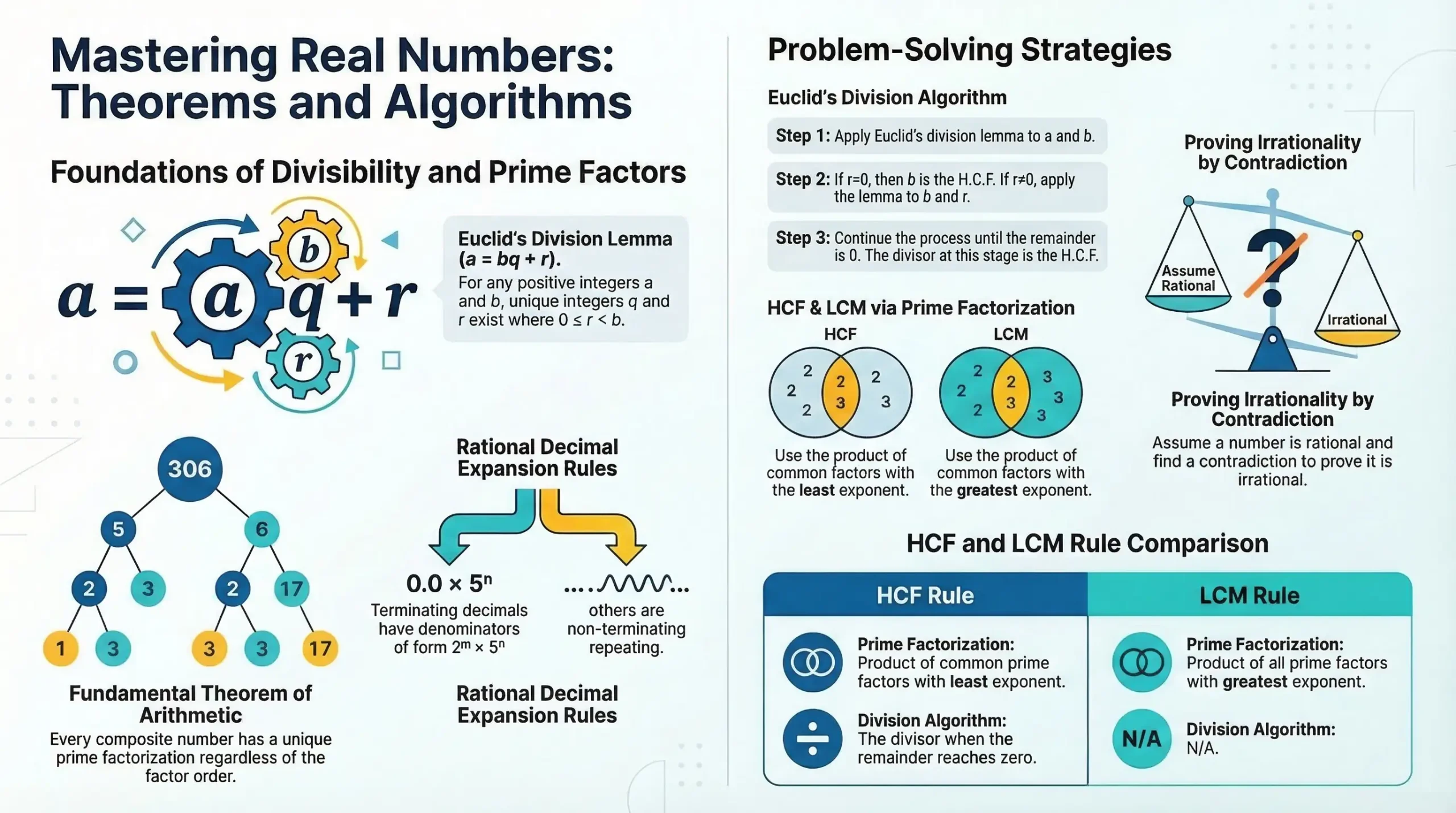
Euclid's Division Lemma
Statement
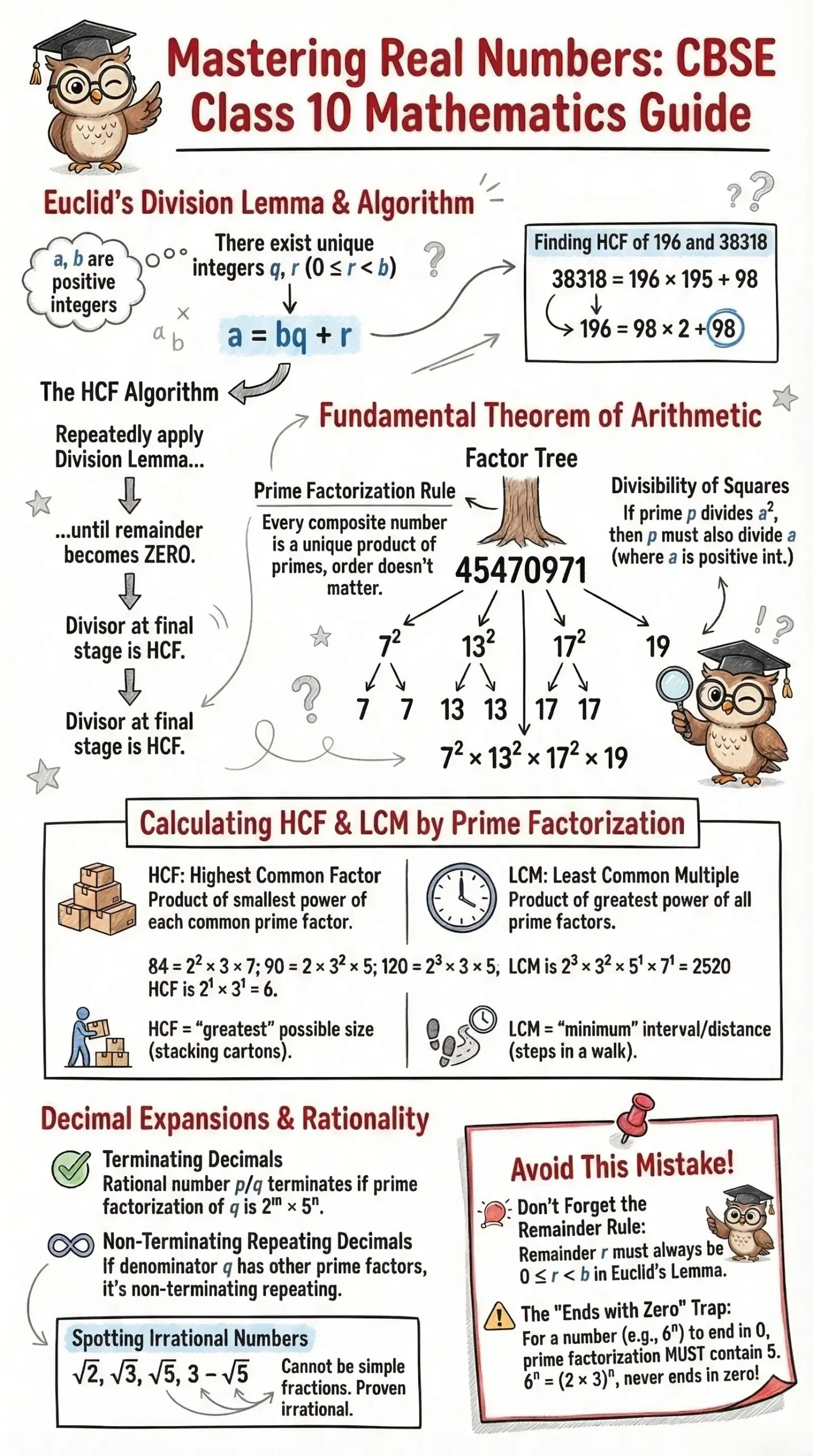
Let 'a' and 'b' be any two positive integers. Then, there exist unique integers 'q' and 'r' such that:
a = bq + r, where 0 ≤ r < b
If b | a, then r = 0.
Here:
- a = Dividend
- b = Divisor
- q = Quotient
- r = Remainder
Intuition
Euclid's Division Lemma is essentially a formal statement of what happens when you perform long division. When you divide any integer a by b, you always get a unique quotient q and a remainder r that is strictly less than b.
Important Consequence
If r = 0, then a = bq, meaning b divides a exactly.
Solved Example 1 - Odd Integer Form
Problem: Show that any positive odd integer is of the form 6q + 1, or 6q + 3, or 6q + 5, where q is some integer.
Solution:
Let 'a' be any positive integer and b = 6.
By Euclid's Division Lemma:
a = 6q + r, where 0 ≤ r < 6
So r can take values: r = 0, 1, 2, 3, 4, 5
This gives six possible forms:
| Form | Even or Odd? |
|---|---|
| a = 6q | Even (divisible by 2) |
| a = 6q + 1 | Odd |
| a = 6q + 2 | Even |
| a = 6q + 3 | Odd |
| a = 6q + 4 | Even |
| a = 6q + 5 | Odd |
Since a is odd, it cannot equal 6q, 6q + 2, or 6q + 4.
∴ Any positive odd integer is of the form 6q + 1, 6q + 3, or 6q + 5. [Proved]
Solved Example 2 - Cube of Positive Integer
Problem: Use Euclid's Division Lemma to show that the cube of any positive integer is of the form 9m, 9m + 1, or 9m + 8.
Solution:
Any positive integer x is of the form 3q, 3q + 1, or 3q + 2.
Case I: x = 3q
x³ = (3q)³ = 27q³ = 9(3q³) = 9m, where m = 3q³
Case II: x = 3q + 1
x³ = (3q + 1)³ = 27q³ + 27q² + 9q + 1
x³ = 9q(3q² + 3q + 1) + 1
x³ = 9m + 1, where m = q(3q² + 3q + 1)
Case III: x = 3q + 2
x³ = (3q + 2)³ = 27q³ + 54q² + 36q + 8
x³ = 9q(3q² + 6q + 4) + 8
x³ = 9m + 8, where m = q(3q² + 6q + 4)
∴ The cube of any positive integer is of the form 9m, 9m + 1, or 9m + 8. [Proved]
Solved Example 3 - Square of 5q + 1
Problem: Prove that the square of any positive integer of the form 5q + 1 is of the same form.
Solution:
Let x = 5q + 1.
x² = (5q + 1)² = 25q² + 10q + 1
x² = 5(5q² + 2q) + 1
x² = 5m + 1, where m = q(5q + 2)
∴ The square is also of the form 5m + 1 - the same form. [Proved]
Euclid's Division Algorithm
Statement
If 'a' and 'b' are positive integers such that a = bq + r, then every common divisor of 'a' and 'b' is a common divisor of 'b' and 'r', and vice-versa.
Algorithm to Find HCF
To find HCF(a, b) where a > b:
Step 1: Apply Division Lemma - a = bq₁ + r₁ (0 ≤ r₁ < b) Step 2: If r₁ ≠ 0, apply again - b = r₁q₂ + r₂ Step 3: Continue until remainder = 0 Step 4: The last non-zero remainder is the HCF
Solved Example 4 - HCF of 196 and 38318
Problem: Use Euclid's division algorithm to find the HCF of 196 and 38318.
Solution:
Applying Euclid's Division Lemma to 38318 and 196:
38318 = 196 × 195 + 98 196 = 98 × 2 + 0
The remainder is 0 at the second step.
∴ HCF(38318, 196) = 98
Solved Example 5 - HCF Expressed in Linear Form
Problem: If the HCF of 657 and 963 is expressible in the form 657x + 963 × (−15), find x.
Solution:
Applying Euclid's Division Lemma:
963 = 657 × 1 + 306 657 = 306 × 2 + 45 306 = 45 × 6 + 36 45 = 36 × 1 + 9 36 = 9 × 4 + 0
∴ HCF(657, 963) = 9
Now: 657x + 963 × (−15) = 9
657x = 9 + 963 × 15 = 9 + 14445 = 14454
x = 14454 ÷ 657 = 22
Solved Example 6 - Largest Divisor with Given Remainders
Problem: What is the largest number that divides 626, 3127, and 15628 leaving remainders 1, 2, and 3 respectively?
Solution:
The required number divides:
626 − 1 = 625, 3127 − 2 = 3125, 15628 − 3 = 15625
HCF(625, 3125):
3125 = 625 × 5 + 0
∴ HCF(625, 3125) = 625
HCF(625, 15625):
15625 = 625 × 25 + 0
∴ HCF(625, 15625) = 625
∴ HCF(625, 3125, 15625) = 625
The required largest number is 625.
Solved Example 7 - Stacking Cartons Problem
Problem: 144 cartons of Coke and 90 cartons of Pepsi are to be stacked in equal-height stacks of the same drink. What is the greatest number of cartons per stack?
Solution:
We need HCF(144, 90):
144 = 90 × 1 + 54 90 = 54 × 1 + 36 54 = 36 × 1 + 18 36 = 18 × 2 + 0
∴ HCF(144, 90) = 18
Each stack will have 18 cartons.
Fundamental Theorem of Arithmetic
Statement
Every composite number can be expressed (factorised) as a product of primes, and this factorisation is unique, apart from the order in which the prime factors occur.
This is also known as the Unique Prime Factorisation Theorem.
Why It's Fundamental
This theorem guarantees that every composite number has one - and only one - prime factorisation (ignoring order). It is the bedrock of number theory.
Consequences
- HCF = Product of the smallest powers of common prime factors
- LCM = Product of the greatest powers of all prime factors
- For any two positive integers a and b: HCF(a, b) × LCM(a, b) = a × b
Solved Example 8 - Prime Factorisation of 45470971
Problem: Determine the prime factors of 45470971.
Solution (Factor Tree):
7 | 4547071 7 | 6495853 7 | 927979 13 | 71383 13 | 5491 17 | 323 17 | 19
4547071 = 7 × 7 × 7 × 13 × 13 × 17 × 17 × 19
∴ 45470971 = 7² × 13² × 17² × 19
Solved Example 9 - Can 6ⁿ End with Digit 0?
Problem: Check whether 6ⁿ can end with the digit 0 for any natural number n.
Solution:
Any number ending in 0 must be divisible by 10 = 2 × 5.
So its prime factorisation must include the prime 5.
Now: 6ⁿ = (2 × 3)ⁿ = 2ⁿ × 3ⁿ
The prime factors of 6ⁿ are only 2 and 3.
Since 5 does not appear in the prime factorisation of 6ⁿ for any natural number n, 6ⁿ cannot end with the digit 0. [Proved]
HCF and LCM Using Prime Factorisation
Rules
| HCF | LCM | |
|---|---|---|
| Definition | Greatest Common Factor | Least Common Multiple |
| Prime Factor Rule | Least power of common primes | Greatest power of all primes |
| Application | Divides all given numbers | Divisible by all given numbers |
Solved Example 10 - HCF and LCM of 84, 90, 120
Problem: Find the LCM and HCF of 84, 90, and 120 using prime factorisation.
Solution:
| Number | Prime Factorisation |
|---|---|
| 84 | 2² × 3 × 7 |
| 90 | 2 × 3² × 5 |
| 120 | 2³ × 3 × 5 |
HCF - Take the least power of common prime factors:
| Common Prime | Least Power |
|---|---|
| 2 | 2¹ |
| 3 | 3¹ |
∴ HCF = 2¹ × 3¹ = 6
LCM - Take the greatest power of all prime factors:
| Prime | Greatest Power |
|---|---|
| 2 | 2³ |
| 3 | 3² |
| 5 | 5¹ |
| 7 | 7¹ |
∴ LCM = 2³ × 3² × 5 × 7 = 8 × 9 × 5 × 7 = 2520
Solved Example 11 - Morning Walk LCM Problem
Problem: Three persons step off together with step lengths of 80 cm, 85 cm, and 90 cm. What is the minimum distance they should walk so each covers the distance in complete steps?
Solution:
Required minimum distance = LCM(80, 85, 90)
Prime Factorisations:
80 = 2⁴ × 5 85 = 5 × 17 90 = 2 × 3² × 5
LCM = 2⁴ × 3² × 5¹ × 17¹ = 16 × 9 × 5 × 17 = 12240 cm = 122 m 40 cm
Irrational Numbers and Proofs
Definition
A number is irrational if it cannot be expressed in the form p/q where p, q are integers and q ≠ 0.
Examples: √2, √3, √5, π, e
Proof Technique - Contradiction
The standard method for proving irrationality:
- Assume the number is rational (i.e., = a/b in lowest terms, HCF(a,b) = 1)
- Derive a contradiction (usually that both a and b share a common factor)
- Conclude the assumption was wrong, so the number is irrational
Key Theorem Used
If prime p divides a², then p divides a.
Solved Example 12 - Prove √2 is Irrational
Problem: Prove that √2 is an irrational number.
Solution:
Assume, for contradiction, that √2 is rational.
Then √2 = a/b where a, b are positive integers with HCF(a, b) = 1.
Squaring both sides:
2 = a²/b²
a² = 2b² … (i)
So a² is divisible by 2. Since 2 is prime, a is divisible by 2.
Let a = 2c for some integer c.
Substituting into (i):
(2c)² = 2b²
4c² = 2b²
b² = 2c²
So b² is divisible by 2, which means b is also divisible by 2.
But now both a and b are divisible by 2, contradicting HCF(a, b) = 1.
∴ Our assumption was wrong. √2 is irrational.[Proved]
Solved Example 13 - Prove 3 − √5 is Irrational
Problem: Prove that 3 − √5 is an irrational number.
Solution:
Assume 3 − √5 is rational.
Then there exist co-prime integers a and b such that:
3 − √5 = a/b
3 − a/b = √5
(3b − a)/b = √5
Since a, b are integers, (3b − a)/b is rational.
This means √5 is rational - a contradiction, since √5 is known to be irrational.
∴ Our assumption is false. 3 − √5 is irrational.[Proved]
Solved Example 14 - Prove √3 is Irrational
Problem: Prove that √3 is irrational.
Solution:
Assume √3 = a/b, where HCF(a, b) = 1.
Then 3 = a²/b² → a² = 3b²
So 3 | a². Since 3 is prime, 3 | a.
Let a = 3k:
9k² = 3b² → b² = 3k²
So 3 | b.
This means 3 | a and 3 | b, contradicting HCF(a, b) = 1.
∴ √3 is irrational.[Proved]
Solved Example 15 - Prove 5 + √2 is Irrational
Problem: Prove that 5 + √2 is irrational.
Solution:
Assume 5 + √2 is rational = a/b (HCF = 1).
Then: √2 = a/b − 5 = (a − 5b)/b
Since a, b are integers, (a − 5b)/b is rational → √2 is rational - contradiction.
∴ 5 + √2 is irrational. [Proved]
Decimal Expansions of Rational Numbers
Theorem 1 - Terminating Decimals
A rational number p/q (in lowest terms) has a terminating decimal expansion if and only if the prime factorisation of q is of the form 2ᵐ × 5ⁿ, where m, n are non-negative integers.
Theorem 2 - Non-Terminating Repeating Decimals
A rational number p/q (in lowest terms) has a non-terminating repeating decimal expansion if the prime factorisation of q includes primes other than 2 or 5.
Quick Reference
| Type of Denominator q | Decimal Expansion |
|---|---|
| q = 2ᵐ × 5ⁿ | Terminating |
| q has factor ≠ 2, 5 | Non-terminating, repeating |
Solved Example 16 - Does 13/3125 Terminate?
Problem: State whether 13/3125 has a terminating decimal expansion.
Solution:
3125 = 5⁵
So: 13/3125 = 13/(2⁰ × 5⁵)
The denominator is of the form 2ᵐ × 5ⁿ (m = 0, n = 5).
∴ 13/3125 has a terminating decimal expansion.
Solved Example 17 - Terminating vs Non-Terminating
Problem: State the nature of the decimal expansions of
(i) 43.123456789 and
(ii) 43.123456789̄ (repeating).
Solution:
(i) 43.123456789 - This is a terminating decimal.
∴ Its denominator's prime factorisation is of the form 2ᵐ × 5ⁿ.
(ii) 43.1̄2̄3̄4̄5̄6̄7̄8̄9̄ - This is a non-terminating, repeating decimal.
∴ Its denominator has prime factors other than 2 or 5.
Solved Example 18 - Decimal Expansion Classification
Problem: Without division, classify 77/210 and 15/1600.
Solution:
77/210:
210 = 2 × 3 × 5 × 7
Since 3 and 7 appear as factors → Non-terminating, repeating.
15/1600:
1600 = 2⁶ × 5²
Denominator is of the form 2ᵐ × 5ⁿ → Terminating.
Solved Example 19 - Army Parade Problem
Problem: An army contingent of 616 members must march behind a band of 32 members, in equal columns. What is the maximum number of columns?
Solution:
Maximum columns = HCF(616, 32)
616 = 32 × 19 + 8 32 = 8 × 4 + 0
∴ HCF (616, 32) = 8
The maximum number of columns = 8
Solved Example 20 - Circular Track Meeting Problem
Problem: Sonia takes 18 minutes and Ravi takes 12 minutes to complete one round of a circular path. They start together. After how many minutes will they meet again at the starting point?
Solution:
They will meet again after LCM(18, 12) minutes.
18 = 2 × 3² 12 = 2² × 3 LCM = 2² × 3² = 4 × 9 = 36
∴ They will meet again after 36 minutes.
Classs 10 Maths chapter 1 Real numbers Practice Questions
Try these questions based on the chapter:
- Can 7ⁿ end with the digit 0 for any natural number n? Justify.
- Without long division, classify: (i) 77/210 (ii) 15/1600
- Use Euclid's algorithm to find HCF of: (i) 56 and 814 (ii) 6265 and 76254
- Find HCF and LCM of: (i) 426 and 576 (ii) 625, 1125 and 2125
- Prove that √5 is irrational. (CBSE 2008)
- Prove that √2 + √3 is irrational.
- Show that the square of any positive integer is of the form 3m or 3m + 1. (CBSE 2008)
- Write a rational number between √2 and √3. (CBSE 2008)
Real Number Chapters Formulas
| Concept | Key Formula / Statement |
|---|---|
| Divisibility | b = ac → a | b |
| Euclid's Lemma | a = bq + r, 0 ≤ r < b |
| HCF via factorisation | Product of least powers of common primes |
| LCM via factorisation | Product of greatest powers of all primes |
| HCF × LCM | = a × b (for two numbers) |
| Terminating decimal | Denominator = 2ᵐ × 5ⁿ |
| Non-terminating repeating | Denominator has prime other than 2 or 5 |
| Irrational proof method | Proof by contradiction |
Important Results
- If prime p divides a², then p divides a
- The sum or difference of a rational and an irrational number is always irrational
- The product of a non-zero rational and an irrational number is irrational
- HCF(a, b) × LCM(a, b) = a × b (only for two numbers)
Conclusion
This comprehensive guide on Class 10 Maths Chapter 1 – Real Numbers has been developed in alignment with the CBSE Class 10 curriculum and the NCERT framework. All theorems, proofs, and solved examples are mathematically verified and cross-referenced with standard academic sources.