
Quadratic equations are an important topic in Class 10 Mathematics and form the base for many higher-level algebra concepts. In Quadratic Equation Class 10 Maths Notes , students learn how to identify, solve, and apply quadratic equations in different types of problems. A quadratic equation is generally written in the standard form ax² + bx + c = 0, where a, b, and c are real numbers and a ≠ 0. These equations often appear in algebra, coordinate geometry, and real-life mathematical applications.
In these quadratic equations class 10 notes, students will understand key concepts such as the standard form of quadratic equations, roots of quadratic equations, discriminant, factorization method, completing the square method, and quadratic formula. The chapter also explains how to check the nature of roots using the discriminant and how quadratic equations are used to solve word problems.
These Quadratic Equation Class 10 notes are prepared according to the CBSE syllabus, making them useful for CBSE board exam preparation. Students can also use them along with quadratic equation class 10 notes NCERT solutions to practice solved examples and important questions. Many learners also prefer downloading a quadratic equation notes PDF for quick revision before exams.
Overall, the Class 10 Maths Chapter 4 Quadratic Equations notes will help students build a clear understanding of algebraic methods and improve their problem-solving skills. The notes provide a simple overview of formulas, concepts, and steps so students can revise the topic quickly and understand it better.
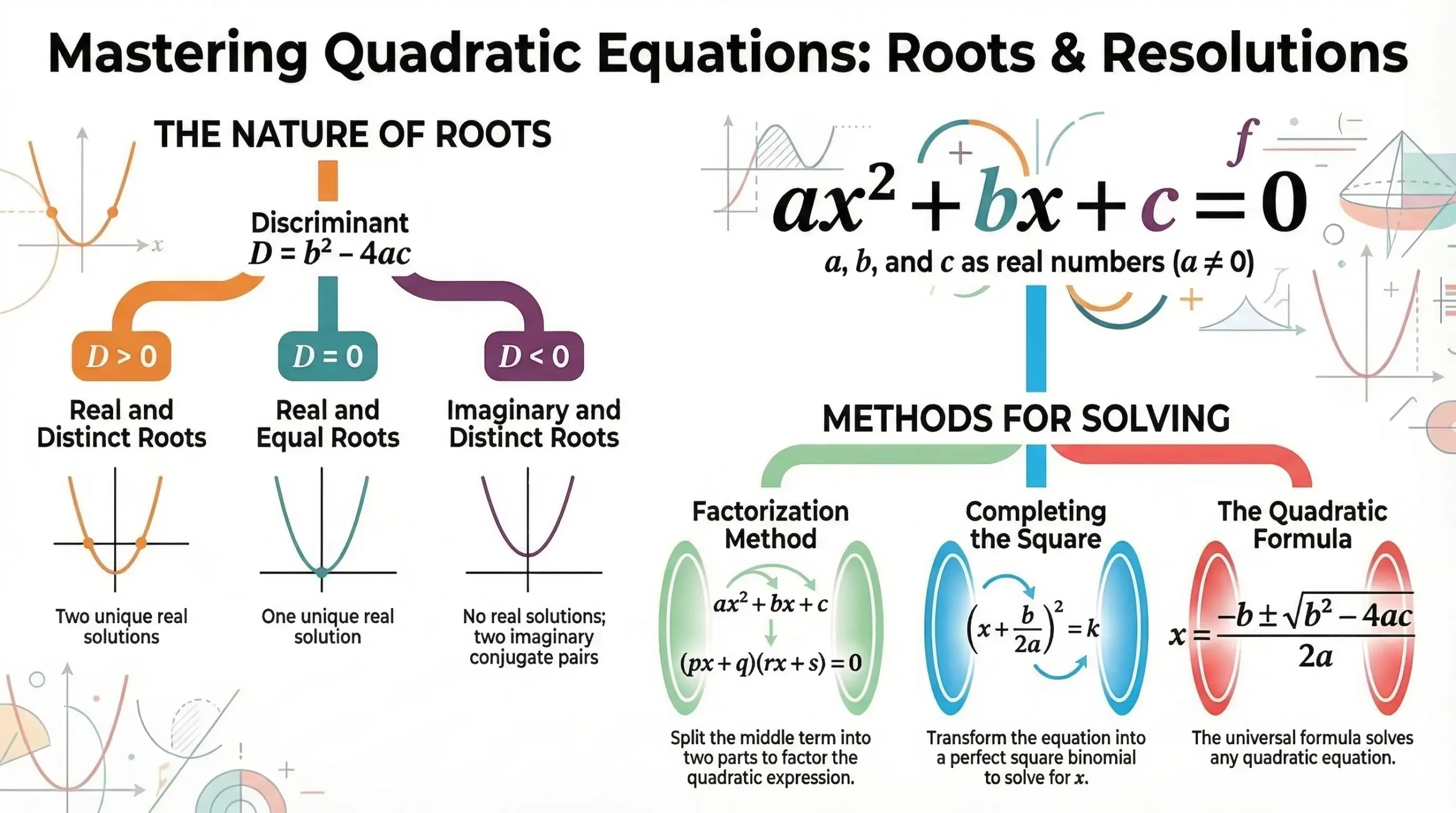
What is a Quadratic Equation?
If P(x) is a quadratic polynomial in variable x, then P(x) = 0 is called a quadratic equation. Its standard (general) form is ax² + bx + c = 0, where a, b, c are real numbers and a ≠ 0.
The term "quadratic" derives from the Latin quadratus, meaning square reflecting the highest power of x being 2. The coefficient a must be non-zero; if it were zero, the equation would reduce to a linear one.
Quadratic Equations Class 10 Maths Revision Notes PDF Download
Fill the form to download this PDF
Types of Quadratic Equations
| Case | Condition | Form |
|---|---|---|
| (i) | b = 0, c ≠ 0 | ax² + c = 0 |
| (ii) | b ≠ 0, c = 0 | ax² + bx = 0 |
| (iii) | b = 0, c = 0 | ax² = 0 |
| (iv) | b ≠ 0, c ≠ 0 | ax² + bx + c = 0 |
Important Identity vs. Equation Distinction
| Condition | Classification | Number of Roots |
|---|---|---|
| a ≠ 0 | Quadratic equation | Exactly 2 |
| a = 0, b ≠ 0 | Linear equation | 1 |
| a = b = 0, c ≠ 0 | Contradiction | 0 |
| a = b = c = 0 | Identity | ∞ (all values of x) |
Fact: A quadratic equation can never have more than two roots. If it appears to be satisfied by more than two values of x, it is, in fact, satisfied by every value making it an identity, not an equation.
Roots of a Quadratic Equation
A root of a quadratic equation is a value of x that satisfies it. Every quadratic equation ax² + bx + c = 0 has exactly two roots (which may be real and distinct, real and equal, or complex).
Derivation of the Quadratic Formula
Starting from ax² + bx + c = 0, multiply through by 4a, then add b² to both sides to complete the square:
(2ax + b)² = b² − 4ac (Completing the square step)
Taking the square root of both sides and solving for x:
x = (−b ± √(b² − 4ac)) / 2a (The Quadratic Formula (Sridharacharya's Formula)
The expression D = b² − 4ac is called the discriminant (also denoted Δ). It is the single most important quantity for predicting the character of the roots.
Solved Example: Solve: x² − 7x − 5 = 0 using the quadratic formula.
- Identify: a = 1, b = −7, c = −5
- Discriminant D = (−7)² − 4(1)(−5) = 49 + 20 = 69 > 0
- x = (7 ± √69) / 2
x = (7 + √69) / 2 or x = (7 − √69) / 2
Nature of Roots: The Discriminant
The discriminant D = b² − 4ac completely determines what kind of roots the quadratic equation has, without actually solving it. This is one of the most frequently tested concepts in Class 10 examinations.
| Discriminant (D) | Nature of Roots | Additional Condition | Root Type |
|---|---|---|---|
| D > 0 | Real and distinct | D is a perfect square; a, b, c ∈ ℚ | Rational & distinct |
| D > 0 | Real and distinct | D is NOT a perfect square; a, b, c ∈ ℚ | Irrational & distinct (conjugate surds) |
| D = 0 | Real and equal | - | Each root = −b/2a |
| D < 0 | No real roots | a, b, c ∈ ℝ | Complex conjugate pair |
Important Remarks on Conjugate Pairs:
- When a, b, c ∈ ℚ and D > 0 but not a perfect square, irrational roots occur in conjugate pairs - e.g., 2 + √3 and 2 − √3. However, this guarantee holds only when coefficients are rational.
- Complex roots of equations with real coefficients always appear in conjugate pairs - e.g., 2 + 3i and 2 − 3i. This symmetry breaks for equations with complex coefficients (e.g., x² − 2ix − 1 = 0 has both roots equal to i).
Sign Analysis of Roots
| Condition on a, b, c | Sign of Roots |
|---|---|
| a and c same sign; b opposite to both | Both roots positive (sum > 0, product > 0) |
| a, b, c all same sign | Both roots negative (sum < 0, product > 0) |
Example: Find all values of a for which x² − 8x + a² − 6a = 0 has real and distinct roots.
- For real and distinct roots, D > 0: 64 − 4(a² − 6a) > 0
- Simplify: 4[16 − a² + 6a] > 0 → a² − 6a − 16 < 0
- Factorise: (a − 8)(a + 2) < 0 → −2 < a < 8
a lies in the open interval (−2, 8)
Three Methods of Solving Quadratic Equations
- Factorisation
Split the middle term and factor the trinomial into two linear factors. Best for "nice" integer or rational roots.
- Completing the Square
Convert the quadratic to a perfect square plus a constant. Forms the basis for deriving the quadratic formula itself.
- Quadratic Formula
Universal method. Apply x = (−b ± √D) / 2a directly. Works for all cases including irrational and complex roots.
Method A: Factorisation
- Factorise the constant term c of ax² + bx + c = 0.
- Express the coefficient of the middle term b as a sum/difference of two factors whose product equals ac.
- Split the middle term and group into two pairs.
- Factorise using the common factor technique to get two linear factors.
- Set each factor equal to zero and solve.
Example: Solve x² + 6x + 5 = 0 by factorisation.
- Find two numbers that multiply to 5 and add to 6: 5 and 1.
- Split: x² + 5x + x + 5 = x(x + 5) + 1(x + 5) = (x + 5)(x + 1)
- Set each factor to zero: x + 5 = 0 → x = −5; x + 1 = 0 → x = −1
∴ x = −5 or x = −1
Example: Solve x² − 2ax + a² − b² = 0.
- Recognise the constant as a difference of squares: a² − b² = (a − b)(a + b).
- Middle coefficient −2a = −[(a − b) + (a + b)], so split accordingly.
- x² − (a − b)x − (a + b)x + (a − b)(a + b) = 0 → {x − (a − b)}{x − (a + b)} = 0
∴ x = a − b or x = a + b
Method B: Completing the Square
- Write the equation as ax² + bx + c = 0, a ≠ 0.
- Divide throughout by a to make the coefficient of x² equal to 1.
- Move the constant to the right-hand side.
- Add (b/2a)² to both sides.
- Write the LHS as a perfect square: (x + b/2a)².
- Take the square root of both sides and solve for x.
Example: Solve x² + 3x + 1 = 0 by completing the square.
- Add and subtract (3/2)²: (x + 3/2)² − 9/4 + 1 = 0
- (x + 3/2)² = 5/4
- x + 3/2 = ±√5/2 → x = (−3 ± √5) / 2
∴ x = (−3 + √5)/2 or x = (−3 − √5)/2
Solved Example - No Real Roots
Show that 4x² + 3x + 5 = 0 has no real roots.
- Divide by 4: x² + (3/4)x + 5/4 = 0
- Complete the square: (x + 3/8)² = (3/8)² − 5/4 = 9/64 − 80/64 = −71/64
- Since (x + 3/8)² cannot be negative for any real x, the RHS is negative → no real solution.
∴ The equation has no real roots (D = 9 − 80 = −71 < 0)
Method C: The Quadratic Formula
- Compare with ax² + bx + c = 0 and identify a, b, c.
- Compute the discriminant: D = b² − 4ac.
- If D ≥ 0, the real roots are x = (−b ± √D) / 2a.
- If D < 0, the equation has no real roots.
Solved Example - Perfect Square Condition
For what values of k is (4 − k)x² + (2k + 4)x + (8k + 1) a perfect square?
- A quadratic is a perfect square iff its discriminant D = 0.
- (2k + 4)² − 4(4 − k)(8k + 1) = 0 → 4(k + 2)² − 4(4 − k)(8k + 1) = 0
- Expanding: (k² + 4k + 4) − (−8k² + 31k + 4) = 0 → 9k² − 27k = 0
- 9k(k − 3) = 0 → k = 0 or k = 3
∴ k = 0 or k = 3
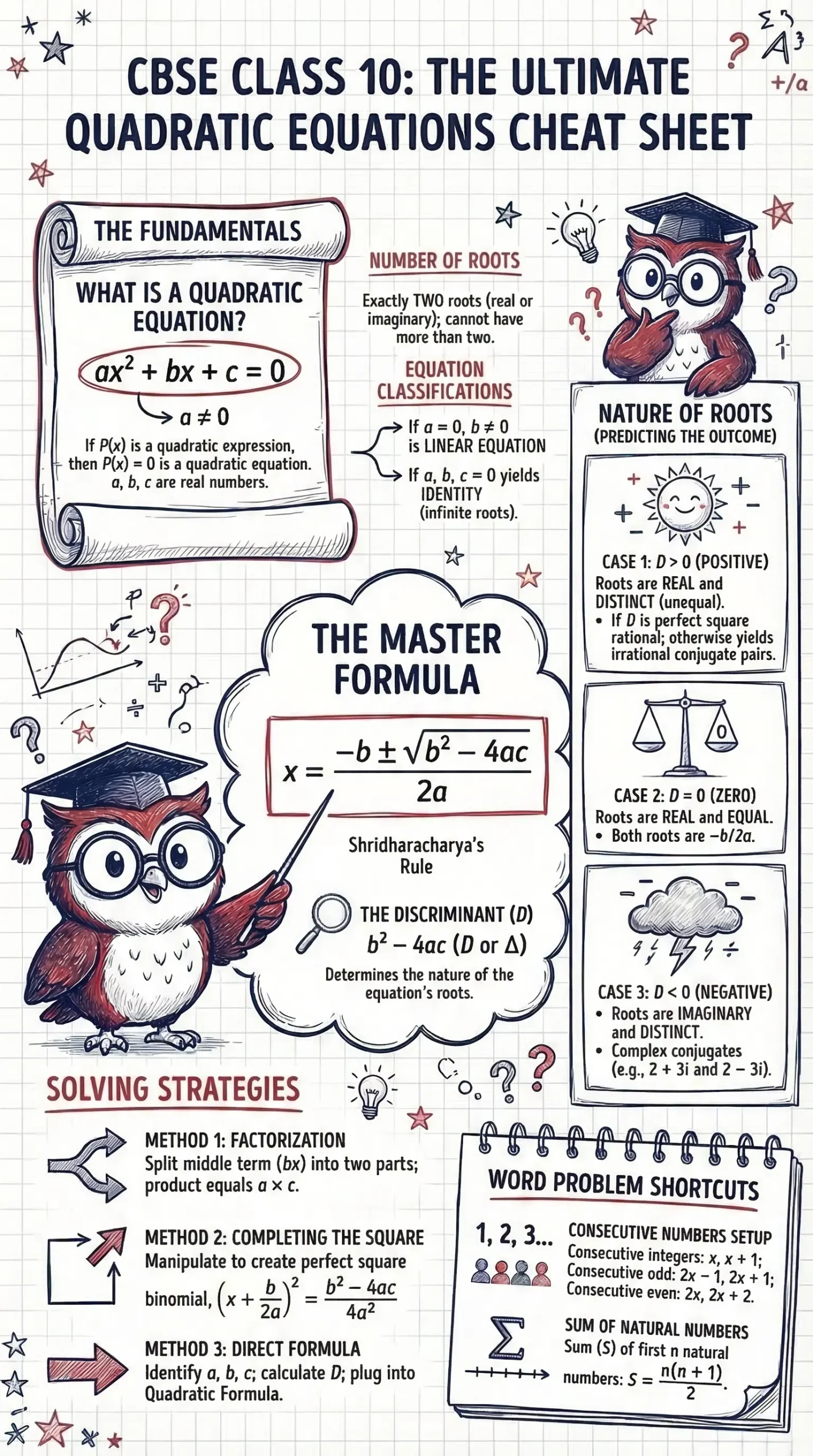
Quadratic Equations Chapter 4 Class 10 Maths Solving Word Problems
Word problems involving quadratic equations are a critical component of Board examinations. The three-step approach below provides a reliable framework.
- Translate: Convert the verbal description into a symbolic (algebraic) equation by identifying the unknown, assigning a variable, and expressing all relationships mathematically.
- Solve: Choose the most appropriate method (factorisation, completing the square, or quadratic formula) and find all roots.
- Interpret: Check each root against the physical constraints of the problem. Reject roots that are inadmissible (e.g., negative lengths, fractional people).
Standard variable representations:
- Two consecutive odd natural numbers: 2x − 1, 2x + 1 (x ∈ ℕ)
- Two consecutive even natural numbers: 2x, 2x + 2 (x ∈ ℕ)
- Consecutive multiples of 5: 5x, 5x + 5, 5x + 10
Ques: The length of a hall is 5 m more than its breadth. If the floor area is 84 m², find the dimensions.
- Let breadth = x m. Then length = (x + 5) m. Area: x(x + 5) = 84
- x² + 5x − 84 = 0 → (x + 12)(x − 7) = 0 → x = 7 or x = −12
- Breadth cannot be negative, so reject x = −12. Breadth = 7 m.
∴ Breadth = 7 m, Length = 12 m
Ques: The sum of squares of two positive integers is 208. The square of the larger is 18 times the smaller. Find both numbers.
- Let the smaller number = x. Then (larger)² = 18x.
- Sum of squares: x² + 18x = 208 → x² + 18x − 208 = 0
- (x − 8)(x + 26) = 0 → x = 8 (reject x = −26, as numbers must be positive)
- Larger number = √(18 × 8) = √144 = 12
∴ Smaller = 8, Larger = 12
Ques: Swati rows at 5 km/h in still water. It takes 1 hour more to row 5.25 km upstream than downstream. Find the stream's speed.
- Let stream speed = x km/h. Upstream speed = (5 − x), Downstream = (5 + x).
- Time equation: 5.25/(5 − x) = 5.25/(5 + x) + 1
- Simplify: 42x = 100 − 4x² → 2x² + 21x − 50 = 0
- (2x + 25)(x − 2) = 0 → x = 2 (reject x = −25/2)
∴ Speed of stream = 2 km/h
Ques: The hypotenuse of a right triangle is 25 cm and the difference between the other two sides is 5 cm. Find both sides.
- Let shorter side = x cm. Longer side = (x + 5) cm.
- By Pythagoras: x² + (x + 5)² = 25² → 2x² + 10x − 600 = 0 → x² + 5x − 300 = 0
- (x + 20)(x − 15) = 0 → x = 15 (reject x = −20)
∴ Shorter side = 15 cm, Longer side = 20 cm