
CBSE Class 10 Maths Chapter 14 Probability Notes: Probability is an important topic in CBSE Class 10 Maths Chapter 14, and it helps students understand how likely an event is to happen. In simple words, probability tells us the chance of something happening, like getting a head when tossing a coin or rolling a certain number on a dice. These class 10 maths probability notes are designed to make this concept easy for students who are preparing for exams or revising the chapter.
In CBSE Class 10 Maths Chapter 14 Probability Notes, students learn about basic ideas such as experiments, outcomes, events, and the formula used to calculate probability. The chapter also explains how probability is used in real-life situations, which makes the topic more interesting and practical. Many students also refer to probability class 10 notes NCERT solutions to understand solved examples and step-by-step methods for solving questions.
These CBSE Class 10 maths Notes give a clear overview of important formulas, definitions, and examples that appear in the syllabus of CBSE class 10. The notes are helpful for quick revision before exams and for practicing different types of questions. Students can access study anytime can also look for class 10 maths probability notes pdf download.
Introduction to Probability
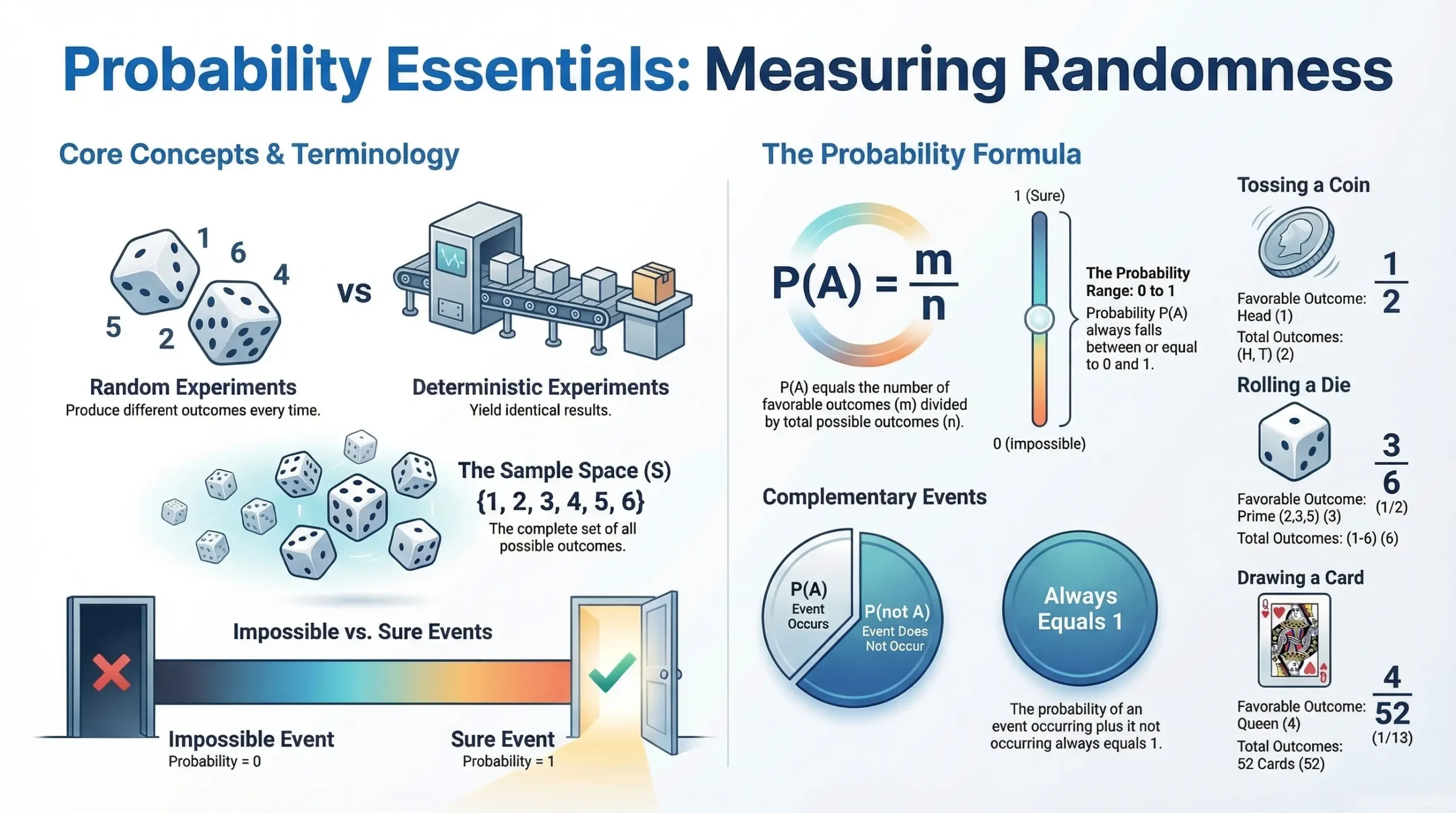
Probability is a fundamental concept in mathematics that measures the likelihood of an event occurring. In Class 10, you'll learn how to calculate probabilities in various real-world scenarios, from tossing coins to drawing cards. This comprehensive guide covers all essential concepts with detailed examples.
Probability Equations Class 10 Maths Revision Notes PDF Download
Fill the form to download this PDF
Understanding Experiments
What is an Experiment?
An experiment is any operation or process that produces well-defined outcomes. In probability theory, we classify experiments into two categories:
1. Deterministic Experiment
A deterministic experiment produces the same result every time when repeated under identical conditions.
Examples:
- Heating water at 100°C at sea level always results in boiling
- Adding 2 + 2 always equals 4
- Physics or chemistry laboratory experiments under controlled conditions
2. Random (Probabilistic) Experiment
A random experiment produces different outcomes when repeated under identical conditions, and we cannot predict the exact outcome in advance.
Examples:
- Tossing a coin (could be heads or tails)
- Rolling a die (could be any number from 1 to 6)
- Drawing a card from a shuffled deck
- Selecting a ball from a bag containing different colored balls
Terminology in Probability
Sample Space (S)
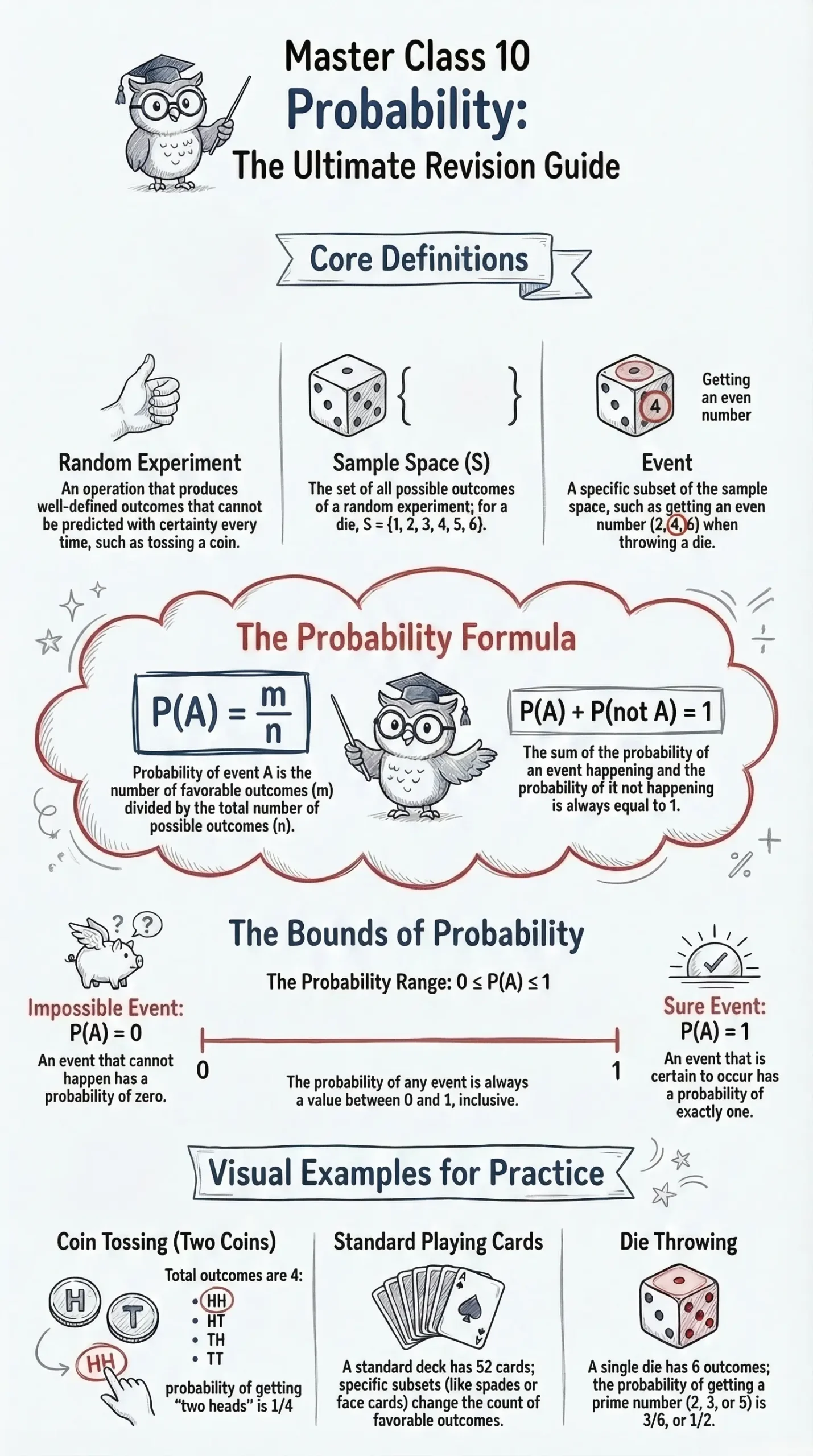
The sample space is the set of all possible outcomes of a random experiment. It is denoted by S.
Examples:
| Experiment | Sample Space |
|---|---|
| Tossing a coin | S = {H, T} |
| Rolling a die | S = {1, 2, 3, 4, 5, 6} |
| Tossing two coins | S = {HH, HT, TH, TT} |
| Drawing a card | S = {All 52 cards} |
Event
An event is a subset of the sample space. It represents one or more outcomes of interest.
Example: When rolling a die, "getting an even number" is an event E = {2, 4, 6}
Elementary Event
Each individual outcome in the sample space is called an elementary event.
Example: In tossing a coin, getting 'Heads' is an elementary event.
Favourable Events
Favourable events are the elementary events that satisfy the condition of the event we're interested in.
Example: When throwing a pair of dice and looking for "sum equals 8":
- Favourable outcomes: (2,6), (3,5), (4,4), (5,3), (6,2)
- Number of favourable events = 5
Probability Formula and Properties
Basic Probability Formula
If there are n elementary events in a random experiment and m of them are favorable to an event A, then:
P(A) = Number of favourable outcomes / Total Numbers of possible of outcomes = m / n
Properties of Probability
Range of Probability:
- The probability of any event always lies between 0 and 1
- 0 ≤ P(A) ≤ 1
Impossible Event:
- If P(A) = 0, then A is called an impossible event
- Example: Getting a 7 when rolling a standard die
Sure Event (Certain Event):
- If P(A) = 1, then A is called a sure event
- Example: Getting a number less than 7 when rolling a die
Complementary Events:
- P(A) + P(A̅) = 1
- Where P(A) = probability of occurrence of A
- P(A̅) = probability of non-occurrence of A (complement of A)
- Therefore: P(A̅) = 1 - P(A)
CBSE Class 10 Maths Chapter 14 Probability Solved Examples
Question: A box contains 5 red balls, 4 green balls, and 7 white balls. A ball is drawn at random from the box. Find the probability that the ball drawn is:
- (i) white
- (ii) neither red nor white
Solution:
Total number of balls = 5 + 4 + 7 = 16 Total number of elementary events = 16
(i) Probability of drawing a white ball:
- Number of white balls = 7
- Favourable outcomes = 7
P(white ball) = 7/16
(ii) Probability of drawing neither red nor white (i.e., green):
- Number of green balls = 4
- Favourable outcomes = 4
P(neither red nor white) = 4/16 = 1/4
Question: All three face cards of spades are removed from a well-shuffled pack of 52 cards. A card is then drawn at random from the remaining pack. Find the probability of getting:
- (i) a black face card
- (ii) a queen
- (iii) a black card
Solution:
After removing 3 face cards of spades (King, Queen, Jack), remaining cards = 52 - 3 = 49 Total elementary events = 49
(i) Probability of getting a black face card:
- Total black face cards in a deck = 6 (3 spades + 3 clubs)
- Removed = 3 (spades face cards)
- Remaining black face cards = 3
P(black face card) = 3/49
(ii) Probability of getting a queen:
- Total queens in deck = 4
- Removed = 1 (Queen of spades)
- Remaining queens = 3
P(queen) = 3/49
(iii) Probability of getting a black card:
- Total black cards in deck = 26
- Removed = 3 (face cards of spades)
- Remaining black cards = 23
P(black card) = 23/49
Question: A die is thrown. Find the probability of:
- (i) getting a prime number
- (ii) getting a multiple of 2 or 3
- (iii) getting a number greater than 3
Solution:
Sample space: S = {1, 2, 3, 4, 5, 6} Total elementary events = 6
(i) Probability of getting a prime number:
- Prime numbers on a die: {2, 3, 5}
- Favourable outcomes = 3
P(prime number) = 3/6 = 1/2
(ii) Probability of getting a multiple of 2 or 3:
- Multiples of 2 or 3: {2, 3, 4, 6}
- Favourable outcomes = 4
P(multiple of 2 or 3) = 4/6 = 2/3
(iii) Probability of getting a number greater than 3:
- Numbers greater than 3: {4, 5, 6}
- Favourable outcomes = 3
P(number > 3) = 3/6 = 1/2
Question:Two unbiased coins are tossed simultaneously. Find the probability of getting:
- (i) two heads
- (ii) at least one head
- (iii) at most one head
Solution:
Sample space: S = {HH, HT, TH, TT} Total elementary events = 4
(i) Probability of getting two heads:
- Favourable outcome: {HH}
- Number of favourable outcomes = 1
P(two heads) = 1/4
(ii) Probability of getting at least one head:
- "At least one head" means one or more heads
- Favourable outcomes: {HH, HT, TH}
- Number of favourable outcomes = 3
P(at least one head) = 3/4
Alternative method: P(at least one head) = 1 - P(no heads) = 1 - 1/4 = 3/4
(iii) Probability of getting at most one head:
- "At most one head" means zero or one head
- Favourable outcomes: {HT, TH, TT}
- Number of favourable outcomes = 3
P(at most one head) = 3/4
Question: A box contains 20 balls numbered 1, 2, 3, 4, ..., 20. A ball is drawn at random. What is the probability that the number on the ball is:
- (i) an odd number
- (ii) divisible by 2 or 3
- (iii) a prime number
Solution:
Total balls = 20 Total elementary events = 20
(i) Probability of getting an odd number:
- Odd numbers: {1, 3, 5, 7, 9, 11, 13, 15, 17, 19}
- Favourable outcomes = 10
P(odd number) = 10/20 = 1/2
(ii) Probability of getting a number divisible by 2 or 3:
- Numbers divisible by 2 or 3: {2, 3, 4, 6, 8, 9, 10, 12, 14, 15, 16, 18, 20}
- Favourable outcomes = 13
P(divisible by 2 or 3) = 13/20
(iii) Probability of getting a prime number:
- Prime numbers from 1 to 20: {2, 3, 5, 7, 11, 13, 17, 19}
- Favourable outcomes = 8
P(prime number) = 8/20 = 2/5
Question: A die is dropped at random on a rectangular region of dimensions 3m × 2m containing a circle with diameter 1m. What is the probability that it will land inside the circle?
Solution:
- Area of rectangular region = 3m × 2m = 6 m²
- Radius of circle = 1/2 m = 0.5 m
- Area of circle = πr² = π × (0.5)² = π/4 m²
P(landing inside circle) = Area of circle / Area of rectangle
P(landing inside circle) =Π by 4 / 6 = Π/24
CBSE Class 10 Maths Chapter 14 Probability Important Concepts and Tips
Understanding "At Least" and "At Most"
At least n: means n or more
- "At least 2 heads" = exactly 2 heads OR more than 2 heads
At most n: means n or fewer
- "At most 2 heads" = 0 heads OR 1 head OR 2 heads
Common Probability Scenarios
| Scenario | Sample Space Size |
|---|---|
| Tossing 1 coin | 2 |
| Tossing 2 coins | 4 |
| Tossing 3 coins | 8 |
| Tossing n coins | 2ⁿ |
| Rolling 1 die | 6 |
| Rolling 2 dice | 36 |
| Drawing from 52 cards | 52 |
Facts About a Standard Deck of Cards
- Total cards: 52
- Suits: 4 (Spades ♠, Hearts ♥, Diamonds ♦, Clubs ♣)
- Cards per suit: 13
- Face cards per suit: 3 (King, Queen, Jack)
- Total face cards: 12
- Red cards: 26 (Hearts and Diamonds)
- Black cards: 26 (Spades and Clubs)
- Aces: 4
CBSE Class 10 Maths Chapter 14 Probability Practice Problems
Problem 1
A bag contains 3 red balls and 5 black balls. A ball is drawn at random. What is the probability that the ball drawn is:
- (a) red?
- (b) not red?
Solution:
- Total balls = 8
- (a) P(red) = 3/8
- (b) P(not red) = 5/8 or 1 - 3/8 = 5/8
Problem 2
What is the probability of getting a sum of 7 when two dice are thrown?
Solution:
- Total outcomes = 36
- Favourable outcomes: (1,6), (2,5), (3,4), (4,3), (5,2), (6,1) = 6
- P(sum = 7) = 6/36 = 1/6
Problem 3
Three coins are tossed simultaneously. Find the probability of getting exactly two heads.
Solution:
- Sample space = {HHH, HHT, HTH, THH, HTT, THT, TTH, TTT}
- Total outcomes = 8
- Favourable outcomes: {HHT, HTH, THH} = 3
- P(exactly 2 heads) = 3/8
CBSE Class 10 Maths Chapter 14 Probability Formulas Summary
| Concept | Formula |
|---|---|
| Basic Probability | P(A) = m/n |
| Probability Range | 0 ≤ P(A) ≤ 1 |
| Impossible Event | P(A) = 0 |
| Sure Event | P(A) = 1 |
| Complementary Events | P(A) + P(A̅) = 1 |
| Complement Formula | P(A̅) = 1 - P(A) |
Common Mistakes to Avoid
- Not identifying the correct sample space: Always list all possible outcomes first
- Counting favorable outcomes incorrectly: Be systematic in listing favorable cases
- Confusing "and" with "or": "And" means both conditions; "or" means at least one condition
- Forgetting to simplify fractions: Always reduce your answer to the simplest form
- Misunderstanding "at least" and "at most": Review these concepts carefully
Exam Preparation Tips for Class 10 Maths
- Practice identifying sample spaces for different experiments
- Master the basic formula and when to apply it
- Understand complementary events to solve problems efficiently
- Work through card and dice problems as they're common in exams
- Show your work step-by-step for partial marks
- Double-check your calculations and simplify fractions
- Draw diagrams when helpful (tree diagrams, Venn diagrams)
Conclusion
Probability is an essential topic in Class 10 Mathematics that forms the foundation for statistical analysis and real-world decision-making. Master the basic concepts, practice various types of problems, and always verify your sample space before calculating probabilities.