
Polynomials Chapter 2 Class 10 Maths Notes: Polynomials Chapter 2 Class 10 Maths Revision Notes help students quickly revise the important ideas of the polynomials class 10 chapter in an easy and clear way. In CBSE Class 10 Mathematics, the chapter on polynomials is very important because many questions in exams are based on polynomial concepts, identities, and factorisation methods. These polynomials class 10 notes are designed to give a simple overview of the chapter so that students can understand the main topics without confusion.
In this chapter, students learn what a polynomial, degree of polynomial, zeroes of a polynomial, and the relationship between zeroes and coefficients mean. The revision notes also explain the division algorithm for polynomials, which is an important rule used to divide one polynomial by another. Along with theory, students can practice questions using polynomials class 10 solutions to improve their problem-solving skills.
These Class 10 Maths notes also include important polynomials class 10 formulas, identities, and step-by-step examples that help students revise before exams. Some topics may look little confusing at first, but with regular practice they become easier to understand.
Overall, these Polynomials Chapter 2 Class 10 Maths Revision Notes give a quick summary of definitions, formulas, solved examples, and key concepts related to algebraic expressions, polynomial equations, and factorisation methods to help students prepare better for their CBSE board exams.
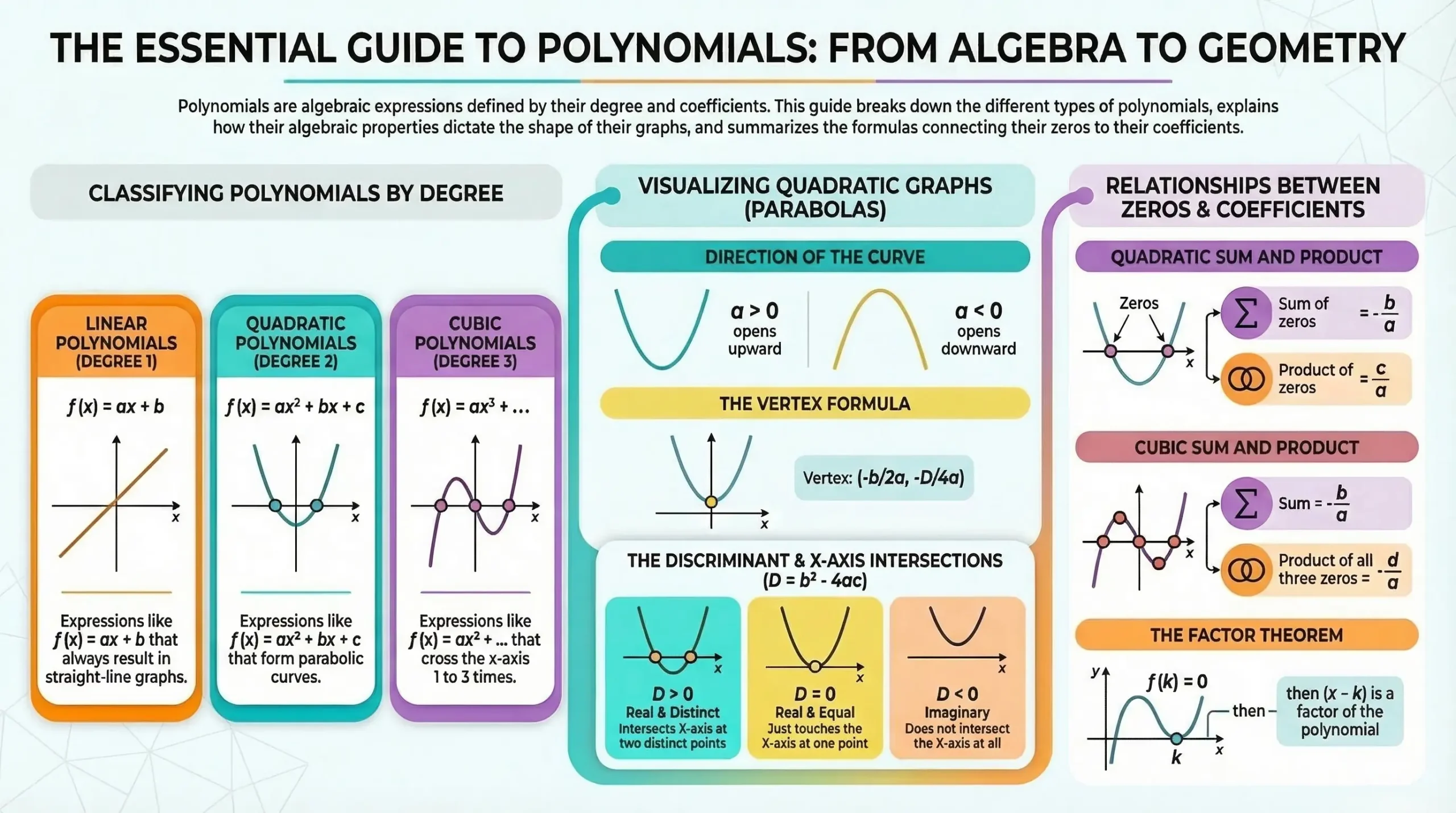
What is Polynomials?
A polynomial is one of the most foundational concepts in algebra and higher mathematics. Whether you are preparing for CBSE Class 11 exams, JEE, or competitive entrance tests, a thorough understanding of polynomials is non-negotiable.
A polynomial in variable x is an algebraic expression of the form:
f(x) = a₀ + a₁x + a₂x² + … + aₙxⁿ
where:
- a₀, a₁, a₂, …, aₙ are real number coefficients
- All exponents of x are non-negative integers
- aₙ ≠ 0 (the leading coefficient is non-zero)
- n is the degree of the polynomial
Polynomials Class 10 Maths Revision Notes PDF Download
Fill the form to download this PDF
Types of Polynomials
Understanding the classification of polynomials by degree is essential before exploring their properties and graphs.
(a) Zero Degree Polynomial
Any non-zero constant is a polynomial of degree zero. For example, f(x) = 7 can be written as f(x) = 7x⁰, making it a zero-degree polynomial.
(b) Constant Polynomial
A polynomial of degree zero is called a constant polynomial. Example: f(x) = 7.
Note: A zero polynomial (f(x) = 0) has no defined degree.
(c) Linear Polynomial
A polynomial of degree 1 is called a linear polynomial. Its general form is f(x) = ax + b, where a ≠ 0.
Examples: p(x) = 4x − 3 and f(t) = √3t + 5
(d) Quadratic Polynomial
A polynomial of degree 2 is a quadratic polynomial. Its general form is f(x) = ax² + bx + c, where a ≠ 0.
Examples: f(x) = 2x² + 5x − 3/5 and g(y) = 3y² − 5
(e) Cubic Polynomial
A polynomial of degree 3 is a cubic polynomial. General form: f(x) = ax³ + bx² + cx + d, where a ≠ 0.
Important Algebraic Identities (Formulae)
These identities are indispensable tools for expanding, factorising and simplifying polynomials:
| Identity | Expanded Form |
|---|---|
| (x + a)² | x² + 2ax + a² |
| (x − a)² | x² − 2ax + a² |
| x² − a² | (x + a)(x − a) |
| (a + b)³ | a³ + b³ + 3ab(a + b) |
| (a − b)³ | a³ − b³ − 3ab(a − b) |
| x³ + a³ | (x + a)(x² − ax + a²) |
| x³ − a³ | (x − a)(x² + ax + a²) |
| (a + b + c)² | a² + b² + c² + 2ab + 2bc + 2ca |
| a³ + b³ + c³ − 3abc | (a + b + c)(a² + b² + c² − ab − bc − ca) |
Special Case: If a + b + c = 0, then a³ + b³ + c³ = 3abc
Graph of Polynomials
The graph of a polynomial f(x) is the set of all points (x, y) in the coordinate plane where y = f(x). Graphing polynomials reveals their zeros, turning points, and overall behavior.
Algorithm to Draw a Polynomial Graph
- Step 1 – Table of Values: Compute y = f(x) for several values of x and record them in a table.
- Step 2 – Plot Points: Mark each (x, y) pair on the rectangular coordinate system using appropriate scales.
- Step 3 – Draw the Curve: Connect all plotted points with a smooth, free-hand curve.
(a) Graph of a Linear Polynomial
For f(x) = ax + b (a ≠ 0), the graph is always a straight line.
- A straight line crosses the X-axis at exactly one point: (−b/a, 0)
- It has exactly one zero: x = −b/a
Example 1:
Draw the graph of f(x) = 2x − 5. Find where it crosses the X-axis.
| x | 1 | 4 |
|---|---|---|
| y = 2x − 5 | −3 | 3 |
Plot A(1, −3) and B(4, 3), then draw a line through them.
The graph crosses the X-axis at (5/2, 0), since 2x − 5 = 0 → x = 5/2.
(b) Graph of a Quadratic Polynomial
For f(x) = ax² + bx + c (a ≠ 0), the graph is always a parabola.
Through algebraic manipulation (completing the square), we arrive at:
(y + D/4a) = a(x + b/2a)²
where D = b² − 4ac is the discriminant.
The vertex of the parabola is at: (−b/2a, −D/4a)
Direction of Opening:
- If a > 0 → Parabola opens upward (minimum vertex)
- If a < 0 → Parabola opens downward (maximum vertex)
Relationship Between Discriminant and X-axis Intersections:
| Discriminant | Graph Behaviour | Nature of Roots |
|---|---|---|
| D > 0 | Parabola cuts X-axis at 2 distinct points | Real & Distinct |
| D = 0 | Parabola touches X-axis at one point | Equal (Repeated) |
| D < 0 | Parabola does not intersect X-axis | Imaginary (No real roots) |
Insight: When D < 0 and a > 0, then f(x) > 0 for all real x (always positive). When D < 0 and a < 0, then f(x) < 0 for all real x (always negative).
Example 2:
Draw the graph of f(x) = x² − 2x − 8.
| x | −4 | −3 | −2 | −1 | 0 | 1 | 2 | 3 | 4 | 5 | 6 |
|---|---|---|---|---|---|---|---|---|---|---|---|
| y | 16 | 7 | 0 | −5 | −8 | −9 | −8 | −5 | 0 | 7 | 16 |
Observations:
- Coefficient of x² is +1 (a > 0), so parabola opens upward
- D = (−2)² − 4(1)(−8) = 4 + 32 = 36 > 0 → 2 distinct real roots
- Vertex: (1, −9) i.e., (−b/2a, −D/4a)
- f(x) = (x − 4)(x + 2) → Zeros at x = 4 and x = −2
- Parabola crosses X-axis at (4, 0) and (−2, 0)
Example 3:
Draw the graph of f(x) = 3 − 2x − x².
| x | −5 | −4 | −3 | −2 | −1 | 0 | 1 | 2 | 3 | 4 |
|---|---|---|---|---|---|---|---|---|---|---|
| y | −12 | −5 | 0 | 3 | 4 | 3 | 0 | −5 | −12 | −21 |
Observations:
- Coefficient of x² is −1 (a < 0), so parabola opens downward
- D = (−2)² − 4(−1)(3) = 4 + 12 = 16 > 0 → 2 distinct real roots
- Vertex (maximum): (−1, 4)
- f(x) = (1 − x)(x + 3) → Zeros at x = 1 and x = −3
(c) Graph of a Cubic Polynomial
Cubic polynomial graphs do not have a fixed standard shape. However, they always cross the X-axis at least once and at most three times.
Example 4:
Draw the graph of f(x) = x³ − 4x.
| x | −3 | −2 | −1 | 0 | 1 | 2 | 3 |
|---|---|---|---|---|---|---|---|
| y | −15 | 0 | 3 | 0 | −3 | 0 | 15 |
Observations:
- f(x) = x(x − 2)(x + 2) → Three distinct real zeros: 0, 2, −2
- Curve cuts X-axis at O(0, 0), P(2, 0), and Q(−2, 0)
Zeros (Roots) of a Polynomial
A real number 'a' is called a zero of polynomial f(x) if f(a) = 0. It is also called a root of the equation f(x) = 0.
Geometrically, the zeros of f(x) are the x-coordinates of the points where the graph of y = f(x) intersects the X-axis.
Example 5:
Show that x = 2 is a root of p(x) = 2x³ + x² − 7x − 6.
p(2) = 2(8) + 4 − 14 − 6 = 16 + 4 − 14 − 6 = 0 ✓
Hence, x = 2 is a root.
Example 6:
If x = 4/3 is a root of f(x) = 6x³ − 11x² + kx − 20, find k.
Substituting x = 4/3:
6(64/27) − 11(16/9) + k(4/3) − 20 = 0
128/9 − 176/9 + 4k/3 − 20 = 0
(128 − 176)/9 + 4k/3 = 20
−48/9 + 4k/3 = 20
→ 128 − 176 + 12k − 180 = 0
→ 12k = 228
→ k = 19
Example 7:
If x = 2 and x = 0 are roots of f(x) = 2x³ − 5x² + ax + b, find a and b.
From f(0) = 0: b = 0
From f(2) = 0: 16 − 20 + 2a + 0 = 0 → 2a = 4 → a = 2, b = 0
Relationship Between Zeros and Coefficients
For a Quadratic Polynomial f(x) = ax² + bx + c
If α and β are the two zeros:
- Sum of zeros: α + β = −b/a = −(Coefficient of x) / (Coefficient of x²)
- Product of zeros: αβ = c/a = (Constant term) / (Coefficient of x²)
Reconstruction Formula: f(x) = k{x² − (Sum of zeros)x + (Product of zeros)}
Solved Example 8
Find the zeros of f(x) = x² − 2x − 8 and verify the relationships.
Factorising: f(x) = (x − 4)(x + 2)
Zeros: α = 4, β = −2
- Sum = 4 + (−2) = 2 = −(−2)/1 = −b/a
- Product = 4 × (−2) = −8 = −8/1 = c/a
Example 9:
Find a quadratic polynomial whose zeros are 5 + √2 and 5 − √2.
- Sum = (5 + √2) + (5 − √2) = 10
- Product = (5 + √2)(5 − √2) = 25 − 2 = 23
f(x) = k(x² − 10x + 23), where k is any non-zero real number.
Example 10:
If the sum and product of zeros are 5 and 17 respectively, find the polynomial.
f(x) = k(x² − 5x + 17), where k is any non-zero real number.
For a Cubic Polynomial f(x) = ax³ + bx² + cx + d
If α, β, γ are the three zeros:
Sum of zeros: α + β + γ = −b/a
Sum of products of zeros (taken two at a time): αβ + βγ + γα = c/a
Product of zeros: αβγ = −d/a
Example 11:
Verify that 1/2, 1, −2 are zeros of f(x) = 2x³ + x² − 5x + 2.
- f(1/2) = 2(1/8) + (1/4) − 5(1/2) + 2 = 1/4 + 1/4 − 5/2 + 2 = 0
- f(1) = 2 + 1 − 5 + 2 = 0
- f(−2) = −16 + 4 + 10 + 2 = 0
Verification:
- Sum = 1/2 + 1 + (−2) = −1/2 = −b/a = −1/2 ✓
- Sum of products (two at a time) = (1/2)(1) + (1)(−2) + (−2)(1/2) = 1/2 − 2 − 1 = −5/2 = c/a ✓
- Product = (1/2)(1)(−2) = −1 = −d/a = −2/2 ✓
Example 12:
Find a cubic polynomial with sum = 3, sum of pairwise products = −1, product = −3.
f(x) = k(x³ − 3x² − x + 3), where k is any non-zero real number.
Factor Theorem
Factor Theorem: Let p(x) be a polynomial of degree ≥ 1. If p(a) = 0 for some real number a, then (x − a) is a factor of p(x). Conversely, if (x − a) is a factor, then p(a) = 0.
This is the direct application of the Remainder Theorem when the remainder is zero.
Example 13:
Show that (x + 1) and (2x − 3) are factors of p(x) = 2x³ − 9x² + x + 12.
- p(−1) = 2(−1) − 9(1) + (−1) + 12 = −2 − 9 − 1 + 12 = 0
- p(3/2) = 2(27/8) − 9(9/4) + 3/2 + 12 = 27/4 − 81/4 + 6/4 + 48/4 = 0/4 = 0
Example 14:
Find α and β if (x + 1) and (x + 2) are factors of p(x) = x³ + 3x² − 2αx + β.
From p(−1) = 0:
−1 + 3 + 2α + β = 0 → β = −2α − 2 … (i)
From p(−2) = 0:
−8 + 12 + 4α + β = 0 → β = −4α − 4 … (ii)
Equating (i) and (ii):
−2α − 2 = −4α − 4 → 2α = −2 → α = −1
Substituting: β = −2(−1) − 2 = 0
α = −1, β = 0
Example 15: Factorisation Using Factor Theorem
Factorise p(x) = 2x⁴ − 7x³ − 13x² + 63x − 45.
Testing x = 1: p(1) = 2 − 7 − 13 + 63 − 45 = 0 → (x − 1) is a factor
Testing x = 3: p(3) = 162 − 189 − 117 + 189 − 45 = 0 → (x − 3) is a factor
Dividing step by step:
p(x) = (x − 1)(x − 3)(2x² + x − 15)
2x² + x − 15 = (2x − 5)(x + 3)
p(x) = (x − 1)(x − 3)(x + 3)(2x − 5)
Remainder Theorem
Remainder Theorem: If a polynomial p(x) of degree ≥ 1 is divided by (x − a), the remainder is p(a).
This eliminates the need for full long division when only the remainder is required.
Example 16:
Find the remainder when f(x) = x³ − 6x² + 2x − 4 is divided by g(x) = 1 − 2x.
Set 1 − 2x = 0 → x = 1/2
f(1/2) = (1/8) − 6(1/4) + 2(1/2) − 4
= 1/8 − 3/2 + 1 − 4
= 1/8 − 12/8 + 8/8 − 32/8
= (1 − 12 + 8 − 32)/8 = −35/8
Remainder = −35/8
Division Algorithm for Polynomials
If f(x) and g(x) are polynomials with g(x) ≠ 0, then:
f(x) = g(x) · q(x) + r(x)
where r(x) = 0 or deg(r) < deg(g)
This is the Euclidean Division Algorithm extended to polynomials.
Example 17:
Divide f(x) = 10x⁴ + 17x³ − 62x² + 30x − 3 by b(x) = 2x² − x + 1.
After performing long division:
- Quotient q(x) = 5x² + 11x − 28
- Remainder r(x) = −9x + 25
Verification:
(5x² + 11x − 28)(2x² − x + 1) + (−9x + 25)
= 10x⁴ + 17x³ − 62x² + 30x − 3 ✓
Example 18:
Find all zeros of f(x) = 2x⁴ − 2x³ − 7x² + 3x + 6, given two zeros are −√(3/2) and √(3/2).
Since −√(3/2) and √(3/2) are zeros, (2x² − 3) is a factor.
Dividing f(x) by (2x² − 3):
f(x) = (2x² − 3)(x² − x − 2) = (2x² − 3)(x − 2)(x + 1)
All zeros: −√(3/2), √(3/2), 2, −1
What to Add or Subtract for Exact Divisibility
Example 19:
What must be added to 3x³ + x² − 22x + 9 so it is exactly divisible by 3x² + 7x − 6?
Perform long division of p(x) by q(x). The remainder obtained is (−2 + a)x + (b − 3).
For exact divisibility, remainder = 0:
→ a − 2 = 0 → a = 2
→ b − 3 = 0 → b = 3
Add 2x + 3
Example 20:
What must be subtracted from x³ − 6x² − 15x + 80 to make it exactly divisible by x² + x − 12?
Perform long division. Remainder obtained is (4 − a)x + (−4 − b).
For exact divisibility:
→ 4 − a = 0 → a = 4
→ −4 − b = 0 → b = −4
Subtract 4x − 4
Value of a Polynomial
The value of f(x) at x = α is obtained by substituting x = α into f(x), denoted f(α).
Example: For f(x) = 2x³ − 13x² + 17x + 12:
f(1) = 2(1) − 13(1) + 17(1) + 12 = 18
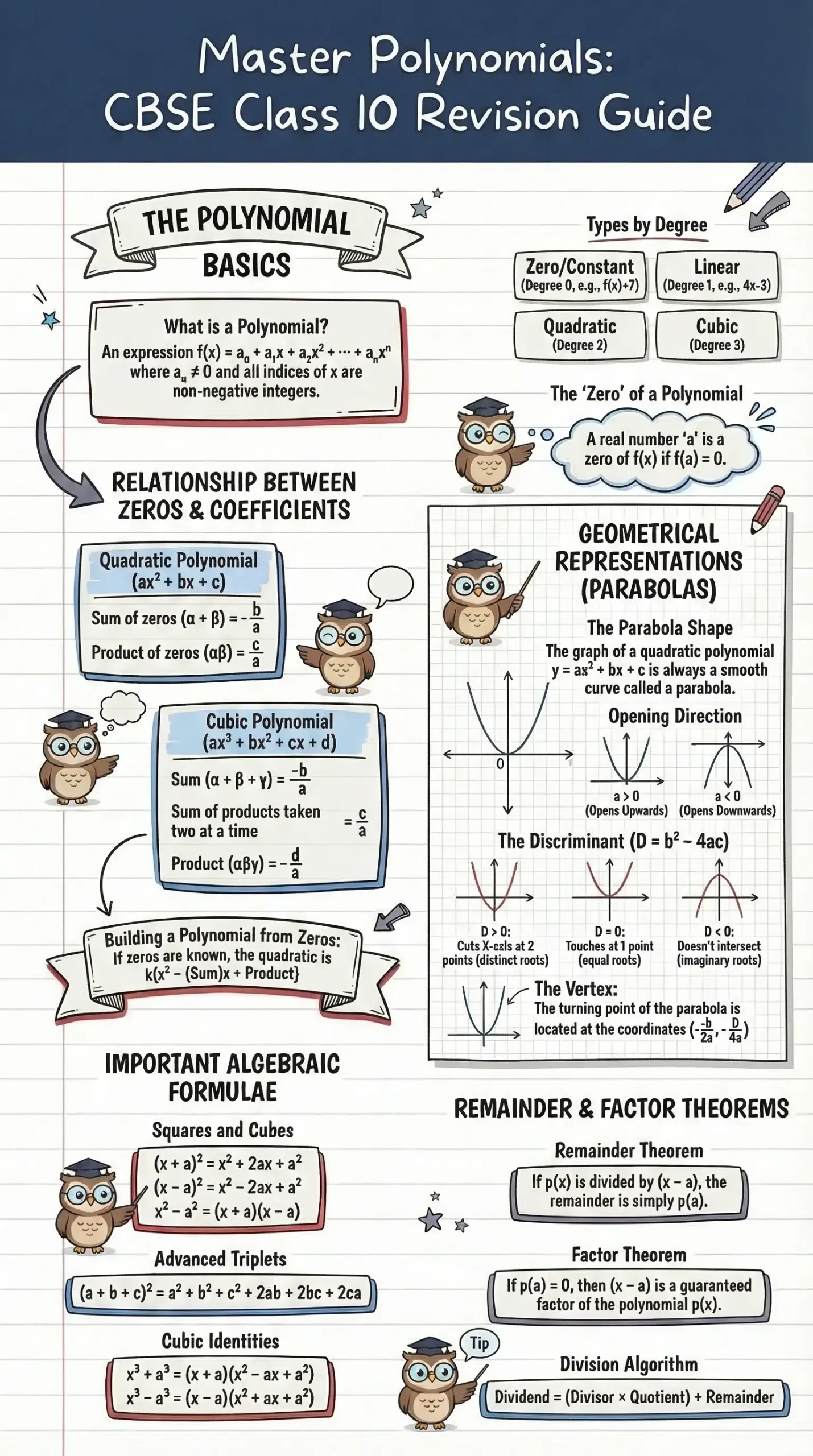
Polynomial Formulas
| Polynomial Type | Zeros | Sum of Zeros | Product of Zeros |
|---|---|---|---|
| Quadratic ax² + bx + c | α, β | −b/a | c/a |
| Cubic ax³ + bx² + cx + d | α, β, γ | −b/a | −d/a |
| Cubic (sum of pairwise products) | — | αβ + βγ + γα = c/a | — |