
Pair of Linear Equations in Two Variables Class 10 MathsNotes: The chapter Pair of Linear Equations in Two Variables Chapter 3 Class 10 Maths Revision Notes helps students understand how two linear equations can be solved together to find the values of two unknown variables. In simple words, a pair of linear equations in two variables class 10 means two equations that contain the same two variables, usually written as x and y. These equations are very important in CBSE Class 10 Maths Chapter 3 because they help students learn how to solve real-life problems using algebra.
These pair of linear equations in two variables class 10 notes are prepared to make revision easy and quick for students. The notes explain important topics like the graphical method, substitution method, and elimination method used to solve equations. Students will also learn about consistent and inconsistent systems, algebraic solutions, and how to represent equations on a Cartesian plane.
Many students also look for pair of linear equations in two variables class 10 notes or chapter 3 class 10 maths notes pdf for quick revision before exams. These CBSE revision notes give a short summary of formulas, key concepts, and solved examples so students can understand the chapter better. Sometimes students think this topic is hard, but with clear concepts and practice it becomes quite easy and intresting to learn. Overall, this chapter builds a strong foundation in algebra, problem-solving skills, and mathematical thinking for CBSE board exam preparation.
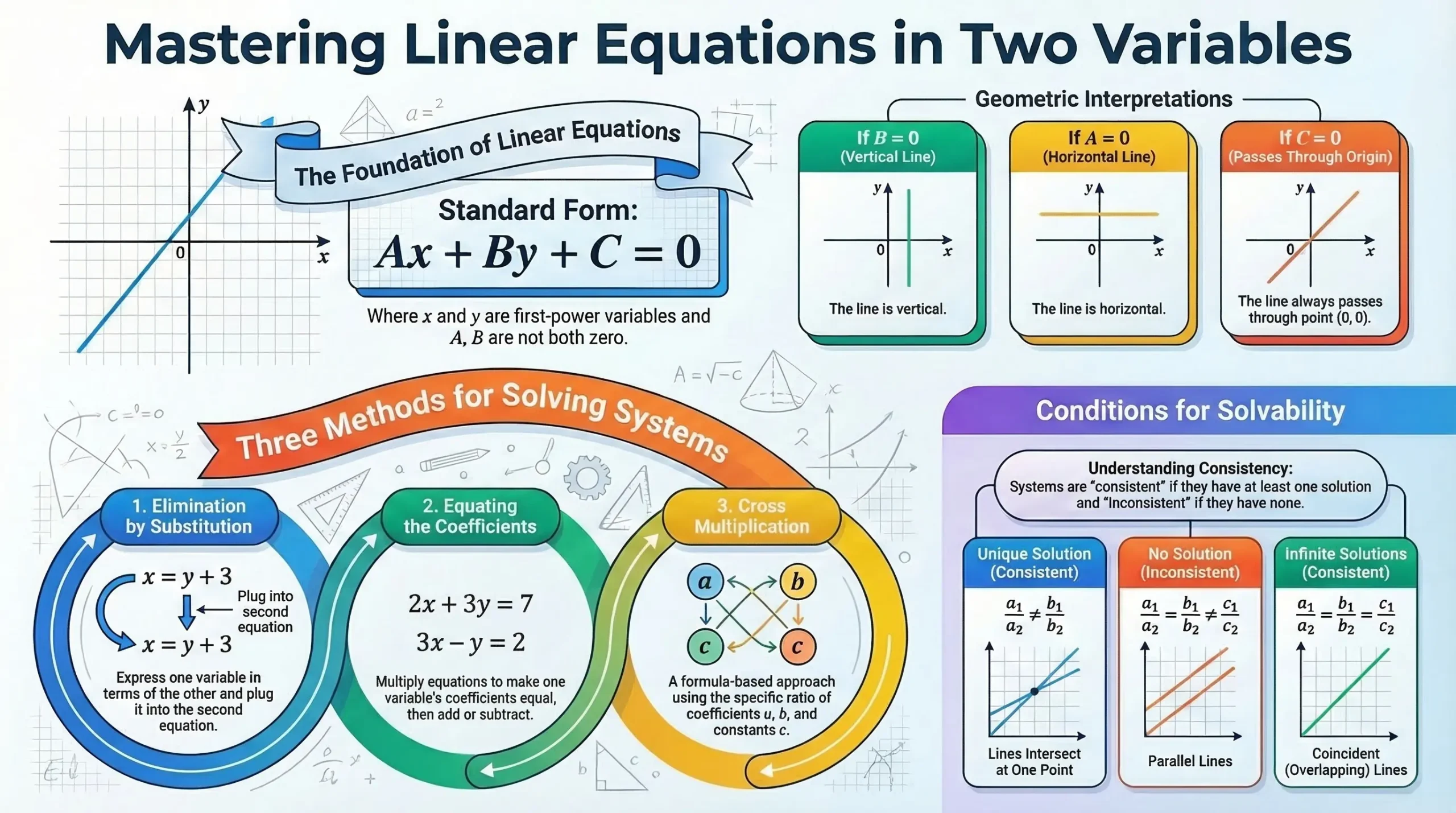
What is a Linear Equation in Two Variables?
A linear equation in two variables is any equation of the form:
Ax + By + C = 0
where:
- A = coefficient of x
- B = coefficient of y
- C = constant term (independent of x and y)
- A, B, C ∈ ℝ (Real Numbers), and A and B cannot both be zero simultaneously
The equation is called linear because both unknowns, x and y, appear only in the first power (degree 1), and there is no product of the two unknowns (i.e., no xy term).
Key Insight: A single linear equation in two variables has an infinite number of solutions (indeterminate solution). This is why we always need a pair of simultaneous equations to find a unique solution.
Pair of Linear Equations in Two Variables Class 10 Maths Revision Notes PDF Download
Fill the form to download this PDF
What is a Linear Equation in Two Variables?
A linear equation in two variables is any equation of the form:
Ax + By + C = 0
where:
- A = coefficient of x
- B = coefficient of y
- C = constant term (independent of x and y)
- A, B, C ∈ ℝ (Real Numbers), and A and B cannot both be zero simultaneously
The equation is called linear because both unknowns, x and y, appear only in the first power (degree 1), and there is no product of the two unknowns (i.e., no xy term).
Key Insight: A single linear equation in two variables has an infinite number of solutions (indeterminate solution). This is why we always need a pair of simultaneous equations to find a unique solution.
Standard Form and Terminology
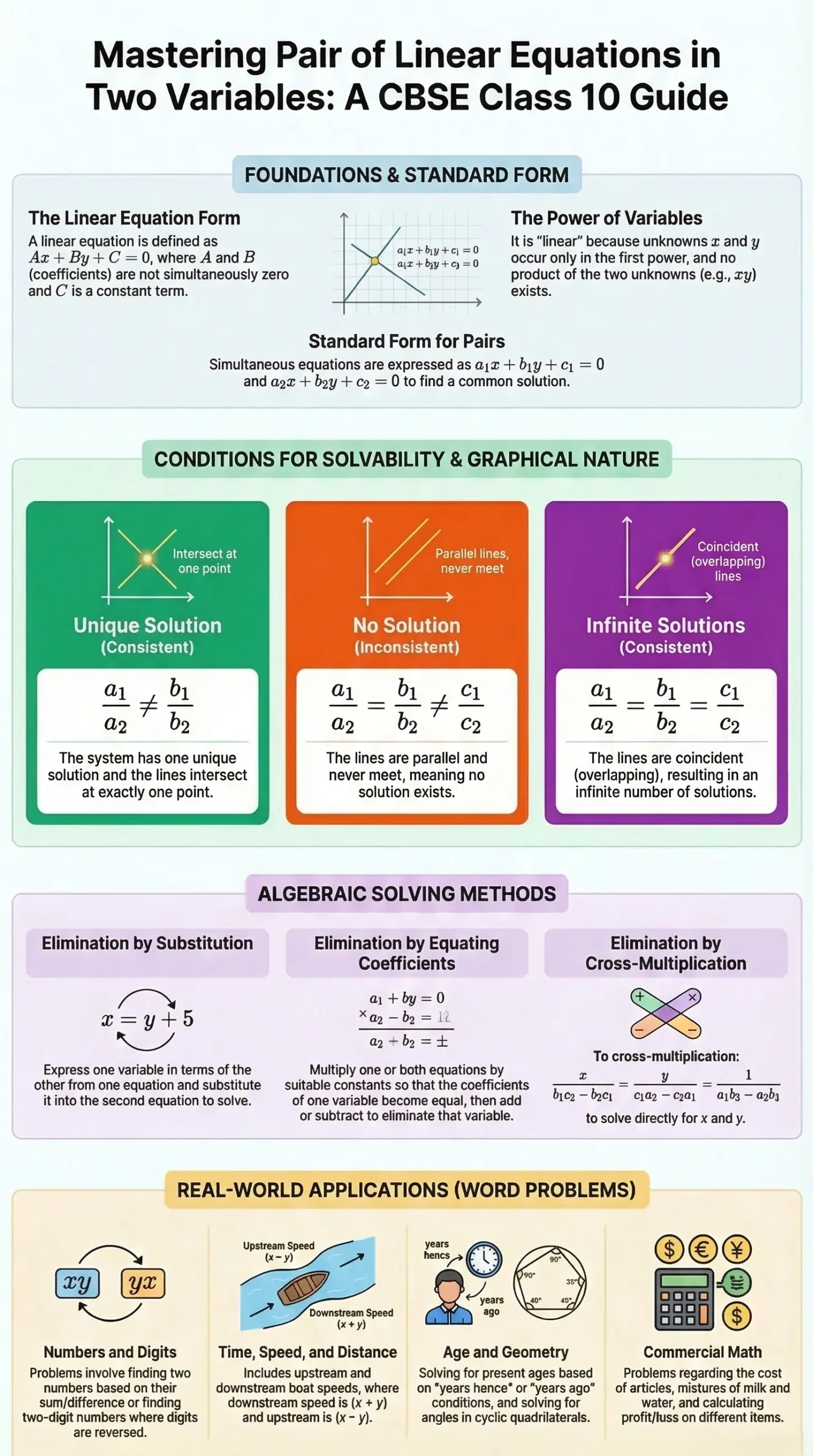
The standard form (all positive coefficients) of a system of two linear equations is:
a₁x + b₁y + c₁ = 0 ...(i) a₂x + b₂y + c₂ = 0 ...(ii)
This pair is called a system of simultaneous linear equations or a pair of linear equations in two variables.
Three Methods of Solving Such Systems:
| Method | Best Used When |
|---|---|
| Elimination by Substitution | One variable is easy to isolate |
| Elimination by Equating Coefficients | Coefficients can be made equal by simple multiplication |
| Elimination by Cross Multiplication | A direct formula-based approach is needed |
Special Cases of Linear Equations
Depending on the values of A and B in Ax + By + C = 0, the line has different orientations:
| Condition | Equation Form | Geometric Meaning |
|---|---|---|
| A ≠ 0, B = 0 | Ax + C = 0 | Line parallel to the Y-axis |
| A = 0, B ≠ 0 | By + C = 0 | Line parallel to the X-axis |
| A ≠ 0, B ≠ 0, C = 0 | Ax + By = 0 | Line passing through the origin |
| A ≠ 0, B ≠ 0, C ≠ 0 | Ax + By + C = 0 | General line cutting both axes |
Methods of Solving a Pair of Linear Equations
Method 1: Elimination by Substitution
Steps:
- Express one variable (say x) in terms of the other (y) from one equation.
- Substitute this expression into the second equation.
- Solve the resulting single-variable equation.
- Back-substitute to find the other variable.
Method 2: Elimination by Equating the Coefficients
Steps:
- Multiply each equation by a suitable non-zero number so that the coefficient of one variable becomes equal in both.
- Add or subtract the equations to eliminate that variable.
- Solve the resulting single-variable equation.
- Back-substitute to find the other variable.
Method 3: Elimination by Cross Multiplication
For the system:
a₁x + b₁y + c₁ = 0 a₂x + b₂y + c₂ = 0
The Cross Multiplication Rule gives:
x y 1 ------------ = ------------ = ------------ b₁c₂ − b₂c₁ a₂c₁ − a₁c₂ a₁b₂ − a₂b₁
Therefore:
x = (b₁c₂ − b₂c₁) / (a₁b₂ − a₂b₁) y = (a₂c₁ − a₁c₂) / (a₁b₂ − a₂b₁)
Memory Aid for Cross Multiplication: Write the coefficients in an X-pattern: b₁ c₁ a₁ b₁ (row 1) over b₂ c₂ a₂ b₂ (row 2), then multiply diagonally and subtract.
Conditions for Consistency
Given:
a₁x + b₁y + c₁ = 0 a₂x + b₂y + c₂ = 0
(a) Unique Solution (Consistent - Lines Intersect)
Condition: a₁/a₂ ≠ b₁/b₂
- The denominator a₁b₂ − a₂b₁ ≠ 0
- The two lines meet at exactly one point
- The system is consistent and has one definite solution
(b) No Solution (Inconsistent - Parallel Lines)
Condition: a₁/a₂ = b₁/b₂ ≠ c₁/c₂
- The lines are parallel and never meet
- The system is inconsistent - it has no solution
(c) Infinitely Many Solutions (Consistent - Coincident Lines)
Condition:a₁/a₂ = b₁/b₂ = c₁/c₂
- The lines are identical (coincident)
- The system has infinitely many solutions
- This is also called a dependent system
| Condition | Graphical Interpretation | Nature of Solution |
|---|---|---|
| a₁/a₂ ≠ b₁/b₂ | Intersecting lines | Unique Solution |
| a₁/a₂ = b₁/b₂ ≠ c₁/c₂ | Parallel lines | No Solution |
| a₁/a₂ = b₁/b₂ = c₁/c₂ | Coincident lines | Infinite Solutions |
Graphical Solution of Linear Equations
Graph Type 1: ax = b (Vertical Lines)
Lines of the form ax = b give vertical lines parallel to the Y-axis.
- x = 2 → vertical line at x = 2
- 2x = 1 → x = ½ → vertical line at x = ½
- x + 4 = 0 → x = −4 → vertical line at x = −4
- x = 0 → the Y-axis itself
Graph Type 2: ay = b (Horizontal Lines)
Lines of the form ay = b give horizontal lines parallel to the X-axis.
- y = 0 → the X-axis itself
- y − 2 = 0 → horizontal line at y = 2
- 2y + 4 = 0 → y = −2 → horizontal line at y = −2
Graph Type 3: ax + by = 0 (Lines Through Origin)
These lines always pass through the origin (0, 0). To plot them, find two non-origin points.
Example: x = y
| x | 1 | 4 | −3 | 0 |
|---|---|---|---|---|
| y | 1 | 4 | −3 | 0 |
Graph Type 4: ax + by + c = 0 (General Line)
These lines intercept both axes. To plot them:
- Set x = 0 to find the y-intercept
- Set y = 0 to find the x-intercept
- Plot both points and draw the line
Example: x − y = 1
| x | 0 | 1 | 2 |
|---|---|---|---|
| y | −1 | 0 | 1 |
Nature of Graphical Solutions
| Situation | Lines | Solution Type |
|---|---|---|
| a₁/a₂ ≠ b₁/b₂ | Intersecting at point P | Unique solution at P |
| a₁/a₂ = b₁/b₂ ≠ c₁/c₂ | Parallel (no intersection) | No solution |
| a₁/a₂ = b₁/b₂ = c₁/c₂ | Coincident (overlapping) | Infinite solutions |
Word Problems - Types and Strategy
General Strategy for Word Problems:
- Define variables: Assign x and y to the two unknown quantities.
- Translate: Convert the verbal/written conditions into two simultaneous equations.
- Solve: Use any algebraic method (substitution, elimination, cross multiplication).
- Interpret: State the result with appropriate units.
Types of Word Problems Covered in Class 10:
| Type | Example Topics |
|---|---|
| Number Problems | Sum of digits, reversed digits, two-digit numbers |
| Fraction Problems | Numerator-denominator relationships |
| Age Problems | Present age, age after/before n years |
| Speed-Distance-Time | Upstream/downstream, trains, cars |
| Geometry | Cyclic quadrilateral angles, triangle areas |
| Mixture Problems | Milk-water ratios, combining vessels |
| Money/Commerce | Coins, profit-loss, salary increments |
| Work Problems | Simultaneous workers |
Linear Equation in Two Variables Class 10 Solved Examples
Example 1 - Substitution Method
Solve: x + 4y = 14 ...(i) and 7x − 3y = 5 ...(ii)
Solution: From (i): x = 14 − 4y ...(iii)
Substituting in (ii):
7(14 − 4y) − 3y = 5 98 − 28y − 3y = 5 98 − 31y = 5 31y = 93 y = 3
Substituting y = 3 in (iii): x = 14 − 4(3) = 14 − 12 = 2
∴ x = 2, y = 3
Example 2 - Equating Coefficients Method
Solve: 9x − 4y = 8 ...(i) and 13x + 7y = 101 ...(ii)
Solution: Multiply (i) by 7: 63x − 28y = 56 Multiply (ii) by 4: 52x + 28y = 404
Adding:
115x = 460 x = 4
Substituting x = 4 in (i): 9(4) − 4y = 8 → 36 − 8 = 4y → y = 7
∴ x = 4, y = 7
Example 3 - Cross Multiplication Method
Solve: 3x + 2y + 25 = 0 ...(i) and x + y + 15 = 0 ...(ii)
Solution: Here a₁ = 3, b₁ = 2, c₁ = 25; a₂ = 1, b₂ = 1, c₂ = 15
x / (b₁c₂ − b₂c₁) = y / (a₂c₁ − a₁c₂) = 1 / (a₁b₂ − a₂b₁) x / (2×15 − 1×25) = y / (1×25 − 3×15) = 1 / (3×1 − 1×2) x / (30 − 25) = y / (25 − 45) = 1 / (3 − 2) x/5 = y/(−20) = 1/1
∴ x = 5, y = −20
Example 4 - Finding k for Unique Solution
Find the value of P for which Px − y = 2 and 6x − 2y = 3 has a unique solution.
Solution: For unique solution: a₁/a₂ ≠ b₁/b₂
P/6 ≠ (−1)/(−2) P/6 ≠ 1/2 P ≠ 3
∴ P can take any real value except 3.
Example 5 - Finding k for Infinite Solutions
Find k for which kx + 4y = k − 4 and 16x + ky = k has infinite solutions.
Solution: For infinite solutions: a₁/a₂ = b₁/b₂ = c₁/c₂
k/16 = 4/k = (k−4)/k From k/16 = 4/k: k² = 64 → k = ±8 From 4/k = (k−4)/k: 4k = k² − 4k → k² − 8k = 0 → k(k−8) = 0 → k = 0 or k = 8
Since k = 0 makes the equation single-variable, ∴ k = 8
Example 6 - Finding k for No Solution
Find k so that (3k+1)x + 3y − 2 = 0 and (k²+1)x + (k−2)y − 5 = 0 has no solution.
Solution: For no solution: a₁/a₂ = b₁/b₂ ≠ c₁/c₂
(3k+1)/(k²+1) = 3/(k−2) and 3/(k−2) ≠ (−2)/(−5) From the first: (3k+1)(k−2) = 3(k²+1) 3k² − 5k − 2 = 3k² + 3 −5k = 5 k = −1 Check: 3/(k−2) = 3/(−3) = −1 and 2/5 ≠ −1 ✓
∴ k = −1
Example 7 - Number Problem
Find two numbers such that twice the first plus thrice the second equals 89, and four times the first exceeds five times the second by 13.
Solution: Let the numbers be x and y.
2x + 3y = 89 ...(i) 4x − 5y = 13 ...(ii)
Multiply (i) by 2: 4x + 6y = 178 Subtract (ii): 11y = 165 → y = 15 Substitute: 2x + 45 = 89 → x = 22 → x = 22
∴ The two numbers are 22 and 15.
Example 8 - Fraction Problem
The numerator of a fraction is 4 less than the denominator. If the numerator is decreased by 2 and the denominator is increased by 1, the denominator becomes eight times the numerator. Find the fraction.
Solution: Let numerator = x, denominator = y.
y − x = 4 ...(i) y + 1 = 8(x − 2) ...(ii)
From (ii): y = 8x − 17 Substituting in (i): (8x − 17) − x = 4 → 7x = 21 → x = 3, y = 7
∴ The fraction is 3/7.
Example 9 - Digit Problem (Type 1)
A two-digit number has a digit sum of 12. If 18 is subtracted from the number, the digits reverse. Find the number.
Solution: Let the number = 10y + x (tens digit y, units digit x).
x + y = 12 ...(i) y − x = 2 ...(ii) [from 10y+x−18 = 10x+y]
Adding: 2y = 14 → y = 7; x = 5
∴ The number is 75.
Example 10 - Digit Problem (Type 2)
The sum of a two-digit number and the number obtained by reversing the digits is 165. If the digits differ by 3, find the number.
Solution: Let the number = 10y + x.
(10y+x) + (10x+y) = 165 → x + y = 15 ...(i) x − y = 3 or y − x = 3
Case 1 (x − y = 3): x = 9, y = 6 → Number = 69 Case 2 (y − x = 3): x = 6, y = 9 → Number = 96
∴ The numbers are 69 or 96.
Example 11 - Age Problem
Six years hence, a man's age will be three times his son's age. Three years ago, he was nine times as old as his son. Find their present ages.
Solution: Let man's age = x, son's age = y.
x + 6 = 3(y + 6) → x − 3y = 12 ...(i) x − 3 = 9(y − 3) → x − 9y = −24 ...(ii)
Subtracting (ii) from (i): 6y = 36 → y = 6; then x = 30
∴ Man's present age = 30 years; Son's present age = 6 years.
Example 12 - Boat and Stream Problem
A boat goes 12 km upstream and 40 km downstream in 8 hours. It can go 16 km upstream and 32 km downstream in the same time. Find the speed of the boat in still water and the speed of the stream.
Solution: Let boat speed in still water = x km/h; stream speed = y km/h.
12/(x−y) + 40/(x+y) = 8 ...(i) 16/(x−y) + 32/(x+y) = 8 ...(ii)
Let u = 1/(x−y), v = 1/(x+y):
12u + 40v = 8 ...(iii) 16u + 32v = 8 ...(iv)
Solving: u = 1/4, v = 1/8 → x − y = 4, x + y = 8
∴ Speed of boat = 6 km/h; Speed of stream = 2 km/h.
Example 13 - Train and Car Problem
Ramesh travels 760 km partly by train and partly by car. He takes 8 hours if he travels 160 km by train, and takes 12 minutes more if he travels 240 km by train. Find the speed of the train and the car.
Solution: Let train speed = x km/h, car speed = y km/h.
160/x + 600/y = 8 ...(i) 240/x + 520/y = 41/5 ...(ii)
Solving: x = 80 km/h (train); y = 100 km/h (car)
Example 14 - Two Cars on a Highway
Points A and B are 90 km apart. Two cars start simultaneously. If they travel in the same direction, they meet in 9 hours. If in opposite directions, they meet in 9/7 hours. Find their speeds.
Solution: Let speeds be x and y km/h (x > y).
9x − 9y = 90 → x − y = 10 ...(i) (9/7)x + (9/7)y = 90 → x + y = 70 ...(ii)
Adding: 2x = 80 → x = 40 km/h; y = 30 km/h
Example 15 - Cyclic Quadrilateral
In cyclic quadrilateral ABCD, ∠A = (2x+11)°, ∠B = (y+12)°, ∠C = (3y+6)°, ∠D = (5x−25)°. Find all angles.
Solution: Opposite angles of a cyclic quadrilateral are supplementary:
∠A + ∠C = 180°: (2x+11) + (3y+6) = 180 → 2x+3y = 163 ...(i) ∠B + ∠D = 180°: (y+12) + (5x−25) = 180 → 5x+y = 193 ...(ii)
Solving: x = 32, y = 33
∴ ∠A = 75°, ∠B = 45°, ∠C = 105°, ∠D = 135°
Example 16 - Mixture Problem
A vessel has 24ℓ milk and 6ℓ water; another has 15ℓ milk and 10ℓ water. How much must be taken from each vessel so that the third vessel contains 25ℓ milk and 10ℓ water?
Solution: Let x ℓ from vessel 1 and y ℓ from vessel 2.
(4/5)x + (3/5)y = 25 ...(i) [milk equation] (1/5)x + (2/5)y = 10 ...(ii) [water equation]
Solving: x = 20 litres, y = 15 litres
Example 17 - Coins Problem
A lady has 25p and 50p coins totalling 40 coins worth ₹12.50. Find the number of each type.
Solution: Let x = number of 25p coins, y = number of 50p coins.
x + y = 40 ...(i) 25x + 50y = 1250 ...(ii)
From (ii): x + 2y = 50 Subtract (i): y = 10; then x = 30
∴ 30 coins of 25p and 10 coins of 50p.
Example 18 - Students in Rows Problem
Students stand in rows. One extra student per row reduces rows by 2; one less student per row increases rows by 3. Find total students.
Solution: Let x = number of rows, y = students per row.
(y+1)(x−2) = xy → x − 2y = 2 ...(i) (y−1)(x+3) = xy → 3y − x = 3 ...(ii)
Adding: y = 5; x = 12
∴ Total students = 60
Example 19 - Salary Increment Problem
A man's salary after 5 years of service was ₹4500 and after 12 years was ₹5550. Find his starting salary and annual increment.
Solution: Let starting salary = ₹x, annual increment = ₹y.
x + 5y = 4500 ...(i) x + 12y = 5550 ...(ii)
Subtracting: 7y = 1050 → y = ₹150; x = ₹3750
Example 20 - Profit and Loss (Commerce)
A dealer sold a VCR and a TV for ₹38,560 making 12% profit on VCR and 15% on TV. By selling them for ₹38,620 he would have made 15% on VCR and 12% on TV. Find the cost price of each.
Solution: Let CP of VCR = ₹x, CP of TV = ₹y.
(112/100)x + (115/100)y = 38560 ...(i) (115/100)x + (112/100)y = 38620 ...(ii)
Adding (i) and (ii): (227/100)(x + y) = 77180 → x + y = 34000
Subtracting (i) from (ii): (3/100)(x − y) = 60 → x − y = 2000
∴ CP of VCR = ₹18,000; CP of TV = ₹16,000
Summary Cheat Sheet
LINEAR EQUATIONS IN TWO VARIABLES - CLASS 10 QUICK REFERENCE
Standard Form: a1x + b1y + c1 = 0 and a2x + b2y + c2 = 0
Consistency Conditions:
| Ratio Condition | Lines | Solutions |
|---|---|---|
| a1/a2 ≠ b1/b2 | Intersecting | Unique (one) |
| a1/a2 = b1/b2 ≠ c1/c2 | Parallel | None |
| a1/a2 = b1/b2 = c1/c2 | Coincident | Infinite |
Cross Multiplication Formula:
x = (b1c2 − b2c1) / (a1b2 − a2b1)
y = (a2c1 − a1c2) / (a1b2 − a2b1)
Pair of Linear Equations in Two Variables Objective Practice Questions
If 29x + 37y = 103 and 37x + 29y = 95, then:
- (A) x = 1, y = 2
- (B) x = 2, y = 1
- (C) x = 2, y = 3
- (D) x = 3, y = 2
If the system 2x + 3y − 5 = 0 and 4x + ky − 10 = 0 has infinite solutions, then:
- (A) k = 3/2
- (B) k ≠ 3/2
- (C) k ≠ 6
- (D) k = 6
The equations x + 2y = 4 and 2x + y = 5:
- (A) Are consistent and have a unique solution
- (B) Infinite solutions
- (C) Inconsistent
- (D) Homogeneous
The equations 3x − 5y + 2 = 0 and 6x − 10y + 4 = 0 have:
- (D) An infinite number of solutions
The value of k for which kx + 3y = 7 and 2x − 5y = 3 has no solution:
- (C) k = −6/5 and k ≠ −14/3(verify using ratio conditions)
The system ax + by = 0 and cx + dy = 0 has no solution if:
- (D) ad − bc = 0(Note: the zero system always has at least one solution - this question tests understanding of the trivial vs. non-trivial solution context)
If p + q = 1 and (p, q) satisfies 3x + 2y = 1, it also satisfies:
- (A) 3x + 4y = 5 (C) 5x + 5y = 4 - verify by substitution.
If x = y, 3x − y = 4 and x + y + z = 6, then z = ?
- (B) 2
Pair of Linear Equations in Two Variables Class 10 Chapter 3 Exercise Problems
1/(3x) + 1/(5y) = 1 and 1/(5x) + 1/(3y) = 2/15
x − y + z = 6, x − 22y − 2z = 5, 2x + y − 3z = 1
px + qy = r and qx = 1 + r
Find k for which the system has a unique solution:
- (i) 3x + 5y = 12 and 4x − 7y = k
- (ii) 3x − 7y = 6 and 21x − 49y = l − 1
Find k for infinitely many solutions (coincident lines):
- (i) 6x + 3y = k − 3 and 2kx + 6y = 6
- (ii) x + 2y + 7 = 0 and 2x + ky + 14 = 0
Find k for no solution:
- (i) 2x + ky + k + 2 = 0 and kx + 8y + 3k = 0
- (ii) Cx + 3y = 3 and 12x + Cy = 6
Solve: (a−b)x + (a+b)y = a² − 2ab − b² and (a+b)(x+y) = a² + b² [CBSE 2008]
Solve: 37x + 43y = 123 and 43x + 37y = 117 [CBSE 2008]
x/3 + y/12 = 7/2 and x/6 − y/8 = 6/8
0.2x + 0.3y = 0.11 and 0.7x − 0.5y + 0.08 = 0
3√2·x − 5√3·y + √5 = 0 and 2√3·x + 7√2·y − 2√5 = 0
x/3 + y = 1.7 and 11/(x + y/3) = 10 where x + y/3 ≠ 0