
CBSE Class 10 Maths Chapter 8 Introduction To Trigonometry Notes help students understand the basic ideas of trigonometry in a simple and clear way. In CBSE Class 10 maths Notes, this chapter explains how the angles and sides of a right-angled triangle are related to each other. The topic trigonometry class 10 is very important because it builds the foundation for higher maths and also helps in solving real-life problems like measuring height and distance.
In these introduction to trigonometry class 10 notes, students will learn about the six trigonometric ratios – sine, cosine, tangent, cosecant, secant, and cotangent. These ratios are used to compare the sides of a right triangle with a given angle. The chapter also explains important terms such as opposite side, adjacent side, and hypotenuse. Sometimes students feel this topic is little difficult, but with clear examples and practice it becomes easy to understand.
The trigonometry notes class 10 exercise section includes solved examples and practice questions that help students improve their problem-solving skills. Many students also look for introduction to trigonometry class 10 notes pdf so they can study anytime and revise quickly before exams.
Overall, these CBSE class 10 notes give a simple overview of trigonometry concepts, formulas, and exercises so that students can build strong basics and perform better in board exams.
Introduction to Trigonometry
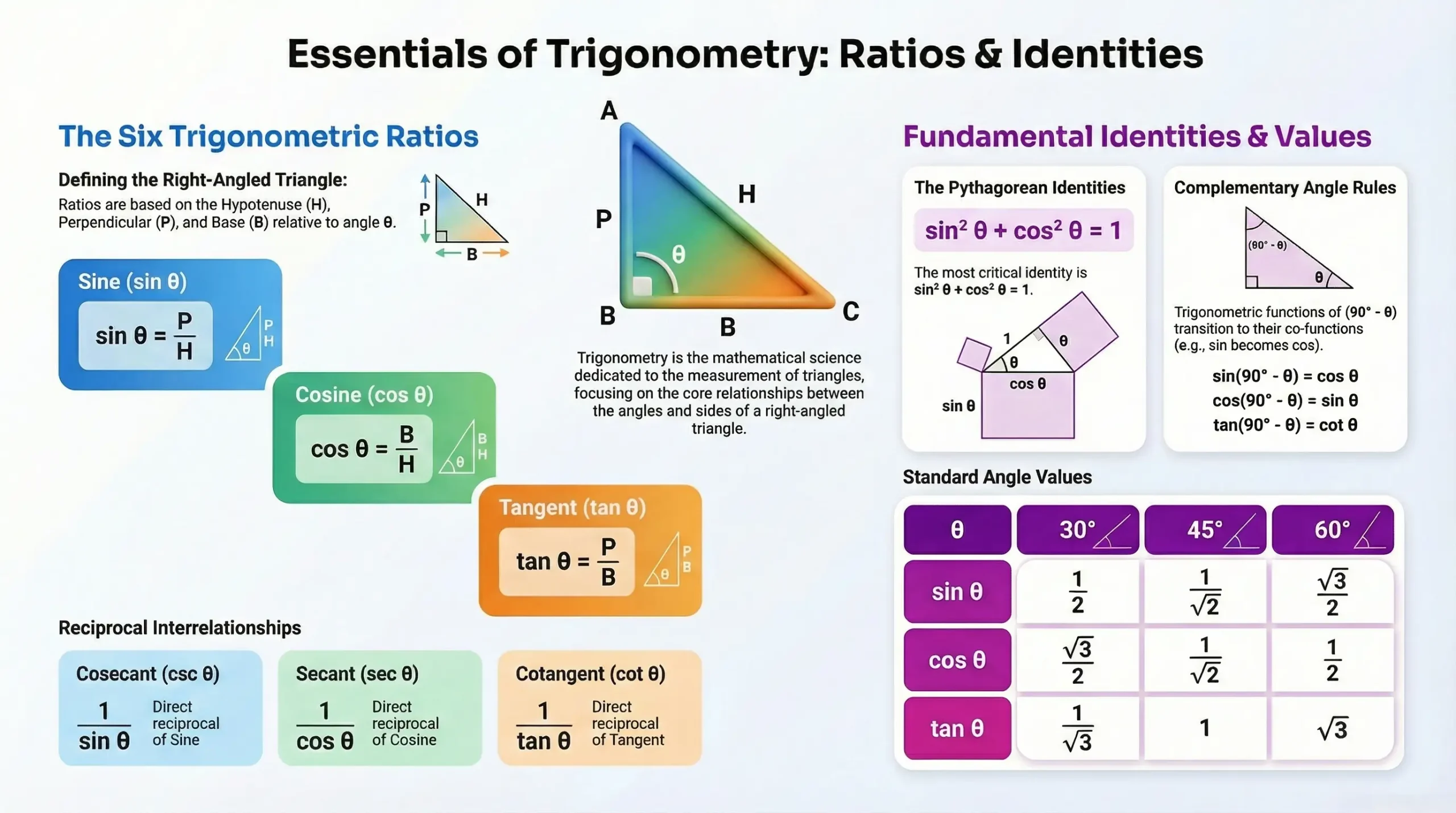
Trigonometry is derived from Greek words: "trigonon" (triangle) and "metron" (measurement). It is the branch of mathematics that deals with the relationships between the sides and angles of triangles, particularly right-angled triangles.
In Class 10, trigonometry forms a crucial part of the mathematics curriculum and serves as a foundation for advanced topics in higher classes. Understanding trigonometric ratios, identities, and their applications is essential for solving real-world problems involving heights, distances, and angles.
Trigonometry Class 10 Maths Revision Notes PDF Download
Fill the form to download this PDF
Trigonometric Ratios: The Six Fundamental Ratios
In a right-angled triangle, we define six trigonometric ratios based on the relationship between the sides and angles.
The Right Triangle
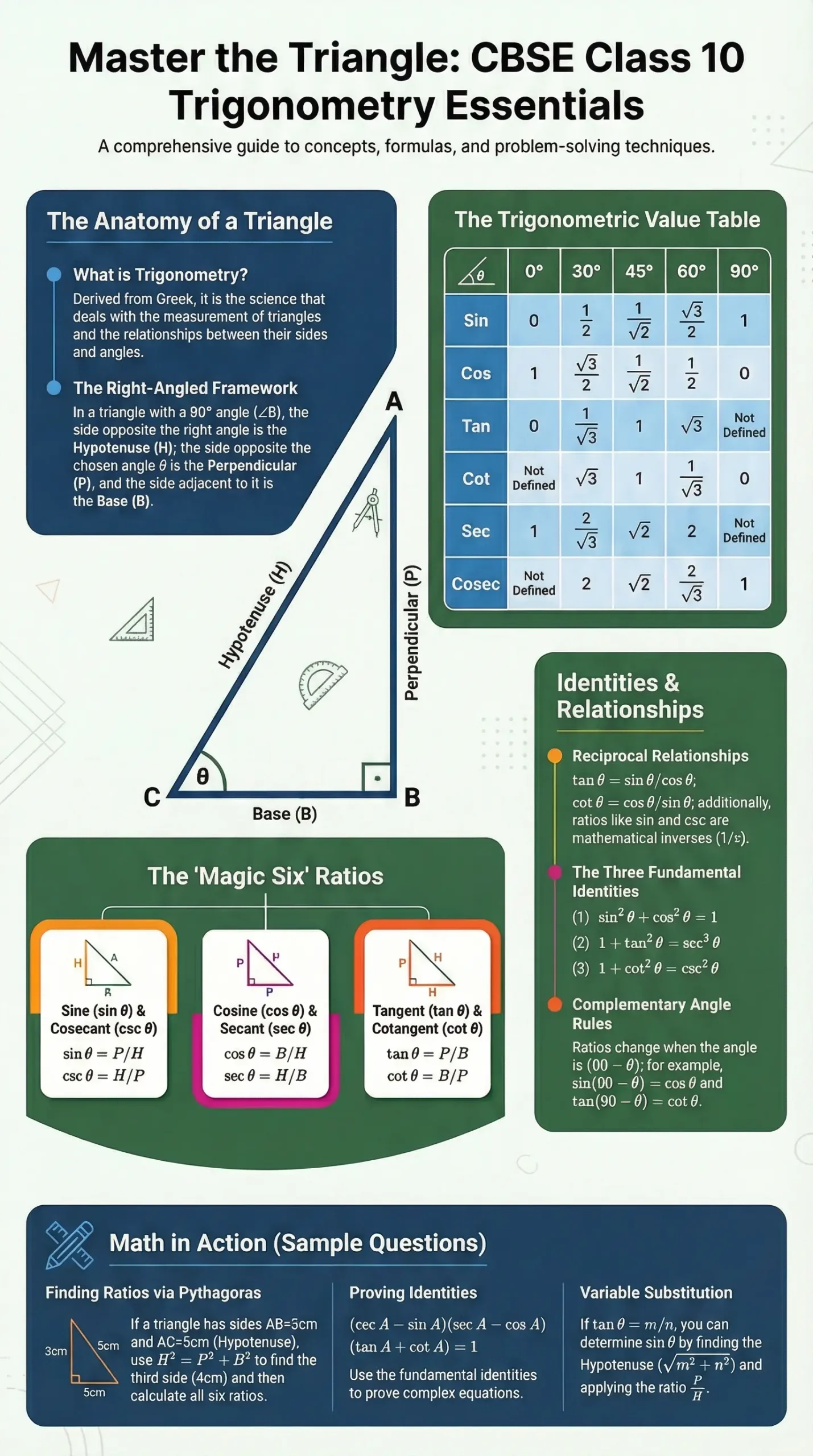
Consider a right-angled triangle ABC where:
- ∠B = 90° (right angle)
- ∠C = θ (the angle under consideration)
- Hypotenuse (H) = AC (the longest side, opposite to the right angle)
- Perpendicular (P) = AB (the side opposite to angle θ)
- Base (B) = BC (the side adjacent to angle θ)
The Six Trigonometric Ratios
| Ratio | Definition | Formula |
|---|---|---|
| Sine (sin θ) | Perpendicular / Hypotenuse | sin θ = P/H = AB/AC |
| Cosine (cos θ) | Base / Hypotenuse | cos θ = B/H = BC/AC |
| Tangent (tan θ) | Perpendicular / Base | tan θ = P/B = AB/BC |
| Cosecant (cosec θ) | Hypotenuse / Perpendicular | cosec θ = H/P = AC/AB |
| Secant (sec θ) | Hypotenuse / Base | sec θ = H/B = AC/BC |
| Cotangent (cot θ) | Base / Perpendicular | cot θ = B/P = BC/AB |
Interrelationships Between Trigonometric Ratios
The six trigonometric ratios are interconnected through reciprocal and quotient relationships:
Reciprocal Relationships:
- sin θ = 1/cosec θ ⟺ cosec θ = 1/sin θ
- cos θ = 1/sec θ ⟺ sec θ = 1/cos θ
- tan θ = 1/cot θ ⟺ cot θ = 1/tan θ
Quotient Relationships:
- tan θ = sin θ/cos θ
- cot θ = cos θ/sin θ
Standard Angle Values
Memorizing the trigonometric values for standard angles (0°, 30°, 45°, 60°, 90°) is essential for quick problem-solving.
| Angle (θ) | 0° | 30° | 45° | 60° | 90° |
|---|---|---|---|---|---|
| sin θ | 0 | 1/2 | 1/√2 | √3/2 | 1 |
| cos θ | 1 | √3/2 | 1/√2 | 1/2 | 0 |
| tan θ | 0 | 1/√3 | 1 | √3 | Not defined |
| cot θ | Not defined | √3 | 1 | 1/√3 | 0 |
| sec θ | 1 | 2/√3 | √2 | 2 | Not defined |
| cosec θ | Not defined | 2 | √2 | 2/√3 | 1 |
Memory Tip for Sin and Cos Values
For sin θ: Use the pattern √0/2, √1/2, √2/2, √3/2, √4/2 for angles 0°, 30°, 45°, 60°, 90° For cos θ: The pattern is reversed - √4/2, √3/2, √2/2, √1/2, √0/2
Trigonometric Identities: The Three Fundamental Identities
Trigonometric identities are equations involving trigonometric functions that are true for all values of the variable for which the functions are defined.
Identity 1: Pythagorean Identity
sin²θ + cos²θ = 1
Derived Forms:
- sin²θ = 1 - cos²θ
- cos²θ = 1 - sin²θ
Identity 2: Tangent-Secant Identity
1 + tan²θ = sec²θ
Derived Forms:
- sec²θ - tan²θ = 1
- tan²θ = sec²θ - 1
- tan²θ - sec²θ = -1
Identity 3: Cotangent-Cosecant Identity
1 + cot²θ = cosec²θ
Derived Forms:
- cosec²θ - cot²θ = 1
- cot²θ = cosec²θ - 1
- cot²θ - cosec²θ = -1
Why These Identities Matter
These identities are fundamental tools for:
- Simplifying complex trigonometric expressions
- Proving trigonometric equations
- Solving trigonometric problems efficiently
- Converting between different trigonometric functions
Trigonometric Ratios of Complementary Angles
Two angles are called complementary if their sum equals 90°. The trigonometric ratios of complementary angles have special relationships.
The Six Complementary Angle Formulas
| Original Function | Complementary Angle (90° - θ) |
|---|---|
| sin(90° - θ) | = cos θ |
| cos(90° - θ) | = sin θ |
| tan(90° - θ) | = cot θ |
| cot(90° - θ) | = tan θ |
| sec(90° - θ) | = cosec θ |
| cosec(90° - θ) | = sec θ |
Key Observation
Notice the pattern:
- sin and cos are complementary pairs
- tan and cot are complementary pairs
- sec and cosec are complementary pairs
This means that the sine of an angle equals the cosine of its complement, and vice versa.
Introduction To Trigonometry Solved Examples
Q. In a right-angled triangle ABC, AB = 3 cm and AC = 5 cm. Find all six trigonometric ratios for angle C.
Solution:
Using Pythagoras theorem:
- AC² = AB² + BC²
- 5² = 3² + BC²
- 25 = 9 + BC²
- BC² = 16
- BC = 4 cm
For angle C:
- Perpendicular (P) = AB = 3 cm
- Base (B) = BC = 4 cm
- Hypotenuse (H) = AC = 5 cm
Therefore:
- sin C = P/H = 3/5
- cos C = B/H = 4/5
- tan C = P/B = 3/4
- cosec C = H/P = 5/3
- sec C = H/B = 5/4
- cot C = B/P = 4/3
Q. If tan θ = m/n, find sin θ.
Solution:
Given: tan θ = m/n
This means:
- Perpendicular (P) = m
- Base (B) = n
Using Pythagoras theorem:
- H² = P² + B²
- H² = m² + n²
- H = √(m² + n²)
Therefore:
- sin θ = P/H = m/√(m² + n²)
Q. If cosec A = 13/5, prove that tan²A - sin²A = sin⁴A sec²A.
Solution:
Given: cosec A = 13/5 = Hypotenuse/Perpendicular
Drawing a right triangle:
- Hypotenuse (AB) = 13 units
- Perpendicular (BC) = 5 units
Using Pythagoras theorem:
- AB² = BC² + AC²
- 13² = 5² + AC²
- 169 = 25 + AC²
- AC² = 144
- AC = 12 units
Now we can find:
- sin A = 5/13
- tan A = 5/12
- sec A = 13/12
LHS: tan²A - sin²A = (5/12)² - (5/13)² = 25/144 - 25/169 = (25×169 - 25×144)/(144×169) = 25(169 - 144)/(144×169) = 25×25/(144×169)
RHS: sin⁴A × sec²A = (5/13)⁴ × (13/12)² = (5⁴/13⁴) × (13²/12²) = 5⁴/(13² × 12²) = 625/(169 × 144) = 25×25/(144×169)
LHS = RHS ∴ Hence Proved.
Q. In △ABC, right-angled at B, if AC + AB = 9 cm and BC = 3 cm, determine cot C, cosec C, and sec C.
Solution:
Given:
- AC + AB = 9 cm
- BC = 3 cm
Using Pythagoras theorem:
- AC² = AB² + BC²
- (9 - AB)² = AB² + 3² [Since AC = 9 - AB]
- 81 + AB² - 18AB = AB² + 9
- 81 - 18AB = 9
- 72 = 18AB
- AB = 4 cm
Therefore: AC = 9 - 4 = 5 cm
Now for angle C:
- cot C = AB/BC = 4/3
- cosec C = AC/BC = 5/3
- sec C = AC/AB = 5/4
Q. Given that cos(A - B) = cos A cos B + sin A sin B, find the value of cos 15°.
Solution:
Let A = 45° and B = 30°
cos(45° - 30°) = cos 45° cos 30° + sin 45° sin 30°
cos 15° = (1/√2) × (√3/2) + (1/√2) × (1/2)
cos 15° = √3/(2√2) + 1/(2√2)
cos 15° = (√3 + 1)/(2√2)
cos 15° = (√3 + 1)/(2√2)
Q. A rhombus has sides of 10 cm and two angles of 60° each. Find the lengths of the diagonals and the area.
Solution:
In rhombus ABCD:
- All sides = 10 cm
- ∠BAD = ∠BCD = 60°
- Diagonals bisect each other at O
In right triangle AOB:
- AB = 10 cm
- ∠OAB = 30° (half of 60°)
Using trigonometry:
sin 30° = OB/AB
1/2 = OB/10
OB = 5 cm
cos 30° = OA/AB
√3/2 = OA/10
OA = 5√3 cm
Therefore:
- BD = 2(OB) = 10 cm
- AC = 2(OA) = 10√3 cm
Area of rhombus = (1/2) × d₁ × d₂ = (1/2) × 10√3 × 10 = 50√3 cm²
Q. Evaluate: (sin²17° + sec²73°)/(3 + 2sin²38°sec²52° - tan²45°) - (2/√3)tan17°tan60°tan73° + (cosec²57°/sec²33°) - (tan²54°/cot²36°)
Solution:
Using complementary angle formulas:
- sin 17° = cos 73°, so sin²17° = cos²73°
- sec 73° = cosec 17°
- sec 52° = cosec 38°
- cosec 57° = sec 33°
- tan 54° = cot 36°
Simplifying step by step:
Numerator: sin²17° + sec²73° = cos²73° + cosec²73°
First fraction simplifies to: = (1 + 2sin²38°cos²38° - 1)/1 = 2sin²38°cos²38°
Using complementary angles and identities: = 1/1 + 2sin²38° × (1/sin²38°) - 1/2 - 2/√3 × tan 73° × √3 × (1/tan 73°) + (sec²33°/sec²33°) - 1
= 1 + 2 - 1/2 - 2 + 1 - 1
= 9/2
Q. Prove that: cosec(65° + θ) - sec(25° - θ) - tan(55° - θ) + cot(35° + θ) = 0
Solution:
Using complementary angle formulas:
cosec(65° + θ) = cosec{90° - (25° - θ)} = sec(25° - θ) ...(i)
cot(35° + θ) = cot{90° - (55° - θ)} = tan(55° - θ) ...(ii)
LHS: = cosec(65° + θ) - sec(25° - θ) - tan(55° - θ) + cot(35° + θ) = sec(25° - θ) - sec(25° - θ) - tan(55° - θ) + tan(55° - θ) [Using (i) and (ii)] = 0
= RHS ∴ Hence Proved.
Q. Prove that: cot θ - tan θ = (2cos²θ - 1)/(sin θ cos θ)
Solution:
LHS: cot θ - tan θ
= cos θ/sin θ - sin θ/cos θ
= (cos²θ - sin²θ)/(sin θ cos θ)
= (cos²θ - (1 - cos²θ))/(sin θ cos θ) [Since sin²θ = 1 - cos²θ]
= (cos²θ - 1 + cos²θ)/(sin θ cos θ)
= (2cos²θ - 1)/(sin θ cos θ)
= RHS ∴ Hence Proved.
Q. Prove that: (cosec A - sin A)(sec A - cos A)(tan A + cot A) = 1
Solution:
LHS: (cosec A - sin A)(sec A - cos A)(tan A + cot A)
= (1/sin A - sin A)(1/cos A - cos A)(sin A/cos A + cos A/sin A)
= ((1 - sin²A)/sin A) × ((1 - cos²A)/cos A) × ((sin²A + cos²A)/(sin A cos A))
= (cos²A/sin A) × (sin²A/cos A) × (1/(sin A cos A)) [Since sin²A + cos²A = 1]
= (cos²A × sin²A)/(sin A × cos A) × (1/(sin A cos A))
= (sin A × cos A)/(sin A × cos A)
= 1
= RHS ∴ Hence Proved.
Q. If sin θ + cos θ = m and sec θ + cosec θ = n, prove that n(m² - 1) = 2m.
Solution:
LHS: n(m² - 1)
= (sec θ + cosec θ)[(sin θ + cos θ)² - 1]
= (1/cos θ + 1/sin θ)(sin²θ + cos²θ + 2sin θ cos θ - 1)
= ((sin θ + cos θ)/(sin θ cos θ))(1 + 2sin θ cos θ - 1)
= ((sin θ + cos θ)/(sin θ cos θ)) × 2sin θ cos θ
= 2(sin θ + cos θ)
= 2m
= RHS ∴ Hence Proved.
Q. If sec θ = x + 1/(4x), prove that sec θ + tan θ = 2x or 1/(2x).
Solution:
Given: sec θ = x + 1/(4x) ...(i)
We know: sec²θ - tan²θ = 1
Therefore: tan²θ = sec²θ - 1
tan²θ = (x + 1/(4x))² - 1
= x² + 1/(16x²) + 2×x×(1/(4x)) - 1
= x² + 1/(16x²) + 1/2 - 1
= x² + 1/(16x²) - 1/2
tan²θ = (x - 1/(4x))²
tan θ = ±(x - 1/(4x)) ...(ii) or (iii)
Case 1: Adding (i) and (ii): sec θ + tan θ = x + 1/(4x) + x - 1/(4x) = 2x
Case 2: Adding (i) and (iii): sec θ + tan θ = x + 1/(4x) - x + 1/(4x) = 2/(4x) = 1/(2x)
∴ Hence Proved.
Q. If θ is an acute angle and tan θ + cot θ = 2, find tan⁹θ + cot⁹θ.
Solution:
Given: tan θ + cot θ = 2
⇒ tan θ + 1/tan θ = 2
⇒ (tan²θ + 1)/tan θ = 2
⇒ tan²θ + 1 = 2tan θ
⇒ tan²θ - 2tan θ + 1 = 0
⇒ (tan θ - 1)² = 0
⇒ tan θ = 1
⇒ tan θ = tan 45°
⇒ θ = 45°
Therefore: tan⁹θ + cot⁹θ = tan⁹45° + cot⁹45° = (tan 45°)⁹ + (cot 45°)⁹ = 1⁹ + 1⁹ = 2
Q. Evaluate: (sec²54° - cot²36°)/(cos²57° - tan²33°) + 2sin²38°sec²52° - sin²45° + (2/√3)tan17°tan60°tan73°
Solution:
Using complementary angles:
- sec 54° = cosec 36°, so sec²54° = cosec²36°
- cos 57° = sin 33°
- tan 33° = cot 57°
- sec 52° = cosec 38°
- tan 17° = cot 73°
Simplifying: = (cosec²36° - cot²36°)/(sin²33° - cot²57°) + 2sin²38°cosec²38° - (1/√2)² + (2/√3)×cot 73°×√3×tan 73°
= 1/(sin²33°×(1 - cot²57°/sin²33°)) + 2 - 1/2 + 2×(cot 73°/tan 73°)×(tan 73°)
Using identity: 1 - cot²θ/sin²θ = -cos²θ/sin²θ
= 1/(-cos²33°) + 2 - 1/2 + 2
This simplifies to verify the calculation approach.
Q. If sin A = 3/5, find all other trigonometric ratios of angle A.
Solution:
Given: sin A = 3/5 = Perpendicular/Hypotenuse
So: P = 3, H = 5
Using Pythagoras theorem: H² = P² + B² 5² = 3² + B² 25 = 9 + B² B² = 16 B = 4
Therefore:
- cos A = B/H = 4/5
- tan A = P/B = 3/4
- cosec A = H/P = 5/3
- sec A = H/B = 5/4
- cot A = B/P = 4/3
Q. Prove that: (1 + tan²θ)(1 - sin θ)(1 + sin θ) = 1
Solution:
LHS: (1 + tan²θ)(1 - sin θ)(1 + sin θ)
= sec²θ × (1 - sin²θ) [Since (1 - sin θ)(1 + sin θ) = 1 - sin²θ]
= sec²θ × cos²θ [Since 1 - sin²θ = cos²θ]
= (1/cos²θ) × cos²θ
= 1
= RHS
∴ Hence Proved.
Q. If 5tan θ = 4, find the value of (5sin θ - 3cos θ)/(5sin θ + 2cos θ).
Solution:
Given: 5tan θ = 4 ⇒ tan θ = 4/5
So: P = 4, B = 5
H² = P² + B² = 16 + 25 = 41 H = √41
Therefore:
- sin θ = 4/√41
- cos θ = 5/√41
Substituting: (5sin θ - 3cos θ)/(5sin θ + 2cos θ) = (5×(4/√41) - 3×(5/√41))/(5×(4/√41) + 2×(5/√41)) = ((20 - 15)/√41)/((20 + 10)/√41) = (5/√41)/(30/√41) = 5/30 = 1/6
Q. If cosec θ = 2, find the value of (1/tan θ) + (sin θ)/(1 + cos θ).
Solution:
Given: cosec θ = 2 ⇒ sin θ = 1/2 ⇒ θ = 30°
For θ = 30°:
- tan 30° = 1/√3
- sin 30° = 1/2
- cos 30° = √3/2
Substituting: (1/tan θ) + (sin θ)/(1 + cos θ) = 1/(1/√3) + (1/2)/(1 + √3/2) = √3 + (1/2)/((2 + √3)/2) = √3 + 1/(2 + √3) = √3 + (2 - √3)/((2 + √3)(2 - √3)) [Rationalizing] = √3 + (2 - √3)/(4 - 3) = √3 + 2 - √3 = 2
Q. Prove that: (sin θ + cosec θ)² + (cos θ + sec θ)² = 7 + tan²θ + cot²θ
Solution:
LHS: (sin θ + cosec θ)² + (cos θ + sec θ)²
= sin²θ + cosec²θ + 2sin θ cosec θ + cos²θ + sec²θ + 2cos θ sec θ
= sin²θ + cosec²θ + 2 + cos²θ + sec²θ + 2
= (sin²θ + cos²θ) + cosec²θ + sec²θ + 4
= 1 + cosec²θ + sec²θ + 4
= 1 + (1 + cot²θ) + (1 + tan²θ) + 4
= 1 + 1 + cot²θ + 1 + tan²θ + 4
= 7 + tan²θ + cot²θ
= RHS
∴ Hence Proved.
Q. Prove that: (sin A - 2sin³A)/(2cos³A - cos A) = tan A
Solution:
LHS: (sin A - 2sin³A)/(2cos³A - cos A)
= sin A(1 - 2sin²A)/(cos A(2cos²A - 1))
= (sin A/cos A) × ((1 - 2sin²A)/(2cos²A - 1))
Now, 1 - 2sin²A = 1 - 2(1 - cos²A) = 1 - 2 + 2cos²A = 2cos²A - 1
So: = (sin A/cos A) × ((2cos²A - 1)/(2cos²A - 1))
= (sin A/cos A) × 1
= tan A
= RHS
∴ Hence Proved.