
Class 10 Maths Chapter 7 Coordinate Geometry Notes: Class 10 Maths Chapter 7 Coordinate Geometry Notes help students understand how geometry and algebra work together to locate points on a plane. In this chapter, students learn how to represent points using coordinates and how to calculate the distance between two points on a graph. These Coordinate Geometry Class 10 Maths Notes are designed to give a simple overview of important concepts, formulas, and problem-solving methods that are useful for board exams.
Coordinate geometry is based on the Cartesian plane, which has two perpendicular lines called the x-axis and y-axis. The point where they meet is called the origin (0,0). By using ordered pairs like (x, y), we can easily find the position of a point on the graph. In this chapter, students also study important topics such as distance formula, section formula, midpoint formula, and graphical representation of points. These topics form the basic formulas of coordinate geometry class 10 and help in solving numerical questions.
These coordinate geometry class 10 solutions explain the step-by-step method to solve problems so students can practice and improve their understanding. Many students also prefer downloading coordinate geometry class 10 notes pdf so they can revise the concepts anytime before exams.
Overall, this chapter builds a strong foundation in graph-based mathematics and helps students understand how coordinates are used in real-life mathematical applications also.
What is Coordinate Geometry?
Coordinate Geometry (also known as Analytical Geometry) is the branch of mathematics that bridges algebra and geometry by representing geometric shapes using a numerical coordinate system. For Class 10 CBSE students, this chapter is foundational it equips you with the analytical tools to describe points, lines, and shapes on a plane using numbers.
This chapter appears in NCERT Class 10 Mathematics textbook and carries significant weightage in board examinations. Mastery of coordinate geometry directly supports higher-level topics including straight lines, circles, and conic sections.
Coordinate Geometry Class 10 Maths Revision Notes PDF Download
Fill the form to download this PDF
Rectangular Coordinate System
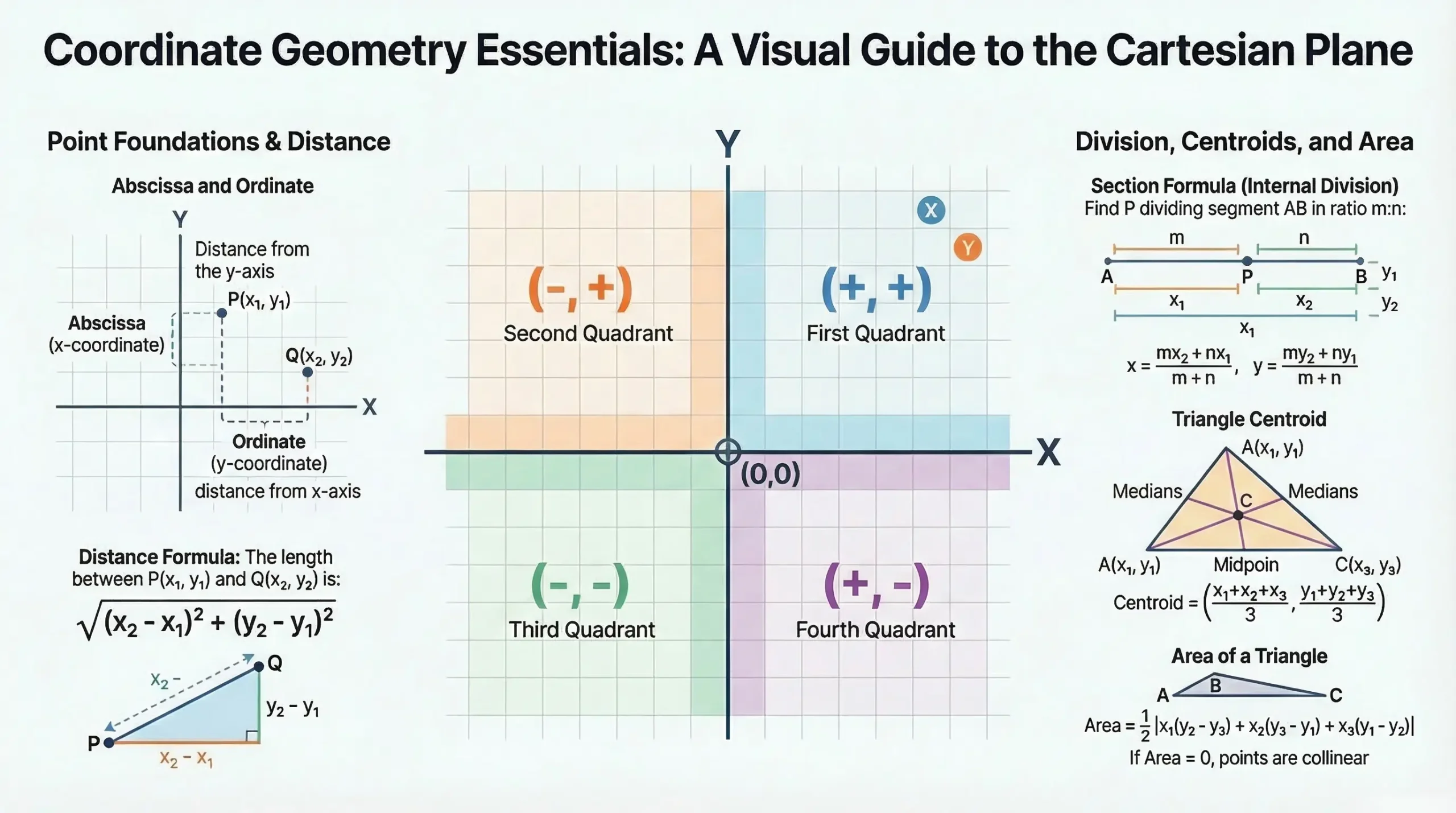
The rectangular (or Cartesian) coordinate system is built on two number lines that are perpendicular to each other:
- X-axis (X′OX): The horizontal number line.
- Y-axis (Y′OY): The vertical number line.
- Origin (O): The intersection point of the two axes, with coordinates (0, 0).
Together, these axes divide the plane into four regions called quadrants.
Coordinates of a Point
For any point P on the plane:
- The abscissa (x-coordinate) is the perpendicular distance of P from the Y-axis.
- The ordinate (y-coordinate) is the perpendicular distance of P from the X-axis.
A point is written as P(x, y).
Insight: The abscissa measures horizontal displacement; the ordinate measures vertical displacement. Together, they uniquely locate any point on the plane.
Quadrants and Sign Convention
| Quadrant | X-Coordinate | Y-Coordinate | Point Form |
|---|---|---|---|
| First (I) | Positive (+) | Positive (+) | (+, +) |
| Second (II) | Negative (−) | Positive (+) | (−, +) |
| Third (III) | Negative (−) | Negative (−) | (−, −) |
| Fourth (IV) | Positive (+) | Negative (−) | (+, −) |
Important Remarks
| Property | Detail |
|---|---|
| Abscissa of any point on the Y-axis | = 0 |
| Ordinate of any point on the X-axis | = 0 |
| Coordinates of the origin | = (0, 0) |
| Abscissa is positive | To the right of Y-axis |
| Abscissa is negative | To the left of Y-axis |
| Ordinate is positive | Above the X-axis |
| Ordinate is negative | Below the X-axis |
Distance Formula
Formula
The distance between two points P(x₁, y₁) and Q(x₂, y₂) is:
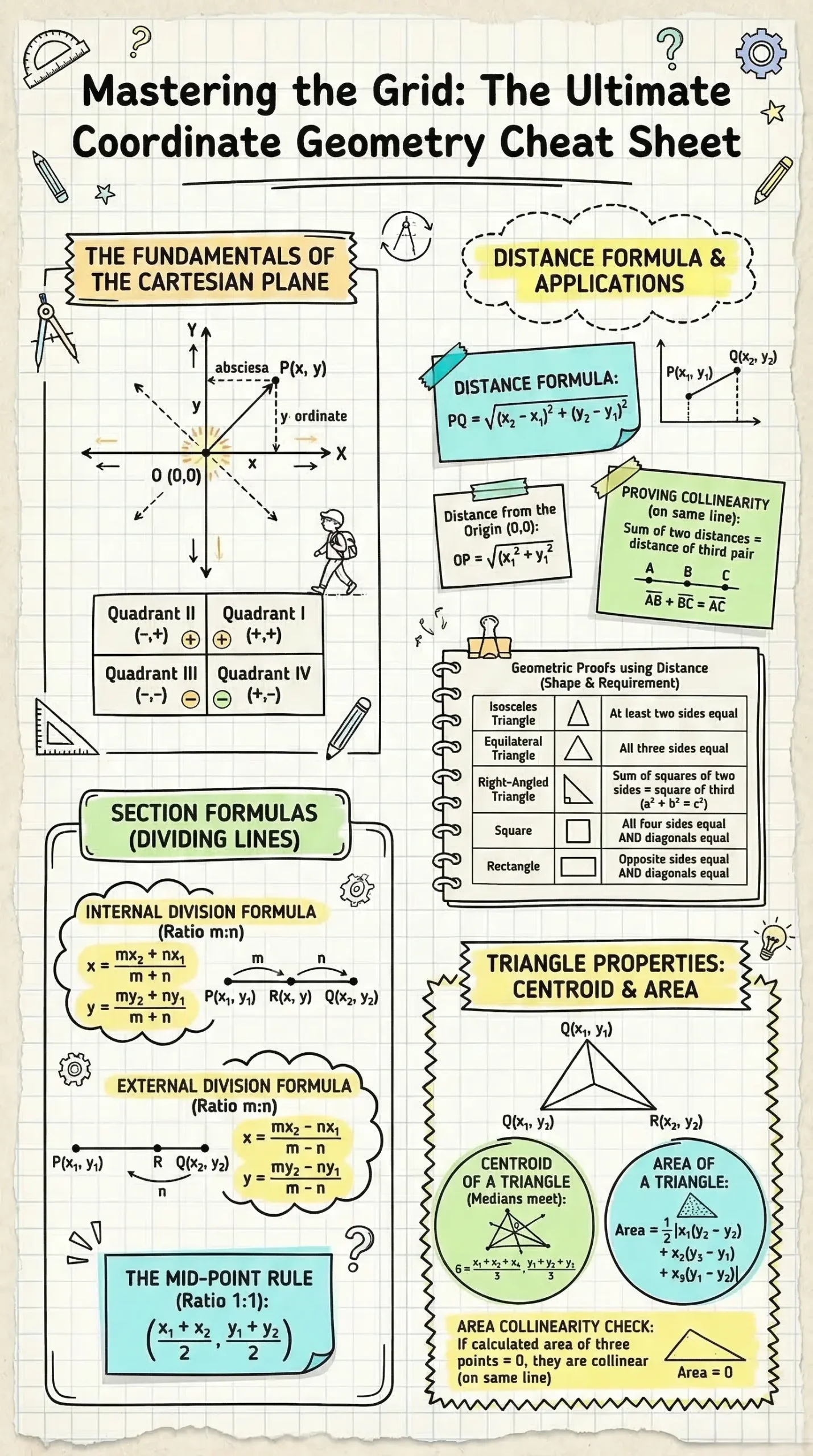
PQ = √(x2 - x1)2 + (y2 - y1)2
Distance from the Origin
The distance of any point P(x₁, y₁) from the origin (0, 0) is:
OP = √x1 2 + y1 2
Derivation (Proof Using Pythagoras Theorem)
Draw perpendiculars from P and Q to the X-axis meeting at A and B respectively. Produce CP to meet BQ at R. Then:
- PR = horizontal distance = x₂ − x₁
- QR = vertical distance = y₂ − y₁
Applying the Pythagorean Theorem in right-angled triangle PRQ:
PQ2 = PR2 + QR2 = (x2 − x1)2 + (y2 − y1)2
Taking the positive square root gives the Distance Formula.
Identifying Triangle Types Using Distance Formula
| Triangle Type | Condition to Verify |
|---|---|
| Isosceles | At least two sides are equal |
| Equilateral | All three sides are equal |
| Right-angled | Sum of squares of two sides equals the square of the third (Pythagoras) |
| Scalene | All three sides are unequal |
Collinearity of Three Points
Three points A, B, and C are collinear if:
AB + BC = AC
(i.e., one distance equals the sum of the other two)
Section Formula
The Section Formula gives the coordinates of a point that divides a line segment in a given ratio.
(a) Internal Division
If point P(x, y) divides the segment joining A(x₁, y₁) and B(x₂, y₂) internally in the ratio m : n, then:
x = mx2 + nx1 / m + n, y = my2 + ny1/m + n
(b) External Division
If point P(x, y) divides the segment externally in the ratio m : n, then:
x = mx2 - nx1 / m - n, y = my2 - ny1 / m - n
Note: External division occurs when the point lies outside the segment, on the extension of line AB. A negative ratio in section formula indicates external division.
Midpoint Formula
The midpoint of a line segment joining A(x₁, y₁) and B(x₂, y₂) is obtained by dividing in the ratio 1 : 1 (internal division):
M = (x1 + x2 / 2, y1 + y2/2)
Centroid of a Triangle
The centroid is the point where all three medians of a triangle intersect. It divides each median in the ratio 2 : 1 from the vertex.
Formula
For a triangle with vertices A(x₁, y₁), B(x₂, y₂), and C(x₃, y₃):
G = (x1 + x2 /3, y1 + y2 + y3 / 3)
Main Property
The three medians of any triangle are concurrent (they all pass through the centroid). This is a fundamental theorem proved using the section formula each median, when divided in ratio 2:1 from its respective vertex, yields the same point G.
Area of a Triangle
Formula
For a triangle with vertices A(x₁, y₁), B(x₂, y₂), and C(x₃, y₃):
Area = 1/2 | x1(y2 - y3) + x2 (y3 - y1) + x3 (y1 - y2)|
The absolute value (modulus) ensures the area is always non-negative.
Collinearity Condition
Three points A, B, and C are collinear if and only if the Area of △ABC = 0.
This condition is highly useful for proving that three points lie on a straight line without finding the equation of the line.
Area of a Quadrilateral
For a quadrilateral ABCD with vertices A(x₁,y₁), B(x₂,y₂), C(x₃,y₃), D(x₄,y₄):
Area of ABCD = Area of △ABC + Area of △ACD
Apply the triangle area formula to each triangle separately, then add the results.
Class 10 Maths Chapter 7 Coordinate Geometry Formula
| Formula | Expression |
|---|---|
| Distance between two points | √[(x₂−x₁)² + (y₂−y₁)²] |
| Distance from origin | √(x₁² + y₁²) |
| Section formula (internal) | ((mx₂+nx₁)/(m+n), (my₂+ny₁)/(m+n)) |
| Section formula (external) | ((mx₂−nx₁)/(m−n), (my₂−ny₁)/(m−n)) |
| Midpoint | ((x₁+x₂)/2, (y₁+y₂)/2) |
| Centroid of triangle | ((x₁+x₂+x₃)/3, (y₁+y₂+y₃)/3) |
| Area of triangle | ½ |x₁(y₂−y₃) + x₂(y₃−y₁) + x₃(y₁−y₂)| |
| Collinearity condition | Area of △ = 0 |
Class 10 Maths Chapter 7 Coordinate Geometry Solved Examples
Example: Find the distance between the points (8, −2) and (3, −6).
Solution:
Let P = (8, −2) and Q = (3, −6).
PQ = √(3−8)2 + (−6 − (−2))2
=√(-5)2 + (-4)2 = √25 + 16 = √41 units
Tip: Always square the differences the sign inside doesn't matter since squaring eliminates negatives.
Example: Prove that the points (1, −1), (−½, ½), and (1, 2) are the vertices of an isosceles triangle.
Solution:
Let P = (1, −1), Q = (−½, ½), R = (1, 2).
PQ = √(-1/2 - 1)2 + (1/2 + 1)2 = √9/4 + 9/4 = √18/4 = 3√2/2
QR = √(1 + 1/2)2 + (2 - 1/2)2 = √9/4 + 9/4 = 3√2/2
PR = √(1 - 1)2 + (2 + 1)2 = √0 + 9 = 3
Since PQ = QR, the triangle has two equal sides → it is isosceles.
Example: Using the distance formula, show that (−3, 2), (1, −2), and (9, −10) are collinear.
Solution:
Let A = (−3, 2), B = (1, −2), C = (9, −10).
AB =√(1 + 3)2 + (-2 -2)2 =√16 + 16 = 4√2
BC = √(9 - 1)2 + (-10- + 2)2 = √64 + 64 = 8√2
AC = √(9 + 3)2 + (-10 - 2)2 = √144 + 144 = 12√2
Since AB + BC = 4√2 + 8√2 = 12√2 = AC, the three points are collinear.
Example: Find a point on the X-axis equidistant from (5, 4) and (−2, 3).
Solution:
Any point on the X-axis has the form P = (x, 0).
Let A = (5, 4) and B = (−2, 3). Given AP = BP:
AP2 = BP2
(x - 5)2 + (0 - 4)2 = (x + 2)2 + (0 - 3)2
x2 - 10x + 25 + 16 = x2 + 4x + 4 + 9
- 10x + 41 = 4x + 13
-14x = -28 ⇒ x = 2
The required point is (2, 0).
Example: The vertices of a triangle are (−2, 0), (2, 3), and (1, −3). Is the triangle equilateral, isosceles, or scalene?
Solution:
Let A = (−2, 0), B = (2, 3), C = (1, −3).
AB = √(2 + 2)2 + (3 - 0)2 = √16 + 9 = 5
BC = √(1 - 2)2 + (-3 - 0)2 = √9 + 9 = 3√2
AC =√(1 + 2)2 + (-3 -0)2 =√9 + 9 = 3√2
Since AB ≠ BC ≠ AC, the triangle is scalene.
Example: A line segment has length 10. One end is at (2, −3) and the abscissa of the other end is 10. Show that the ordinate is either 3 or −9.
Solution:
Let B = (10, y). Then AB = 10.
AB2 = (10 - 2)2 + (u + 3)2 = 100
64 + y2 + 6y + 9 = 100
y2 + 6y - 27 = 0
(y + 9) (y - 3) = 0
∴ y = 3 or y = −9.
Example: Show that (−2, 5), (3, −4), and (7, 10) are vertices of a right triangle.
Solution:
Let A = (−2, 5), B = (3, −4), C = (7, 10).
AB2 = (3 + 2)2 + (-4 - 5)2 = 25 + 81 = 106
BC2 = (7 - 3)2 + (10 + 4)2 = 16 + 196 = 212
AC2 = (7 + 2)2 + (10 - 5)2 = 81 + 25 = 106
Check: BC² = AB² + AC² → 212 = 106 + 106
Since the Pythagorean condition holds, ∠A = 90°, and ABC is a right-angled triangle.
Example: Find the coordinates of the point dividing the segment joining (6, 3) and (−4, 5) in the ratio 3 : 2 (i) internally, (ii) externally.
Solution:
(i) Internal Division:
x = 3(-4) + 2 (6) / 3 + 2 = -12 + 12/5 = 0
y = 3(5) + 2(3) / 3 + 2 = 15 + 6/5 = 21/5
Point: (0, 21/5)
(ii) External Division:
x = 3(-4) - 2(6) / 3 - 2 = -12 - 12 / 1 = - 24
y = 3(5) - 2(3) / 3 - 2 = 15 - 6 / 1 = 9
Point: (−24, 9)
Example: In what ratio does the X-axis divide the segment joining (2, −3) and (5, 6)?
Solution:
Let the ratio be k : 1. The point of division lies on the X-axis, so its y-coordinate = 0.
y = k(6) + 1 (-3) / k + 1 = 0
6k - 3 = 0 ⇒ k = 1/2
The X-axis divides the segment in the ratio 1 : 2.
Example: The vertices of △ABC are (−2, 1), (5, 4), and (2, −3). Find the area.
Solution:
Here x₁ = −2, y₁ = 1; x₂ = 5, y₂ = 4; x₃ = 2, y₃ = −3.
Area = 1/2 |x1(y2 - y3) + x2(y3 - y1) + x3 (y1 - y2) |
= 1/2 |(-2) (4 + 3) + 5 (-3 - 1) + 2 (1 - 4)|
= 1/2 |(-14) + (-20) + (-6)|
= 1/2 x 40 = 20 sq. units