
Class 10 Maths Construction Revision Notes: Class 10 Maths Construction is an important chapter in the geometry section of the CBSE syllabus. In this topic, students learn how to draw accurate geometric figures using basic tools like a compass, ruler, and pencil. These Class 10 Maths Construction Notes help students understand the step-by-step methods used to construct different shapes and divisions of lines or angles. The chapter mainly focuses on practical geometry, where students apply mathematical concepts in drawing and problem solving.
In construction class 10, students study how to divide a line segment in a given ratio, construct triangles based on given conditions, and draw tangents to a circle from an external point. These constructions are based on geometric properties and theorems learned in earlier classes. Good construction class 10 Maths notes make these concepts easier to revise before exams.
Students can also practice problems with the help of construction class 10 solutions, which explain the reasoning behind each step of a construction. These notes are designed according to the latest CBSE syllabus, so they work well as quick CBSE Class 10 notes for revision.
Overall, this chapter builds strong visualization and logical thinking skills. By studying these notes carefully and practicing diagrams regularly, students can understand constructions better and perform well in CBSE board exams. Sometimes students feel this topic is tricky, but with regular practice it becomes much more easy.
Introduction to Construction in Mathematics
Construction is a fundamental topic in Class 10 Mathematics that deals with drawing geometric figures using only a compass and straightedge (ruler). Unlike freehand drawing, mathematical construction follows precise steps to create accurate geometric shapes, ensuring mathematical properties are maintained.
This comprehensive guide covers three essential construction techniques:
- Division of line segments in given ratios
- Construction of triangles similar to given triangles
- Construction of tangents to circles
These constructions form the basis for understanding geometric relationships and are crucial for solving advanced problems in coordinate geometry and trigonometry.
Construction Class 10 Maths Revision Notes PDF Download
Fill the form to download this PDF
Introduction to Construction in Mathematics
Construction is a fundamental topic in Class 10 Mathematics that deals with drawing geometric figures using only a compass and straightedge (ruler). Unlike freehand drawing, mathematical construction follows precise steps to create accurate geometric shapes, ensuring mathematical properties are maintained.
This comprehensive guide covers three essential construction techniques:
- Division of line segments in given ratios
- Construction of triangles similar to given triangles
- Construction of tangents to circles
These constructions form the basis for understanding geometric relationships and are crucial for solving advanced problems in coordinate geometry and trigonometry.
Division of a Line Segment
Understanding the Concept
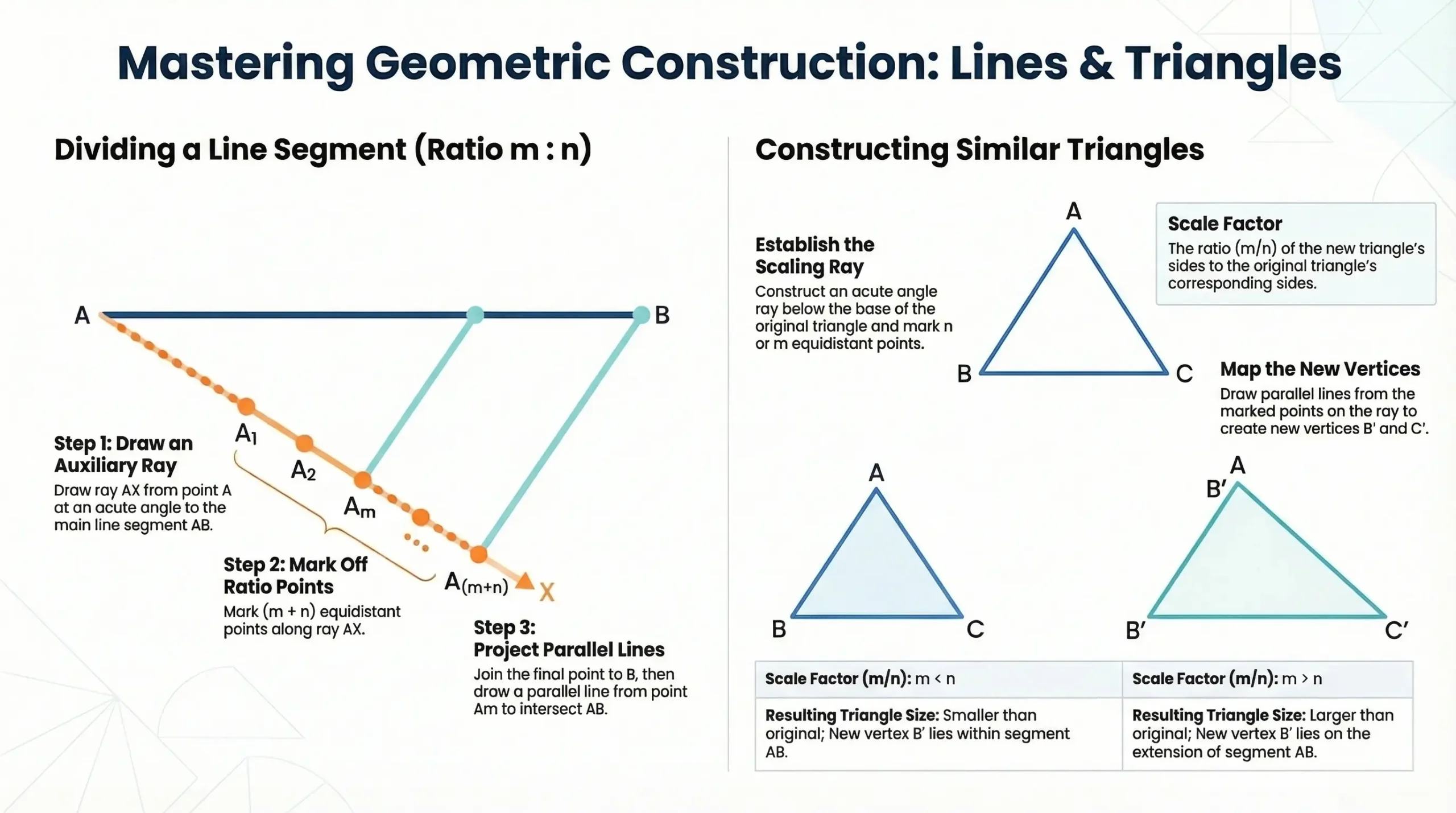
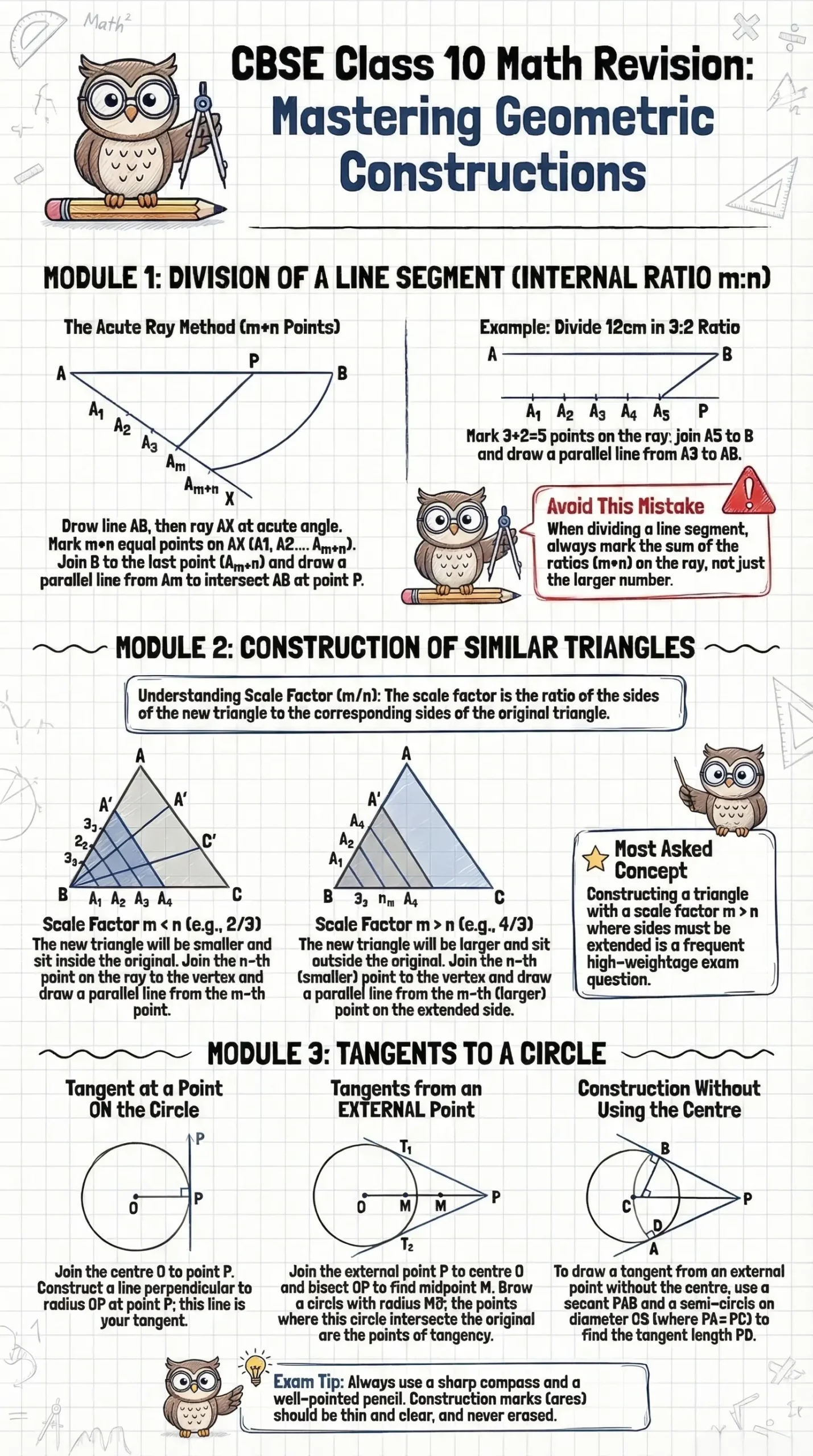
Dividing a line segment internally in a given ratio m:n means finding a point P on the line segment AB such that AP:PB = m:n, where m and n are positive integers.
Method 1: Standard Construction Method
Steps of Construction:
- Draw the base line segment: Using a ruler, draw line segment AB of the given length
- Create an auxiliary ray: Draw ray AX making an acute angle with AB
- Mark equal divisions: Along AX, mark (m + n) points A₁, A₂, ..., A_{m+n} such that AA₁ = A₁A₂ = ... = A_{m-1}A_m = ... = A_{m+n-1}A_{m+n}
- Join the endpoint: Join point B to A_{m+n}
- Draw parallel line: Through point A_m, draw a line parallel to A_{m+n}B by constructing an equal angle. This line intersects AB at point P
Result: Point P divides AB internally in the ratio m:n
Worked Example 1: Dividing a 12 cm Line Segment in Ratio 3:2
Given: Line segment of length 12 cm
Required: Divide internally in ratio 3:2
Solution:
Steps:
- Draw AB = 12 cm using a ruler
- Draw ray AX making an acute angle ∠BAX with AB
- Mark 5 points (3 + 2 = 5) A₁, A₂, A₃, A₄, A₅ on AX such that AA₁ = A₁A₂ = A₂A₃ = A₃A₄ = A₄A₅
- Join BA₅
- Through A₃, draw line A₃P parallel to A₅B, making an angle equal to ∠AA₅B at A₃, intersecting AB at P
Result: Point P divides AB in the ratio 3:2, meaning AP = 7.2 cm and PB = 4.8 cm
Method 2: Alternative Method Using Two Rays
This method uses two rays on opposite sides of the line segment, providing better visual clarity for some students.
Steps of Construction:
- Draw line segment AB of given length
- Draw ray AX making acute angle ∠BAX with AB
- Draw ray BY on the opposite side of AX, parallel to AX, making ∠ABY equal to ∠BAX
- Mark m points A₁, A₂, ..., A_m on AX and n points B₁, B₂, ..., B_n on BY such that AA₁ = A₁A₂ = ... = BB₁ = B₁B₂ = ... = B_{n-1}B_n
- Join A_mB_n. Let it intersect AB at P
Result: Point P divides AB in the ratio m:n
Worked Example 2: Dividing a 6 cm Line Segment in Ratio 3:4
Given: Line segment AB = 6 cm
Required: Divide internally in ratio 3:4
Solution:
Steps:
- Draw AB = 6 cm
- Draw ray AX making acute angle ∠BAX
- Draw ray BY parallel to AX with ∠ABY = ∠BAX
- Mark 3 points A₁, A₂, A₃ on AX and 4 points B₁, B₂, B₃, B₄ on BY with equal spacing
- Join A₃B₄. It intersects AB at point P
Result: P divides AB in ratio 3:4, where AP ≈ 2.57 cm and PB ≈ 3.43 cm
Construction of Similar Triangles
Understanding Scale Factor
The scale factor is the ratio of corresponding sides of the triangle to be constructed to the given triangle. If the scale factor is m/n:
- When m < n: The new triangle is smaller than the original
- When m > n: The new triangle is larger than the original
Case 1: When Scale Factor m/n < 1 (Smaller Triangle)
This construction creates a triangle whose sides are (m/n)th of the original triangle's sides.
Steps of Construction:
- Construct the given triangle ABC using provided measurements
- Choose one side as the base (let AB be the base)
- At point A, construct acute angle ∠BAX below base AB
- Along AX, mark n points A₁, A₂, ..., A_n with equal spacing
- Join A_nB
- Draw A_mB' parallel to A_nB, meeting AB at B'
- From B', draw B'C' parallel to BC, meeting AC at C'
Result: Triangle AB'C' is similar to △ABC with each side being (m/n) times the corresponding side of △ABC
Worked Example 3: Constructing Triangle with Sides 2/3 of Original
Given: △ABC with AB = 5 cm, BC = 6 cm, AC = 7 cm
Required: Construct similar triangle with sides = 2/3 of △ABC
Solution:
Steps:
- Draw AB = 5 cm
- With A as center and radius 7 cm, draw an arc
- With B as center and radius 6 cm, draw an arc intersecting the first arc at C
- Join AC and BC to form △ABC
- Below AB, construct acute angle ∠BAX
- Mark 3 points (denominator of 2/3) A₁, A₂, A₃ on AX with AA₁ = A₁A₂ = A₂A₃
- Join A₃B
- Draw A₂B' parallel to A₃B, meeting AB at B'
- From B', draw B'C' parallel to BC, meeting AC at C'
Result: △AB'C' ~ △ABC with AB'/AB = B'C'/BC = AC'/AC = 2/3
Case 2: When Scale Factor m/n > 1 (Larger Triangle)
This construction creates a triangle whose sides are (m/n) times larger than the original.
Steps of Construction:
- Construct the given triangle using provided data
- Choose base AB
- At point A, construct acute angle ∠BAX below AB (opposite side of vertex C)
- Mark m points (numerator) A₁, A₂, ..., A_m on AX with equal spacing
- Join A_nB and draw a line through A_m parallel to A_nB, intersecting extended AB at B'
- Draw a line through B' parallel to BC, intersecting extended AC at C'
Result: △AB'C' is similar to △ABC with sides (m/n) times the original
Worked Example 4: Constructing Triangle with Sides 4/3 Times Original
Given: △ABC with BC = 7 cm, ∠B = 45°, ∠A = 105°
Required: Construct triangle with sides = 4/3 times △ABC
Solution:
Steps:
- Draw BC = 7 cm
- At B, construct ∠CBX = 45°
- At C, construct ∠BCY = 180° - (45° + 105°) = 30°
- Let BX and CY intersect at A to form △ABC
- At B (opposite side of A), construct acute angle ∠CBZ
- Mark 4 points B₁, B₂, B₃, B₄ on BZ with equal spacing (4 is larger of 4 and 3)
- Join B₃ (the 3rd point) to C
- Draw line through B₄ parallel to B₃C, intersecting extended BC at C'
- Draw line through C' parallel to CA, intersecting extended BA at A'
Result: △A'BC' ~ △ABC with A'B'/AB = BC'/BC = A'C'/AC = 4/3
Construction of Tangents to a Circle
A tangent to a circle is a line that touches the circle at exactly one point, called the point of tangency. The tangent is always perpendicular to the radius at the point of contact.
Method 1: Tangent at a Point When Center is Known
Given: Circle with center O and point P on it
Required: Draw tangent at P
Steps:
- Join OP (this is the radius to point P)
- Draw line AB perpendicular to OP at point P
Result: AB is the required tangent at P
Worked Example 5: Tangent to Circle with Diameter 6 cm
Given: Circle with center O, diameter = 6 cm
Required: Draw tangent through point A or B on diameter
Solution:
Steps:
- With O as center and radius 3 cm (6 ÷ 2), draw the circle
- Draw diameter AOB
- Draw CD ⊥ AB at point A (or B)
Result: CD is the required tangent at A
Method 2: Tangent at a Point When Center is Not Known
Given: Circle and point P on it (center unknown)
Required: Draw tangent at P
Steps:
- Draw any chord PQ from point P
- Join P and Q to any point R on the major arc PQ (or minor arc)
- Draw ∠QPB equal to ∠PRQ on the opposite side of chord PQ
Result: Line BPA is the tangent at P
Worked Example 6: Tangent Without Using Center
Given: Circle with radius 4.5 cm, point P on circle
Required: Construct tangent at P without using center
Solution:
Steps:
- Draw circle with radius 4.5 cm
- Mark point P on the circle
- Draw chord PQ from P
- Take point R on the circle and join PR and QR
- Draw ∠QPB = ∠PRQ on opposite side of chord PQ
- Produce BP to A
Result: APB is the required tangent
Method 3: Tangents from External Point When Center is Known
Given: Circle with center O, external point P
Required: Construct two tangents from P to circle
Steps:
- Join OP and bisect it. Let M be the midpoint of OP
- Taking M as center and MO as radius, draw a circle to intersect the given circle at points A and B
- Join PA and PB
Result: PA and PB are the required tangents from P
Worked Example 7: Tangents from Point 6 cm Away
Given: Circle with radius 2.5 cm, point P at 6 cm from center O
Required: Draw two tangents from P
Solution:
Steps:
- Draw circle with center O and radius 2.5 cm
- Mark point P such that OP = 6 cm
- Bisect OP. Let M be the midpoint
- With M as center and MO as radius, draw circle intersecting the given circle at A and B
- Join PA and PB
Result: PA and PB are the required tangents with lengths = √(OP² - r²) = √(36 - 6.25) ≈ 5.46 cm
Method 4: Tangents from External Point When Center is Not Known
Given: Point P outside circle (center unknown)
Required: Draw two tangents from P
Steps:
- Draw secant PAB intersecting circle at A and B
- Produce AP to point C such that PA = PC
- With BC as diameter, draw a semicircle
- Draw PD ⊥ CB, intersecting the semicircle at D
- With P as center and PD as radius, draw arcs intersecting the circle at T and T'
- Join PT and PT'
Result: PT and PT' are the required tangents
Worked Example 8: Tangents Without Using Center
Given: Circle with radius 3 cm, external point P
Required: Draw tangents without using center
Solution:
Steps:
- Draw circle with radius 3 cm
- Mark external point P
- Draw secant PAB intersecting circle at A and B
- Produce AP to C with AP = CP
- Draw semicircle with CB as diameter
- Draw PD ⊥ AB, intersecting semicircle at D
- With P as center and PD as radius, draw arcs intersecting circle at T and T'
- Join PT and PT'
Result: PT and PT' are the required tangents
Principles and Theorems
Important Properties
Line Segment Division: The point dividing a line segment in ratio m:n uses the Basic Proportionality Theorem (Thales' Theorem)
Similar Triangles: Triangles are similar if:
- Corresponding angles are equal (AA criterion)
- Corresponding sides are proportional (SSS criterion)
- Two sides are proportional and included angle is equal (SAS criterion)
Tangent Properties:
- Tangent is perpendicular to radius at point of contact
- Two tangents from external point are equal in length
- Angle between tangent and chord equals angle in alternate segment
Mathematical Justification
- For Line Division: Using similar triangles formed by parallel lines, we can prove: If P divides AB in ratio m:n, then AP/PB = m/n
- For Similar Triangles: The construction maintains angle equality and proportional sides due to parallel line properties.
- For Tangents: The perpendicularity follows from the fact that radius to point of tangency is the shortest distance from center to tangent line.
Common Mistakes to Avoid
- Inaccurate Angle Construction: Always use a compass and protractor properly for accurate angles
- Unequal Divisions: When marking points on rays, ensure equal spacing using compass
- Wrong Parallel Lines: Verify parallel construction by checking equal corresponding angles
- Incorrect Scale Factor: Remember: m/n < 1 gives smaller triangle, m/n > 1 gives larger triangle
- Tangent Direction: Tangent must be perpendicular to radius, not at arbitrary angles
Practice Tips for Students
- Use Sharp Instruments: Keep compass and pencil sharp for accurate constructions
- Light Construction Lines: Draw construction lines lightly; darken final figures
- Label Clearly: Mark all points, angles, and measurements clearly
- Verify Results: Measure the constructed figures to verify accuracy
- Practice Regularly: Construction requires manual dexterity that improves with practice
- Understand the Logic: Don't just memorize steps; understand why each step works
Conclusion
Construction in Class 10 Mathematics is a practical application of geometric theorems and properties. Mastering these techniques requires:
- Understanding the underlying geometry: Why each step works
- Precision in execution: Careful use of instruments
- Regular practice: Building manual dexterity and accuracy
- Verification: Checking results through measurement
These construction skills form the foundation for advanced topics in geometry, trigonometry, and coordinate geometry. They also develop spatial reasoning and logical thinking that extend beyond mathematics into fields like engineering, architecture, and design.