
Circles Chapter 10 Class 10 Maths Revision Notes: Circles is an important topic in Class 10 Mathematics because it explains many geometric ideas related to tangents and properties of circles. These Circles Chapter 10 Class 10 Maths Revision Notes are designed to help students quickly understand the key concepts of the chapter and revise them before exams. In simple words, a circle is a set of all points in a plane that are at the same distance from a fixed point called the centre. In this chapter, students mainly learn about tangents to a circle and the important theorems related to them.
These class 10 circles notes cover all important definitions, formulas, diagrams, and properties that are commonly asked in board exams. Students will also find explanations of concepts like radius, tangent, point of contact, and the relationship between the radius and tangent. The notes are prepared based on NCERT guidelines, so they match well with circles class 10 notes NCERT solutions and help in understanding the step-by-step method used in textbook questions.
Along with theory, these notes also guide students in solving problems similar to circles class 10 solutions provided in NCERT exercises. If students want quick revision material, they can also refer to the circles chapter 10 class 10 maths notes pdf for practice and last-minute revision. Overall, these notes give a clear overview of the chapter and help students build strong basics in geometry, although sometimes students may need extra practice to fully understand the concepts.
Introduction to Circles
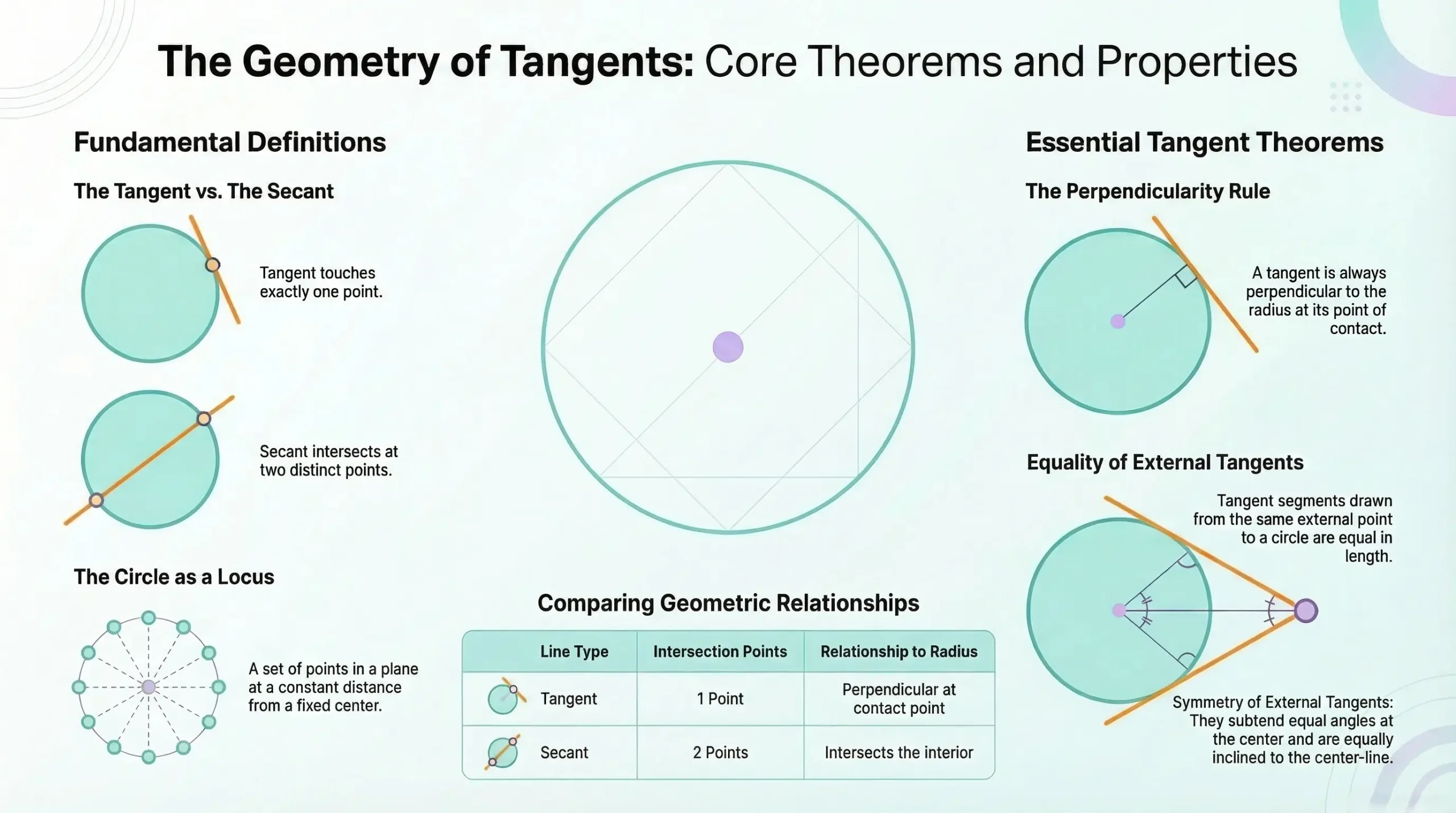
A circle is one of the most fundamental geometric figures studied in Class 10 Mathematics. In formal terms, a circle is defined as the locus of all points in a plane that are equidistant from a fixed point, called the centre. This constant distance from the centre to any point on the circle is called the radius.
Formal Definition
A circle C(O, r) is the set of all points P in a plane such that |OP| = r, where O is the fixed centre and r > 0 is the radius.
For Class 10 CBSE board examinations, Chapter 10 on Circles focuses primarily on the relationship between a circle and lines specifically tangents and secants and the theorems that govern them. These concepts regularly appear in both short-answer and proof-based questions carrying significant marks.
Circles Class 10 Maths Revision Notes PDF Download
Fill the form to download this PDF
Secant and Tangent
- Secant
A secant to a circle is a straight line that intersects the circle at exactly two distinct points. It passes through the interior of the circle.
- Tangent
A tangent to a circle is a straight line that touches the circle at exactly one point. This unique point is called the point of contact (or point of tangency). The tangent never enters the interior of the circle.
Insight: A tangent can be thought of as the limiting position of a secant when the two intersection points gradually approach each other and ultimately coincide at a single point.
Number of Tangents from a Point
| Position of Point | Number of Tangents | Reason |
|---|---|---|
| Inside the circle | 0 (zero) | Any line through an interior point intersects the circle at two points no tangent is possible. |
| On the circle | 1 (one) | Exactly one tangent can be drawn at any point on a circle. |
| Outside the circle | 2 (two) | Two distinct tangents can be drawn from any external point to the circle. |
Theorem 1 - Radius is Perpendicular to the Tangent
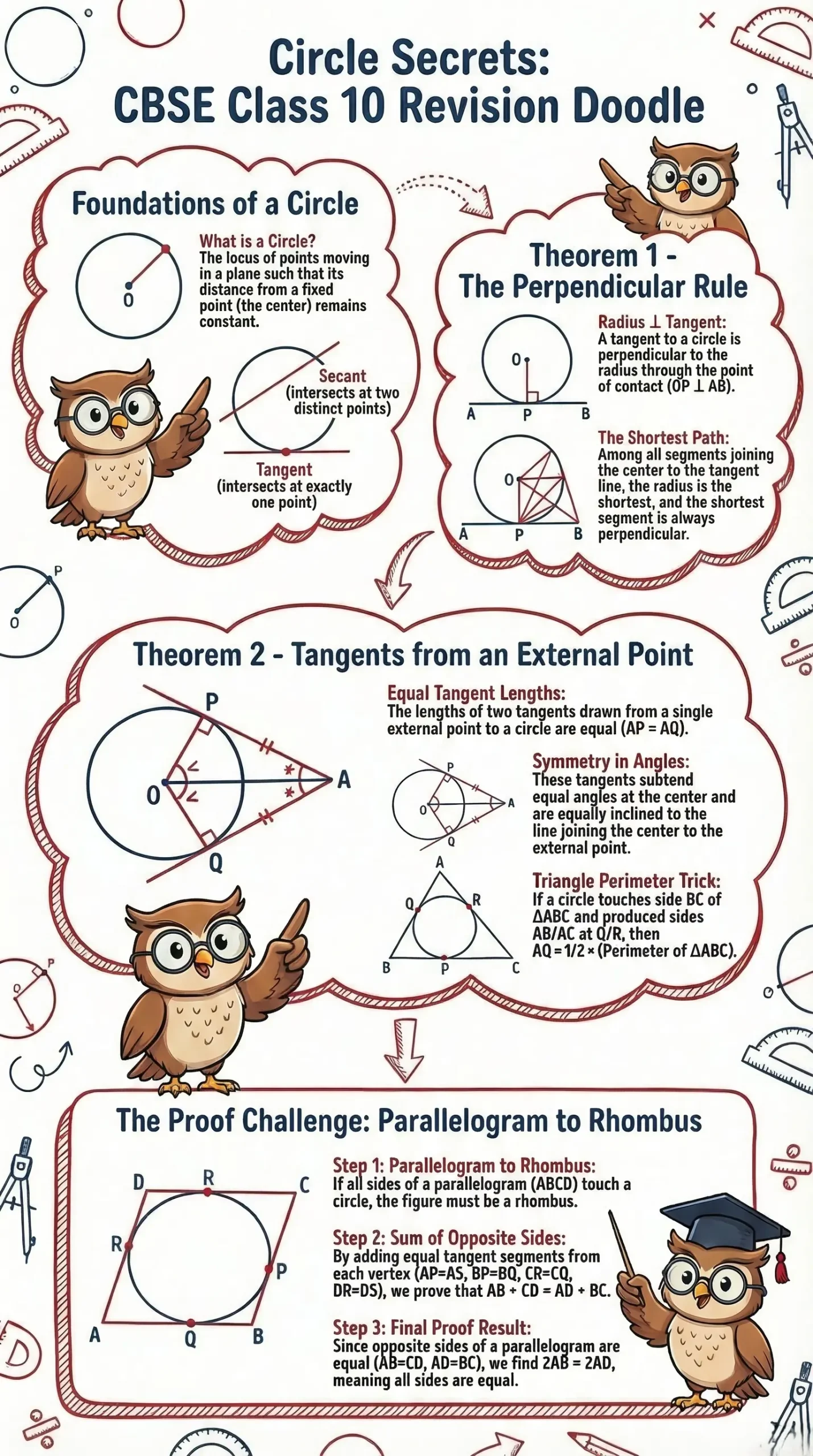
The tangent at any point of a circle is perpendicular to the radius drawn to the point of contact.
Given: A circle C(O, r) with a tangent line AB at point P on the circle.
To Prove: OP ⊥ AB
Construction: Take any point Q (other than P) on the tangent line AB. Join OQ. Suppose OQ meets the circle at the point R.
Proof: Among all line segments drawn from centre O to a point on line AB, the shortest one is perpendicular to AB. So it suffices to show OP is shorter than every other such segment.
- Since P lies on the circle: OP = OR = r (both are radii)
- Q is outside the circle, so: OQ = OR + RQ
- Therefore: OQ > OR
- Since OR = OP: OQ > OP
- OP is shorter than any segment from O to any other point on AB.
- Hence, OP ⊥ AB.
Converse (also important for exams): The line drawn through the point of contact of a tangent to a circle, perpendicular to the tangent, passes through the centre of the circle.
Section 04
Theorem 2 - Equal Tangents from an External Point
The lengths of two tangents drawn from an external point to a circle are equal.
Given: AP and AQ are two tangents drawn from an external point A to a circle C(O, r), touching the circle at P and Q respectively.
To Prove: AP = AQ
Construction: Join OP, OQ, and OA.
Proof: Consider triangles ΔAOQ and ΔAOP:
- ∠OQA = ∠OPA = 90° (tangent ⊥ radius at point of contact - Theorem 1)
- OA = OA (common hypotenuse)
- OQ = OP = r (radii of the same circle)
- By R.H.S. Congruence: ΔAOQ ≅ ΔAOP
- Therefore, by CPCT: AP = AQ
Corollary Results
The proof of Theorem 2 (via CPCT) yields two additional important results that are regularly tested in CBSE examinations:
Result 1 - Equal Angles at Centre
Two tangents drawn from an external point subtend equal angles at the centre of the circle.
∠OAQ = ∠OAP
Result 2 - Equal Inclination
The two tangents from an external point are equally inclined to the line segment joining that point to the centre.
∠OAQ = ∠OAP
Memory Aid: Both results share the same equation ∠OAQ = ∠OAP, derived from CPCT. The line OA is the angle bisector of the angle formed by the two tangents at A, and also bisects the angle at the centre between OQ and OP.
Section 06
Circles Chapter 10 Maths Class 10 Solved Examples
Example 1: If all the sides of a parallelogram touch a circle, prove that the parallelogram is a rhombus.
Solution
Given: Sides AB, BC, CD, and DA of parallelogram ABCD touch a circle at points P, Q, R, and S respectively.
To Prove: ABCD is a rhombus (i.e., AB = BC = CD = DA).
Property Used: Tangents drawn from an external point to a circle are equal in length (Theorem 2).
Proof: Applying the equal tangent property at each vertex:
- From vertex A: AP = AS ...(1)
- From vertex B: BP = BQ ...(2)
- From vertex C: CR = CQ ...(3)
- From vertex D: DR = DS ...(4)
- Adding all four equations:
(AP + BP) + (CR + DR) = (AS + DS) + (BQ + CQ)
- AB + CD = AD + BC
- In a parallelogram: AB = CD and AD = BC, so:
2AB = 2AD ⇒ AB = AD
- Since AB = CD and AD = BC (opposite sides), we get AB = BC = CD = DA
- ∴ ABCD is a rhombus.
Example 2: A circle touches side BC of △ABC at P and touches AB and AC (when produced) at Q and R respectively. Show that: AQ = ½ × (Perimeter of △ABC)
Solution
Given: A circle touches BC at P, and AB (produced) at Q, and AC (produced) at R.
To Prove: AQ = ½ × (Perimeter of △ABC)
Proof: Using equal tangent lengths from each external vertex:
- From A: AQ = AR ...(1)
- From B: BQ = BP ...(2)
- From C: CP = CR ...(3)
- Perimeter of △ABC = AB + BC + CA
- = AB + (BP + PC) + CA [BC = BP + PC]
- = (AB + BQ) + (CR + CA) [from (2) & (3)]
- = AQ + AR [AB + BQ = AQ; CR + CA = AR]
- = AQ + AQ = 2AQ [from (1)]
- ∴ AQ = ½ × (Perimeter of △ABC)
Interpretation: This is a beautiful result: the distance from the external vertex A to the point of tangency on the produced side equals half the triangle's perimeter a fact useful in computing perimeters in excircle problems.
Example 3: Prove that tangents at the extremities of any chord of a circle make equal angles with the chord.
Solution
Given: AB is a chord of a circle with centre O. Tangents AP and BP at A and B respectively meet at point P. OP meets AB at C. To Prove: ∠PAC = ∠PBC
Proof: Consider triangles ΔPCA and ΔPCB:
- PA = PB - tangents from external point P are equal (Theorem 2)
- ∠APC = ∠BPC - PA and PB are equally inclined to OP (Corollary of Theorem 2)
- PC = PC - common side
- By SAS congruence: ΔPCA ≅ ΔPCB
- By CPCT: ∠PAC = ∠PBC
Example 4: Prove that the segment joining the points of contact of two parallel tangents to a circle passes through the centre.
Solution
Given: PAQ and RBS are two parallel tangents to a circle with centre O, touching the circle at A and B respectively.
To Prove: AB passes through O (i.e., AOB is a straight line).
Construction: Join OA and OB. Draw OC ∥ PQ (i.e., OC is parallel to the tangents).
Proof:
- Since PA ∥ OC: ∠PAO + ∠COA = 180° (co-interior angles)
- ∠PAO = 90° (radius ⊥ tangent) so ∠COA = 90°
- Similarly, since RB ∥ OC: ∠COB = 90°
- ∠COA + ∠COB = 90° + 90° = 180°
- ∴ AOB is a straight line, meaning AB passes through O.
Conclusion: The chord of contact (AB) of two parallel tangents is a diameter of the circle.
Circles Chapter 10 Maths Class 10 Concept
| Concept | Statement / Formula | Reason / Method |
|---|---|---|
| Tangent ⊥ Radius | OP ⊥ AB at point of contact P | OP is shortest distance from O to line AB |
| Equal Tangents | AP = AQ from external point A | RHS congruence of ΔAOP and ΔAOQ |
| Equal Angles at Centre | ∠OAP = ∠OAQ | CPCT from above congruence |
| Tangent-Chord Angle | ∠PAC = ∠PBC | SAS congruence + CPCT |
| Parallel Tangents | Chord of contact is a diameter | Co-interior angles + radius ⊥ tangent |
| Inscribed Parallelogram | All sides equal → rhombus | Equal tangents from each vertex |
| Perimeter Relation | AQ = ½ × Perimeter(△ABC) | Equal tangent sums from A, B, C |