
Arithmetic Progression Chapter 5 Class 10 Maths Notes: Arithmetic Progression (AP) is one of the most important topics in Class 10 Mathematics. In simple words, an arithmetic progression is a sequence of numbers where the difference between two consecutive terms remains constant. This constant value is called the common difference (d). In the arithmetic progression Chapter 5 class 10 maths notes, students learn how to identify an AP, find different terms, and apply formulas to solve mathematical problems.
These arithmetic progression class 10 notes help students understand basic concepts such as the first term (a), common difference (d), nth term (an), and sum of n terms (Sn). The chapter also explains how arithmetic sequences are used in real-life situations like calculating savings, patterns, or regular increases in values. Many students also search for arithmetic progression class 10 notes pdf and arithmetic progression class 10 formulas pdf so they can quickly revise important concepts and formulas before exams.
In addition, the arithmetic progression class 10 notes NCERT solutions provide step-by-step explanations for textbook questions, helping students understand the logic behind each solution. These arithmetic progression class 10 solutions also include important questions, examples, and practice problems.
By studying arithmetic progression class 10 all formulas and concepts carefully, students can build a strong foundation for algebra and higher mathematics. Sometimes this chapter may look little confusing at first, but with practice and clear notes, it becomes easy to understand and solve problems.
What is Arithmetic Progression?
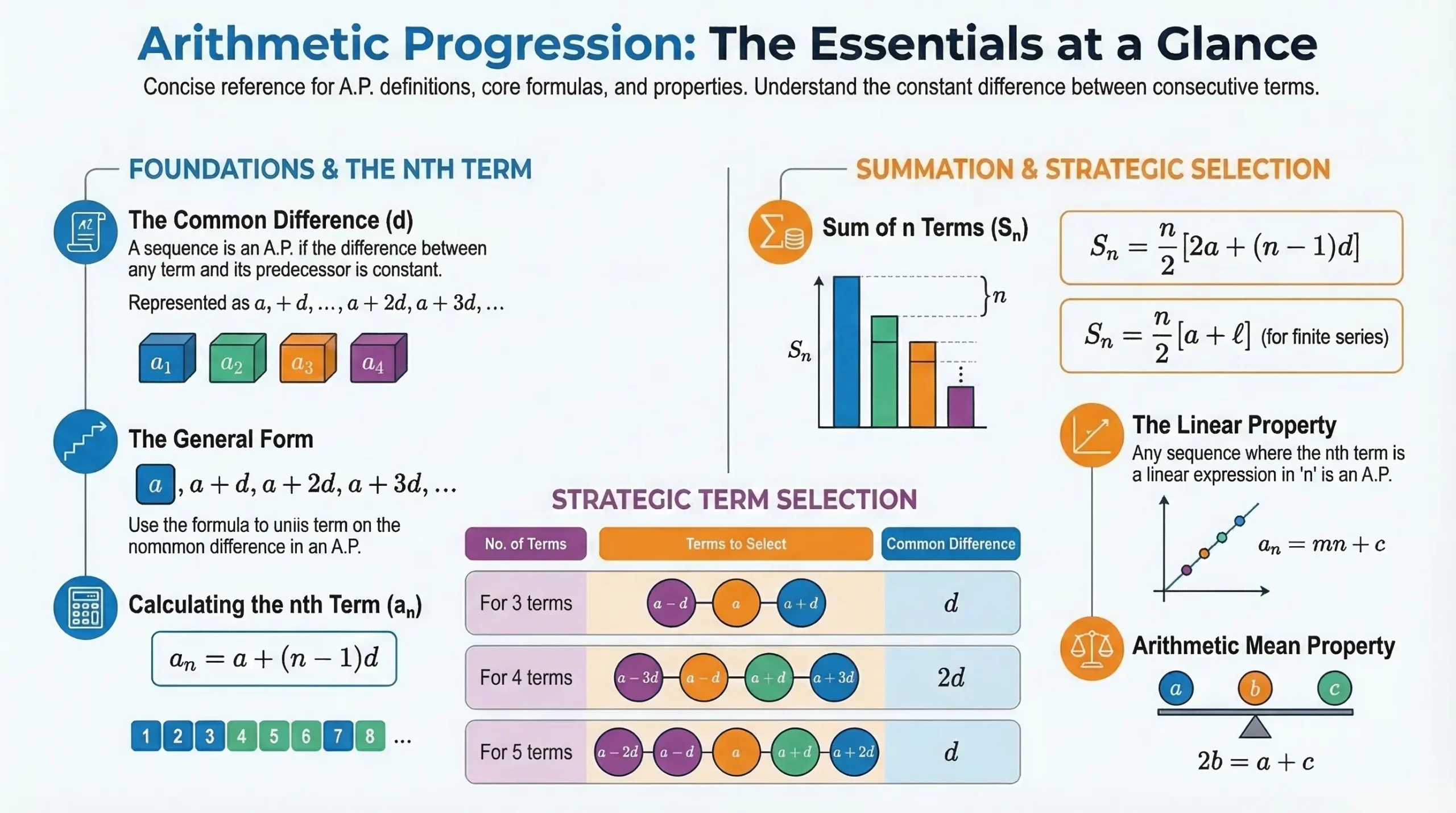
An Arithmetic Progression (AP) is a sequence of numbers in which the difference between any two consecutive terms is always constant. This fixed constant difference is known as the common difference, denoted by d.
Definition: A sequence a1, a2, a3,… is called an Arithmetic Progression if: d = an+1 - an = Constant , for alln ∈ N
Arithmetic Progression Class 10 Maths Revision Notes PDF Download
Fill the form to download this PDF
What is Arithmetic Progression?
An Arithmetic Progression (AP) is a sequence of numbers in which the difference between any two consecutive terms is always constant. This fixed constant difference is known as the common difference, denoted by d.
Definition: A sequence a1, a2, a3,… is called an Arithmetic Progression if:
d = an+1 - an = Constant , for alln ∈ N
Types of Progressions (Overview)
In mathematics, sequences that follow a definite pattern are called progressions. There are three major types:
| Type | Full Form | Pattern |
|---|---|---|
| AP | Arithmetic Progression | Constant difference between consecutive terms |
| GP | Geometric Progression | Constant ratio between consecutive terms |
| HP | Harmonic Progression | Reciprocals form an AP |
For Class 10 CBSE, the focus is exclusively on Arithmetic Progressions.
Real-Life Examples of AP
- Saving ₹100 every week: 100, 200, 300, 400, … (d = 100)
- Seat rows in a cinema hall: 20, 22, 24, 26, … (d = 2)
- Natural numbers: 1, 2, 3, 4, 5, … (d = 1)
- Even numbers: 2, 4, 6, 8, … (d = 2)
General Form of an AP
If the first term is denoted by a and the common difference is d, the general form of an AP is:
a, a + d, a + 2d, a + 3d, a + 4d, ...
Example: Find the AP whose 1st term is 10 and common difference is 5.
- a = 10, d = 5
- AP: 10, 15, 20, 25, 30, …
How to find the common difference:
Subtract any term from the term that immediately follows it.
Example: For the AP 1, 4, 7, 10, 13, 16, …
d=4−1=7−4=10−7=3
∴ Common difference d = 3
nth Term of an AP
The nth term (also called the general term) of an AP is one of the most important formulas in Chapter 5 of Class 10 Mathematics.
Arithmetic Progression Formula – nth Term
an = a + (n−1) d
Where:
- an = nth term
- a = first term
- d = common difference
- n = position of the term
Derivation
| Term | Expression |
|---|---|
| 1st term (a1) | a + 0⋅ d = a |
| 2nd term (a2) | a + 1 ⋅ d |
| 3rd term (a3) | a + 2 ⋅ d |
| nth term (an) | a + (n − 1) ⋅ d |
The pattern is clear: each term adds one more d than the previous. Hence, an = a + (n−1) d.
mth Term from the End
If an AP has n terms, the mth term from the end corresponds to the (n − m + 1)th term from the beginning.
an-m+1 = a + (n - m) . d
Sum of n Terms of an AP
Arithmetic Progression Sum Formula
The sum of the first n terms of an AP is given by:
Sn = n/2 [2 + (n - 1) d]
Alternatively, if the last term ℓ is known:
Sn = n/2 (a+ℓ)
Where:
- Sn = sum of first n terms
- a = first term
- d = common difference
- ℓ = last term
- n = number of terms
Derivation (Gauss's Method)
Write the sum forwards and backwards, then add:
Sn = a + (a + d) + (a + 2d) +⋯+ ℓ
Sn = ℓ + (ℓ − d) + (ℓ − 2d) +⋯+ a
Adding both:
2Sn = n (a + ℓ) ⟹ Sn = n/2 (a + ℓ)
Since ℓ = a + (n−1)d, substituting gives the primary formula.
Formulas for Arithmetic Progression
| Formula Name | Mathematical Representation | Explanation |
|---|---|---|
| Common Difference | d = an + 1 − an | Difference between any two consecutive terms |
| nth Term (General Term) | an = a + (n − 1)d | Finds the value of any term at position n |
| mth Term from End | an−m+1 = a + (n − m)d | Locates a term counting from the last term |
| Sum of n Terms | Sn = n/2 [2a + (n−1)d] | Total sum of the first n terms |
| Sum using Last Term | Sn = n/2 (a + ℓ) | Sum when first and last terms are known |
| Middle Term Property | 2b = a + c | If a, b, c are in AP, the middle term equals half the sum of the other two |
| nth Term from Sum | an = Sn − Sn−1 | Recover any term from the sum formula |
Properties of AP
Understanding these properties helps solve complex problems efficiently in Class 10 CBSE exams.
(A) Linear nth Term → AP: If the nth term of a sequence is a linear expression in n (i.e., an = an + b), the sequence is always an AP with common difference equal to the coefficient of n.
(B) Adding/Subtracting a Constant: If a constant is added to or subtracted from every term of an AP, the resulting sequence is also an AP with the same common difference.
(C) Multiplying/Dividing by a Constant: If every term of an AP is multiplied or divided by a non-zero constant K, the result is an AP with common difference Kd or d/K respectively.
(D) Equidistant Terms: In a finite AP, the sum of terms equidistant from the beginning and the end is always equal to the sum of the first and last terms:
ak + an-k+1 = a1 + an
(E) Three Numbers in AP
If three numbers a, b, c are in AP, then:
2b = a + c
This is a frequently tested property in CBSE Class 10 exams.
(F) Checking if a Sequence is AP
A sequence is an AP only if the difference between consecutive terms is constant. If the nth term is quadratic (e.g., an = 2n2 + 1), the sequence is not an AP because:
an+1 - an = 4n + 2 (not constant)
Selection of Terms in an AP
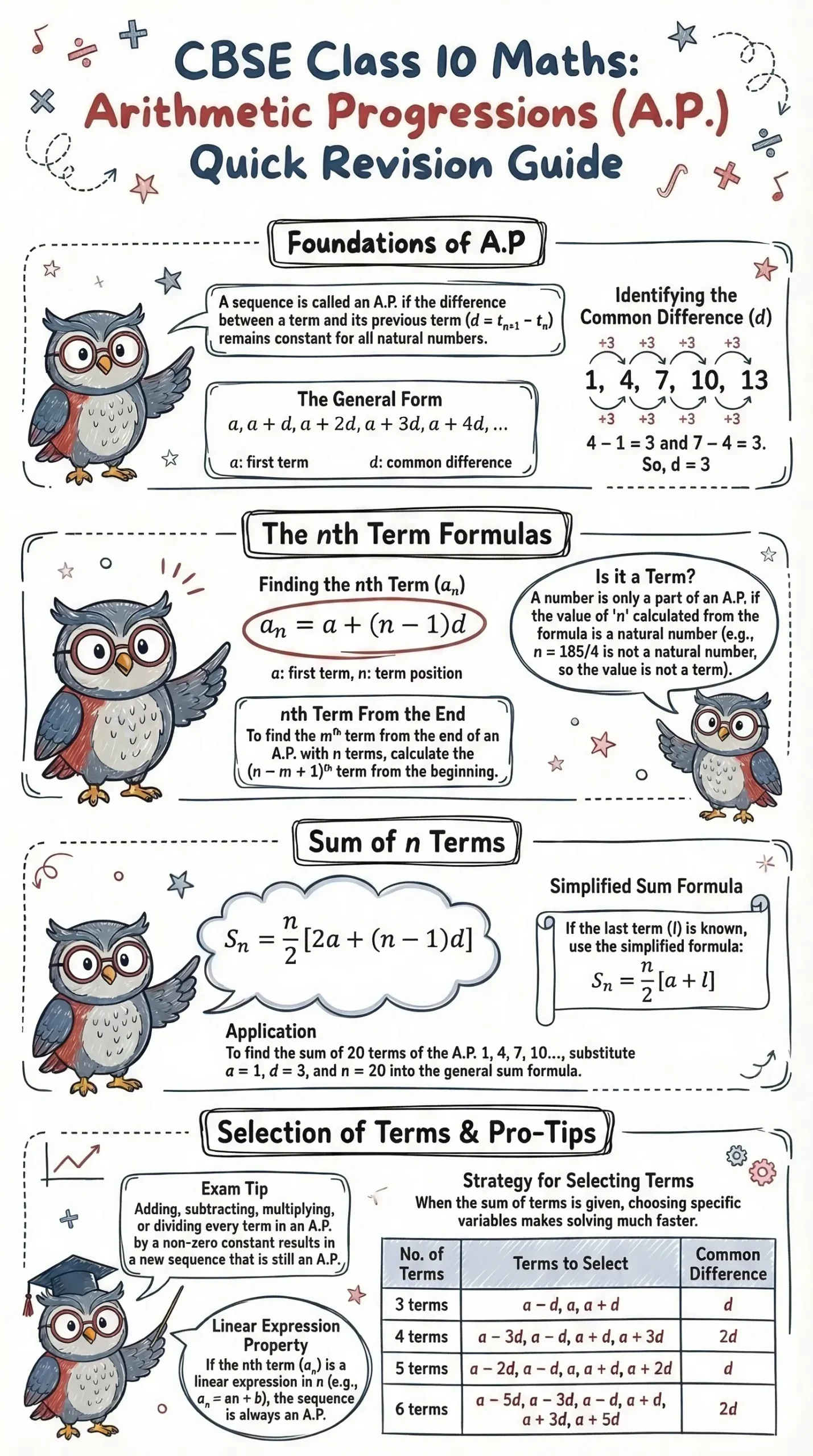
When solving problems involving an unknown AP with a given number of terms, using symmetric representations around a centre term simplifies computation significantly.
| Number of Terms | Representation | Common Difference Used |
|---|---|---|
| 3 terms | a − d, a, a + d | d |
| 4 terms | a − 3d, a − d, a + d, a + 3d | 2d |
| 5 terms | a − 2d, a − d, a, a + d, a + 2d | d |
| 6 terms | a − 5d, a − 3d, a − d, a + d, a + 3d, a + 5d | 2d |
Tip: Using these representations, the sum of terms simplifies beautifully — the d terms cancel, making it easy to find a first
Arithmetic Progression Class 10 Solutions Solved Examples
Example 1: Finding the AP Given the 3rd Term and Condition on 5th and 7th Terms
Problem: Determine the AP whose 3rd term is 16 and the difference of the 5th term from the 7th term is 12.
Solution:
Given: a3 = a + 2d =16 … (i)
a7 − a5 = 12
(a + 6d) − (a + 4d) = 12
2d = 12 ⟹ d = 6
Substituting in (i): a = 16 − 12 = 4
∴ AP is: 4, 10, 16, 22, 28, …
Example 2: Finding Which Term Equals a Given Value
Problem: Which term of the sequence 72, 70, 68, 66, … is 40?
Solution:
a =72, d=70−72=−2
Using an = a + (n−1)d:
40 = 72 + (n−1)(−2)
−32 = −2(n−1)
n − 1 = 16 ⟹ n = 17
∴ The 17th term is 40.
Example 3: Checking if a Number is a Term of an AP
Problem: Is 184 a term of the sequence 3, 7, 11, …?
Solution:
a = 3, d = 4
184 = 3 + (n−1) × 4
181 = 4 (n−1)
n − 1 = 45.25 ⟹ n = 46.25
Since n is not a natural number, 184 is not a term of the given sequence.
Example 4: Sum of Three Numbers in AP
Problem: The sum of three numbers in AP is −3 and their product is 8. Find the numbers.
Solution:
Let the three numbers be a−d, a, a+d.
Sum: (a − d) + a + ( a + d) =−3 ⟹ 3a =−3 ⟹ a=−1
Product: (a − d) ⋅ a ⋅ (a + d) = 8
a(a2 − d2) = 8
(−1) (1 − d2) = 8
d2 = 9 ⟹ d = ±3
∴ The numbers are: −4, −1, 2 or 2, −1, −4
Example 5: Sum of All 3-Digit Numbers Divisible by 7
Problem: Find the sum of all three-digit natural numbers divisible by 7.
Solution:
First term a = 105 (smallest 3-digit multiple of 7), Last term ℓ = 994
994 = 105 + (n − 1) × 7 ⟹ n = 128
S128 = 128/2 (105 + 994) = 64 × 1099 =70,336
Example 6: Proving Properties of AP
Problem: If the pth term of an AP is q and the qth term is p, prove that its nth term is (p + q − n).
Solution:
A + (p − 1) D= q… (i)
A + (q − 1) D = p… (ii)
Subtracting (ii) from (i):
(p − q) D = q − p ⟹ D =−1
Substituting: A = p + q −1
Therefore: an = A + (n−1) D = (p + q − 1) + (n − 1) (−1) = p + q−n
∴ nth term = p + q − n