
Areas Related to Circles Class 10 Maths Notes: The chapter Areas Related to Circles Class 10 Maths Notes is an important part of the CBSE Class 10 Mathematics syllabus. In this chapter, students learn how to calculate different measurements connected to a circle, such as the area of a circle, area of a sector, area of a segment, and area of combinations of circles. These concepts are very useful for solving practical geometry problems and also appear frequently in the CBSE board examination. Therefore, understanding the areas related to circles class 10 topic clearly is very important for exam preparation.
In these Areas Related to Circles Chapter 11 Class 10 Maths Revision Notes, students will find a quick and simple explanation of all key ideas. The notes include important concepts, step-by-step explanations, and the most useful areas related to circles class 10 formulas that help in solving questions faster. These formulas are mainly based on circle geometry, radius, diameter, central angle, and π (pi) value.
These areas related to circles class 10 notes are specially prepared for quick revision before exams. They are part of the CBSE Class 10 notes, which aim to make learning easier with clear explanations and examples. By studying these revision notes, students can quickly recall formulas, understand problem-solving methods, and improve their confidence in geometry topics. Sometimes students feel this chapter is little confusing, but with proper practice it becomes much easier to understand.
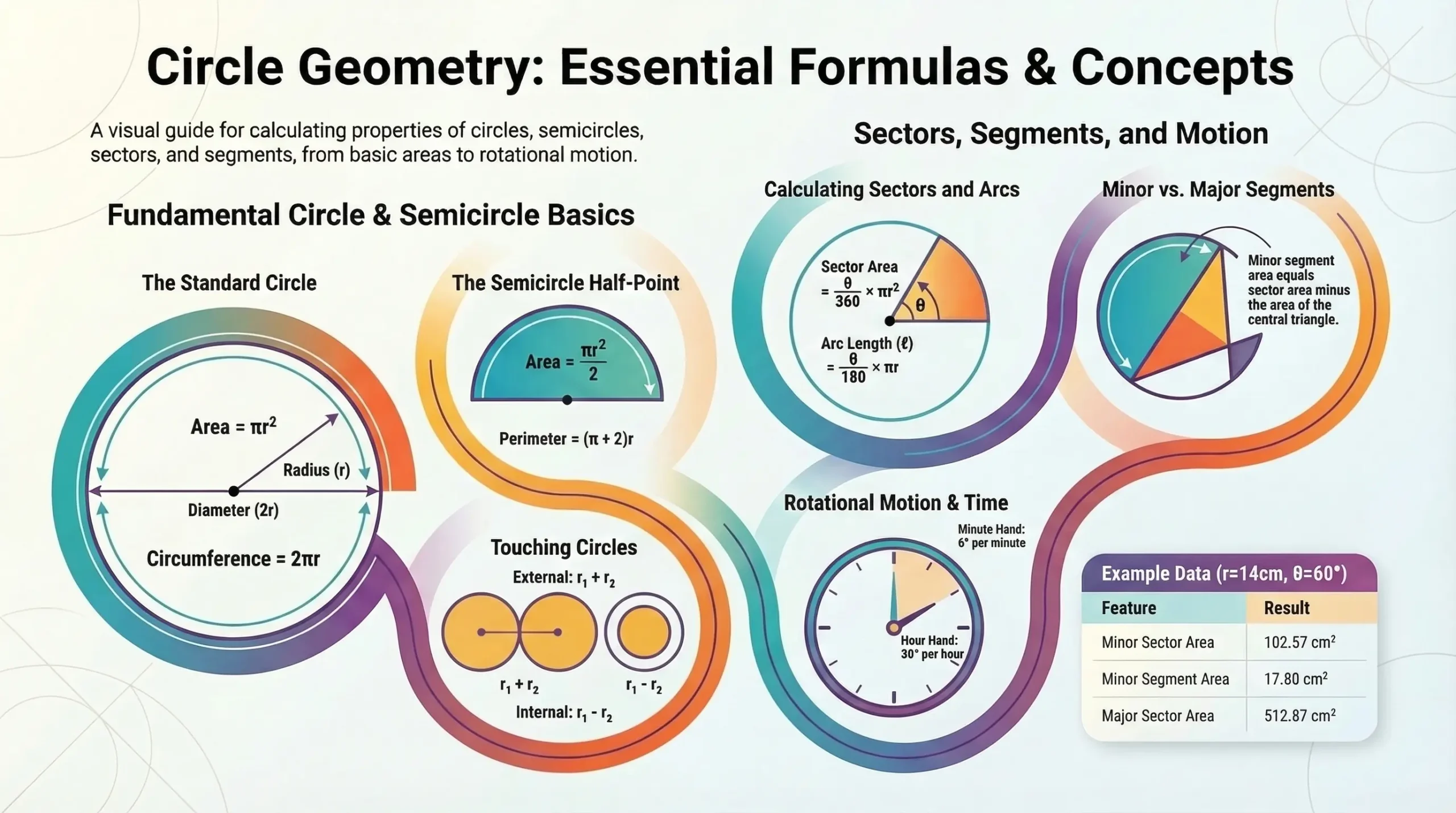
Introduction to Circles
A circle is the locus of a point that moves in a plane such that its distance from a fixed point remains constant. This fixed point is called the center of the circle, and the constant distance is known as the radius.
Main Components of a Circle
- Center (O): The fixed point from which all points on the circle are equidistant
- Radius (r): The distance from the center to any point on the circle
- Diameter (D): The longest chord passing through the center; D = 2r
- Chord: A line segment joining any two points on the circle
- Arc: A continuous piece of the circle
- Circumference: The perimeter or boundary length of the circle
Areas Related to Circles Class 10 Maths Revision Notes PDF Download
Fill the form to download this PDF
Fundamental Circle Formulas
Understanding these fundamental formulas is essential for solving problems related to circles:
1. Area of Circle
A = πr²
Where:
- A = Area of the circle
- r = Radius of the circle
- π ≈ 22/7 or 3.14159
2. Circumference of Circle
C = 2πr
Where:
- C = Circumference (perimeter) of the circle
- r = Radius of the circle
3. Diameter
D = 2r
Where:
- D = Diameter of the circle
- r = Radius of the circle
Relationship: Since D = 2r, we can also write C = πD
Important Results and Properties
Tangent Circles - Internal and External Contact
Understanding how circles interact is crucial for solving complex geometry problems:
1. Circles Touching Internally
When two circles touch internally, they have one common point, and one circle lies inside the other.
Formula: Distance between centers = |r₁ - r₂|
Where r₁ and r₂ are the radii of the two circles.
2. Circles Touching Externally
When two circles touch externally, they have one common point, and both circles lie outside each other.
Formula: Distance between centers = r₁ + r₂
Rotating Wheels and Revolutions
These concepts are frequently used in real-world applications:
3. Distance Covered in One Revolution
Distance = Circumference of the wheel = 2πr
This formula applies to any circular object that completes one full rotation.
4. Number of Revolutions
Number of revolutions = Total distance moved / Circumference
Example Application: If a wheel of radius 14 cm travels 88 km, the number of revolutions can be calculated using this formula.
Clock Hand Movements
Understanding angular displacement helps in time-related problems:
1. Minute Hand Movement
The minute hand of a clock describes an angle of 6° in one minute.
Calculation: 360°/60 minutes = 6° per minute
2. Hour Hand Movement
The hour hand of a clock describes an angle of 30° in one hour.
Calculation: 360°/12 hours = 30° per hour
Semicircle - Area and Perimeter
A semicircle is exactly half of a complete circle, formed by cutting a circle along its diameter.
Formulas for Semicircle
Perimeter of Semicircle
Perimeter = πr + 2r = (π + 2)r
Explanation: The perimeter includes the curved part (half the circumference = πr) plus the straight diameter (2r).
Area of Semicircle
Area = πr²/2
Explanation: Since a semicircle is half of a circle, its area is half of πr².
Visual Representation
The semicircle consists of:
- Curved boundary: πr
- Straight boundary (diameter): 2r
Sector of a Circle
A sector is the region enclosed by two radii and the corresponding arc. Think of it as a "slice of pizza" from a circular pizza.
Types of Sectors
- Minor Sector: The smaller region (when θ < 180°)
- Major Sector: The larger region (when θ > 180°)
Formulas for Sector
Area of Sector
Area = (θ/360°) × πr²
Where:
- θ = Central angle in degrees
- r = Radius of the circle
Alternative Formula:
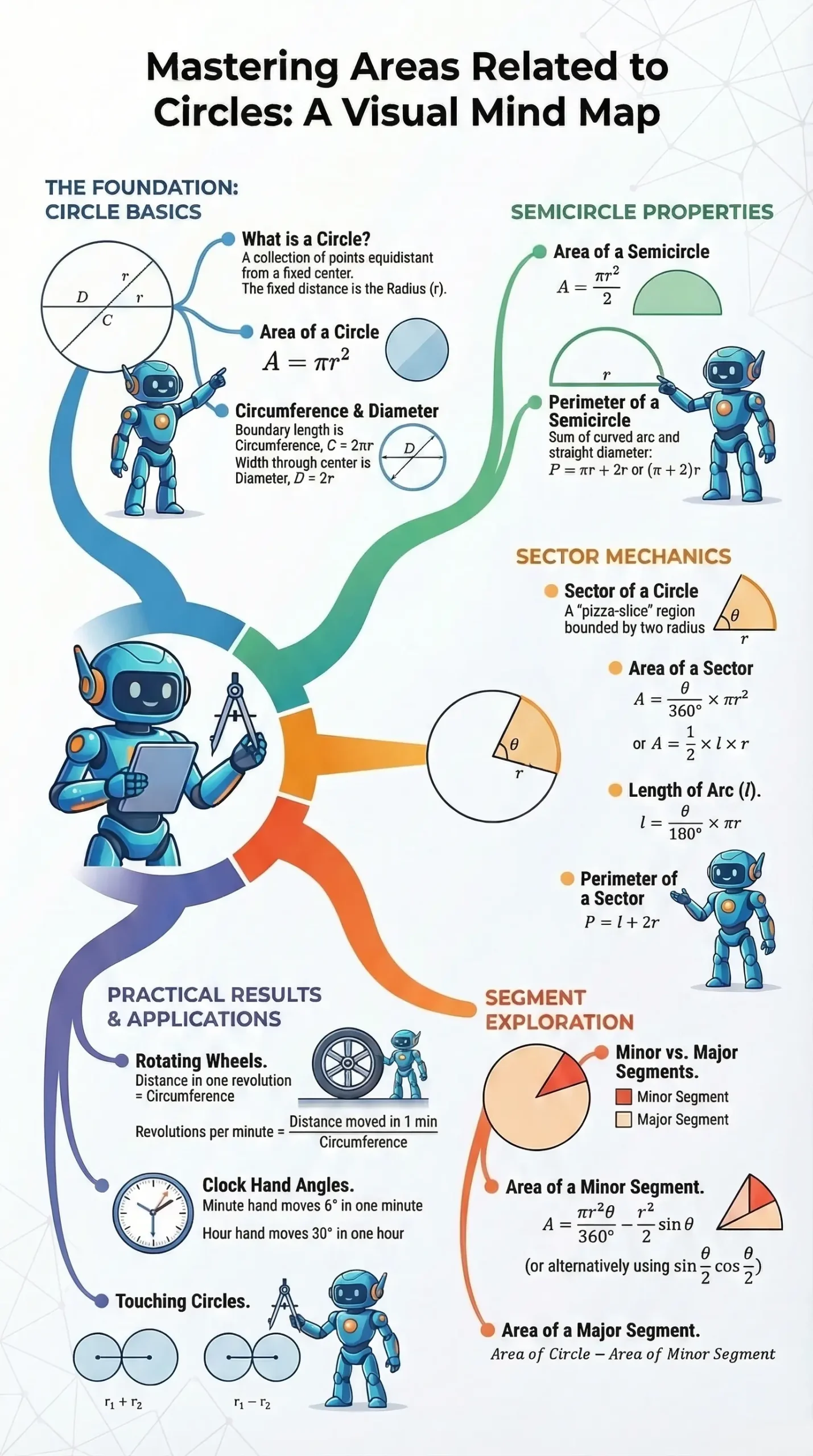
Area = (1/2) × ℓ × r
Where ℓ is the arc length.
Length of Arc
Arc length (ℓ) = (θ/180°) × πr
Simplified:
ℓ = (πrθ)/180°
Perimeter of Sector
Perimeter = ℓ + 2r
The perimeter includes the arc length plus two radii.
Important Note
When the central angle θ = 90°, the sector is called a quadrant (one-fourth of the circle).
Segment of a Circle
A segment is the region enclosed by a chord and the corresponding arc. It's the area "cut off" by a chord.
Types of Segments
- Minor Segment: The smaller region bounded by the chord and minor arc
- Major Segment: The larger region bounded by the chord and major arc
Formula for Segment Area
The area of a segment is calculated by subtracting the triangle area from the sector area:
Area of Minor Segment = Area of Sector - Area of Triangle
Mathematical Expression:
A = (πr²θ/360°) - (r²/2) × sin θ
Alternative Form:
A = (r²/2)[πθ/180° - sin θ]
Where:
- θ = Central angle in degrees
- r = Radius of the circle
Special Case: Semicircular Segment
When θ = 180°, the segment becomes a semicircle, and the area formula simplifies to πr²/2.
Areas Related to Circles Class 10 Maths Solved Examples
Problem: A chord of a circle with radius 14 cm makes an angle of 60° at the center of the circle. Find:
- Area of minor sector
- Area of minor segment
- Area of major sector
- Area of major segment
Solution:
Given:
- Radius (r) = 14 cm
- Central angle (θ) = 60°
(i) Area of Minor Sector OAPB
Area = (θ/360°) × πr² = (60°/360°) × (22/7) × 14 × 14 = (1/6) × (22/7) × 196 = 102.67 cm²
(ii) Area of Minor Segment APB
Area = (πr²θ/360°) - (r²/2) × sin θ = 102.67 - (14 × 14)/2 × sin 60° = 102.67 - 98 × (√3/2) = 102.67 - 84.87 = 17.80 cm²
(iii) Area of Major Sector
Area = Area of circle - Area of minor sector = πr² - 102.67 = (22/7) × 14 × 14 - 102.67 = 616 - 102.67 = 513.33 cm²
(iv) Area of Major Segment AQB
Area = Area of circle - Area of minor segment = 616 - 17.80 = 598.20 cm²
Problem: ABCP is a quadrant of a circle of radius 14 cm. With AC as diameter, a semicircle is drawn. Find the area of the shaded portion.
Solution:
Step 1: Find AC using Pythagorean theorem
In right-angled triangle ABC:
AC² = AB² + BC² AC² = 14² + 14² AC² = 196 + 196 = 392 AC = 14√2 cm
Step 2: Calculate the required area
Required Area = Area of semicircle on AC - Area of segment APC = Area of semicircle - (Area of quadrant - Area of triangle ABC) = (1/2) × π × (14√2/2)² - [(1/4) × π × 14² - (1/2) × 14 × 14] = (1/2) × (22/7) × (7√2)² - [(1/4) × (22/7) × 196 - 98] = (1/2) × (22/7) × 98 - [154 - 98] = 154 - 56 = 98 cm²
Problem: The diameter of a cycle wheel is 28 cm. How many revolutions will it make in moving 13.2 km?
Solution:
Step 1: Calculate distance covered in one revolution
Circumference = πD = (22/7) × 28 = 88 cm
Step 2: Convert total distance to cm
Total distance = 13.2 km = 13.2 × 1000 × 100 cm = 1,320,000 cm
Step 3: Calculate number of revolutions
Number of revolutions = Total distance / Circumference = 1,320,000 / 88 = 15,000 revolutions
Answer: The wheel will make 15,000 revolutions.
Areas Related to Circles Class 10 Maths Practical Applications
Understanding areas related to circles has numerous real-world applications:
1. Engineering and Design
- Calculating material needed for circular components
- Designing gears, wheels, and rotating machinery
- Planning circular gardens or fountains
2. Sports and Recreation
- Marking circular sports fields (discus throw, shot put)
- Calculating area coverage for sprinkler systems
- Designing circular running tracks
3. Architecture
- Planning domes and circular structures
- Calculating window areas in circular or arched designs
- Estimating paint or material requirements
4. Transportation
- Calculating wheel rotations for distance measurement
- Designing circular roads and roundabouts
- Determining gear ratios in machinery
5. Astronomy and Physics
- Calculating planetary orbits
- Understanding circular motion
- Analyzing rotation dynamics
Areas Related to Circles Class 10 Maths Common Mistakes to Avoid
1. Confusing Radius and Diameter
Mistake: Using diameter in place of radius in formulas
Solution: Always identify whether the given measurement is radius or diameter. Remember: D = 2r
2. Incorrect Angle Units
Mistake: Using radians instead of degrees (or vice versa)
Solution: Most Class 10 problems use degrees. Always check the unit specified in the problem.
3. Forgetting to Add All Perimeter Components
Mistake: For sectors or segments, forgetting to add the radii or chord to the arc length
Solution: Perimeter of sector = arc length + 2r (both radii must be included)
4. Sign Errors in Segment Calculations
Mistake: Adding instead of subtracting when calculating segment area
Solution: Remember: Segment area = Sector area - Triangle area
5. Using Wrong Value of π
Mistake: Using π = 3.14 when 22/7 is required (or vice versa)
Solution: Use the value specified in the problem. If not specified, 22/7 is generally preferred for easier calculations.
6. Not Converting Units
Mistake: Mixing different units (cm and m) in the same calculation
Solution: Always convert all measurements to the same unit before calculating.
Areas Related to Circles Class 10 Maths Practice Problems
Test your understanding with these problems:
Basic Level
Find the circumference and area of a circle with radius 7 cm.
A circle has a diameter of 42 cm. Calculate its area and circumference.
Find the perimeter and area of a semicircle with radius 10 cm.
Intermediate Level
A sector of a circle with radius 21 cm has a central angle of 120°. Find:
- Area of the sector
- Length of the arc
- Perimeter of the sector
Two circles of radii 10 cm and 6 cm touch externally. Find the distance between their centers.
A wheel makes 500 revolutions to cover a distance of 1.1 km. Find the diameter of the wheel.
Advanced Level
A chord of length 16 cm is at a distance of 6 cm from the center of a circle. Find the area of the minor segment formed by this chord.
A horse is tied to a pole at one corner of a square-shaped grass field of side 15 m by a rope 7 m long. Find the area of that part of the field in which the horse can graze.
The minute hand of a clock is 12 cm long. Find the area swept by it in 35 minutes.
A circular park has a path of uniform width around it. The difference between the outer and inner circumferences is 132 m. Find the width of the path.