What Is a Physical Wave?
Understanding the Basic Idea of a Wave
In physics, a wave is a disturbance that moves through a medium or space and transfers energy from one place to another. While the energy travels forward, the particles of the medium usually move back and forth around their original position. This back-and-forth motion is called oscillation.
An important point students often miss is that matter itself does not travel with the wave. For example, when a stone falls into water, circular waves spread outward on the surface. The water particles only move slightly up and down, but the energy of the disturbance travels across the water.
We can see many examples of waves in everyday life. Sound waves carry vibrations through air so that we can hear. Water waves move across the surface of lakes and oceans. If a rope or string is shaken, waves on a string travel along its length. Even light waves from the Sun travel through space and reach the Earth.
To understand these waves scientifically, physicists describe them using measurements such as amplitude, wavelength, and frequency. For accurate study and problem-solving, scientists also use a mathematical model or wave representation in physics to show how a wave changes with position and time.
What Is a Sinusoidal Wave in Physics?
Understanding the Shape of a Sinusoidal Wave
A sinusoidal wave in physics is a wave that follows the shape of a smooth sine or cosine curve. When this type of wave is drawn on a graph, it forms a regular pattern of crests and troughs that repeat in a predictable way. This repeating pattern shows that the motion of the wave is periodic, meaning it follows the same cycle again and again.
Many natural vibrations behave in this way. For example, when a stretched string or a tuning fork vibrates, the particles move back and forth in a regular pattern. Because this motion is smooth and repeating, the wave produced by it can be described using sine or cosine functions.
The Sinusoidal Wave Equation
To study this motion scientifically, physicists use a mathematical expression called the sinusoidal wave equation. It shows how the displacement of the wave changes with position and time.
A simplified form of the equation is often written as:
y(x,t) = A sin(kx − ωt + φ)
In this equation:
- Amplitude (A) shows the maximum displacement of the wave from its rest position.
- Wavelength describes the distance between two repeating points of the wave, such as two crests.
- Frequency tells how many oscillations occur in one second.
- Phase (φ) indicates the starting position of the wave in its cycle.
Understanding these quantities helps students answer problems related to wave motion and explains what is a sinusoidal wave in physics in a clear mathematical way.
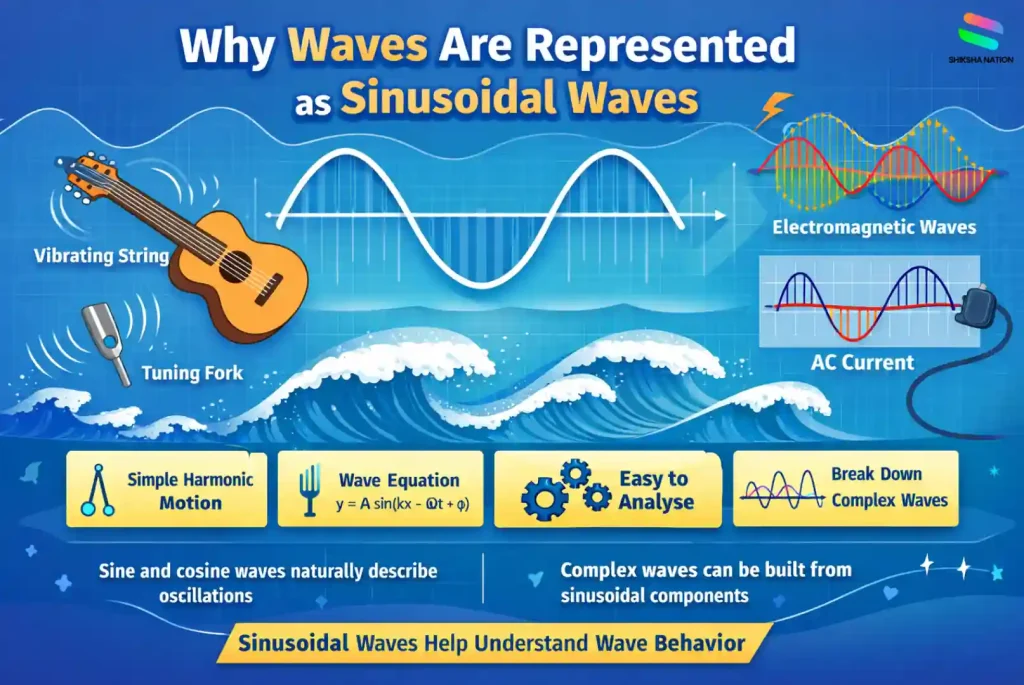
Why Waves Are Represented as Sinusoidal Waves
Physicists often represent waves using sinusoidal curves because this mathematical form naturally describes many systems where particles move in regular oscillatory motion. In such systems, the motion repeats in a predictable pattern, making sinusoidal functions a reliable way to study and calculate wave behaviour.
A sinusoidal model also helps students and researchers analyse wave properties like frequency, wavelength, and amplitude more easily. Instead of dealing with irregular shapes, scientists use this smooth mathematical pattern to understand how waves move and interact.
1. Many Waves Originate from Simple Harmonic Motion
In many physical situations, waves begin with a source that vibrates back and forth around a central position. This type of motion is called simple harmonic motion. When such vibrations spread through a medium, they create waves that naturally follow a sine-like pattern.
For example, when a guitar string is plucked, it starts vibrating regularly. The disturbance travels along the string and produces a wave with a smooth repeating shape. Because the motion of the string is periodic, the resulting wave can be represented using a sinusoidal form.
2. Sinusoidal Functions Match the Wave Equation
Another important reason lies in mathematics. The equation that describes how waves travel through a medium, often called the wave equation, has solutions that follow sine and cosine patterns.
This means that when physicists solve the wave equation, the results naturally produce sinusoidal waves. Using this representation therefore matches the underlying physical laws that govern wave motion.
3. Sinusoidal Waves Are Easy to Analyse Mathematically
Sinusoidal functions have useful mathematical properties. When these functions are differentiated or integrated, they still remain sine or cosine functions. This makes calculations simpler when studying wave motion.
Because of this simplicity, sinusoidal waves help scientists understand important phenomena such as interference, resonance, and superposition. For students preparing for board exams or entrance tests, this mathematical clarity makes problem solving easier.
4. Complex Waves Can Be Built from Sinusoidal Waves
In real life, many waves do not look perfectly smooth. Ocean waves or sound waves may appear irregular. However, an important principle in physics and mathematics shows that any complex periodic wave can be broken into a combination of many sinusoidal waves with different frequencies.
This idea, often explained using Fourier analysis, allows physicists to study complicated wave patterns by analysing simpler sinusoidal components.
Because of these reasons, sinusoidal waves provide a practical and scientifically accurate model for understanding wave motion in physics.
Do Real Physical Waves Always Look Sinusoidal?
Many students assume that real waves in nature always have the same smooth shape shown in textbooks. In reality, this is not always true. Natural waves can look irregular because different disturbances combine and interact with each other.
For example:
- Ocean waves often appear uneven due to wind, tides, and obstacles in water.
- Sound waves from daily activities may contain many mixed vibrations rather than a single smooth pattern.
- Disturbances in real environments rarely remain perfectly uniform.
Because of these factors, the shape of real waves can become complicated.
However, sinusoidal waves are still widely used in physics because they act as idealized models. Scientists use these models to study how waves behave under simple and controlled conditions.
A sinusoidal pattern represents a pure and regular form of periodic motion. By understanding this basic model first, students can later analyse more complex wave patterns.
This is also the reason behind the common question why physical waves are sinusoidal in physics. The sinusoidal form does not mean all waves look exactly like that in nature. Instead, it provides a clear and reliable way to study wave motion and predict how waves will behave in many physical systems.
Examples of Sinusoidal Waves in Physics
Sinusoidal waves are not just theoretical ideas. Students can observe them in many physical systems studied in school physics. These examples help explain how a sine wave in oscillations appears naturally in different situations.
Some common examples include:
- Waves on a stretched string:
When a rope or guitar string is disturbed, the particles move up and down repeatedly. This regular vibration creates a smooth wave pattern that closely follows a sinusoidal shape.
- Sound waves in air:
When objects like speakers, tuning forks, or musical instruments vibrate, they create pressure changes in air. These vibrations often form a periodic motion sine wave that carries sound energy.
- Electromagnetic waves:
Light waves, radio waves, and X-rays are forms of electromagnetic radiation. In many cases, their electric and magnetic fields vary in a sinusoidal pattern as the wave travels through space.
- Alternating current (AC):
In electrical circuits, the voltage and current change direction repeatedly. This variation usually follows a sinusoidal pattern, which helps engineers analyse electrical systems easily.
These examples show that sinusoidal waves appear across many areas of physics and engineering.
Key Takeaways
Understanding wave representation becomes easier when students focus on the basic ideas behind wave motion. The following points summarise the main concepts discussed in this article.
- Waves transfer energy through oscillations.
In most wave phenomena, particles of the medium move back and forth around a fixed position while the energy travels forward.
- Many oscillations follow simple harmonic motion.
Vibrations of strings, tuning forks, and similar systems often produce smooth and repeating motion.
- The wave equation produces sinusoidal solutions.
When physicists solve the mathematical equations describing waves, the results commonly appear in sine or cosine form.
- Sinusoidal waves make analysis easier.
Their regular pattern helps students measure properties like wavelength, frequency, and amplitude clearly.
- Complex waves can be built from sinusoidal components.
This explains why waves are represented as sinusoidal waves when studying wave behaviour in physics.
FAQs on Why Waves Are Represented as Sinusoidal Waves
Q. Why are waves represented by sine functions?
In many physical systems, the motion of particles follows simple harmonic motion, which naturally produces sine or cosine patterns. Because of this, scientists often use sine functions to represent waves. This mathematical form helps describe how wave displacement changes with position and time.
Q. What is a sinusoidal wave in physics?
A sinusoidal wave in physics is a wave that follows the shape of a smooth sine or cosine curve. It has a regular repeating pattern defined by properties such as amplitude, wavelength, frequency, and phase. This type of wave is commonly used to model periodic motion in physics.
Q. Why does simple harmonic motion produce sine waves?
Simple harmonic motion occurs when an object moves back and forth under a restoring force proportional to its displacement. When physicists solve the motion mathematically, the displacement varies in a sine or cosine form. This explains why simple harmonic motion produces a sine wave.
Q. Are all waves sinusoidal?
No. Real waves in nature can be irregular or complex due to multiple disturbances. However, sinusoidal waves are often used as ideal models because they clearly represent periodic motion and make calculations easier.
Q. Why do sine and cosine functions describe waves?
Sine and cosine functions naturally describe repeating patterns. Since many waves involve periodic oscillations, these functions provide a convenient mathematical way to represent wave behaviour.
Q. Why are sine waves used in physics?
Sine waves are widely used because they simplify calculations and help scientists study wave properties like frequency and phase. They also appear as solutions when solving the equations that describe wave motion.
Q. What is the sinusoidal wave equation?
The sinusoidal wave equation describes how a wave changes with position and time. It includes quantities such as amplitude, wavelength, frequency, and phase, which help explain the shape and motion of the wave.
Q. Do real waves always follow perfect sine curves?
In real environments, waves may not always look perfectly smooth. For example, ocean waves or complex sound waves can have irregular shapes. However, sinusoidal waves still provide a useful approximation for analysing many physical systems.
Q. Why are physical waves often described using sinusoidal models?
Physicists use sinusoidal models because they match the mathematics of wave motion and help break complex waves into simpler components. This approach explains why physical waves are sinusoidal in physics when represented in textbooks and equations.