

Introduction
Imagine you’re standing at the entrance of your school. Not everyone can just walk in students with ID cards get through, visitors need permission, and unauthorized people are stopped. Your cell’s plasma membrane works exactly the same way! It’s like a smart security guard that decides what enters and exits the cell.
Understanding why the plasma membrane is called selectively permeable is crucial for Class 9, Class 11 biology, and competitive exams like NEET. This concept explains how cells maintain their internal environment, absorb nutrients, and eliminate waste all essential for life itself.
Table of Contents
- What Is a Selectively Permeable Membrane?
- Why Is the Plasma Membrane Called Selectively Permeable?
- Structure of the Plasma Membrane
- How Does Selective Permeability Work?
- Difference Between Permeable and Selectively Permeable
- Functions of Selective Permeability
- Real-Life Examples
- Common Mistakes Students Make
- Memory Tips
- Conclusion
- FAQs
What Is a Selectively Permeable Membrane?
A selectively permeable membrane is a biological barrier that allows only certain substances to pass through while blocking others.
Key characteristics:
- Permits small molecules like water, oxygen, and carbon dioxide
- Blocks large molecules like proteins and starch
- Controls the movement based on size, charge, and solubility
- Maintains the cell’s internal balance (homeostasis)
Think of it as a filter in your water purifier it lets clean water through but stops impurities.
Why Is the Plasma Membrane Called Selectively Permeable?
The plasma membrane is called selectively permeable because it doesn’t allow all substances to pass freely. It selects what enters and exits based on the cell’s needs.
Reasons for selective permeability:
1. Size-based selection: Small molecules like oxygen and carbon dioxide pass easily, but large molecules like glucose need special transport proteins.
2. Charge-based selection: Charged ions (Na⁺, K⁺, Cl⁻) cannot freely cross the lipid bilayer and require ion channels.
3. Solubility-based selection: Fat-soluble substances pass through the lipid bilayer, while water-soluble substances need protein channels.
4. Cell protection: Prevents harmful substances and toxins from entering the cell.
5. Maintains concentration: Keeps essential nutrients inside and waste products outside.
Structure of the Plasma Membrane
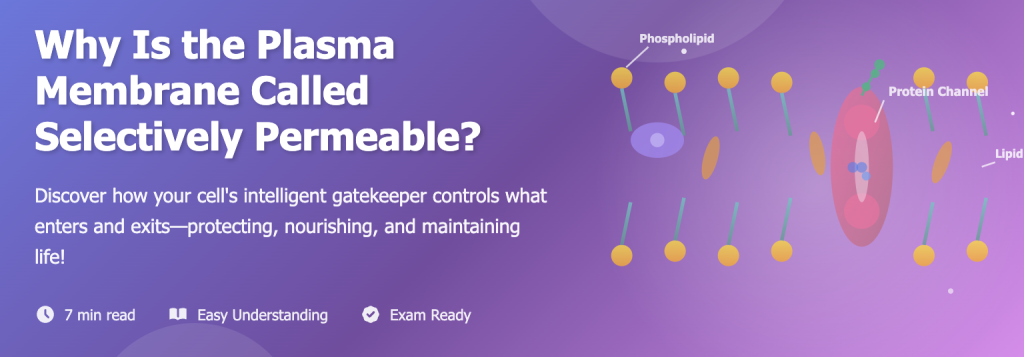
The plasma membrane’s structure explains its selective nature.
Fluid Mosaic Model:
| Component | Function in Permeability |
|---|---|
| Phospholipid bilayer | Forms the basic barrier; hydrophobic core blocks water-soluble substances |
| Proteins | Create channels and carriers for specific molecules |
| Cholesterol | Regulates membrane fluidity and stability |
| Carbohydrates | Help in cell recognition and signaling |
The lipid bilayer is hydrophobic (water-repelling) in the middle, which naturally blocks most water-soluble substances. This is the foundation of selective permeability.
How Does Selective Permeability Work?
The plasma membrane uses different methods to control substance movement:
1. Simple Diffusion
Small, non-polar molecules (O₂, CO₂) pass directly through the lipid bilayer.
2. Facilitated Diffusion
Larger or charged molecules (glucose, amino acids, ions) use protein channels or carriers.
3. Active Transport
Substances move against their concentration gradient using energy (ATP). Example: sodium-potassium pump.
4. Osmosis
Water molecules pass through aquaporins (special water channels).
Classroom analogy: Think of your classroom door (simple diffusion), the window that only opens with a key (facilitated diffusion), and the emergency exit that requires pushing hard (active transport).
Difference Between Permeable and Selectively Permeable
| Feature | Permeable Membrane | Selectively Permeable Membrane |
|---|---|---|
| What passes | All substances | Only specific substances |
| Control | No control | Controlled passage |
| Example | Filter paper, cloth | Plasma membrane, cell wall |
| Function | Simple filtration | Regulates cell environment |
Important for exams: Many students confuse “permeable” with “selectively permeable.” Remember—permeable means everything passes, selectively permeable means the membrane chooses.
Functions of Selective Permeability
1. Nutrient Absorption
Allows glucose, amino acids, and vitamins to enter the cell.
2. Waste Removal
Permits carbon dioxide and other metabolic wastes to exit.
3. Maintains pH and Ion Balance
Controls the concentration of H⁺, Na⁺, K⁺, and Cl⁻ ions.
4. Cell Communication
Allows signaling molecules to bind to receptors.
5. Protection
Blocks toxins, pathogens, and unnecessary substances.
6. Osmotic Balance
Regulates water content to prevent cell bursting or shrinking.
Real-Life Examples
Example 1: Diffusion of Oxygen
When you breathe, oxygen from your lungs diffuses into red blood cells through the plasma membrane. The membrane allows O₂ but blocks larger molecules in the blood.
Example 2: Glucose Absorption
After you eat, glucose from food needs to enter cells for energy. The plasma membrane uses GLUT proteins (glucose transporters) to allow glucose inside—it doesn’t pass freely.
Example 3: Plant Cells and Water
When you water a plant, water enters root cells through osmosis. The plasma membrane controls this flow to prevent the cell from bursting.
Example 4: Nerve Signal Transmission
When you touch something hot, nerve cells rapidly exchange Na⁺ and K⁺ ions through selective channels, creating electrical signals your brain interprets as “hot!”
Common Mistakes Students Make
Mistake 1: Thinking all molecules pass freely
Reality: Only specific small, non-polar molecules pass without help.
Mistake 2: Confusing semi-permeable with selectively permeable
Clarification: Both terms are often used interchangeably, but “selectively permeable” is more accurate as it emphasizes active selection.
Mistake 3: Forgetting about active transport
Remember: Not all movement is passive. Some substances need energy to cross the membrane.
Mistake 4: Assuming the membrane is solid
Truth: The fluid mosaic model shows the membrane is dynamic and fluid, with moving components.
Memory Tips
Acronym: SMART Membrane
- Selects substances
- Maintains balance
- Allows small molecules
- Rejects large molecules
- Transports using proteins
Visual trick: Remember the school gate analogy—students (small molecules) with IDs pass freely, visitors (large molecules) need special permission (proteins), and troublemakers (toxins) are blocked.
Exam tip: When asked “Why is it called selectively permeable?” always mention: (1) allows some substances, (2) blocks others, (3) based on size/charge/solubility.
Conclusion
The plasma membrane is called selectively permeable because it acts as an intelligent gatekeeper for the cell. It allows essential nutrients like oxygen, water, and glucose to enter while keeping harmful substances out and letting waste exit. This selective control is vital for maintaining cell health, enabling proper metabolism, and ensuring survival.
Understanding this concept helps you grasp how cells function, how medicines work, and why osmosis matters in real life—from plant watering to kidney function. Master this topic, and you’ll find cell biology much easier to understand!
Remember: every cell in your body relies on this selective permeability to stay alive and function properly. It’s not just a textbook concept—it’s happening in billions of cells inside you right now!
FAQs on Why Plasma Membrane Is Selectively Permeable
Q. What is a selectively permeable membrane?
A selectively permeable membrane allows only certain substances to pass through based on their size, charge, and solubility, while blocking others. The plasma membrane is the best example, controlling what enters and exits cells to maintain proper cell function.
Q. Why is the plasma membrane permeable?
The plasma membrane is permeable to specific substances because its phospholipid bilayer allows small, non-polar molecules to pass through easily, while protein channels and carriers facilitate the transport of larger or charged molecules that cells need for survival and metabolism.
Q. What is a permeable membrane Class 9th?
In Class 9 biology, a permeable membrane is one that allows all substances to pass through freely without any selection. Examples include filter paper or cellophane. It differs from the selectively permeable plasma membrane, which controls substance passage.
Q. What is the difference between permeable and impermeable?
Permeable membranes allow all substances to pass through freely, while impermeable membranes block all substances completely. Selectively permeable membranes fall in between, allowing only specific substances to cross based on the cell’s requirements and the molecule’s properties.
Q. What is the main function of the plasma membrane?
The main function of the plasma membrane is to regulate what enters and exits the cell, protecting cellular contents while allowing nutrient absorption and waste removal. It maintains homeostasis by controlling ion concentrations, pH levels, and osmotic balance.
Q. Why does the plasma membrane have selective permeability?
The plasma membrane has selective permeability because of its phospholipid bilayer structure and embedded proteins. This design blocks most water-soluble and large molecules while allowing essential small molecules and using protein channels for controlled transport of necessary substances.
Q. Is the plasma membrane only in animals?
No, the plasma membrane is found in all living cells—animal, plant, bacterial, and fungal. All cells need this selectively permeable barrier to separate their internal environment from the outside world and control substance exchange for survival.
Q. What is called cell membrane Class 9?
In Class 9, the cell membrane (or plasma membrane) is defined as the thin, selectively permeable outer boundary of all cells. It separates the cell’s cytoplasm from its external environment and regulates the movement of materials in and out.