

Why Can’t Copper Replace Iron from Its Salt Solution? A Complete Chemistry Guide
Picture this: You’re in your chemistry lab, and your teacher places a shiny copper wire into a beaker containing iron
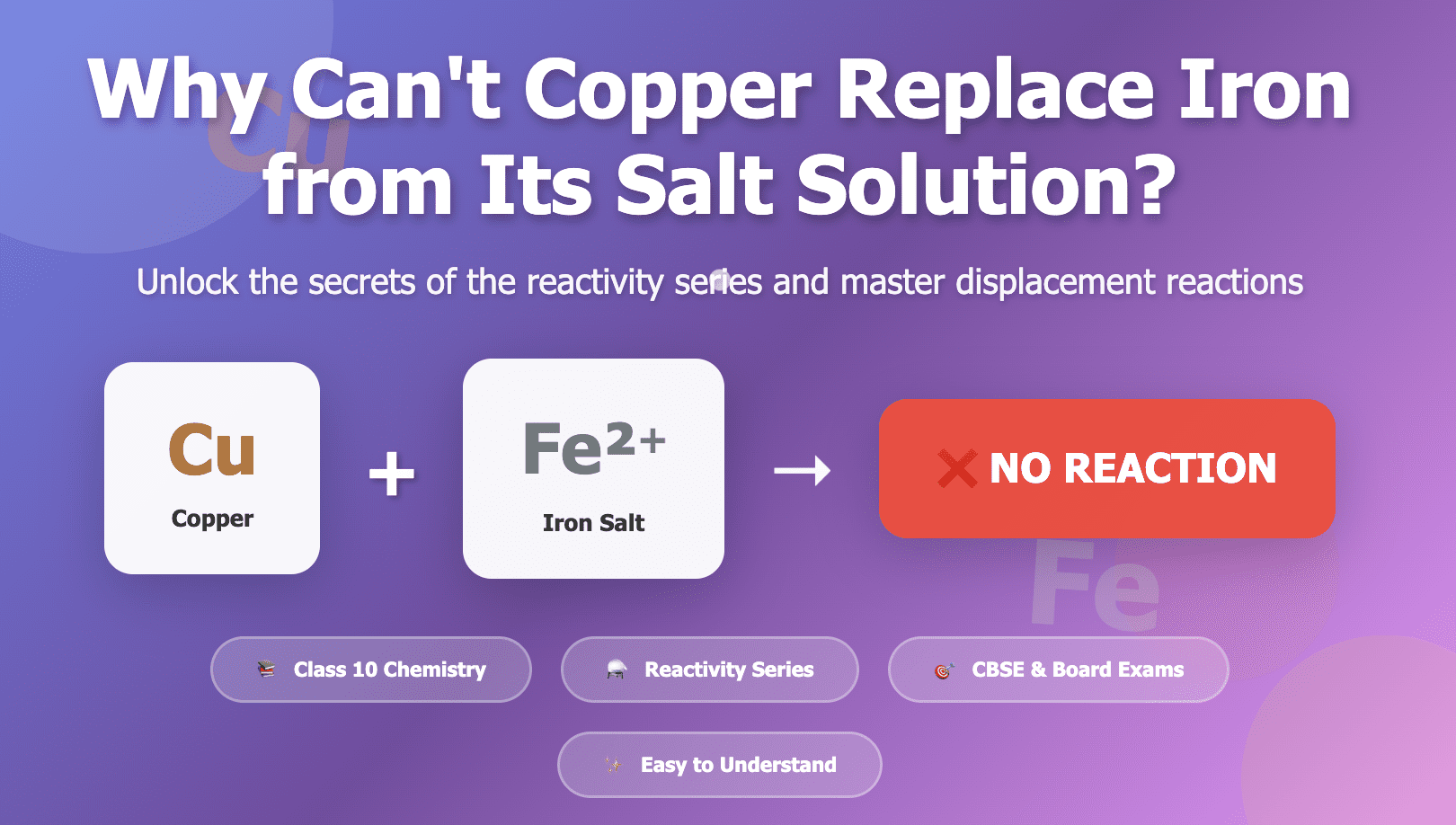
Picture this: You’re in your chemistry lab, and your teacher places a shiny copper wire into a beaker containing iron sulfate solution. Everyone leans in, expecting a reaction. Minutes pass. Nothing happens. Your classmate whispers, “Why isn’t anything changing?”
This simple experiment reveals one of chemistry’s most fundamental principles: the reactivity series. Understanding why copper can’t replace iron from its salt solution isn’t just about passing your exam. It’s about figuring how metals behave, predict chemical reactions, and solve real-world problems. Whether you’re preparing for Class 10 boards, NEET, or JEE, this concept forms the foundation of electrochemistry and metallurgy.
Let’s decode this mystery together.
What is a Displacement Reaction?
A displacement reaction occurs when a more reactive metal replaces a less reactive metal from its salt solution.
General Format:
A + BC → AC + B
Where:
- A = More reactive metal
- BC = Salt solution (compound)
- AC = New salt formed
- B = Displaced metal
Example: When zinc is placed in copper sulfate solution: Zn + CuSO₄ → ZnSO₄ + Cu
The blue color fades, and reddish-brown copper deposits on zinc. This happens because zinc is more reactive than copper.
Main Point: The metal that’s higher in the reactivity series can displace the one that’s lower.
Understanding the Reactivity Series
The reactivity series ranks metals from most reactive to least reactive. Think of it as a power ranking in chemistry.
The Reactivity Series (High to Low):
| Position | Metal | Symbol |
| Most Reactive | Potassium | K |
| ↓ | Sodium | Na |
| ↓ | Calcium | Ca |
| ↓ | Magnesium | Mg |
| ↓ | Aluminium | Al |
| ↓ | Zinc | Zn |
| ↓ | Iron | Fe |
| ↓ | Lead | Pb |
| ↓ | Copper | Cu |
| ↓ | Silver | Ag |
| Least Reactive | Gold | Au |
Memory Trick: Please Send Cats Monkeys And Zebras Into Large Cages Safely Guarded
Notice that iron sits above copper in this series. This positioning is crucial.
Why Copper Cannot Displace Iron
Here’s the answer: Copper is less reactive than iron.
In the reactivity series, iron ranks higher than copper. This means:
- Iron loses electrons more easily than copper
- Iron forms positive ions (Fe²⁺ or Fe³⁺) more readily
- Copper holds onto its electrons more tightly
The Attempted Reaction: Cu + FeSO₄ → No Reaction
Why Nothing Happens:
When you place copper in an iron sulfate solution, copper atoms cannot provide enough chemical force to pull iron ions out of the solution. Iron ions remain bonded to sulfate ions because copper lacks the reactivity to break that bond.
Think of it Like This:
Imagine a tug-of-war. Iron (stronger) holds the rope firmly. Copper (weaker) tries to pull the rope away but doesn’t have enough strength. The rope stays with iron.
The Reverse Works:
Fe + CuSO₄ → FeSO₄ + Cu
When iron is placed in copper sulfate, the blue solution turns greenish, and copper deposits form. Iron successfully displaces copper because it’s more reactive.
Can Copper Displace Other Metals?
Yes! Copper can displace metals that are below it in the reactivity series.
Metals Copper CAN Displace:
- Silver (Ag)
Cu + 2AgNO₃ → Cu(NO₃)₂ + 2Ag
Silver deposits form on copper wire.
- Gold (Au)
Cu + 2AuCl₃ → CuCl₂ + 2AuCl + 2Au
(Under specific conditions)
Metals Copper CANNOT Displace:
- Iron, Zinc, Magnesium, Aluminium, Calcium, Sodium, Potassium
- All metals above copper in the reactivity series
Lab Observation:
Place a copper wire in silver nitrate solution. Within minutes, you’ll see:
- Grayish-silver crystals forming on copper
- Solution turning bluish (copper ions entering solution)
- This confirms copper’s ability to displace silver
Real-Life Examples and Lab Observations
Experiment 1: Copper Wire in Iron Sulfate
Setup: Dip clean copper wire in pale green iron sulfate solution.
Observation: No color change. No coating on copper wire.
Conclusion: No reaction occurs. Copper cannot displace iron.
Experiment 2: Iron Nail in Copper Sulfate
Setup: Place an iron nail in bright blue copper sulfate solution.
Observation:
- Blue color fades gradually
- Solution turns pale green
- Reddish-brown copper coating appears on the nail
Conclusion: Iron successfully displaces copper.
Chemical Equation:
Fe + CuSO₄ → FeSO₄ + Cu
Real-World Application
Metallurgy: This principle helps extract metals from ores. More reactive metals like zinc extract less reactive metals from their compounds.
Electroplating: Understanding which metals can displace others helps in coating processes.
Common Mistakes Students Make
Mistake 1: Confusing the Direction
- Wrong: Copper can displace iron because it’s a better conductor.
- Correct: Reactivity determines displacement, not conductivity.
Mistake 2: Reversing the Reactivity Series
- Wrong: Thinking copper is more reactive because it’s commonly used.
- Correct: Copper’s common use is precisely because it’s less reactive (doesn’t corrode easily).
Mistake 3: Assuming All Metals React Similarly
- Wrong: If zinc displaces copper, copper should displace iron.
- Correct: Each metal has a specific position. You must check the reactivity series.
Mistake 4: Forgetting About Ionic Forms
- Wrong: Writing Cu + Fe → CuFe
- Correct: Always write complete ionic equations with compounds.
Mistake 5: Ignoring Practical Observations
Students sometimes memorize without understanding. Always connect theory with lab results.
Memory Tricks and Exam Tips
The Golden Rule
“More reactive displaces less reactive”
Higher in series → Can displace → Lower in series
Quick Check Method
- Locate both metals in the reactivity series
- The one higher up wins
- It can displace the one below
Exam Strategy
For MCQs:
- Quickly write down the reactivity series
- Mark the positions of both metals
- Apply the displacement rule
For Theory Questions:
- Always mention the reactivity series
- Write the chemical equation
- Explain with observations
- Conclude with the reason
Sample Exam Question
Q: Why doesn’t copper react with iron sulfate solution?
Answer: Copper cannot displace iron from iron sulfate solution because copper is less reactive than iron. In the reactivity series, iron is positioned above copper, which means iron has a greater tendency to lose electrons and form positive ions. Therefore, copper lacks the chemical reactivity required to replace iron ions from the salt solution. The reaction Cu + FeSO₄ → No reaction demonstrates this principle.
Conclusion
Understanding why copper cannot replace iron from its salt solution is more than memorizing a rule it’s about seeing chemistry in action. The reactivity series isn’t just a list- it’s a powerful tool that predicts how metals behave, interact, and react.
Important Note:
- Iron is more reactive than copper in the reactivity series
- Only more reactive metals can displace less reactive ones from solutions
- Copper can displace silver and gold but cannot displace iron, zinc, or magnesium
- Always check the reactivity series position before predicting displacement reactions
This concept appears in board exams, competitive tests, and practical chemistry applications. Master it once, and you’ll confidently solve questions on displacement reactions, electrochemistry, and metallurgy.
Remember: Chemistry isn’t about complicated formulas it’s about understanding patterns. Once you see why copper and iron behave the way they do, a whole world of chemical reactions becomes crystal clear.
Frequently Asked Questions
Can iron displace copper from copper sulfate?+
Yes, iron can displace copper from copper sulfate solution because iron is more reactive than copper. When an iron nail is placed in blue copper sulfate solution, the color fades and copper deposits on the nail, forming iron sulfate.
Which metals can copper displace?+
Copper can displace metals below it in the reactivity series, including silver and gold. For example, when copper is placed in silver nitrate solution, silver metal deposits on the copper surface as copper displaces silver from the solution.
Why is zinc used to galvanize iron?+
Zinc is more reactive than iron and sits above it in the reactivity series. When zinc coats iron, it acts as a sacrificial layer, corroding first and protecting the iron beneath. This prevents rusting and extends the iron’s lifespan significantly.
Does copper react with iron chloride?+
No, copper does not react with iron chloride (FeCl₃ or FeCl₂) because copper is less reactive than iron. The reaction cannot proceed as copper cannot displace iron from its compound. No observable change occurs when copper is added to iron chloride.
Can aluminum displace iron from iron sulfate?+
Yes, aluminum can displace iron from iron sulfate because aluminum is more reactive than iron. The reaction produces aluminum sulfate and metallic iron. However, the aluminum oxide layer on aluminum’s surface may slow down the reaction initially.
Why is the reactivity series important in chemistry?+
The reactivity series helps predict displacement reactions, explains metal extraction methods, determines corrosion behavior, and guides electrochemical cell design. It’s fundamental for understanding redox reactions, metallurgy, and practical applications like metal selection for construction and manufacturing.
What happens when copper is placed in zinc sulfate?+
Nothing happens when copper is placed in zinc sulfate solution because copper is less reactive than zinc. Copper cannot displace zinc from its salt solution. The solution remains colorless and no coating forms on the copper.
Why doesn’t copper corrode as easily as iron?+
Copper is less reactive than iron in the reactivity series, meaning it has less tendency to lose electrons and form ions. This lower reactivity makes copper more resistant to oxidation and corrosion, which is why copper is used for water pipes and electrical wiring.