

Introduction
Imagine you’re pushing your heavy school bag across the classroom floor. At first, it doesn’t budge. You push harder still nothing. Then suddenly, with one more push, it starts sliding. But here’s the interesting question: what if the floor itself is moving, like standing on a bus or train? How fast can that floor move before your bag starts slipping?
This fascinating physics problem helps us understand static friction, relative motion, and why objects stay put or suddenly start moving. Whether you’re preparing for board exams, competitive tests, or just curious about everyday physics, this concept connects classroom learning with real-world experiences.
Understanding the Core Question
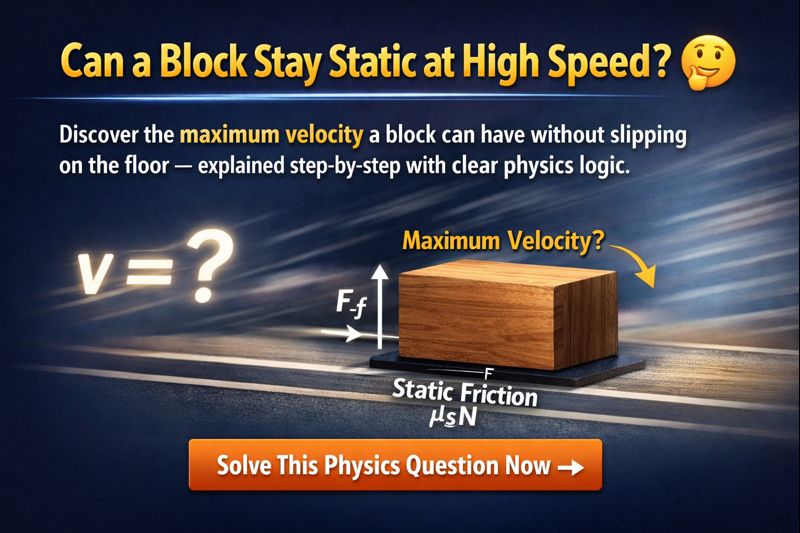
What does “maximum velocity while remaining static” mean?
This phrase sounds contradictory at first. How can something have velocity and still be static?
The answer lies in relative motion. The block is static relative to the floor, meaning it’s not sliding across the floor. But the floor itself can be moving like when you’re standing in a moving vehicle.
The maximum velocity refers to the fastest speed the floor can reach while the block still stays in place without slipping.
What Does “Static” Actually Mean?
In physics, “static” means:
- No relative motion between two surfaces in contact
- The object and surface move together as one unit
- Static friction keeps them locked together
Example: When you stand on a bus, you’re static relative to the bus floor. You and the bus move together. But if the bus brakes suddenly, you might slide forward you’re no longer static.
The Physics Behind Maximum Velocity
The maximum velocity depends on the acceleration of the floor, not velocity itself.
Here’s why: An object can move at any constant velocity and remain static on the floor. Even at 100 km/h, if the speed is constant, everything stays in place.
The critical factor is acceleration or deceleration.
When the floor accelerates or decelerates beyond a certain limit, static friction can’t hold the block anymore, and it starts slipping.
Main Concepts: Static Friction and Relative Motion
Static Friction (fs)
Static friction is the force that prevents two surfaces from sliding past each other.
Formula:
- Maximum static friction: fs(max) = μs × N
- μs = coefficient of static friction
- N = normal force (usually equal to mg for horizontal surfaces)
The Limiting Condition
The block remains static when: Required force ≤ Maximum static friction
For a block on an accelerating floor: ma ≤ μs × mg
Simplifying: a ≤ μs × g
This gives us the maximum acceleration, not velocity.
Mathematical Formula and Calculation
Maximum Acceleration Formula
a(max) = μs × g
Where:
- a(max) = maximum acceleration before slipping occurs
- μs = coefficient of static friction
- g = acceleration due to gravity (9.8 m/s²)
Important Clarification
There is no theoretical maximum velocity for constant motion. The block can move at any speed as long as acceleration stays within limits.
Maximum velocity becomes relevant when:
- The floor must stop within a certain distance
- The floor is moving in a circular path (centripetal acceleration)
- There’s a time constraint for acceleration
Example Calculation
Given: A block rests on a floor with μs = 0.4
Find: Maximum acceleration before slipping
Solution:
- a(max) = μs × g
- a(max) = 0.4 × 9.8
- a(max) = 3.92 m/s²
Real-Life Examples from Student Experience
Example 1: School Bus Scenario
You’re sitting on a school bus with your water bottle on the seat beside you.
- Constant speed: Bottle stays in place at any velocity
- Bus accelerates: Bottle remains static if acceleration < μs × g
- Sudden braking: If deceleration > μs × g, bottle slides forward
Example 2: Laboratory Experiment
In physics lab, a block sits on a horizontal platform that can be tilted or accelerated.
Setup: Block with mass 2 kg, μs = 0.5
Question: Maximum acceleration of platform?
Answer: a(max) = 0.5 × 9.8 = 4.9 m/s²
Example 3: Books on Car Dashboard
When parents drive with books on the car dashboard:
- Smooth acceleration: Books stay put
- Hard braking: Books slide off
The coefficient of friction between book and dashboard determines the critical acceleration.
Common Mistakes Students Make
Mistake 1: Confusing Velocity with Acceleration
Wrong thinking: “Maximum velocity means the block will slip at high speeds”
Correct concept: Maximum acceleration determines slipping, not velocity itself
Mistake 2: Ignoring the Word “Static”
Students sometimes calculate kinetic friction instead of static friction.
Remember: Static friction applies when there’s no relative motion (no slipping)
Mistake 3: Forgetting Direction
Friction always opposes the tendency to move, not actual motion.
When a floor accelerates forward, friction acts forward on the block to prevent backward slipping.
Mistake 4: Wrong Formula Application
Wrong: Using fs = μs × N as the actual friction force
Correct: fs ≤ μs × N (inequality showing maximum possible value)
Mistake 5: Neglecting Reference Frame
The block is static relative to the floor, not relative to an outside observer.
Easy Tricks to Remember This Concept
Memory Trick 1: “No Speed Limit, But Acceleration Has One”
For constant velocity → no slipping at any speed
For changing velocity → friction has limits
Memory Trick 2: “SAME Movement = Static”
Surface And Mass move Equally = Static condition
Memory Trick 3: The Formula Triangle
 a(max)
 /\
 / \
 /____\
 μs × g
Cover what you need to find, multiply the other two.
Memory Trick 4: “Friction Fights Change”
Static friction prevents relative motion changes. The harder the change (acceleration), the stronger friction must be.
Practice Problems with Solutions
Problem 1
A block of mass 5 kg rests on a floor with μs = 0.3. What is the maximum acceleration the floor can have?
Solution:
- a(max) = μs × g = 0.3 × 9.8 = 2.94 m/s²
Problem 2
If a truck accelerates at 4 m/s², what minimum coefficient of friction is needed to keep a box from sliding?
Solution:
- a = μs × g
- 4 = μs × 9.8
- μs = 4/9.8 = 0.408
Problem 3
Can a block remain static on a floor moving at 50 m/s if μs = 0.5?
Solution: Yes, as long as velocity is constant. Speed doesn’t matter—only acceleration does.
FAQs on What Is the Maximum Velocity a Block Can Have While Remaining Static on the Floor
Q. Can a block have maximum velocity while being static?
A block can move at any constant velocity while remaining static on the floor. The “maximum velocity” concept applies when there’s a constraint on acceleration or when motion involves curves.
Q. What determines the maximum acceleration before slipping?
The coefficient of static friction (μs) and gravitational acceleration (g) determine maximum acceleration. The formula is a(max) = μs × g, which gives the threshold before slipping occurs.
Q. Does the mass of the block affect maximum velocity?
No, mass cancels out in the equation. Maximum acceleration (a(max) = μs × g) is independent of mass. However, heavier blocks have more friction force in absolute terms.
Q. What happens if acceleration exceeds the maximum value?
The block starts slipping across the floor. Static friction can no longer hold it, and kinetic friction takes over, which is usually weaker than static friction.
Q. How is this concept used in real vehicles?
This principle explains why passengers lurch forward during sudden braking. Vehicle safety systems calculate maximum safe acceleration/deceleration based on typical friction coefficients to prevent objects from sliding.
Q. What’s the difference between static and kinetic friction here?
Static friction prevents slipping when surfaces move together. Once slipping begins, kinetic friction takes over. Static friction is generally higher, which is why starting to slide requires more force.
Q. Can friction increase the maximum velocity?
Higher friction increases maximum allowable acceleration, which can help reach higher velocities faster. But constant velocity itself isn’t limited by friction—only acceleration is.
Q. Why do exam questions often mention “maximum velocity”?
Exam questions use this phrasing to test understanding of relative motion and acceleration limits. They often involve scenarios where velocity must increase within constraints, requiring calculation of friction-based limits.
Conclusion
Understanding the maximum velocity a block can have while remaining static teaches us fundamental physics principles that apply far beyond textbooks.
Note:
- Static means no relative motion between surfaces
- Constant velocity doesn’t cause slipping—acceleration does
- Maximum acceleration before slipping: a(max) = μs × g
- Mass doesn’t affect the acceleration limit
- Real-world applications include vehicle safety and everyday object stability
This concept bridges theoretical physics with practical experience. Every time you ride in a vehicle, carry objects on a tray, or observe items staying put despite motion, you’re witnessing these principles in action.
Master this topic, and you’ll not only ace your physics exam but also understand the invisible forces shaping motion all around you. Keep practicing with different scenarios, and soon this concept will become second nature!