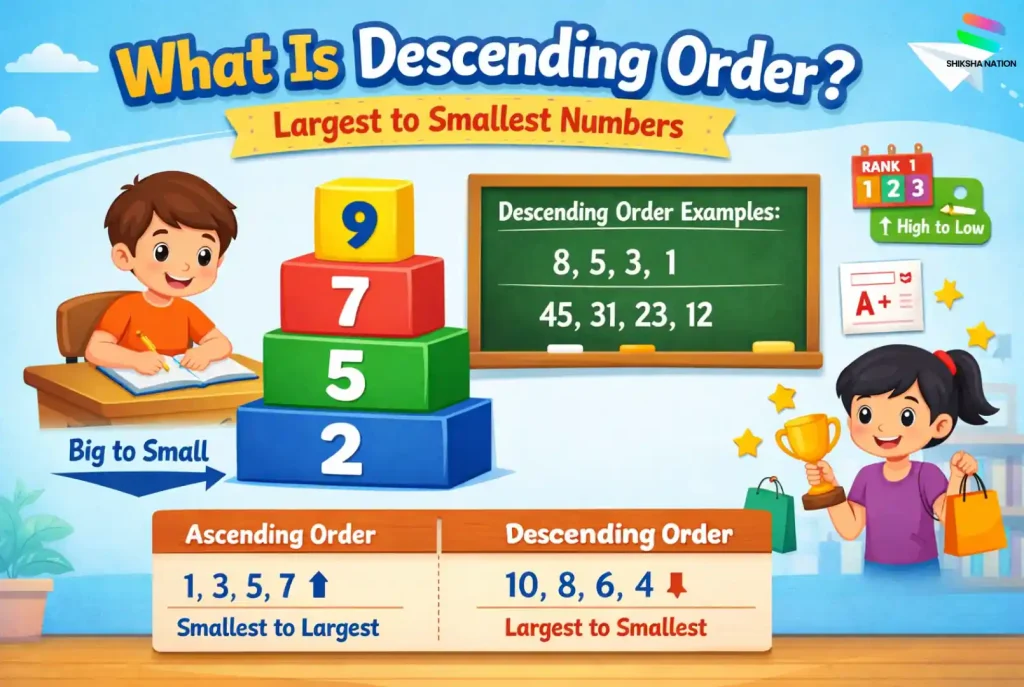
Descending Order Meaning in Maths
The descending order meaning in maths is simple. It refers to arranging numbers from the largest value to the smallest value. When numbers are written in this order, each number is smaller than the number before it.
In basic maths learning, understanding the descending order in maths helps students compare numbers easily. It also improves number recognition and place value understanding, which is important for early classes.
Descending Order Definition
The descending order definition is the arrangement of numbers from the greatest number to the least number.
In simple terms, the numbers move in this pattern:
Largest → Smaller → Smallest
Example:
9, 7, 5, 2
Here, the numbers start from the biggest value and gradually decrease.
Decreasing Order Meaning
Another name for descending order is decreasing order. The decreasing order meaning is the same — numbers reduce in value step by step.
Teachers often use both terms in maths lessons, so students should know that descending order and decreasing order refer to the same concept. Understanding this makes it easier for students to follow instructions in worksheets and homework questions.
Simple Descending Order Examples for Students
Understanding a descending order example becomes easier when students practice with real numbers. In maths, we arrange the largest number first and the smallest number last. These descending order examples for students help children clearly see how numbers decrease step by step.
Parents and teachers often encourage students to first identify the biggest number, then continue arranging the remaining numbers in descending order.
Example 1: Basic Numbers
Let us look at a simple set of numbers.
Numbers:
7, 2, 9, 5
Step 1: Identify the largest number → 9
Step 2: Next largest → 7
Step 3: Next → 5
Step 4: Smallest → 2
Descending order of numbers:
9, 7, 5, 2
This type of example helps young students quickly understand how numbers decrease.
Example 2: Two-Digit Numbers
Now let’s try a slightly bigger set.
Numbers:
12, 45, 23, 31
First, find the largest number → 45
Next → 31
Then → 23
Finally → 12
Numbers in descending order:
45, 31, 23, 12
This exercise helps students compare two-digit numbers correctly.
Example 3: Descending Order Numbers 1 to 100
Descending order can also be applied to a larger sequence of numbers.
Example sequence:
100, 99, 98, 97, 96, 95…
Here, the numbers gradually decrease by one. Practicing such patterns helps students recognise the descending order of numbers quickly in worksheets and classroom activities.
How to Arrange Numbers in Descending Order
Students often learn how to arrange numbers in descending order during early maths lessons. The idea is simple: write the numbers from largest to smallest numbers. When students follow a clear method, it becomes much easier to arrange in descending order correctly.
Teachers usually suggest looking for the biggest number first, and then arranging the remaining numbers step by step. Parents can also guide children to compare numbers carefully before writing the final order.
Step 1: Find the Largest Number
Look at all the numbers in the list.
- Identify the biggest number among them.
• This number will come first in descending order.
Step 2: Write It First
Once the largest number is found:
- Write it at the beginning of the sequence.
• Remove that number from the list and focus on the remaining numbers.
Step 3: Find the Next Largest Number
From the remaining numbers:
- Identify the next biggest number.
• Place it after the first number.
Step 4: Continue Until All Numbers Are Arranged
Repeat the same process until every number is written.
In the end, the numbers will appear from largest to smallest.
Example: Step-by-Step Solution
Numbers:
14, 6, 21, 9
Step 1: Largest number → 21
Step 2: Next largest → 14
Step 3: Next → 9
Step 4: Smallest → 6
Final answer:
21, 14, 9, 6
By practicing this method regularly, students can quickly learn to arrange numbers correctly in descending order.
Descending Order Symbol in Maths
In maths, we often use a special sign to show numbers arranged from bigger to smaller. The descending order symbol commonly used is the greater than symbol ( > ). This sign helps students quickly understand which number has a higher value.
Teachers introduce this symbol in early classes so students can easily compare numbers while solving questions.
Understanding the Greater Than Symbol (>)
The greater than symbol ( > ) means the number on the left is larger than the number on the right.
Example:
8 > 5 > 3 > 1
This shows a descending order of numbers. Each number is greater than the number that comes after it.
For students, a simple way to check is to read it from left to right. If every number is bigger than the next one, the numbers are correctly written in descending order.
What Is Ascending Order and Descending Order?
Many students learn ascending and descending order together because both concepts explain how numbers are arranged. Understanding what is ascending order and descending order helps children compare numbers and organise them correctly in maths exercises.
In simple terms, ascending order means arranging numbers from the smallest to the largest, while descending order means writing numbers from the largest to the smallest. Teachers often use both methods in classroom practice so students can understand number patterns better.
For parents helping with homework, remembering this simple rule makes it easier to guide children during practice.
Ascending vs Descending Order
The main difference between ascending vs descending order is the direction in which numbers are arranged.
| Order Type |
Meaning |
Example |
| Ascending Order |
Numbers arranged from smallest to largest |
2, 4, 6, 8 |
| Descending Order |
Numbers arranged from largest to smallest |
8, 6, 4, 2 |
So, when students are asked what is descending order and ascending order, they simply need to check whether the numbers are increasing or decreasing in value.
Descending Order Examples for Class 1 Students
Learning descending order for class 1 becomes easier when students practice with small and simple numbers. At this stage, children are just beginning to compare numbers, so starting with basic examples helps them understand how descending order numbers work.
Students should first look for the biggest number, write it first, and then arrange the remaining numbers from bigger to smaller.
Example 1
Numbers:
5, 1, 3
Step 1: Largest number → 5
Step 2: Next number → 3
Step 3: Smallest number → 1
Answer:
5, 3, 1
Example 2
Numbers:
10, 8, 6, 2
Here, the numbers are already arranged from biggest to smallest.
Descending order:
10, 8, 6, 2
Parents and teachers can encourage children to practice with similar number sets so they gain confidence in arranging numbers correctly.
Practice Questions (Descending Order Worksheet)
Practising with simple exercises helps students understand how to arrange in descending order without confusion. A short descending order worksheet can help children apply what they learned in class.
Try solving these questions:
Arrange in descending order
- 3, 9, 5
- 12, 7, 15
- 21, 19, 24
Students should first identify the largest number and then write the rest in decreasing order.
Answers
- 9, 5, 3
- 15, 12, 7
- 24, 21, 19
Regular practice like this helps students quickly recognise number patterns and improve their basic maths skills.
Real Life Examples of Descending Order
Students often understand maths concepts better when they see them in daily life. Descending order numbers are used in many real situations where values are arranged from higher to lower.
Some common examples include:
- Exam ranks: Students are listed from highest marks to lowest marks.
• Shopping filters: Many websites show products from price high to low.
• Game leaderboards: Players with the highest scores appear at the top.
These examples help students see how descending order works outside the classroom. For parents and teachers, connecting maths concepts with real-life situations makes learning easier and more meaningful for children.
Common Mistakes Students Make
While learning descending order, students sometimes make small mistakes. Understanding these errors can help them avoid confusion during practice.
Mistake 1: Confusing Ascending and Descending Order
Some students mix up the two concepts and arrange numbers from smallest to largest instead of largest to smallest.
Mistake 2: Writing the Smallest Number First
Children may quickly pick a number without checking which one is the biggest.
Mistake 3: Ignoring Place Value in Large Numbers
When numbers have two or three digits, students may not compare the tens or hundreds place correctly.
Parents and teachers can help by asking students to identify the largest number first before arranging the list.
FAQs About Descending Order
Q. What is descending order in maths?
Descending order in maths means arranging numbers from the largest value to the smallest value. The biggest number comes first, and the smallest number comes last. This concept helps students compare numbers and understand which number has a greater value.
Q. What is an example of descending order?
A simple example of descending order is arranging the numbers 8, 3, 6, and 1.
When arranged from largest to smallest, the correct order becomes 8, 6, 3, 1. This shows how numbers gradually decrease.
Q. What is the symbol used in descending order?
The greater than symbol ( > ) is commonly used to show descending order.
For example: 9 > 7 > 4 > 2. This means each number is greater than the number that comes after it.
Q. What is the difference between ascending and descending order?
In ascending order, numbers are arranged from the smallest to the largest.
In descending order, numbers are arranged from the largest to the smallest.
For example:
Ascending → 2, 4, 6, 8
Descending → 8, 6, 4, 2
Q. How do you arrange numbers in descending order?
To arrange numbers in descending order, first identify the largest number in the list. Write it first, then find the next largest number and place it after it. Continue this process until all numbers are arranged from biggest to smallest.
Q. What are descending order numbers?
Descending order numbers are numbers written in a sequence where each number is smaller than the one before it. For example: 20, 15, 10, 5. The values decrease as we move from left to right.
Q. Is descending order the same as decreasing order?
Yes, descending order and decreasing order mean the same thing. Both describe numbers arranged from greater value to smaller value. Teachers may use either term while explaining number arrangements in maths.
Q. Why do students learn descending order in early classes?
Students learn descending order in primary classes because it helps them compare numbers, understand place value, and organise numbers correctly. It is also useful for solving maths worksheets and basic number exercises.