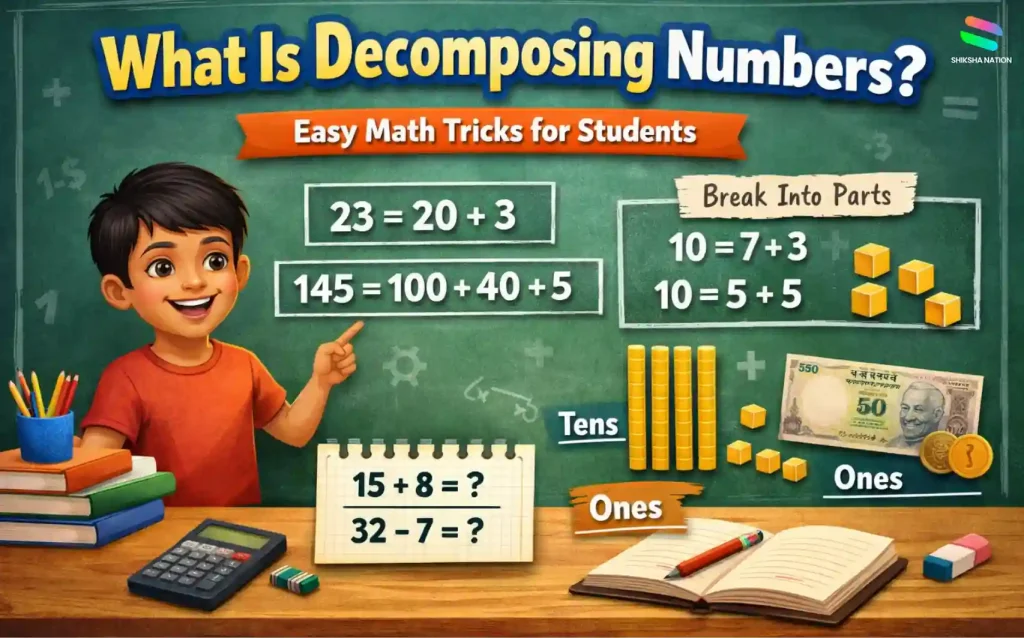
How to Decompose a Number (Step-by-Step Method)
If you are confused about how to decompose a number, don’t worry. The process is simple once you understand the steps. It mainly depends on place value, which tells us the value of each digit in a number.
Step 1 – Identify Place Value
First, look at each digit and its position.
- In 23 → 2 is in tens place, 3 is in ones
- In 106 → 1 is hundreds, 0 is tens, 6 is ones
This step builds clarity before breaking the number.
Step 2 – Break into Tens and Ones
Now split the number based on tens and ones (and hundreds if needed).
- 23 → 20 + 3
- 45 → 40 + 5
- 106 → 100 + 0 + 6
This makes numbers easier to understand and use.
Step 3 – Write in Expanded Form
Finally, write the number in expanded form.
- 23 = 20 + 3
- 45 = 40 + 5
- 106 = 100 + 0 + 6
For students: This helps in solving sums faster.
For parents: It shows whether the child truly understands numbers, not just reads them.
Decomposing Numbers Examples (Easy to Understand)
The best way to learn is by seeing decomposing numbers examples. Once students practice a few cases, the idea of number splitting becomes very clear and natural.
Example 1 – Two-digit Number
Let’s take a simple number: 34
- Break it as: 30 + 4
- Here, 30 is tens and 4 is ones
Another example:
For students, this helps in quick calculations. Parents can check if the child understands each part correctly.
Example 2 – Three-digit Number
Now take a bigger number: 245
- Break it as: 200 + 40 + 5
Another example:
Here, we are splitting the number into hundreds, tens, and ones.
Example 3 – Multiple Ways to Decompose
A number can be broken in more than one way. This is where real understanding comes.
Take 10:
- 10 = 7 + 3
- 10 = 5 + 5
- 10 = 6 + 4
This flexibility improves thinking and problem-solving.
For students, this is useful in mental maths. For parents, it shows the child is not just memorising but actually understanding numbers.
Decomposing Numbers for Class 2 and 3 (Why It Matters)
For students in early classes, decomposing numbers for class 2 and class 3 is not just a topic – it is a base for many future chapters. Schools focus on this to build strong understanding from the beginning.
This concept connects directly with basic maths concepts taught in NCERT and school books.
How It Helps in Learning Maths
- Addition:
Students can break numbers to add faster (like making 10 first)
- Subtraction:
Helps in solving questions step by step instead of confusion
- Place Value:
Makes it clear how numbers are formed (tens, ones)
For students: It improves confidence while solving sums.
For parents: It builds strong number sense, which is more important than just getting answers right.
When this concept is clear, higher maths becomes much easier.
How Decomposing Helps in Addition and Subtraction
Decomposing numbers is not just a concept – it is a practical addition strategy and a useful mental maths method. When students learn to break a number into parts in maths, calculations become faster and easier to manage.
Using Decomposition in Addition
Let’s understand with an example:
Instead of adding directly, break 8 into parts:
Now solve step by step:
- (15 + 5) = 20
- 20 + 3 = 23
This method helps students reach round numbers first, which makes addition simple.
Using Decomposition in Subtraction
Now take a subtraction example:
Break 7 into smaller parts:
Now solve:
This avoids confusion and reduces mistakes.
For students, this approach makes calculations quicker without stress.
For parents, it shows the child is using logic instead of memorising steps.
With practice, this method becomes natural and improves overall speed in exams.
Decomposing Numbers Using Place Value (Core Concept)
Understanding decomposing numbers using place value is the key to mastering this topic. Every number is made using positions like tens, ones, and hundreds. When students see this clearly, maths becomes much easier.
Place value tells us what each digit actually means.
- Example: 47
- 4 tens = 40
- 7 ones = 7
- So, 47 = 40 + 7
- Example: 326
- 3 hundreds = 300
- 2 tens = 20
- 6 ones = 6
This way of writing numbers is called expanded form.
For students: It helps in understanding numbers deeply, not just reading them.
For parents: It ensures the child is learning the logic behind numbers.
When place value is clear, decomposition becomes simple and natural.
Common Mistakes Students Make While Decomposing Numbers
Many students understand the idea but still make small mistakes. These errors can affect overall understanding.
Common Errors to Watch
- Mixing place values:
Writing 45 as 4 + 5 instead of 40 + 5
- Wrong splitting:
Breaking numbers randomly without logic
- Ignoring flexibility:
Thinking there is only one correct way to split a number
For students: Focus on understanding, not just writing answers.
For parents: Check how the child is thinking, not just the final answer.
Avoiding these mistakes improves accuracy and confidence.
Quick Tips to Understand Decomposition Faster
Learning decomposition becomes easy with simple daily practice.
Easy Tips for Students
- Use real objects:
Count coins, pencils, or erasers and split them
- Practice number bonds:
Break numbers in different ways regularly
- Think in parts:
Always ask: “How can I split this number?”
These small habits improve speed and clarity over time.
FAQs about Decomposing Numbers
Q. What is decomposing numbers in simple words?
Decomposing numbers means breaking a number into smaller parts to understand it better. For example, 25 can be written as 20 + 5. If you’re wondering what is decomposing numbers, it simply means splitting a number into easier parts.
Q. How do you decompose numbers step by step?
To understand how to decompose a number, follow these steps:
First, identify the place value (tens, ones, hundreds).
Then, break the number into parts.
Finally, write it in expanded form like 34 = 30 + 4.
Q. What is an example of decomposing numbers?
One of the easiest decomposing numbers examples is:
45 = 40 + 5
Another example:
106 = 100 + 0 + 6
This shows how numbers are split based on their place values.
Q. Why is decomposing numbers important?
Decomposing numbers helps students understand numbers clearly. It improves addition, subtraction, and builds strong basics. For Class 2 and 3 students, it also improves number sense and problem-solving skills.
Q. Is decomposing the same as expanded form?
Decomposing and expanded form are closely related. When you decompose a number using place value, you often write it in expanded form. For example, 23 = 20 + 3 is both decomposition and expanded form.
Q. How is decomposing numbers used in addition?
In addition, you can break a number into parts in maths to make calculation easier. For example, 15 + 8 can be solved as (15 + 5) + 3. This makes it faster and less confusing.
Q. How is decomposing numbers used in subtraction?
In subtraction, numbers can be split to simplify the process. For example, 32 – 7 can be done as 32 – 2 – 5. This step-by-step approach reduces mistakes.
Q. Which class students learn decomposing numbers?
This concept is mainly taught in decomposing numbers for class 2 and class 3, but it is also useful for higher classes as it builds a strong maths foundation.
Q. Can a number be decomposed in different ways?
Yes, a number can be split in multiple ways. For example, 10 can be 7 + 3, 5 + 5, or 6 + 4. This flexibility helps students think better and improves mental maths skills.