

CNG stands for Compressed Natural Gas a cleaner, cheaper alternative to petrol and diesel. For students learning about environmental science, chemistry, or sustainable development, understanding CNG isn’t just academic knowledge it’s about grasping real-world solutions to pollution and energy challenges. This guide breaks down everything you need to know about CNG in simple, relatable terms.
CNG Full Form and Basic Definition
CNG full form: Compressed Natural Gas
CNG is natural gas stored under high pressure (200-250 bar) to reduce its volume, making it easier to store and transport in vehicles. Think of it like compressing air into a balloon except this “air” is methane, the cleanest-burning fossil fuel.
Key Points:
- Main component: 90-95% methane (CH₄)
- Stored in strong cylindrical tanks
- Used primarily as vehicle fuel
- Colorless, odorless (but odorized for safety)
What is CNG? How is it Made?
Natural gas is extracted from underground reserves, similar to petroleum. But unlike petrol, which is liquid, natural gas is gaseous. Here’s the simple process:
Production Steps:
- Extraction: Natural gas is drilled from underground deposits
- Purification: Impurities like water, sulfur, and carbon dioxide are removed
- Compression: Gas is compressed to 1% of its original volume
- Storage: Stored in high-pressure cylinders at CNG stations
For your chemistry class, remember: CNG is primarily methane (CH₄), the simplest hydrocarbon. When burned, it produces carbon dioxide and water—much cleaner than petrol or diesel combustion.
Why CNG is Better Than Petrol and Diesel
If you’re studying environmental science or preparing for competitive exams, understanding CNG’s advantages is crucial:
Cost Benefits
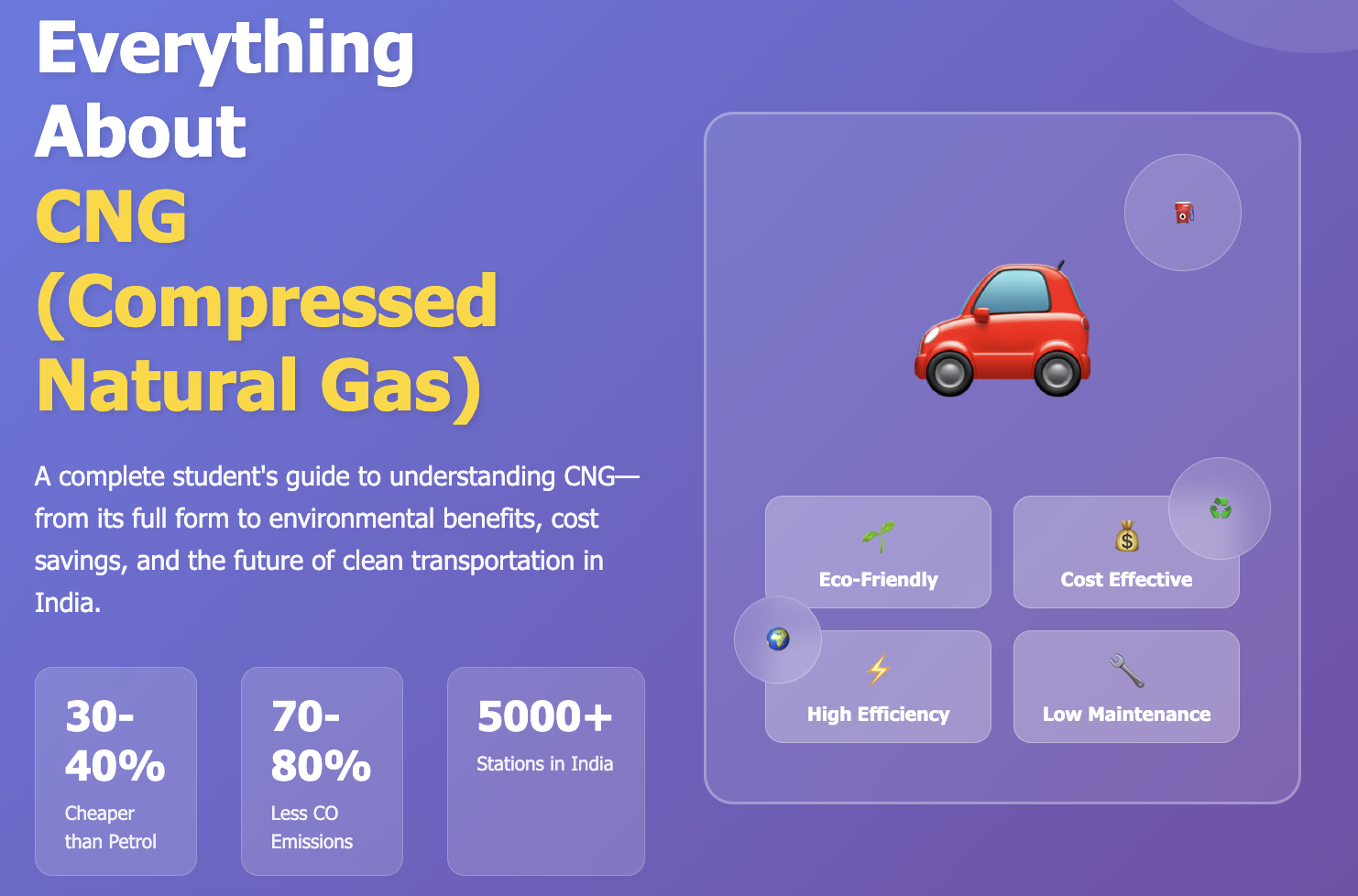
- 30-40% cheaper than petrol per kilometer
- Lower maintenance costs (cleaner combustion)
- Longer engine life due to reduced wear
Environmental Benefits
- 70-80% less carbon monoxide emissions
- 87% lower nitrogen oxide emissions
- Minimal particulate matter (no smoke)
- Reduces greenhouse gas emissions by 20-25%
Performance Benefits
- Higher octane rating (120-130) than petrol (87-91)
- Cleaner engine oil (fewer oil changes needed)
- No fuel evaporation or spillage
Real-Life Example: A student’s family switches from a petrol car consuming ₹4,000 monthly to CNG, spending only ₹2,500 saving ₹18,000 yearly. That’s money for extra coaching classes!

How to Find CNG Stations Near You
Searching “cng near me” or “cng pump near me” on Google Maps shows nearby stations. But here’s what students should know:
Ways to Locate CNG Stations:
- Google Maps: Search “CNG petrol pump” or “cng gas station”
- Company Apps:
- Mahanagar Gas app for Mumbai/surrounding areas
- Indraprastha Gas for Delhi-NCR
- Adani Total Gas app
- Government Portals: Ministry of Petroleum & Natural Gas website lists all stations
Pro Tip: Not all areas have CNG infrastructure yet. Cities like Delhi, Mumbai, Pune, and Ahmedabad have extensive networks, while smaller towns are gradually getting coverage.
Major CNG Providers in India
Understanding CNG distribution helps in geography and economics lessons:
1. Mahanagar Gas (Mumbai & MMR)
- Operates over 300+ mahanagar gas CNG stations
- Covers Mumbai, Thane, Raigad districts
- Largest CNG distribution network in Maharashtra
2. Indraprastha Gas Limited (Delhi-NCR)
- Over 600 CNG stations
- Supplies to Delhi, Noida, Greater Noida, Ghaziabad
- Pioneers of CNG adoption in India since 1998
3. Adani Total Gas
- Expanding rapidly across multiple states
- Adani CNG stations in Gujarat, UP, Telangana, and more
- Focus on tier-2 and tier-3 cities
4. Gujarat Gas
- Dominant in Gujarat
- Over 200 stations across the state
Quick Fact: India has 5,000+ CNG stations as of 2024, growing by 500+ annually.
CNG Vehicles: From Cars to Bikes
CNG isn’t just for cars anymore. The automotive industry has expanded significantly:
CNG Cars
- Maruti Ertiga, WagonR, Alto (factory-fitted)
- Hyundai Aura, Grand i10 Nios
- Tata Tiago, Tigor
CNG Bikes: The New Frontier
In 2023, Bajaj launched India’s first CNG bike—the Bajaj Freedom 125. This innovation is revolutionary:
Bajaj CNG Bike Features:
- 125cc engine running on CNG + petrol
- 2 kg CNG tank + 2-liter petrol reserve
- Running cost: ₹1 per kilometer (CNG mode)
- Range: 200+ km on full tank
Why It Matters for Students: This represents engineering innovation solving real problems. In your projects on sustainable transport, the Bajaj CNG bike exemplifies how technology adapts fossil fuels during the transition to electric vehicles.
CNG Auto-Rickshaws
- Most economical option for drivers
- Mandatory in many metro cities
- Run 300-400 km daily at minimal fuel cost
Environmental Impact: Why CNG Matters
For your environmental studies or EVS projects, here’s why CNG is significant:
Pollution Reduction
| Pollutant | Reduction vs. Petrol |
|---|---|
| Carbon Monoxide | 70-80% lower |
| Nitrogen Oxides | 87% lower |
| Particulate Matter | 90% lower |
| Sulfur Dioxide | Zero emissions |
Climate Change Connection
While CNG still produces CO₂, it emits 25% less than petrol. For countries transitioning from coal and oil, CNG serves as a “bridge fuel” toward renewable energy.
FAQs About CNG
Q. What is the full form of CNG?
CNG stands for Compressed Natural Gas. It’s natural gas stored under high pressure (200-250 bar) for use in vehicles, making it a cleaner alternative to petrol and diesel.
Q. How do I find a CNG pump near me?
Search “cng near me” or “cng petrol pump” on Google Maps. You can also use apps from providers like Mahanagar Gas, Indraprastha Gas, or Adani CNG for real-time station locations and availability.
Q. Is CNG cheaper than petrol?
Yes, CNG costs 30-40% less per kilometer than petrol. A CNG vehicle typically runs at ₹1-1.5 per km, while petrol vehicles cost ₹3-4 per km, resulting in significant annual savings.
Q. What is the Bajaj CNG bike?
The Bajaj Freedom 125 is India’s first CNG motorcycle, launched in 2023. It runs on both CNG and petrol, offers 200+ km range, and costs approximately ₹1 per kilometer in CNG mode.
Q. Which cities have the most CNG gas stations?
Delhi-NCR has 600+ stations (Indraprastha Gas), Mumbai-MMR has 300+ (Mahanagar Gas CNG station network), followed by Ahmedabad, Pune, Vadodara, and Bengaluru. Over 5,000 stations exist across India.
Q. Can any car use CNG?
No, vehicles need either factory-fitted CNG systems or aftermarket CNG kit installation. Converting involves adding a CNG cylinder, pressure regulator, and modified fuel system—costing ₹40,000-70,000.
Q. Is CNG safe for vehicles?
Yes, CNG is safer than petrol. It’s lighter than air (disperses quickly if leaked), has a higher ignition temperature (540°C vs. petrol’s 246°C), and tanks undergo rigorous safety testing.
Q. What are Adani CNG stations?
Adani Total Gas operates CNG stations across multiple Indian states including Gujarat, Uttar Pradesh, and Telangana. They’re rapidly expanding CNG infrastructure in tier-2 and tier-3 cities nationwide.
Conclusion
Understanding CNG goes beyond memorizing that its full form is Compressed Natural Gas. It’s about recognizing how science, economics, and environmental responsibility intersect in everyday life. Whether you’re searching for a “cng pump near me” for your family’s new vehicle, studying alternative fuels for your chemistry exam, or considering the Bajaj CNG bike’s innovation for a project CNG represents practical solutions to real-world challenges.
As students and future decision-makers, knowing about cleaner fuels like CNG helps you contribute to discussions on sustainability, urban planning, and energy policy. While CNG isn’t the final answer to pollution, it’s an important stepping stone toward a cleaner, more sustainable future.