CAGR Full Form and Meaning
The full form of CAGR is Compound Annual Growth Rate. In simple terms, CAGR meaning refers to the average rate at which an investment grows each year over a specific period.
The compound annual growth rate meaning is easier to understand when we think about long-term investments. Instead of showing different returns every year, CAGR converts them into one consistent annual growth rate.
What Does CAGR Measure?
CAGR mainly measures how fast money, revenue, or an investment grows over time. It assumes that the profits earned every year are reinvested again, which creates compounding growth.
For example, if a mutual fund investment grows steadily over five years, CAGR helps calculate the average annual growth rate during that period.
For students learning business or economics, CAGR is a useful concept because it explains how investments or companies grow consistently over many years, rather than focusing on short-term changes.
What Does CAGR Tell Investors?
CAGR helps investors understand the overall investment growth rate over several years. Instead of looking at different yearly returns, it shows one clear number that represents the average yearly performance of an investment.
This is useful because investments rarely grow at the same rate every year. Some years may give higher returns, while others may give lower returns. CAGR simplifies these changes and presents a single annual growth figure that is easier to understand and compare.
Why Investors and Businesses Use CAGR
CAGR is commonly used to analyse long-term financial performance. For example:
- Stock performance: Investors check the stock market growth rate of a company over 5 or 10 years.
- Company revenue growth: Businesses analyse how their sales or profits grow each year.
- Mutual fund performance: Investors compare funds using their mutual fund annual return over time.
For students or beginners learning about finance, CAGR helps explain how investments grow steadily over the long term, not just in one year.
CAGR Formula Explained
To calculate the average yearly growth of an investment, investors use the CAGR formula. This formula helps find how much an investment grows every year on average when the growth follows compounding.
Formula:
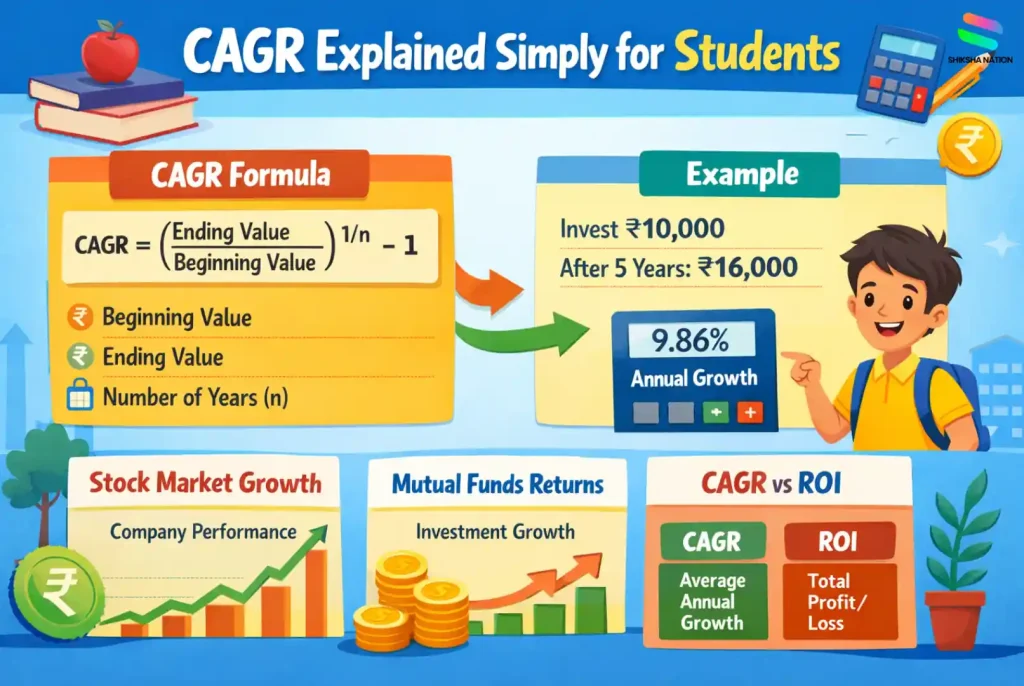
CAGR = (Ending Value / Beginning Value)^(1/n) – 1
This compound annual growth rate formula may look complex at first, but each part of the formula is simple to understand.
Key Parts of the Formula
- Beginning Value:
This is the initial amount of money invested at the start. For example, the amount you first invest in a stock or mutual fund.
- Ending Value:
This is the final value of the investment after a certain period.
- Number of Years (n):
This represents the total number of years the investment was held.
For students learning basic finance concepts, the CAGR formula helps explain how investments grow steadily over several years rather than just in a single year.
How to Calculate CAGR (Step-by-Step)
Understanding how to calculate CAGR becomes easier when the process is broken into simple steps. Students or beginner investors can follow the steps below to find the average yearly growth of an investment.
Step 1 – Find the Initial Investment
First, identify the starting value of the investment.
For example, suppose you invest ₹20,000 in a mutual fund.
Step 2 – Find the Final Value
Next, check how much the investment is worth after a few years.
Assume the value becomes ₹32,000 after the investment period.
Step 3 – Count the Number of Years
Now determine how long the money stayed invested.
In this example, assume the investment was held for 4 years.
Step 4 – Apply the Formula
Now apply the CAGR formula:
CAGR = (Ending Value / Beginning Value)^(1/n) – 1
When you calculate CAGR using the numbers:
CAGR = (32,000 / 20,000)^(1/4) – 1
This gives the average yearly growth rate of the investment.
For students learning finance basics, this method helps understand how long-term investments grow over time.
CAGR Example (Easy Explanation for Students)
Understanding CAGR becomes much easier with a simple example. Let us see how the concept works in a real-life investment situation.
Example Calculation
Suppose a student or parent invests ₹10,000 in a mutual fund or stock. After 5 years, the value of that investment becomes ₹16,000.
To find the annual growth rate, we use the CAGR formula:
CAGR = (Ending Value / Beginning Value)^(1/n) – 1
Putting the values in the formula:
CAGR = (16,000 / 10,000)^(1/5) – 1
The result comes to about 9.86%.
What This Percentage Means
This percentage does not mean the investment grew exactly 9.86% every year. In reality, yearly returns may go up or down.
However, CAGR shows the average annual growth rate assuming the profits were reinvested each year. This is called compounding growth.
For students learning about finance, this example helps explain how small investments can grow steadily over time when money remains invested for several years.
Where is CAGR Used in Real Life?
CAGR is not only a theory used in finance books. It is widely used to understand how investments and businesses grow over time. Investors, companies, and even students studying commerce use it to analyse long-term performance.
Stock Market Growth
In the stock market, CAGR helps measure the stock market growth rate of a company over several years.
For example, investors often check the 5-year or 10-year CAGR of a company’s share price or revenue. This helps them understand whether the company has been growing steadily over time.
For students learning business studies, this concept explains how companies expand gradually instead of growing suddenly in a single year.
Mutual Funds Performance
CAGR is also used to measure mutual fund annual return. When investors compare different funds, they often check the CAGR to see which fund has delivered better long-term returns.
It gives a clearer idea of the average yearly return over the investment period.
Business Growth Analysis
Companies also use CAGR to analyse their financial growth rate. They study how their revenue, profit, or customer base has grown over multiple years.
This helps businesses plan future strategies and understand their long-term growth pattern.
CAGR vs Absolute Return (Important for Beginners)
When students or beginner investors analyse investments, they often see two terms: CAGR and Absolute Return. Both measure returns, but they explain growth in different ways.
Absolute return simply shows the total profit or loss over the investment period. CAGR, on the other hand, shows the average yearly investment growth rate considering the time period.
This is why CAGR is usually more useful for understanding long-term performance.
| Metric |
CAGR |
Absolute Return |
| Meaning |
Shows the average yearly growth of an investment |
Shows total percentage gain or loss |
| Time factor |
Considers the number of years invested |
Does not consider time duration |
| Use |
Helpful for comparing long-term investments |
Useful for checking overall profit |
| Growth view |
Reflects yearly investment growth rate |
Shows total return only |
For students learning finance basics, understanding this difference helps in analysing investment performance more clearly.
Advantages of CAGR
CAGR is widely used in finance because it gives a clear and simplified view of investment performance over time. It helps students, investors, and parents understand how money grows in the long run.
Easy Comparison of Investments
One major advantage of CAGR is that it allows easy comparison between different investments.
For example, investors can compare two mutual funds or stocks and see which one has delivered better growth over several years.
Better Understanding of Long-Term Growth
CAGR focuses on long-term performance instead of short-term fluctuations. This helps people understand how an investment performs over many years.
For students studying business or economics, this concept explains how steady growth matters more than short-term gains.
Reflects Compounding Growth
Another benefit is that CAGR considers compounding growth, where profits are reinvested and continue to generate more returns. Over time, this compounding effect can significantly increase the value of an investment.
Limitations of CAGR
Although CAGR is a useful financial metric, it also has some limitations that students and beginner investors should understand.
Assumes Steady Growth
CAGR assumes that an investment grows at the same rate every year. In reality, markets rarely grow in a smooth pattern. Returns can go up or down depending on economic conditions.
Ignores Market Volatility
Another limitation is that CAGR does not show yearly fluctuations. An investment may have strong gains in one year and losses in another, but CAGR only presents a single average figure.
Assumes Reinvestment of Profits
CAGR also assumes that all profits are reinvested during the investment period. However, in real situations, investors may withdraw returns instead of reinvesting them.
Understanding these limitations helps students analyse investment data more carefully.
Conclusion
The full form of CAGR is Compound Annual Growth Rate, a concept used to measure the average yearly growth of an investment over time.
Understanding what is CAGR full form helps students and beginner investors learn how investments grow through compounding. It simplifies complex financial data and shows growth in a clear annual percentage.
For students studying economics or business, knowing the CAGR meaning makes it easier to understand long-term financial performance in stocks, mutual funds, or business revenue growth.
FAQs About CAGR
Q. What is CAGR in simple terms?
CAGR stands for Compound Annual Growth Rate. In simple terms, it shows the average yearly growth of an investment over a period of time. Instead of showing different returns every year, CAGR converts them into one clear annual growth rate, which helps investors understand long-term performance easily.
Q. What is the full form of CAGR?
The full form of CAGR is Compound Annual Growth Rate. It is used to measure how fast an investment, business revenue, or financial asset grows over several years. Students studying business or economics often learn this concept when understanding long-term financial growth and investment analysis.
Q. How do you calculate CAGR?
CAGR is calculated using a standard formula:
CAGR = (Ending Value / Beginning Value)^(1/n) – 1
Where:
- Beginning Value = initial investment
- Ending Value = final investment value
- n = number of years
This formula helps calculate the average annual growth rate of an investment.
Q. Why is CAGR used instead of average return?
Average return simply adds yearly returns and divides them by the number of years. However, this method ignores the effect of compounding.
CAGR is preferred because it considers compounding growth, which gives a more realistic view of long-term investment performance.
Q. Is CAGR better than ROI?
CAGR and ROI serve different purposes.
- ROI shows the total profit or loss from an investment.
- CAGR shows the average yearly growth rate over time.
For long-term investments, CAGR is usually more useful because it considers the time period.
Q. What is a good CAGR for investment?
There is no fixed number for a good CAGR. It depends on the investment type and market conditions.
In general:
- Stable investments may give 8-12% CAGR
- Higher-risk investments may give higher returns
A good CAGR usually means the investment grows steadily and beats inflation over time.
Q. Where is CAGR used in finance?
CAGR is commonly used in many financial situations, such as:
- Measuring stock market growth of companies
- Comparing mutual fund performance
- Analysing business revenue growth
It helps investors understand the long-term growth pattern of investments or businesses.
Q. What is the difference between CAGR and XIRR?
CAGR is mainly used for lump-sum investments, where money is invested once and held for several years. XIRR is used when investments happen at different times, such as SIP investments in mutual funds. It adjusts the return based on the timing of cash flows.
Q. Why is CAGR important for long-term investors?
CAGR helps investors understand how consistently an investment has grown over time. It removes yearly fluctuations and shows one average growth rate. For students and beginner investors, this makes it easier to compare different investment options and analyse long-term financial growth.