

Water animals isn’t just about memorizing facts for tests. It helps students appreciate biodiversity, understand ecosystems, and connect classroom learning to the natural world. Whether you’re preparing for a biology exam, working on a science project, or simply curious about marine life, this guide covers everything you need to know about animals that call water their home.
What Are Aquatic Animals?
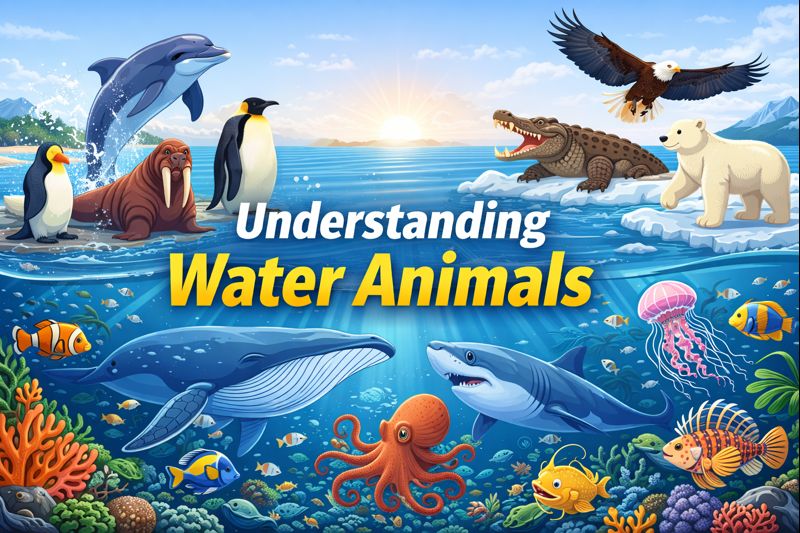
Aquatic animals are living creatures that spend all or most of their lives in water. The word “aquatic” comes from the Latin word “aqua,” meaning water.
These animals have adapted to live in various water environments:
- Oceans and seas (saltwater)
- Rivers and streams (freshwater)
- Lakes and ponds (freshwater)
- Wetlands and marshes (mixed habitats)
Any animal that lives in water and has special body features to survive there is called an aquatic animal. In biology exams, you’ll often be asked to classify animals based on their habitat. Aquatic animals form a major classification alongside terrestrial (land) and aerial (air) animals.
Main Characteristics of Aquatic Animals
Understanding the key features of water animals helps students identify them correctly in exams and projects.
Primary Characteristics:
1. Streamlined Body Shape
- Most aquatic animals have smooth, torpedo-shaped bodies
- This reduces water resistance and helps them swim faster
- Example: Fish, dolphins, sharks
2. Specialized Breathing Organs
- Gills for extracting oxygen from water (fish)
- Lungs for breathing air at the surface (whales, dolphins)
- Skin breathing in some amphibians (frogs)
3. Fins, Flippers, or Webbed Feet
- Help in swimming and steering through water
- Fish have multiple fins (dorsal, pectoral, caudal)
- Ducks and frogs have webbed feet
4. Body Temperature Regulation
- Cold-blooded (Ectothermic): Most fish, reptiles
- Warm-blooded (Endothermic): Whales, dolphins, seals
5. Scales or Smooth Skin
- Fish have scales for protection
- Marine mammals have smooth, thick skin with blubber underneath
- Amphibians have moist, permeable skin
Characteristics Summary Table:
| Feature | Purpose | Example Animals |
|---|---|---|
| Gills | Extract oxygen from water | Fish, tadpoles, crabs |
| Streamlined body | Reduce water resistance | Sharks, dolphins, seals |
| Fins/Flippers | Swimming and steering | Fish, turtles, penguins |
| Webbed feet | Paddling through water | Ducks, frogs, otters |
| Blubber layer | Insulation in cold water | Whales, seals, walruses |
Types of Animals That Live in Water
Aquatic animals can be classified into several major groups based on their biological characteristics.
1. Fish (Pisces)
The largest group of aquatic animals with over 30,000 species.
Characteristics:
- Have gills throughout their life
- Cold-blooded vertebrates
- Covered with scales
- Use fins for movement
Common Examples:
- Salmon, tuna, goldfish, shark, ray
2. Aquatic Mammals
Warm-blooded animals that breathe air but live in water.
Characteristics:
- Have lungs, must surface to breathe
- Give birth to live young
- Feed milk to their babies
- Have hair or fur (minimal in some species)
Common Examples:
- Whales, dolphins, seals, sea lions, otters, manatees
3. Aquatic Reptiles
Cold-blooded reptiles adapted to water life.
Characteristics:
- Have lungs for breathing
- Lay eggs (mostly on land)
- Covered with tough scales
- Can hold breath for long periods
Common Examples:
- Sea turtles, sea snakes, crocodiles, alligators
4. Aquatic Birds
Birds that depend on water for food and habitat.
Characteristics:
- Have feathers and wings
- Webbed feet for swimming
- Waterproof feathers
- Lay eggs on land or near water
Common Examples:
- Ducks, swans, pelicans, penguins, herons
5. Amphibians
Animals that live both in water and on land.
Characteristics:
- Start life in water (with gills)
- Develop lungs as adults
- Moist, permeable skin
- Undergo metamorphosis
Common Examples:
- Frogs, toads, salamanders, newts
6. Invertebrates (No Backbone)
Aquatic animals without a spinal column.
Major Groups:
- Mollusks: Octopus, squid, clams, snails
- Crustaceans: Crabs, lobsters, shrimp
- Echinoderms: Starfish, sea urchins
- Cnidarians: Jellyfish, corals, sea anemones
- Sponges: Simple multicellular organisms
Classification Memory Trick: Use FMARBI – Fish, Mammals, Amphibians, Reptiles, Birds, Invertebrates.
Water Animals That Are Not Fish
This is a common confusion in student exams. Many water animals look like fish but belong to different groups.
Aquatic Mammals (Not Fish):
Dolphins and Whales
- Breathe air through lungs
- Give birth to live young
- Warm-blooded
- Have horizontal tail flukes (fish have vertical tail fins)
Seals and Sea Lions
- Have flippers, not fins
- Come to land to rest and breed
- Breathe air
Otters
- Have fur, not scales
- Live in rivers and coastal waters
- Use tools to crack open shells
Aquatic Reptiles (Not Fish):
Sea Turtles
- Have lungs, come up to breathe
- Have a hard shell
- Lay eggs on beaches
Crocodiles and Alligators
- Powerful jaws with teeth
- Can walk on land
- Breathe air through nostrils
Aquatic Invertebrates (Not Fish):
Octopus and Squid
- Have eight or ten arms
- No skeleton
- Very intelligent
Jellyfish
- Soft, gelatinous body
- No brain or heart
- Drift with currents
Crabs and Lobsters
- Have hard exoskeleton
- Walk on the ocean floor
- Have claws
Animals That Live on Land and Water
These animals split their time between aquatic and terrestrial environments.
Amphibians (Primary Group)
Frogs
- Tadpoles live in water
- Adults can live on land but need moisture
- Breathe through skin and lungs
Salamanders
- Some species are fully aquatic
- Others live in damp forests
- Return to water to breed
Toads
- Rougher, drier skin than frogs
- Spend more time on land
- Breed in water
Semi-Aquatic Mammals
Hippopotamus
- Spend days in water to stay cool
- Come to land at night to graze
- Can hold breath for 5 minutes
Beavers
- Build dams in rivers
- Excellent swimmers
- Live in lodges with underwater entrances
Platypus
- Egg-laying mammal
- Hunts underwater
- Burrows on riverbanks
Semi-Aquatic Reptiles
Crocodiles
- Powerful swimmers
- Bask on riverbanks
- Hunt both in water and on land
Water Monitor Lizards
- Strong swimmers
- Climb trees on land
- Found near rivers and coasts
Semi-Aquatic Birds
Ducks
- Swim in ponds and lakes
- Nest on land
- Fly between habitats
Cormorants
- Dive to catch fish
- Dry wings on land
- Roost in trees
Note: The ability to live in both environments requires special adaptations like webbed feet, waterproof skin, and the ability to regulate body temperature in different conditions.
Animals That Can Live in Water, Land, and Air
Very few animals can truly thrive in all three environments, but some remarkable creatures come close.
Birds (Best Examples)
Ducks
- Water: Swim and dive for food
- Land: Walk, nest, and rest
- Air: Fly long distances during migration
- Webbed feet for swimming, wings for flying
Pelicans
- Water: Dive-bomb to catch fish
- Land: Nest on islands and shores
- Air: Soar on thermal currents
- Large throat pouch for catching fish
Penguins (Limited Air)
- Water: Expert swimmers (can “fly” underwater)
- Land: Waddle and breed on ice/land
- Air: Cannot fly but ancestors could
- Wings evolved into flippers
Amphibians (Developmental Stages)
Frogs
- Water: Tadpole stage (fully aquatic)
- Land: Adult stage (terrestrial)
- Air: Adults breathe air; some tree frogs glide short distances
Flying Frogs
- Water: Lay eggs in water
- Land: Live in rainforest trees
- Air: Glide between trees using webbed feet (not true flight)
Insects
Dragonflies
- Water: Nymphs live underwater (months to years)
- Land: Adults rest on plants
- Air: Adults are powerful fliers
- Complete metamorphosis from aquatic to aerial
Mosquitoes
- Water: Larvae and pupae stages
- Land: Rest on surfaces
- Air: Adults fly and feed
Special Mention: Flying Fish
Flying Fish
- Water: Primary habitat
- Air: Glide above water surface up to 200 meters
- Land: Cannot survive on land
- Use enlarged pectoral fins as “wings”
How Aquatic Animals Breathe Underwater
Breathing underwater is one of the most important adaptations for aquatic life. Different animals use different methods.
Method 1: Gills (Most Common)
How Gills Work:
- Water enters through the mouth
- Passes over thin gill filaments
- Oxygen dissolves in blood through gill membranes
- Carbon dioxide exits through gills
- Water flows out through gill slits
Animals with Gills:
- All fish (sharks, salmon, goldfish)
- Tadpoles (young amphibians)
- Some aquatic invertebrates (crabs, lobsters)
Method 2: Lungs + Surfacing
How It Works:
- Animals hold their breath underwater
- Must regularly surface to breathe air
- Lungs extract oxygen from air, not water
Animals That Surface:
- Whales and dolphins (blowholes)
- Sea turtles
- Seals and sea lions
- Crocodiles and alligators
Breath-Holding Records:
- Sperm whale: Up to 90 minutes
- Sea turtle: 4-7 hours (when resting)
- Dolphin: 8-10 minutes
- Crocodile: 1-2 hours
Method 3: Skin Breathing (Cutaneous Respiration)
How It Works:
- Oxygen passes directly through thin, moist skin
- Works only for small animals or as supplementary breathing
- Skin must stay wet
Animals Using Skin Breathing:
- Frogs (supplement to lung breathing)
- Salamanders
- Some sea snakes
- Earthworms (in moist soil)
Method 4: Specialized Structures
Dive Response (Mammals):
- Heart rate slows down
- Blood flow redirected to vital organs
- More efficient oxygen use
Swim Bladder (Fish):
- Not for breathing, but for buoyancy
- Helps fish stay at desired depth without swimming
Book Gills (Horseshoe Crabs):
- Flat, leaf-like gills under the body
- Wave back and forth to absorb oxygen
Memory Trick:GLSS – Gills (fish), Lungs (mammals), Skin (amphibians), Specialized (invertebrates).
Common Exam
Question: How do fish breathe underwater?
Answer: Fish breathe using gills, which extract dissolved oxygen from water as it passes over thin gill membranes.
Animals That Can Breathe in Water and on Land
These animals have dual respiratory systems a remarkable evolutionary adaptation.
Amphibians (Primary Group)
Frogs and Toads
- As Tadpoles: Use gills (fully aquatic)
- As Adults: Use lungs and skin
- Can absorb oxygen through moist skin in water
- Use lungs when on land
Why It Matters: This dual system allows frogs to hibernate underwater in winter, breathing entirely through their skin.
Lungfish
Unique Fish with Lungs:
- Have both gills AND primitive lungs
- Can breathe water through gills
- Can gulp air and breathe with lungs
- Survive droughts by burrowing in mud and breathing air
Geographic Location: Found in Africa, South America, and Australia.
Mudskippers
Amphibious Fish:
- Use gills in water
- Can breathe through wet skin and mouth lining on land
- Carry water in their gill chambers when on land
- Can “skip” across mudflats
Habitat: Mangrove swamps and mudflats in tropical regions.
Sea Turtles (Limited Dual Breathing)
Primary: Lungs (breathe air) Secondary: Cloaca breathing (absorb oxygen through rear opening when underwater)
- This is a minor supplement, not primary breathing
- Allows longer dives
Axolotl (Salamander)
Unique Feature:
- Retains gills as an adult (usually amphibians lose them)
- Also has lungs
- Can breathe both underwater and on land
- Often kept as an aquarium pet
Scientific Importance: Used in regeneration research can regrow lost limbs.
How Animals Move and Survive in Water
Movement in water requires different strategies than on land because water is 800 times denser than air.
Swimming Methods
1. Undulation (Wave-Like Movement)
- Body curves in S-shaped waves
- Used by: Eels, sea snakes, lampreys
- Efficient for long-distance travel
2. Fin Propulsion
- Fins push water backward
- Used by: Most fish
- Different fins serve different purposes:
- Caudal fin (tail): Forward movement
- Pectoral fins: Steering and balance
- Dorsal fin: Stability
3. Jet Propulsion
- Forcefully expel water to move forward
- Used by: Octopus, squid, jellyfish
- Allows quick escape from predators
4. Paddling
- Use limbs to push water
- Used by: Ducks (webbed feet), sea turtles (flippers), penguins (wings as flippers)
5. Tail Fluking
- Powerful up-and-down tail movement
- Used by: Whales, dolphins, manatees
- Generates tremendous speed
Survival Adaptations
Camouflage and Color
- Countershading: Dark top, light bottom (makes animals hard to see from above or below)
- Example: Sharks, dolphins, penguins
- Transparency: Some jellyfish and fish larvae are see-through
- Color Changing: Octopus, cuttlefish, chameleon shrimp
Defense Mechanisms
- Spines: Pufferfish, lionfish, stingrays
- Shells: Turtles, crabs, clams
- Venom: Sea snakes, jellyfish, cone snails
- Ink Clouds: Octopus, squid (creates confusion)
- Electric Shocks: Electric eels, electric rays
Feeding Strategies
- Filter Feeding: Whales (baleen), manta rays
- Active Hunting: Sharks, barracudas, orcas
- Ambush: Crocodiles, anglerfish
- Scavenging: Crabs, catfish
Temperature Regulation
- Blubber Layer: Insulation in whales, seals (up to 50 cm thick)
- Countercurrent Heat Exchange: Blood vessels arranged to retain heat
- Behavioral: Basking (turtles), seeking warm/cold water zones
Buoyancy Control
- Swim Bladder: Fish inflate/deflate to change depth
- Oil-Filled Liver: Sharks (less dense than water)
- Bone Density: Penguins have dense bones to help dive
Communication
- Echolocation: Dolphins, whales (using sound waves)
- Bioluminescence: Deep-sea fish (light production)
- Chemical Signals: Pheromones in water
Table: Movement Speed Comparison
| Animal | Top Speed | Method |
|---|---|---|
| Sailfish | 110 km/h | Fin propulsion |
| Orca | 56 km/h | Tail fluking |
| Dolphin | 60 km/h | Tail fluking |
| Penguin | 36 km/h | Wing flippers |
| Sea Turtle | 35 km/h | Flipper paddling |
| Octopus | 40 km/h | Jet propulsion |
The King and Queen of Water Animals
While there’s no official “royalty” in the animal kingdom, certain animals dominate their aquatic environments.
The “King” – Great White Shark
Why It’s Considered King:
- Apex Predator: Top of the food chain
- Size: Up to 6 meters long, 2,000+ kg
- Strength: Bite force of 1.8 tons
- Intelligence: Problem-solving abilities
- Longevity: Lives 70+ years
- Range: Found in oceans worldwide
Characteristics:
- 300 sharp, serrated teeth
- Can detect one drop of blood in 100 liters of water
- Breaches (jumps) out of water while hunting
- Can swim at 56 km/h
Conservation Status: Vulnerable (threatened by overfishing)
Alternative “King” – Orca (Killer Whale)
Why Orcas Are Also Called Kings:
- Hunt great white sharks
- No natural predators
- Highly intelligent and social
- Can hunt cooperatively
- Found in all oceans
The “Queen” – Blue Whale
Why It’s Considered Queen:
- Largest Animal Ever: Up to 30 meters long, 200 tons
- Grace: Despite size, moves elegantly
- Voice: Songs travel thousands of kilometers
- Gentle Nature: Filter feeder, not aggressive
- Nurturing: Cares for young for long periods
Amazing Facts:
- Heart is the size of a small car
- Tongue weighs as much as an elephant
- Eats 4 tons of krill daily
- Can live 80-90 years
Conservation Status: Endangered (recovering from whaling)
Other Contenders
Saltwater Crocodile:
- Largest living reptile
- Most powerful bite in the animal kingdom
- Dominates rivers and coasts
Giant Pacific Octopus:
- Most intelligent invertebrate
- Can solve complex puzzles
- Changes color instantly
Sperm Whale:
- Largest toothed predator
- Dives deepest (over 2,000 meters)
- Has the largest brain on Earth
Student Discussion Point: “King” and “Queen” are human concepts. In nature, every animal plays an important role in its ecosystem. The tiny plankton that whales eat are just as important to ocean health as the whales themselves.
Most Dangerous Water Animals
Understanding dangerous aquatic animals helps students appreciate both their power and the importance of respecting wildlife.
Top Dangerous Water Animals
1. Box Jellyfish
- Danger Level: Extremely High
- Venom: Can kill a human in minutes
- Location: Waters around Australia and Southeast Asia
- Symptoms: Intense pain, cardiac arrest
- Defense: Nearly transparent, hard to see
2. Saltwater Crocodile
- Danger Level: Extremely High
- Attack Method: Ambush and death roll
- Bite Force: 3,700 psi (strongest of any animal)
- Size: Up to 7 meters, 1,000 kg
- Fatalities: Hundreds of attacks annually
3. Blue-Ringed Octopus
- Danger Level: Extremely High
- Size: Only 20 cm but deadly
- Venom: Tetrodotoxin (no antidote)
- Symptoms: Paralysis, respiratory failure
- Warning: Shows bright blue rings when threatened
4. Stonefish
- Danger Level: Very High
- Camouflage: Looks exactly like a rock
- Venom: Extremely painful, potentially fatal
- Location: Indo-Pacific shallow waters
- Risk: People step on them accidentally
5. Great White Shark
- Danger Level: High
- Attacks: 5-10 per year worldwide (rarely fatal)
- Reason: Mistaken identity (surfers look like seals)
- Behavior: Curious, not aggressive toward humans
6. Bull Shark
- Danger Level: Very High
- Unique Trait: Can live in freshwater rivers
- Aggressive: More aggressive than great whites
- Range: Found in shallow coastal waters and rivers
7. Portuguese Man o’ War
- Danger Level: High
- Not a Jellyfish: Actually a colony of organisms
- Tentacles: Up to 50 meters long
- Sting: Extremely painful, rarely fatal
- Problem: Washes up on beaches
8. Electric Eel
- Danger Level: Moderate to High
- Shock: Up to 860 volts
- Effect: Can stun a horse
- Location: Amazon and Orinoco river basins
- Multiple Shocks: Can discharge repeatedly
9. Stingray
- Danger Level: Moderate
- Weapon: Barbed tail with venom
- Behavior: Usually docile, attacks when stepped on
- Famous Incident: Steve Irwin tragedy
10. Cone Snail
- Danger Level: High
- Beautiful but Deadly: Colorful shell
- Venom: Harpoon-like tooth delivers toxin
- No Antidote: Can be fatal
- Rule: Never pick up cone shells
Danger Comparison Table
| Animal | Fatality Rate | Pain Level | Main Threat |
|---|---|---|---|
| Box Jellyfish | Very High | Extreme | Venom |
| Saltwater Crocodile | High | Extreme | Physical attack |
| Blue-Ringed Octopus | Very High | Moderate | Venom |
| Stonefish | Low | Extreme | Venom |
| Great White Shark | Very Low | Extreme | Bite |
Safety Tips for Students
Beach and Ocean Safety:
- Never swim alone
- Avoid murky water
- Don’t swim at dawn/dusk (shark feeding times)
- Watch for warning signs
- Shuffle feet in shallow water (avoid stepping on stingrays)
Avoiding Dangerous Animals:
- Don’t touch colorful or unusual sea creatures
- Keep distance from wildlife
- If you see jellyfish, exit the water
- Never feed wild aquatic animals
First Aid Basics:
- Jellyfish sting: Rinse with vinegar, seek medical help
- Stingray: Immerse in hot water, see a doctor
- Any serious injury: Call emergency services immediately
Aquatic Animals with Special Powers
Nature has given some water animals extraordinary abilities that seem almost superhuman.
Echolocation (Biological Sonar)
Dolphins and Whales:
- Power: “See” using sound waves
- How It Works: Send out clicks, interpret echoes
- Accuracy: Can detect a fish the size of a golf ball from 200 meters
- Use: Navigation, hunting, communication in dark/murky water
- Comparison: Like submarine sonar but much more sophisticated
Real-Life Application: Scientists study dolphin echolocation to improve underwater navigation technology.
Bioluminescence (Natural Light)
Anglerfish:
- Power: Produces light from a lure on its head
- Purpose: Attracts prey in deep, dark ocean
- Chemistry: Bacteria in the lure create light
Firefly Squid:
- Power: Entire body glows with blue light
- Use: Communication, camouflage, attracting mates
- Spectacle: Creates stunning displays in Japanese waters
Jellyfish (Some Species):
- Power: Glow when disturbed
- Science: Green Fluorescent Protein (GFP) revolutionized biology
- Medical Impact: Used to track cancer cells and research
Regeneration
Starfish:
- Power: Regrow lost arms
- Extreme Ability: Some species can regenerate entire body from one arm
- Time: Takes several months
- Limitation: Cannot regenerate if central disk is damaged
Axolotl:
- Power: Regrows limbs, organs, even parts of brain and spine
- Uniqueness: Best regeneration ability among vertebrates
- Research: Scientists study them for human medical applications
Camouflage and Color Change
Octopus:
- Power: Change color and texture in milliseconds
- Method: Chromatophores (color cells) in skin
- Intelligence: Chooses patterns consciously
- Ability: Can mimic other animals (rocks, lionfish)
Cuttlefish:
- Power: Even more sophisticated than octopus
- Hypnotic Display: Creates moving patterns to mesmerize prey
- 3D Effect: Can create appearance of depth on flat skin
Mimic Octopus:
- Power: Impersonates multiple species (lionfish, sea snake, jellyfish)
- Intelligence: Chooses which animal to mimic based on threat
Electric Powers
Electric Eel:
- Power: Generate 860 volts of electricity
- Use: Stun prey, defend against predators, navigate
- Control: Can adjust voltage (low for sensing, high for hunting)
- Capacity: Can discharge hundreds of times before needing to recharge
Electric Ray:
- Power: Deliver shocks up to 220 volts
- History: Ancient Greeks and Romans used them for medical treatment
- Method: Special organs made of modified muscle cells
Extreme Strength
Mantis Shrimp:
- Power: Fastest punch in the animal kingdom
- Speed: 80 km/h (underwater!)
- Force: Accelerates like a .22 caliber bullet
- Effect: Can break aquarium glass, split prey shells
- Vision: Sees 12 primary colors (humans see 3)
Coconut Crab:
- Power: Grip strength of 3,300 newtons (stronger than most animal bites)
- Size: Largest land-living arthropod
- Aquatic Connection: Breathes through gills in early life
Navigation
Sea Turtles:
- Power: Return to exact beach where they were born (after 20+ years)
- Method: Sense Earth’s magnetic field
- Distance: Migrate thousands of kilometers with precision
Salmon:
- Power: Navigate from ocean back to their birth stream
- Method: Smell, magnetic sense, sun position
- Journey: Travel up rivers, jumping waterfalls
Survival in Extreme Conditions
Tardigrade (Water Bear):
- Power: Survive extreme heat, cold, radiation, vacuum of space
- Method: Enter cryptobiosis (suspended animation)
- Aquatic: Live in water droplets
- Research: Studied for space exploration
Pompeii Worm:
- Power: Survives in 80°C water near deep-sea vents
- Adaptation: Special bacteria protect its body
- Discovery: Shows life can exist in extreme conditions
Intelligence
Octopus:
- Power: Solve puzzles, open jars, recognize individual humans
- Tool Use: Uses coconut shells as portable shelter
- Escape Artist: Can squeeze through tiny openings
- Learning: Watches and learns from other octopuses
Dolphins:
- Power: Complex social structures, teach offspring, use tools
- Language: Unique signature whistles (like names)
- Cooperation: Work together to hunt and protect each other
Memory Trick for Special Powers:ERBICNE – Echolocation, Regeneration, Bioluminescence, Intelligence, Camouflage, Navigation, Electric.
Science Fair Idea: Create a presentation comparing animal “superpowers” to human technology (echolocation vs. sonar, electric eel vs. battery, bioluminescence vs. LED).
Common Mistakes Students Make
Understanding common errors helps students avoid them in exams and projects.
Mistake 1: Calling All Water Animals “Fish”
Wrong: “Whales are fish because they live in water.”
Correct: Whales are mammals. They breathe air, give birth to live young, and feed milk to their babies.
Remember: Living in water doesn’t make something a fish. Check for gills, scales, and how they reproduce.
Mistake 2: Thinking All Aquatic Animals Have Gills
Wrong: “All animals that live in water breathe through gills.”
Correct: Whales, dolphins, sea turtles, and many others have lungs and must surface to breathe air.
Key Point: Gills are common but not universal. Marine mammals never have gills.
Mistake 3: Confusing Amphibians with Reptiles
Wrong: “Frogs are reptiles because they can live on land.”
Correct: Frogs are amphibians. They have moist skin, undergo metamorphosis, and lay eggs in water.
Distinction:
- Amphibians: Moist skin, start in water, metamorphosis
- Reptiles: Dry scaly skin, usually lay eggs on land, no metamorphosis
Mistake 4: Believing Sharks Are Mammals
Wrong: “Sharks are mammals because they’re smart and large.”
Correct: Sharks are fish. They have gills, cartilage skeleton, and scales.
Confusion Source: Some sharks give birth to live young (not eggs), which confuses students, but reproduction method alone doesn’t determine classification.
Mistake 5: Thinking Seahorses Aren’t Fish
Wrong: “Seahorses are too different to be fish.”
Correct: Seahorses are fish. They have gills, fins, and a swim bladder.
Unusual Fact: Male seahorses carry babies, but they’re still fish by biological classification.
Mistake 6: Assuming “Jelly-fish” Are Actually Fish
Wrong: Written answer: “Jellyfish are a type of fish.”
Correct: Jellyfish are invertebrates (cnidarians). They have no bones, heart, or brain.
Exam Tip: Many animals have “fish” in their name but aren’t fish: jellyfish, crayfish, starfish, shellfish.
Mistake 7: Believing All Fish Lay Eggs
Wrong: “All fish reproduce by laying eggs.”
Correct: Some sharks and guppies give birth to live young (ovoviviparous or viviparous).
Reproduction Types:
- Oviparous: Lay eggs (most fish)
- Ovoviviparous: Eggs hatch inside, born live (some sharks)
- Viviparous: Placental development (some sharks, rays)
Mistake 8: Thinking Dolphins and Porpoises Are the Same
Wrong: “Dolphins and porpoises are the same animal.”
Correct: They’re different species with distinct features.
Differences:
- Dolphins: Curved dorsal fin, beak-like snout, visible teeth
- Porpoises: Triangular dorsal fin, rounded snout, spade-shaped teeth
Mistake 9: Classification by Appearance Alone
Wrong: “It has a shell, so it’s a turtle.”
Correct: Could be a turtle (reptile), tortoise (reptile), or even a molusk. Need more information.
Proper Approach: Consider habitat, behavior, breathing method, and reproduction.
Mistake 10: Mixing Up Food Chain Terms
Wrong: “Sharks are omnivores because they eat different fish.”
Correct: Sharks are carnivores. Eating different types of animals doesn’t make you an omnivore.
Definitions:
- Carnivore: Eats only animals
- Herbivore: Eats only plants
- Omnivore: Eats both plants and animals
Easy Tips to Remember Aquatic Animals
Memory techniques make studying more efficient and help recall information during exams.
Acronyms and Mnemonics
Animal Classification (FMARBI):
- Fish
- Mammals
- Amphibians
- Reptiles
- Birds
- Invertebrates
Fish Fins (DCPACP):
- Dorsal (top)
- Caudal (tail)
- Pectoral (chest)
- Anal (bottom rear)
- Caudal (tail)
- Pelvic (belly)
Remember: “Don’t Catch Peaceful Angel Cat Pets”
Marine Mammal Groups (SWPDO):
- Seals
- Whales
- Porpoises
- Dolphins
- Otters
Breathing Methods (GLSS):
- Gills (fish)
- Lungs (mammals)
- Skin (amphibians)
- Specialized (invertebrates)
Rhymes for Memory
Dolphin or Fish?
“If it comes up to breathe the air, It’s a mammal, not fish swimming there!”
Amphibian Life Cycle: “Water babies, land adults, Metamorphosis with grand results!”
Shark Classification: “Sharks have gills and swim so free, They’re fish, not mammals in the sea!”
Visual Memory Techniques
Body Temperature:
- Cold-blooded = Blue: Fish, reptiles (imagine ice-cold water)
- Warm-blooded = Red: Mammals (imagine warm blood)
Habitat Zones:
- Surface: Dolphins, sea turtles (sunlight)
- Middle: Most fish (twilight zone)
- Deep: Anglerfish, giant squid (darkness)
Comparison Tables for Quick Review
Dolphin vs. Shark:
| Feature | Dolphin | Shark |
|---|---|---|
| Group | Mammal | Fish |
| Breathing | Lungs | Gills |
| Tail | Horizontal fluke | Vertical fin |
| Birth | Live young | Eggs or live young |
| Temperature | Warm-blooded | Cold-blooded |
Frog vs. Lizard:
| Feature | Frog | Lizard |
|---|---|---|
| Group | Amphibian | Reptile |
| Skin | Moist, smooth | Dry, scaly |
| Life Start | Water (tadpole) | Land (egg) |
| Breathing | Skin + lungs | Lungs only |
| Eggs | Water | Land |
Story-Based Memory
The Amphibian Journey: Create a story: “Freddy the frog was born as a tadpole in a pond (aquatic), using gills to breathe. As he grew, he developed lungs and legs (metamorphosis). Now he can hop on land but returns to water to stay moist and lay eggs.”
Number Tricks
3-3-3 Rule for Marine Mammals:
- 3 Types: Whales, dolphins, seals
- 3 Traits: Warm-blooded, lungs, live young
- 3 Adaptations: Blubber, flippers, streamlined
5-Point Fish Check:
- Has gills
- Has fins
- Has scales
- Cold-blooded
- Lays eggs (usually)
Movement Method
Physical Gestures:
- Swimming motion = Think fish
- Coming up for air = Think mammal
- Hopping = Think amphibian (frog)
- Crawling = Think reptile
Question-Based Learning
Ask yourself:
- “Does it have gills?” → If yes, likely fish or young amphibian
- “Does it breathe air?” → If yes, could be mammal, reptile, bird, or adult amphibian
- “Does it have scales?” → If yes, likely fish or reptile
- “Can it live on land and water?” → If yes, likely amphibian or semi-aquatic
Color-Coded Notes
Use Colors for Different Groups:
- Blue: Fish and ocean-only animals
- Green: Amphibians
- Red: Marine mammals
- Orange: Reptiles
- Yellow: Birds
FAQs on Water Animals
Q. What is the difference between aquatic animals and marine animals?
Aquatic animals live in any water environment, including freshwater rivers, lakes, and ponds, as well as saltwater oceans and seas. Marine animals specifically live only in saltwater environments like oceans and seas. All marine animals are aquatic, but not all aquatic animals are marine. For example, salmon are aquatic (live in water) but not always marine (they swim between oceans and rivers).
Q. Can fish survive out of water?
Most fish cannot survive out of water for more than a few minutes because their gills need water to extract oxygen. However, some exceptional fish like mudskippers and lungfish have adapted to survive on land for hours or even months. Mudskippers use their wet skin and mouth lining to breathe, while lungfish have primitive lungs and can breathe air during droughts.
Q. Are dolphins smarter than dogs?
Yes, dolphins are considered more intelligent than dogs based on brain-to-body ratio, problem-solving abilities, and self-awareness. Dolphins can recognize themselves in mirrors, use tools, understand complex instructions, communicate with unique signature whistles, and teach learned behaviors to their offspring. They have larger brains relative to body size and demonstrate advanced social cooperation that exceeds most terrestrial mammals including dogs.
Q. Why do whales beach themselves?
Whales beach themselves for several reasons, though scientists don’t fully understand this behavior. Possible causes include illness or injury, disorientation from naval sonar or underwater noise, following prey too close to shore, strong currents or storms pushing them off course, old age, or social bonds (following a sick leader). When one whale beaches, others sometimes follow due to their strong social connections.
Q. How do sharks know when there’s blood in water?
Sharks have an extraordinary sense of smell with specialized olfactory organs that can detect blood at concentrations as low as one part per million. Their nostrils are purely for smelling, not breathing. Water flows through their nostrils as they swim, and scent receptors analyze chemicals in the water. Combined with their ability to detect electrical signals, this makes them incredibly efficient hunters even in murky water.
Q. Can octopuses really predict the future?
No, octopuses cannot predict the future. The famous case of Paul the Octopus “predicting” World Cup matches was pure coincidence and probability. However, octopuses are remarkably intelligent and can solve problems, escape enclosures, recognize individual humans, and learn through observation. Their cognitive abilities are exceptional among invertebrates, but this doesn’t include precognition or predicting future events.
Q. What is the deepest living ocean animal?
The deepest living fish is the Mariana snailfish, found at depths of 8,000+ meters in the Mariana Trench. Single-celled organisms and some invertebrates have been found even deeper, at 10,900 meters. These animals survive crushing pressure, complete darkness, and near-freezing temperatures through special adaptations like gel-filled bodies, no swim bladder, and extremely slow metabolism.
Q. How long can sea turtles hold their breath?
Adult sea turtles can hold their breath for 4-7 hours when resting or sleeping underwater. During active swimming, they need to surface every 4-7 minutes. This ability comes from a slow metabolism, efficient oxygen use, and the ability to store oxygen in their blood and muscles. When water temperature drops, their metabolism slows further, allowing even longer dives.
Conclusion
Understanding water animals opens a window into one of Earth’s most diverse and fascinating ecosystems. From the tiniest plankton to the massive blue whale, from the highly intelligent octopus to the ancient sea turtle, aquatic animals demonstrate nature’s incredible adaptability and creativity.
Important Notes for Students:
- Classification is key: Remember that water animals belong to different groups fish, mammals, reptiles, amphibians, birds, and invertebrates. Each group has distinct characteristics that help with identification in exams.
- Breathing methods matter: Understanding whether an animal uses gills, lungs, or skin breathing helps you classify it correctly and appreciate its adaptations.
- Not everything that swims is a fish: This is the most common mistake in exams. Dolphins, whales, sea turtles, and jellyfish all live in water but belong to completely different groups.
- Special adaptations are survival tools: Every unusual feature—from echolocation in dolphins to bioluminescence in deep-sea fish—evolved to help these animals survive in their specific environment.
- Conservation is everyone’s responsibility: Many aquatic animals face threats from pollution, climate change, and overfishing. Understanding these creatures helps us protect them for future generations.
The world beneath the water’s surface is as rich and complex as life on land. Every time you see a fish in a tank, a duck on a pond, or waves crashing on a beach, remember the incredible diversity of life thriving in Earth’s waters. These animals aren’t just exam topics they’re living proof of nature’s endless ingenuity, and understanding them connects us to the planet’s most vital ecosystems.