

Introduction
You’re filling out your exam answer sheet, writing about the “twelveth chapter” of your history textbook, when suddenly you pause. Wait—is it twelveth or twelfth? You’ve seen both spellings, and now doubt creeps in. You’re not alone. This seemingly simple spelling trips up students, parents helping with homework, and even adults writing emails.
Here’s the truth: only “twelfth” is correct. “Twelveth” is a common misspelling that doesn’t exist in standard English. Understanding why this confusion happens and learning a simple trick to remember the right spelling can save you from embarrassing mistakes in essays, exams, and everyday writing.
What Is the Correct Spelling?
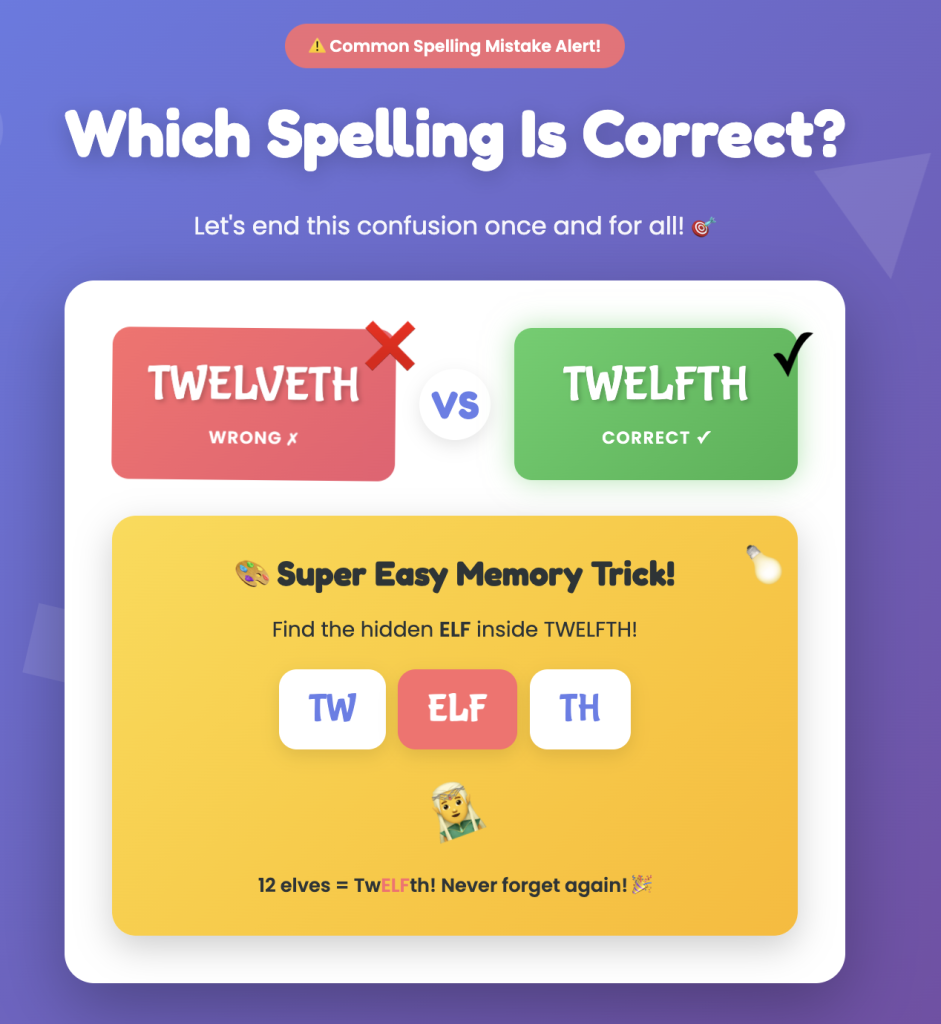
Correct: Twelfth
Incorrect: Twelveth
Definition: Twelfth is the ordinal form of the number 12. It indicates position or order in a sequence.
Example: December is the twelfth month of the year.
The spelling “twelveth” doesn’t appear in any English dictionary. It’s a phonetic misspelling that comes from how we pronounce numbers ending in “-teen” or “-ty.”
Why Is It Twelfth and Not Twelveth?
The confusion stems from a pattern we see in other ordinal numbers:
- Four → Fourth
- Six → Sixth
- Seven → Seventh
You might expect: Twelve → Twelveth
But English breaks its own pattern here. The correct transformation is:
Twelve → Twelfth
The “v” changes to “f,” and we drop the “e” before adding “-th.”
This irregularity comes from Old English. The word “twelve” has Germanic roots (twelf), and when forming the ordinal, the “v” sound naturally shifted to “f” over centuries of spoken English. Language evolved for ease of pronunciation, not logical consistency.
Understanding Ordinal Numbers
Ordinal numbers show position or rank in a sequence.
| Cardinal Number | Ordinal Number |
|---|---|
| 1 (One) | 1st (First) |
| 2 (Two) | 2nd (Second) |
| 3 (Three) | 3rd (Third) |
| 11 (Eleven) | 11th (Eleventh) |
| 12 (Twelve) | 12th (Twelfth) |
| 13 (Thirteen) | 13th (Thirteenth) |
| 20 (Twenty) | 20th (Twentieth) |
Notice that most numbers simply add “-th” to form ordinals. But numbers like five (fifth), eight (eighth), nine (ninth), and twelve (twelfth) change spelling.
Key Pattern: Numbers ending in “-ve” change to “-fth”
- Five → Fifth
- Twelve → Twelfth
Common Mistakes Students Make
Mistake 1: Writing “Twelveth”
This is the most common error. Students apply the general “-th” rule without noticing the spelling change.
Wrong: The twelveth grade is crucial for college applications.
Right: The twelfth grade is crucial for college applications.
Mistake 2: Confusing “12th” vs “Twelfth”
Both are correct, but context matters.
Use “12th” for:
- Dates: May 12th
- Short forms: 12th position
- Mathematical contexts: 12th term in the sequence
Use “Twelfth” for:
- Formal writing: The twelfth chapter discusses democracy.
- Beginning of sentences: Twelfth place isn’t bad at all.
Mistake 3: Silent “F” Assumption
Some students pronounce it as “twel-th” and miss the “f” sound entirely.
Correct pronunciation: TWELFTH (pronounce the “f”)
Easy Memory Tricks
Trick 1: Connect to “Elf”
Think of the word “elf” hiding inside twelfth.
Twelve → Tw-elf-th
Imagine twelve elves celebrating—the word contains “elf”!
Trick 2: Remember the “V to F” Rule
Whenever a number ends in -ve, change it to -fth:
- Twelve (has “ve”) → Twelfth (becomes “fth”)
- Five (has “ve”) → Fifth (becomes “fth”)
Trick 3: Spell Out Loud
Say each letter while writing: T-W-E-L-F-T-H
The “F” becomes harder to forget when you vocalize it.
Trick 4: Visual Reminder
Write this in your notebook:
TWELVE + TH = TWELFTH
(Drop the “ve,” keep the “l,” add “fth”)
Real-Life Examples
In School Contexts:
Report Cards: “Riya secured first rank in the twelfth standard board exams.”
History Class: “The Twelfth Amendment to the U.S. Constitution changed electoral procedures.”
Mathematics: “Find the twelfth term in this arithmetic progression.”
In Everyday Life:
Birthdays: “My little brother is celebrating his twelfth birthday next week.”
Sports: “He finished in twelfth place in the marathon.”
Calendar: “August is the eighth month, and December is the twelfth.”
In Writing:
Essays: “By the twelfth century, Gothic architecture became prominent.”
Stories: “On the twelfth day of Christmas, my true love sent to me…”
FAQs about Twelfth or Twelveth
Q. Is “twelveth” ever acceptable?
No, “twelveth” is never correct in standard English. It’s a common misspelling. Always use “twelfth” in academic writing, formal documents, and exams.
Q. How do you pronounce “twelfth”?
Pronounce it as “TWELFTH” with the “f” sound clearly audible. The “l” and “f” blend together: /twɛlfθ/. Practice saying “twelve” then add “th” at the end.
Q. Is the “f” in “twelfth” silent?
No, the “f” is not silent. Though subtle, it should be pronounced. Many people slur it, which leads to spelling confusion. Articulate each sound: tw-el-f-th.
Q. Should I write “12th” or “twelfth” in formal essays?
Use “twelfth” in formal academic writing, especially at the start of sentences. Use “12th” for dates, lists, or when space is limited, like in tables or charts.
Q. Are there other numbers with tricky ordinal spellings?
Yes. Watch for: fifth (not fiveth), eighth (not eightth), ninth (not nineth), and twelfth (not twelveth). These break the standard “-th” pattern.
Q. Why does English have irregular ordinal numbers?
English evolved from Germanic and Latin roots over centuries. Pronunciation ease and historical language shifts created irregularities. These exceptions survived because they became standard through widespread use.
Q. How do I remember the spelling during exams?
Use the “elf” trick: tw-ELF-th. Visualize twelve elves. Write it out several times before your exam. The muscle memory helps during pressure situations.
Q. What’s the mistake if I write “twelvth”?
“Twelvth” is also incorrect—it’s missing the “e” after “lf.” The correct spelling is “twelfth” (t-w-e-l-f-t-h), with seven letters total.
Conclusion
The correct spelling is twelfth, not twelveth. This quirky exception exists because English prioritized pronunciation comfort over spelling logic. Remember the “elf” hiding in twelfth, or recall that “-ve” endings change to “-fth” in ordinal numbers.
Mastering small details like this shows attention to precision—a quality that impresses teachers and strengthens your writing. Whether you’re labeling your twelfth chapter notes, writing about the twelfth grade, or simply filling in dates, you’ll never second-guess this spelling again.