

Choosing the right engineering college is one of the most important decisions for students after Class 12. The top 50 engineering colleges in India as per NIRF 2025 offer a reliable starting point for students and parents who want a government-backed, transparent view of how institutes perform across the country.
The National Institutional Ranking Framework (NIRF), released by the Ministry of Education, ranks engineering colleges based on clear parameters such as teaching quality, learning resources, research output, graduation outcomes, inclusivity, and peer perception. Because these rankings follow a standard and publicly available methodology, they are widely used by parents and aspirants during college shortlisting.
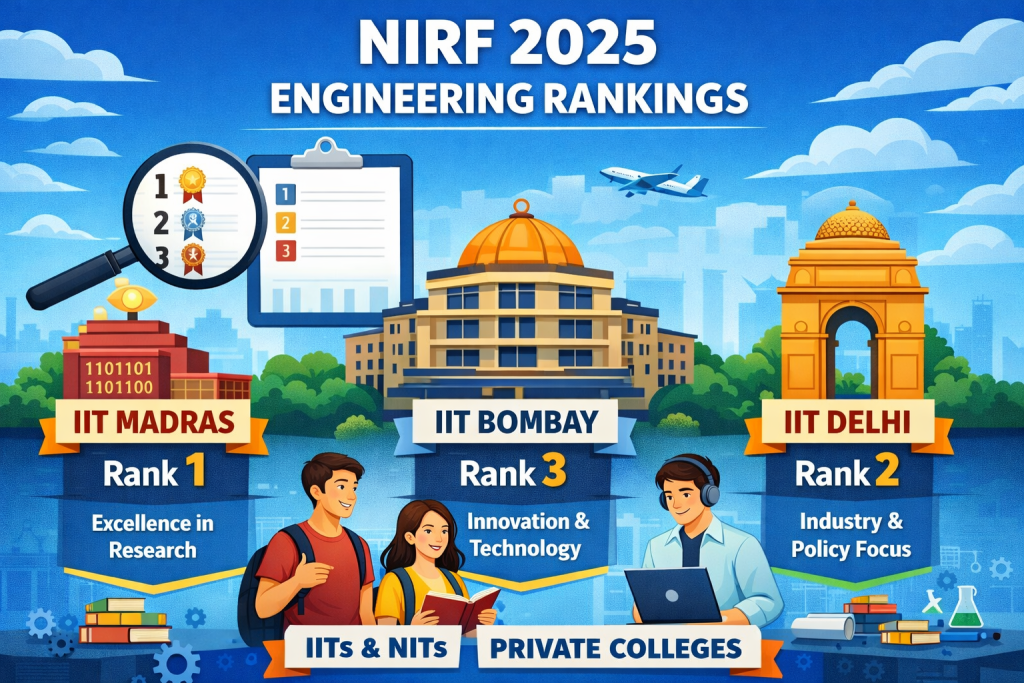
However, rankings alone should not be the final decision factor. A higher rank does not always mean a better fit for every student. Factors like preferred branch, entrance exam performance, location, fees, campus environment, and long-term academic goals also play a major role.
In this guide, we present the top 50 engineering colleges in India as per NIRF 2025, along with practical insights to help students and parents understand how to use this list correctly. The aim is not just to show rankings, but to support informed, realistic, and confident college choices.
What Is NIRF Ranking and Why It Matters for Engineering Aspirants
For students planning an engineering career and parents looking for a trusted reference, the NIRF ranking helps bring clarity to college selection. The nirf engineering ranking 2025 offers a structured way to compare engineering institutes across India using uniform and transparent criteria. Instead of relying on advertisements or opinions, students can see how colleges perform on academic and outcome-based factors.
These rankings are especially useful during shortlisting. They help parents understand the overall academic environment of an institute, while students get a fair idea of where strong teaching, research, and campus resources are available. However, NIRF should be used as a guidance tool, not as the only decision-maker.
Who releases the NIRF rankings?
The NIRF rankings are released by the Ministry of Education, Government of India. They are published every year after a detailed data review process that includes information submitted by colleges and independent evaluation. Because the process is government-led and consistent each year, parents often trust NIRF as a reliable and unbiased reference.
Parameters used in NIRF 2025 engineering rankings
The NIRF ranking parameters focus on five main areas: teaching and learning resources, research and professional work, graduation outcomes, outreach and inclusivity, and peer perception. Together, these factors help show how well an engineering college supports students academically, professionally, and socially.
Top 50 Engineering Colleges in India as per NIRF 2025
The top 50 engineering colleges in India as per NIRF 2025 are listed below to help students and parents compare institutes using a common and official reference. This list is based on the latest NIRF engineering rankings released by the Ministry of Education and reflects overall institutional performance, not individual branch strength.
For parents, this table gives a clear snapshot of where an institute stands nationally. For students, it helps in shortlisting colleges before looking deeper into branches, entrance cut-offs, fees, and location. The rankings are shown rank wise, along with the previous year’s position, to indicate stability or movement.
Top 50 Engineering Colleges in India (NIRF 2025 – Rank Wise)
| NIRF 2025 Rank | NIRF 2024 Rank | Institute Name | State |
| 1 | 1 | IIT Madras | Tamil Nadu |
| 2 | 2 | IIT Delhi | Delhi |
| 3 | 3 | IIT Bombay | Maharashtra |
| 4 | 4 | IIT Kanpur | Uttar Pradesh |
| 5 | 5 | IIT Kharagpur | West Bengal |
| 6 | 6 | IIT Roorkee | Uttarakhand |
| 7 | 8 | IIT Hyderabad | Telangana |
| 8 | 7 | IIT Guwahati | Assam |
| 9 | 9 | NIT Tiruchirappalli | Tamil Nadu |
| 10 | 10 | IIT BHU, Varanasi | Uttar Pradesh |
| 11 | 20 | BITS Pilani | Rajasthan |
| 12 | 16 | IIT Indore | Madhya Pradesh |
| 13 | 19 | NIT Rourkela | Odisha |
| 14 | 13 | SRM Institute of Science and Technology | Tamil Nadu |
| 15 | 15 | IIT (ISM) Dhanbad | Jharkhand |
| 16 | 11 | Vellore Institute of Technology | Tamil Nadu |
| 17 | 17 | NIT Karnataka, Surathkal | Karnataka |
| 18 | 12 | Jadavpur University | West Bengal |
| 19 | 34 | IIT Patna | Bihar |
| 20 | 14 | Anna University | Tamil Nadu |
| 21 | 25 | NIT Calicut | Kerala |
| 22 | 26 | Siksha ‘O’ Anusandhan | Odisha |
| 23 | 23 | Amrita Vishwa Vidyapeetham | Tamil Nadu |
| 24 | 24 | Jamia Millia Islamia | Delhi |
| 25 | 18 | IIT Gandhinagar | Gujarat |
| 26 | 31 | IIT Mandi | Himachal Pradesh |
| 27 | 28 | IIT Jodhpur | Rajasthan |
| 28 | 21 | NIT Warangal | Telangana |
| 29 | 29 | Thapar Institute of Engineering & Technology | Punjab |
| 30 | 27 | Delhi Technological University | Delhi |
| 31 | 32 | Chandigarh University | Punjab |
| 32 | 22 | IIT Ropar | Punjab |
| 33 | 36 | Kalasalingam Academy of Research & Education | Tamil Nadu |
| 34 | 33 | Aligarh Muslim University | Uttar Pradesh |
| 35 | 35 | KL Deemed to be University | Andhra Pradesh |
| 36 | 37 | KIIT University | Odisha |
| 37 | 30 | Amity University | Uttar Pradesh |
| 38 | 47 | IIIT Hyderabad | Telangana |
| 39 | 54 | IIT Bhubaneswar | Odisha |
| 40 | 38 | SASTRA Deemed University | Tamil Nadu |
| 41 | 41 | Institute of Chemical Technology | Maharashtra |
| 42 | 43 | MNIT Jaipur | Rajasthan |
| 43 | 42 | UPES | Uttarakhand |
| 44 | 39 | VNIT Nagpur | Maharashtra |
| 45 | 53 | Saveetha Institute of Medical & Technical Sciences | Tamil Nadu |
| 46 | – | Symbiosis International University | Maharashtra |
| 47 | 46 | SSN College of Engineering | Tamil Nadu |
| 48 | 50 | Lovely Professional University | Punjab |
| 49 | 44 | NIT Durgapur | West Bengal |
| 50 | 40 | NIT Silchar | Assam |
This top 50 engineering colleges in India rank wise list should be used as a reference point. Students are advised to combine this information with branch availability, entrance exam performance, and personal goals before making final admission decisions.
Key Highlights from NIRF 2025 Engineering Rankings
The NIRF 2025 results give more insight than just rank positions. For students and parents reviewing the top engineering colleges in India NIRF list, these highlights explain why certain institutes consistently perform well and how different types of colleges compare at a national level.
Why IIT Madras continues to lead
IIT Madras has once again secured the top position due to its balanced performance across academics, research, and student outcomes. Strong faculty depth, high-quality research output, and stable graduation results play a key role. From a parent’s point of view, this consistency shows reliability. For students, it reflects an environment where academic support and opportunities remain strong year after year.
Also Read: IIT Madras – A Complete Guide to India’s Top Engineering Institute
IIT Delhi and IIT Bombay in NIRF 2025: What Students Should Know
IIT Delhi and IIT Bombay consistently feature among the top engineering colleges in India NIRF, and their close rankings often confuse students and parents. Both institutes offer strong academics, research exposure, and career opportunities, but their strengths differ slightly in approach and environment.
IIT Delhi: Strong industry and policy exposure
IIT Delhi performs well in the IITs NIRF ranking 2025 due to its balanced focus on academics, research, and industry collaboration. Its location in the national capital gives students better exposure to policy institutions, startups, and internships. For parents, this often translates into wider career options and professional networking opportunities for students.
Also read: IIT Delhi: Courses, Fees, Cut-off, Placements & Campus Life
IIT Bombay: Research depth and global reputation
IIT Bombay is known for its strong research culture and international academic connections. Students benefit from advanced laboratories, active innovation cells, and a highly competitive peer group. From a parent’s perspective, IIT Bombay’s long-standing reputation and alumni presence provide confidence in academic quality and long-term outcomes.
Both institutes remain top choices, and students should compare them based on branch availability, personal learning style, and location preference rather than rank difference alone.
Also read: IIT Bombay Admission Process: NIRF Ranking, Fees & Hostel Life.
Performance of IITs vs NITs
In the IITs NIRF ranking 2025, IITs continue to dominate the top ranks, mainly because of advanced research facilities and global academic exposure. NITs, however, maintain solid positions within the top 50 and perform well in teaching quality and regional accessibility. For many students, NITs offer a good balance of affordability, strong academics, and competitive peer groups.
Rise of private engineering institutes
Several private engineering colleges NIRF ranked institutions have shown steady improvement. Their focus on infrastructure, industry-linked programs, and modern teaching methods has helped them move up the rankings. For parents, this indicates more quality options beyond government colleges, especially when entrance rank or location limits choices.
How Students and Parents Should Use NIRF Rankings (Important)
NIRF rankings are a helpful reference, but they should be used with care during engineering college selection India. For both students and parents, the goal is not to chase the highest rank, but to choose a college that matches academic ability, career plans, and personal comfort. Using NIRF as a guide, not a final rule, leads to better long-term decisions.
Why rank alone should not decide your college
A higher-ranked college does not automatically suit every student. Rankings reflect overall institutional performance, not how well a specific student will adapt or succeed there. Parents should also note that factors like class size, teaching approach, and student support systems vary widely. This is why understanding how to choose engineering college goes beyond just looking at numbers.
Branch preference vs college rank
For many students, getting the right branch matters more than the college’s overall rank. Studying a preferred branch in a slightly lower-ranked institute often leads to better interest, performance, and career clarity. Parents should support this choice by focusing on learning quality and future opportunities rather than brand value alone.
Location, fees, and peer group factors
Location affects daily life, safety, travel, and living costs. Fees and scholarship options also play a major role in long-term affordability. Equally important is the peer group, as motivated classmates create a better learning environment. Considering these factors together helps families make balanced and practical college choices.
IITs, NITs, and Private Colleges in NIRF 2025 – What’s the Difference?
The NIRF 2025 rankings include a mix of IITs, NITs, and private institutions, each serving students in different ways. For parents and aspirants, understanding these differences helps in realistic shortlisting instead of comparing colleges only by rank numbers.
IIT ecosystem and academic exposure
IITs are known for their strong academic culture, research focus, and competitive peer group. Students benefit from advanced labs, experienced faculty, and exposure to national and international opportunities. For parents, IITs often signal long-term academic stability and strong alumni support, which reflects in consistent performance across NIRF parameters.
NITs and regional advantages
In the NITs engineering ranking India, many institutes continue to hold solid positions due to quality teaching and balanced academic systems. NITs are spread across different states, making them accessible to students from various regions. For families, this often means lower living costs, cultural familiarity, and good government-backed education with reasonable fees.
When private colleges make sense
Several private engineering colleges NIRF ranked institutes offer modern infrastructure, industry-linked courses, and flexible learning models. These colleges can be a good option when entrance exam ranks limit government college choices or when students prefer specific programs or locations. Parents should assess faculty quality, academic discipline, and long-term outcomes before finalising such options.
Common Mistakes Students Make While Following NIRF Rankings
The nirf ranking 2025 engineering colleges list is a useful reference, but many students make avoidable mistakes while using it for college decisions. Parents often assume that a higher rank automatically means a better outcome, which is not always true. Understanding these common errors can help families make more balanced choices.
Ignoring branch cut-offs
One of the biggest mistakes is focusing only on the college rank and ignoring branch cut-offs. A student may get admission into a lower-preference branch in a top-ranked college, which can affect interest and performance. Parents should consider whether the branch aligns with the student’s strengths and future plans.
Chasing top 5 colleges blindly
Many students aim only for the top 5 colleges without checking realistic admission chances. This approach can lead to missed opportunities in well-ranked institutes just below the top tier. A wider and practical shortlist often results in better academic comfort and growth.
Overlooking affordability and distance
Fees, hostel costs, and travel distance are sometimes ignored during shortlisting. For parents, long-term affordability and the student’s ability to adjust to a new location are important factors. These practical aspects strongly influence a student’s overall college experience.
Frequently Asked Questions (FAQs)
Q. Is NIRF ranking the best way to choose an engineering college?
NIRF rankings are a helpful starting point, but they should not be the only deciding factor. Students and parents should also consider branch availability, entrance exam cut-offs, fees, and personal comfort. Using rankings along with these factors leads to better decisions.
Q. Is NIRF ranking reliable for parents?
Yes, many parents trust NIRF because it is released by the Ministry of Education using a clear evaluation process. However, it reflects overall institutional performance and not individual student experience. This is why additional research is always useful.
Q. Does NIRF ranking affect placements?
NIRF ranking itself does not guarantee placements. Higher-ranked colleges usually have better infrastructure and exposure, which can support placements. Final outcomes still depend on the student’s skills, branch, and academic performance.
Q. Should students prefer branch or college rank?
In most cases, choosing the right branch is more important than choosing a higher-ranked college. Students tend to perform better when they study a subject they are interested in. Parents should support branch-focused decisions for long-term clarity.
Q. Are private colleges in NIRF rankings worth considering?
Some private colleges perform well in academics and industry exposure. When government options are limited, NIRF-ranked private institutes can be a practical choice. Parents should review faculty quality, discipline, and past student outcomes.
Q. Where can I check the official NIRF 2025 list?
Students and parents can check the official nirf ranking 2025 list on the NIRF website managed by the Ministry of Education. This ensures access to updated and accurate information.
Q. Is the NIRF ranking 2025 PDF available?
Yes, the nirf ranking 2025 pdf is available on the official NIRF portal. It contains detailed rankings and scores for engineering and other categories.
Q. Does NIRF ranking change every year?
Yes, rankings are updated every year based on fresh data. Colleges may move up or down depending on their recent academic, research, and student outcome performance.
Q. Can students rely only on NIRF rankings for counselling?
No, rankings should be used as guidance during counselling. Students should also look at branch cut-offs, counselling rules, location, and affordability to make a confident final choice.