
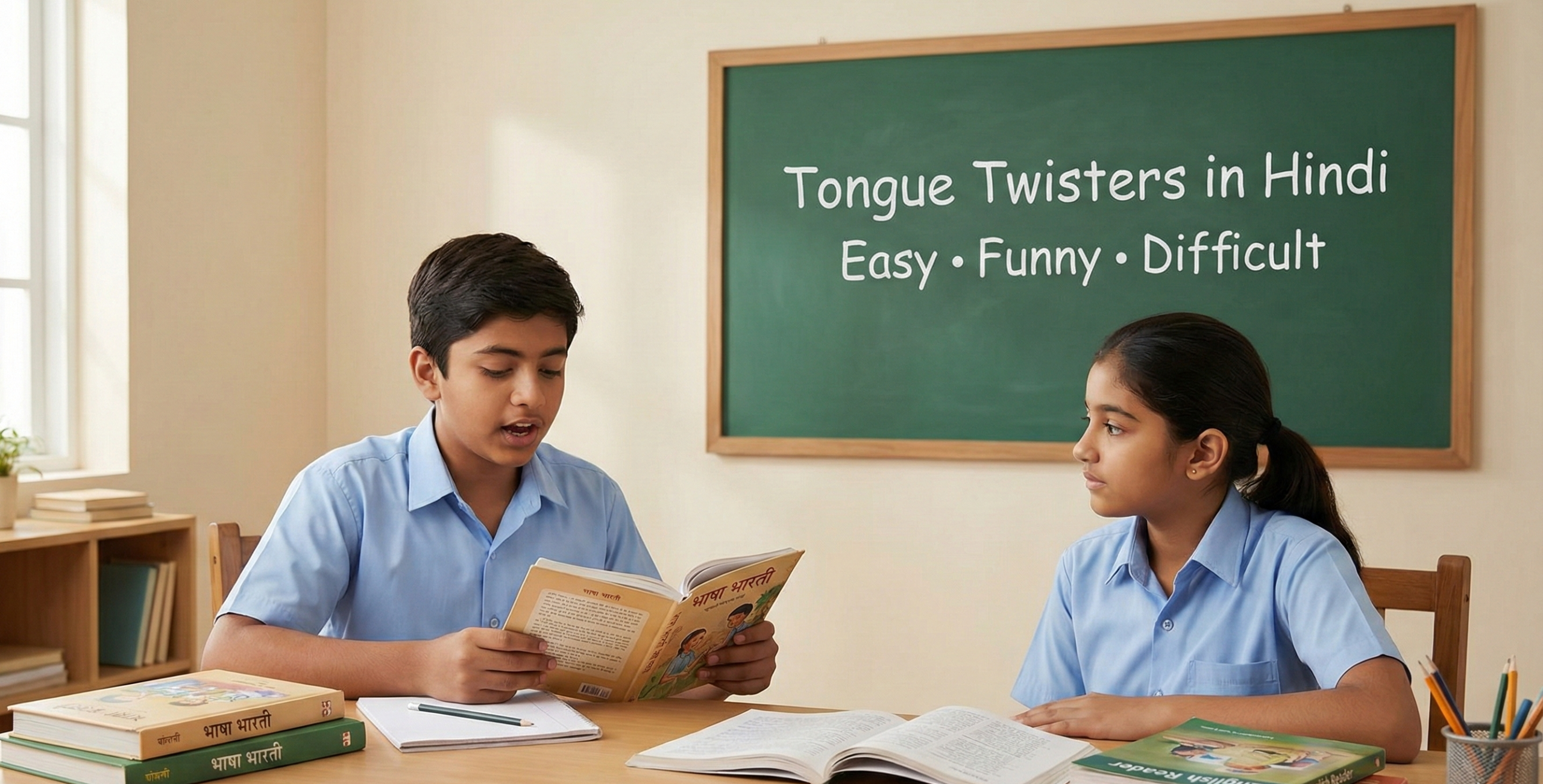

What Are Tongue Twisters in Hindi? (Meaning & Purpose)
Tongue twisters in Hindi are short sentences or phrases made with similar-sounding words that are intentionally difficult to pronounce quickly and clearly. Understanding the tongue twisters in Hindi meaning is important for both students and parents, because these lines are not just for fun, they are a practical tool to improve speaking skills.
For school students, especially from Classes 6 to 10, tongue twisters in Hindi help strengthen pronunciation, clarity of speech, and reading confidence. When a student repeats these lines slowly and correctly, it trains the tongue, lips, and mind to coordinate better while speaking. This is especially helpful for students who hesitate while reading aloud, mix up sounds, or feel nervous during oral exams and classroom activities.

For parents, tongue twisters in Hindi offer a simple and pressure-free way to support language development at home. They do not require special materials or long study hours. Just a few minutes of regular practice can help children become more comfortable with Hindi sounds and sentence flow.
In simple terms, tongue twisters are structured speaking exercises. When used correctly, they support clear communication, better confidence, and stronger language basics, skills that matter throughout school life and beyond.

Why Tongue Twisters Help Students Improve Speaking Skills
Tongue twisters in Hindi play a practical role in improving a student’s speaking skills when used correctly and regularly. For school students, especially in the middle and secondary classes, clear speech is not just about language marks, it directly affects reading aloud, classroom participation, and overall confidence.
From an educational point of view, tongue twisters work like structured speech exercises. They train students to pronounce similar sounds accurately, control their pace while speaking, and reduce common mistakes such as mixing letters or skipping syllables. This is why many teachers consider the best tongue twisters in Hindi useful for daily speaking and reading practice, not just as a fun activity.
For younger learners, tongue twisters in Hindi for kids help build comfort with sounds at an early stage. Repeating these lines improves mouth movement coordination and makes students more confident while reading textbooks or answering orally in class. Over time, this practice supports clearer expression and better fluency.
For parents, the value is simple and practical. Tongue twisters require no extra study material and can be practiced at home in a stress-free way. Even a few minutes of guided practice helps students speak more clearly, read with confidence, and communicate their thoughts without hesitation, skills that support learning across all subjects.
Easy Tongue Twisters in Hindi (For Beginners & Kids)
Easy tongue twisters in Hindi are ideal for students who are new to speaking practice or feel nervous while reading aloud. For Class 6-8 students, this stage is crucial because pronunciation habits are still forming. Using tongue twisters in Hindi easy format helps students practise sounds clearly without feeling pressured or confused by complex words.
These tongue twisters focus on simple word patterns and commonly used Hindi sounds. When practised slowly and regularly, they help students improve clarity, reduce hesitation, and gain control over their speech. This is especially helpful for students who make mistakes while reading textbooks, hesitate during oral answers, or struggle to pronounce similar-sounding words.
For parents, tongue twisters in Hindi for kids are a safe and practical learning tool. They can be practised at home in a relaxed environment and do not require extra study time or special materials. Even 5-10 minutes of daily practice can support better speaking confidence and smoother reading flow.
Students should start by reading each line slowly, focusing on correct pronunciation. Speed should be increased only after accuracy improves. Regular practice builds confidence gradually and prepares students for classroom speaking, oral exams, and daily communication in Hindi.
Easy Tongue Twisters in Hindi for Daily Practice
- कच्चा पापड़, पक्का पापड़
- राम ने राधा से रसगुल्ला लिया
- नानी ने नन्हे नीलू को नौ नीलम दिए
- टोपी वाले पापा टोपी पहनकर आए
- चिंटू चाचा चाय चम्मच से पीते हैं
- लाल लोहे की रेल लाइन
- मीना ने मीठा आम मंगाया
- गोल गिलहरी गमले के पास गई
These easy tongue twisters in Hindi are suitable for daily practice. Students should repeat each line 3-4 times slowly, then try again with slightly increased speed. Consistent practice will help improve pronunciation, clarity, and overall speaking confidence.
Short Tongue Twisters in Hindi (Quick Speaking Practice)
Tongue twisters in Hindi are commonly used by teachers and students for quick speaking practice, especially when time is limited. Among them, short tongue twisters in Hindi are most effective because they are easy to remember and can be practised in just a few minutes.
These short lines help students focus on clear pronunciation and sound accuracy without feeling overwhelmed. When repeated regularly, they improve mouth movement control, reduce hesitation, and support better reading aloud. Many teachers use a set of 10 tongue twisters in Hindi as short warm-up exercises before oral reading or speaking activities, as they help students shift into a focused learning mode.
For students who feel shy or unsure while speaking, short tongue twisters are less intimidating than long sentences. They allow gradual improvement and build confidence step by step. Parents also find this format useful because it fits easily into daily routines and does not add academic pressure.
Short Tongue Twisters in Hindi for Daily Practice
- कच्चा पापड़, पक्का पापड़
- लाल लोहे की रेल लाइन
- नानी ने नन्हे नीलू को नौ नीलम दिए
- राम ने राधा से रसगुल्ला लिया
- चिंटू चाचा चाय पीते हैं
- मीना ने मीठा आम खाया
- गोल गिलहरी गमले के पास गई
- टोपी वाले पापा टोपी पहनते हैं
- बिल्लू बोला बबलू से
- छोटा चूहा चटनी चाटे
How to practise:
Students should start slowly, focus on clear pronunciation, and repeat each line 3-4 times. Speed should be increased only after accuracy improves. Regular practice helps improve clarity, confidence, and fluency in Hindi speaking.
Funny Tongue Twisters in Hindi (Learning with Fun)
Tongue twisters in Hindi can make speaking practice more engaging for students when used in a safe and structured way. Funny tongue twisters in Hindi help students stay interested while practising pronunciation, without turning learning into jokes or distractions. The focus remains on clarity, sound accuracy, and confidence.
These tongue twisters use playful word patterns that naturally create a light learning atmosphere. This helps students relax and participate more actively in speaking exercises. Teachers often include some of the best tongue twisters in Hindi during oral practice to keep students attentive, especially those who hesitate or lose focus during repetitive drills.
For parents, this type of practice is useful because it combines learning with enjoyment without adding pressure. Students practise willingly, which leads to better consistency and improvement over time.
Funny Tongue Twisters in Hindi for Students
- चंदू के चाचा ने चंदू की चाची को चांदनी चौक में चांदी की चम्मच चटाई
- खड़क सिंह के खड़कने से खड़कती हैं खिड़कियाँ
- ऊँट ऊँचा, ऊँट की पीठ ऊँची
- बंदर क्या जाने अदरक का स्वाद
- पीतल के पतीले में पपीता पीला
- सड़क पर चढ़ी छिपकली फिसल गई
- टोपी वाले पापा टोपी पहनकर पान खा रहे हैं
- नटखट नंदू ने नीली नंदी को नहलाया
Practice tip:
Students should read each line slowly first, focusing on correct pronunciation. Speed should be increased only after clarity improves. Practising 5-10 minutes daily is enough to build confidence without fatigue.
Difficult Tongue Twisters in Hindi (Advanced Practice)
Tongue twisters in Hindi are useful at every learning stage, but for senior school students, they serve a more advanced purpose. For Class 9-10 students who already have basic speaking clarity, difficult tongue twisters in Hindi help improve fluency, speed control, and accuracy under pressure. At this level, students often face longer reading passages, oral assessments, presentations, and classroom discussions where confident speech is important.
Advanced tongue twisters combine similar sounds, longer words, and faster transitions between syllables. Practising tongue twisters in Hindi hard format challenges students to maintain clarity while increasing speed. This helps reduce common issues such as slurring words, missing sounds, or rushing through sentences while speaking.
For students, this practice builds strong speaking discipline and confidence. For parents, it provides a structured and meaningful way to support advanced language practice at home without adding extra academic load. Even 5-10 minutes of focused practice can make a visible difference over time.
Students should always start slowly, focus on accuracy first, and increase speed only when pronunciation remains clear. Consistency is more important than speed.
Hard Tongue Twisters in Hindi for Fluency & Speed
- खड़क सिंह के खड़कने से खड़कती हैं खिड़कियाँ
- पीतल के पतीले में पपीता पीला पीसकर रखा
- चंदू के चाचा ने चंदू की चाची को चांदनी चौक में चांदी की चम्मच चटाई
- सड़क पर चढ़ी छिपकली फिसलकर नीचे गिरी
- ऊँट ऊँचा, ऊँट की पीठ ऊँची, ऊँट से ऊँची ऊँचाई
- नटखट नंदू ने नीली नंदी को नहर में नहलाया
- टोपी वाले पापा टोपी पहनकर पान खाते हुए पार्क पहुँचे
- लाल लोहे की रेल लाइन पर रेल तेज़ी से दौड़ी
- ककड़ी काटकर कचरे के डिब्बे में रखी गई
- बंदर क्या जाने अदरक का स्वाद, अदरक है कड़वा
Practice guidance:
- Read each line slowly first
- Repeat 3-4 times with correct pronunciation
- Increase speed only when clarity remains intact
- Practise daily for 5-10 minutes
This level of practice helps students speak clearly even at higher speeds, improves reading aloud, and builds confidence for school presentations and oral exams.
Hindi and English Tongue Twisters (For Bilingual Practice)
Tongue twisters in Hindi and English are especially helpful for students who regularly switch between both languages at school. In Indian classrooms, students often read English textbooks, speak in Hindi with teachers or friends, and answer questions using a mix of both. Practising tongue twisters in Hindi and English helps students manage this transition smoothly and speak with better clarity.
For students studying in bilingual or English-medium schools, switching languages can sometimes cause hesitation, mispronunciation, or loss of fluency. Regular practice with both Hindi and English tongue twisters trains the mouth and mind to adapt to different sound patterns. This improves reading aloud, classroom responses, and overall speaking confidence.
For parents, bilingual tongue twisters are a simple tool to support language development at home. They do not add academic pressure and can be practised in short sessions. Over time, this practice helps students become more comfortable expressing themselves clearly in both languages, which is important for exams, presentations, and everyday communication.
Hindi and English Tongue Twisters for Daily Practice
Hindi Tongue Twisters
- कच्चा पापड़, पक्का पापड़
- लाल लोहे की रेल लाइन
- नानी ने नन्हे नीलू को नौ नीलम दिए
- पीतल के पतीले में पपीता पीला
English Tongue Twisters
- She sells seashells by the seashore
- Peter Piper picked a peck of pickled peppers
- Red lorry, yellow lorry
- Unique New York
How to practise bilingually:
- Start with Hindi tongue twisters and focus on clear pronunciation
- Switch to English tongue twisters slowly
- Avoid mixing languages in one sentence during practice
- Repeat each line 3-4 times before increasing speed
Regular bilingual practice improves pronunciation control, reduces hesitation while switching languages, and builds confidence in both Hindi and English speaking.
How Students Should Practice Tongue Twisters Correctly
Tongue twisters in Hindi are most effective only when students practise them in the right way. Simply speaking them fast does not improve clarity or confidence. To gain real benefit, students need a structured and patient approach that focuses on accuracy first and speed later.
For students, especially from Classes 6 to 10, correct practice helps improve pronunciation, reading aloud, and speaking confidence. The first step is to read each tongue twister slowly and clearly, paying attention to every sound. Students should not rush. If a word feels difficult, it should be repeated separately before saying the full line again. This helps the mouth and mind coordinate better.
Parents play an important role here. A calm and supportive environment matters more than correction or pressure. Parents should encourage children to practise for short durations, ideally 5-10 minutes a day, instead of long sessions. Listening patiently and appreciating effort builds confidence and consistency.
Students should increase speed only when they can say the tongue twister clearly without mistakes. Using a mirror while practising can also help students notice mouth movements and improve clarity. Regular, correct practice leads to gradual improvement in speech control, confidence, and fluency. When practised with discipline and patience, tongue twisters become a simple yet effective tool for stronger communication skills.
Tips for Parents to Help Children with Speaking Practice
Tongue twisters in Hindi can be a helpful speaking practice tool when parents use them with the right approach at home. For many students, especially in Classes 6 to 10, speaking hesitation does not come from lack of ability but from fear of making mistakes. A supportive and calm environment plays a key role in overcoming this.
Parents should focus on encouragement rather than correction. Listening patiently and appreciating effort helps children feel comfortable while speaking. It is important to keep practice sessions short and relaxed. Five to ten minutes of daily practice is more effective than long, pressured sessions. The goal is to build confidence, not speed.
Parents can also practise along with their children. This removes performance pressure and makes the activity feel normal and shared. If a child struggles with a line, parents should allow repetition without pointing out errors repeatedly. Gentle guidance works better than strict monitoring.
Most importantly, parents should avoid comparisons or expectations of quick improvement. Speaking skills develop gradually with regular practice. With patience and consistent support, children become more confident, clear, and comfortable while expressing themselves in Hindi, both at home and in school.
FAQs – “People Also Ask”
Q. What are tongue twisters in Hindi?
Tongue twisters in Hindi are short sentences made with similar sounds that are difficult to pronounce quickly. They help students practise clear pronunciation and speaking control.
Q. Are tongue twisters useful for school students?
Yes. Tongue twisters help students improve pronunciation, reading aloud, and speaking confidence, which are important for classroom participation and oral exams.
Q. Which tongue twisters are best for beginners?
Easy and short tongue twisters with simple words are best for beginners. Students should start slowly and focus on clear pronunciation before increasing speed.
Q. How often should students practise tongue twisters?
Students can practise for 5–10 minutes daily. Regular short practice is more effective than long or irregular sessions.
Q. Can tongue twisters help in exams or oral tests?
Yes. Regular practice improves clarity and confidence, which helps students perform better in oral exams, presentations, and reading-based assessments.
Q. Are tongue twisters suitable for Class 9 and 10 students?
Yes. Difficult tongue twisters are useful for Class 9–10 students to improve fluency, speed control, and accurate pronunciation under pressure.
Q. Can parents help children practise tongue twisters at home?
Yes. Parents can support by creating a calm environment, encouraging daily practice, and avoiding pressure or constant correction.
Q. Do tongue twisters help both Hindi and English speaking?
Yes. Practising tongue twisters in Hindi and English helps students switch between languages smoothly and speak more confidently in bilingual classrooms.
Q. Is speed more important than clarity while practising tongue twisters?
No. Clarity is more important than speed. Students should increase speed only after they can pronounce each word clearly.
Q. At what age can children start practising tongue twisters?
Children can start practising easy tongue twisters from primary classes. The difficulty level should increase gradually as speaking confidence improves.