What is SSC MTS?
SSC MTS stands for Staff Selection Commission Multi-Tasking Staff. It is a national-level recruitment examination conducted by the Staff Selection Commission (SSC) to fill Group C, non-gazetted, non-ministerial posts across various central government ministries, departments, and offices.
In simpler terms, SSC MTS is a government job exam for students who have passed their Class 10 (Matriculation) examination.
SSC MTS Full Form
The full form of SSC MTS is Staff Selection Commission Multi-Tasking Staff. The post of Multi-Tasking Staff (MTS) is a Group-C non-gazetted post in government offices. MTS employees perform various routine tasks that help maintain smooth functioning of offices.
Departments Where MTS Employees Work
Selected candidates may work in different departments such as:
- Ministries of the Government of India
- Central government offices
- Government departments
- Central administrative offices
- Income Tax offices
- Customs and Excise departments
Because of job stability and government benefits, the SSC MTS job is considered a good opportunity for many candidates.
What Does a Multi-Tasking Staff Employee Do?
MTS employees handle essential support functions in government offices. Their work includes:
- Filing and maintaining records
- Delivering dak (official correspondence) within and outside the office
- Cleaning and maintaining office premises
- Assisting senior officials in day-to-day tasks
- Running official errands and managing supplies
- Operating duplicating machines, photocopiers, and basic office equipment
It’s a foundational government job steady, respected, and a gateway to further promotions through departmental exams.

SSC MTS 2026
Here’s a quick snapshot of everything important about SSC MTS 2026:
| Parameter |
Details |
| Conducting Body |
Staff Selection Commission (SSC) |
| Exam Name |
Multi-Tasking (Non-Technical) Staff and Havaldar Exam |
| Post Names |
MTS (Multi-Tasking Staff) & Havaldar (CBIC & CBN) |
| Exam Level |
National |
| Educational Qualification |
Class 10 Pass (Matriculation) |
| Age Limit |
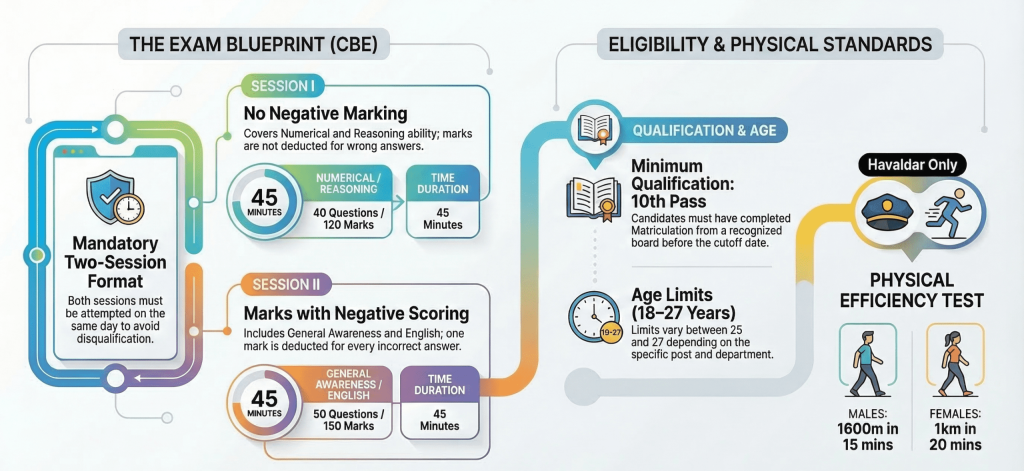
18 to 25 years (MTS); 18 to 27 years (Havaldar) |
| Mode of Application |
Online (ssc.gov.in) |
| Exam Mode |
Computer Based Test (CBT) |
| Official Website |
ssc.gov.in |
SSC MTS Exam Dates 2026 (Expected)
The official notification for SSC MTS 2026 will be released by the Staff Selection Commission on its official website. Candidates should regularly check the notification to stay updated.
Below is the expected schedule for SSC MTS 2026.
| Event |
Expected Date |
| SSC MTS Notification Release |
June 2026 |
| Online Application Start |
June 2026 |
| Last Date to Apply |
July 2026 |
| Application Correction Window |
July 2026 |
| Admit Card Release |
September 2026 |
| SSC MTS Exam Date |
September – October 2026 |
| Result Declaration |
December 2026 |
Candidates should complete the application form before the deadline to avoid last-minute issues.
SSC MTS Eligibility Criteria
Before applying, it is critical to confirm that you meet the eligibility requirements. Many students lose out simply because they miss checking one condition.
Educational Qualification
- Candidates must have passed Matriculation Examination (Class 10) or equivalent from a recognized board or university.
- There is no graduation requirement making this exam uniquely accessible.
Age Limit
| Post |
Minimum Age |
Maximum Age |
| MTS (Multi-Tasking Staff) |
18 years |
25 years |
| Havaldar (CBIC & CBN) |
18 years |
27 years |
Age is calculated as of the 1st August of the exam year.
Age Relaxation (As per Government Norms)
| Category |
Relaxation |
| OBC (Non-Creamy Layer) |
3 years |
| SC / ST |
5 years |
| PwD (Unreserved) |
10 years |
| PwD + OBC |
13 years |
| PwD + SC/ST |
15 years |
| Ex-Servicemen |
As per Govt. rules |
Nationality
Candidates must be:
- A citizen of India, or
- A subject of Nepal or Bhutan, or
- A Tibetan refugee who came to India before January 1, 1962
SSC MTS Apply Online – Step-by-Step Process
Applying for SSC MTS is straightforward once you understand the steps. Here’s a clean, step-by-step breakdown:
How to Apply for SSC MTS Online
Step 1: Visit the Official Website Go to ssc.gov.in the only official platform for SSC MTS applications.
Step 2: Register as a New User
- Click on “Register Now” under the New User section.
- Fill in your name, date of birth, mobile number, and email ID.
- You will receive an OTP for verification.
Step 3: Log In with Your Credentials
- Use your Registration Number and Password to log in.
- Proceed to the SSC MTS application form.
Step 4: Fill in the Application Form Provide accurate details including:
- Personal information (name, father’s name, DOB, gender, category)
- Contact information (address, mobile, email)
- Educational qualifications
- Preference of exam centres
Step 5: Upload Required Documents Upload scanned copies of:
- Recent passport-size photograph (20–50 KB, JPEG)
- Signature (10–20 KB, JPEG)
- Left thumb impression (if required in that cycle)
Step 6: Pay the Application Fee
| Category |
Fee |
| General / OBC / EWS |
₹100 |
| SC / ST / PwD / ESM / Female |
Nil (Exempted) |
Payment can be made via:
- BHIM UPI
- Net Banking
- Debit/Credit Card
- SBI Challan (offline)
Step 7: Submit and Save
- Review all details before submitting.
- Download and print the confirmation page for future reference.
Tips for Applying
- Use a valid and active email ID and mobile number all official communication will be sent there.
- Upload clear, high-quality documents to avoid rejection.
- Double-check your date of birth and category before submission these cannot be changed later.
SSC MTS Last Date to Apply
The SSC MTS last date to apply is one of the most critical deadlines for aspirants.
For the SSC MTS 2024 cycle, the application window typically remains open for 30–45 days after the notification.
Important reminders:
- Do not wait until the last day server overload can cause technical issues.
- The fee payment deadline may be 1–2 days after the final application date.
- Late submissions are not accepted under any circumstances.
Bookmark ssc.gov.in and check it daily during the notification period to stay updated.
SSC MTS Syllabus
Understanding the SSC MTS syllabus is the foundation of smart preparation. The 2024 exam tests candidates on a focused set of subjects designed to assess fundamental competency.
SSC MTS Exam Syllabus Complete Breakdown
The exam consists of two sessions in the Computer Based Test (CBT):
Session 1 — Numerical and Mathematical Ability + Reasoning Ability and Problem Solving
Part A: Numerical and Mathematical Ability (20 Questions – 60 Marks)
Topics include:
- Number Systems (natural numbers, integers, fractions, decimals)
- Fundamental Arithmetic Operations (BODMAS, HCF, LCM)
- Percentages
- Ratio and Proportion
- Simple and Compound Interest
- Profit and Loss
- Discount
- Time, Speed and Distance
- Time and Work
- Basic Mensuration (area and perimeter of squares, rectangles, circles)
- Data Interpretation (tables, bar graphs, pie charts)
Part B: Reasoning Ability and Problem Solving (20 Questions | 60 Marks)
Topics include:
- Alpha-Numeric Series
- Coding-Decoding
- Analogy
- Similarities and Differences
- Jumbling
- Problem Solving and Analysis
- Non-Verbal Reasoning (pattern completion, figure classification)
- Embedded Figures
- Critical Thinking
- Emotional and Social Intelligence
Session 2 — General Awareness + English Language & Comprehension
Part A: General Awareness (25 Questions – 75 Marks)
Topics include:
- History of India (Ancient, Medieval, Modern)
- Geography of India and World
- Indian Polity and Constitution
- Indian Economy
- General Science (Physics, Chemistry, Biology)
- Current Affairs (National and International)
- Static GK (important dates, awards, books & authors, sports)
- Culture, Art, and Literature
Part B: English Language and Comprehension (25 Questions – 75 Marks)
Topics include:
- Reading Comprehension
- Fill in the Blanks
- Error Spotting
- Sentence Correction
- Vocabulary (Synonyms, Antonyms)
- One Word Substitution
- Idioms and Phrases
- Cloze Test
- Spelling Correction
SSC MTS Syllabus
| Session |
Part |
Subject |
Questions |
Marks |
| Session 1 |
Part A |
Numerical & Mathematical Ability |
20 |
60 |
| Session 1 |
Part B |
Reasoning & Problem Solving |
20 |
60 |
| Session 2 |
Part A |
General Awareness |
25 |
75 |
| Session 2 |
Part B |
English Language & Comprehension |
25 |
75 |
| Total |
90 |
270 |
SSC MTS Exam Pattern
Features of the Exam Pattern
- Mode: Computer Based Test (CBT)
- Number of Sessions: 2 (on the same day or different days)
- Total Questions: 90
- Total Marks: 270
- Duration: 45 minutes per session (90 minutes for PwD candidates per session)
- Negative Marking: 1 mark deducted for every wrong answer
Important Note on Negative Marking
Many students lose marks due to random guessing. With 1 mark deducted per wrong answer, it is always better to attempt only those questions you are reasonably confident about.
SSC MTS Salary — In-Hand Pay and Perks
The SSC MTS salary is one of the biggest motivations for aspirants. Let’s break it down honestly and completely.
Pay Scale
| Post |
Pay Level |
Basic Pay |
| MTS (Multi-Tasking Staff) |
Level 1 (7th CPC) |
₹18,000 per month |
| Havaldar (CBIC & CBN) |
Level 1 (7th CPC) |
₹18,000 per month |
In-Hand Salary After Allowances
The actual in-hand salary depends on the posting city (classified as X, Y, or Z cities based on population):
| City Type |
Approx. In-Hand Salary |
| X Category (Metro cities) |
₹22,000 – ₹26,000/month |
| Y Category (Mid-size cities) |
₹20,000 – ₹23,000/month |
| Z Category (Small cities) |
₹18,500 – ₹21,000/month |
Additional Allowances and Benefits
Beyond the base pay, SSC MTS employees receive:
- Dearness Allowance (DA) — revised twice yearly
- House Rent Allowance (HRA) — based on posting location
- Transport Allowance (TA)
- Medical Benefits — CGHS coverage for employee and family
- Pension — National Pension Scheme (NPS)
- Leave Benefits — Casual leave, earned leave, medical leave
- Promotion Opportunities — Through departmental exams (to LDC, UDC, and higher grades)
The salary may seem modest at entry level, but the job security, allowances, pension, and promotion potential make SSC MTS one of the most valued entry-level government positions in India.
SSC MTS Result — How to Check
After working hard for the exam, checking your SSC MTS result is a moment of great anticipation.
Steps to Check SSC MTS Result
- Visit ssc.gov.in (the official SSC portal)
- Click on “Result” in the top navigation menu
- Select “MTS” from the dropdown
- Click on the result link for your exam year
- Enter your Roll Number and Date of Birth
- Your result will be displayed on the screen
- Download and save the result PDF
SSC MTS Result 2023 (ssc.nic.in MTS Result 2023)
Candidates who appeared in the SSC MTS 2023 exam can check their results at the official SSC portal. Note that ssc.nic.in was the older domain the commission has now migrated fully to ssc.gov.in. Both may redirect to the same portal.
The result is typically declared in the form of:
- Merit List based on normalized marks
- Cut-off scores category-wise qualifying marks
- Shortlist for Document Verification
SSC MTS Previous Year Cut-Off Trends
Understanding cut-off trends helps you set realistic preparation targets.
SSC MTS Approximate Previous Year Cut-Off (General Category)
| Year |
Session 1 Cut-Off |
Session 2 Cut-Off |
| 2023 |
130–145 (approx.) |
90–110 (approx.) |
| 2022 |
125–140 (approx.) |
85–105 (approx.) |
| 2021 |
120–138 (approx.) |
80–100 (approx.) |
Note: Cut-offs vary by state/region and category. Always refer to the official cut-off released by SSC post-result.
Insight: Scoring above 150+ in Session 1 significantly improves your chances of selection across most states.
Preparation Tips & Common Mistakes
Smart Preparation Strategy for SSC MTS
1. Start With the Syllabus Never begin preparation without reading the complete SSC MTS exam syllabus. Understand what’s included and what’s not.
2. Create a Realistic Study Schedule
- Allocate 2–3 hours daily to SSC MTS prep.
- Dedicate equal time to Maths, Reasoning, English, and GK.
- Reserve the last 30 minutes each day for current affairs revision.
3. Focus on NCERT Basics First For a 10th-pass exam, NCERT textbooks (Classes 6–10) cover most of the math, science, and social studies content. Master these before moving to advanced resources.
4. Practice Mock Tests Regularly Start mock tests at least 4 weeks before the exam. Analyse your wrong answers carefully most mistakes are conceptual, not random.
5. Revise Current Affairs Monthly Use a reliable monthly current affairs app or magazine. Focus on national awards, government schemes, sports champions, and science achievements.
6. Work on Speed and Accuracy Together With negative marking in play, rushing through questions is dangerous. Practice with a timer to build the right balance of speed and accuracy.
Common Mistakes Students Make
- Ignoring the syllabus: Many students study irrelevant topics and waste precious time.
- Skipping mock tests: Knowing the syllabus is not enough; you need exam simulation.
- Guessing randomly: With negative marking, blind guessing reduces your score.
- Neglecting English: Many students from Hindi-medium backgrounds avoid English, losing easy marks.
- Poor time management in the exam: Spending too long on one question means leaving others unattempted.
- Not saving the application form: Always print the confirmation page. You’ll need it at the admit card and document verification stage.
Conclusion
The journey from Class 10 to a Central Government job may sound like a long road but SSC MTS makes that journey shorter and far more achievable than most students realize.
Here’s what we covered today:
- SSC MTS is a national exam for 10th-pass candidates for Group C government posts.
- The SSC MTS 2024 exam includes two CBT sessions covering Maths, Reasoning, GK, and English.
- The salary starts at ₹18,000/month, with in-hand pay ranging from ₹20,000–₹26,000 after allowances.
- Applications are submitted online at ssc.gov.in, and the last date must never be missed.
- Smart preparation using NCERT basics, mock tests, and current affairs gives you a real edge.
Whether you’re 18 and just finished your boards, or 24 and looking for a stable career entry point SSC MTS is your door to a dignified, secure government career.
FAQs about SSC MTS
Q. What is SSC MTS exam?
SSC MTS (Multi-Tasking Staff) is a national-level government job exam conducted by the Staff Selection Commission. It recruits Group C support staff for central government departments. It is open to candidates who have passed Class 10 and are between 18–25 years of age.
Q. What is the SSC MTS salary in 2024?
The basic pay for SSC MTS is ₹18,000 per month (Pay Level 1, 7th CPC). With allowances like DA, HRA, and TA, the in-hand salary ranges from ₹20,000 to ₹26,000 depending on the posting city category.
Q. What is the SSC MTS syllabus 2024?
The SSC MTS 2024 syllabus covers four subjects: Numerical and Mathematical Ability, Reasoning and Problem Solving, General Awareness, and English Language & Comprehension. The exam is conducted in two sessions via Computer Based Test (CBT).
Q. How to apply for SSC MTS online?
Visit ssc.gov.in, register as a new user, fill in the application form, upload your photo and signature, pay the application fee of ₹100 (exempted for SC/ST/PwD/female/ESM), and submit. Save the confirmation page for your records.
Q. What is the SSC MTS last date to apply for 2024?
The SSC MTS 2024 application window is typically open for 30–45 days from the notification release date. For exact last dates, always check the official SSC website (ssc.gov.in) or the official notification PDF published by the commission.
Q. How can I check my SSC MTS result?
Go to ssc.gov.in, click on “Result,” select “MTS,” and enter your Roll Number and Date of Birth. Download and save your result PDF. For SSC MTS Result 2023, the link is also available on the SSC portal under the result section.
Q. What is the age limit for SSC MTS 2024?
The age limit for the MTS post is 18 to 25 years. For the Havaldar post (CBIC & CBN), the age limit is 18 to 27 years. Age relaxation is available for OBC (3 years), SC/ST (5 years), and PwD candidates (10 years) as per government norms.
Q. Is SSC MTS a good job for Class 10 pass students?
Yes, SSC MTS is one of the best government job options for Class 10 pass students. It offers job security, a steady salary with allowances, pension benefits under NPS, CGHS medical coverage, and promotion opportunities through departmental exams.