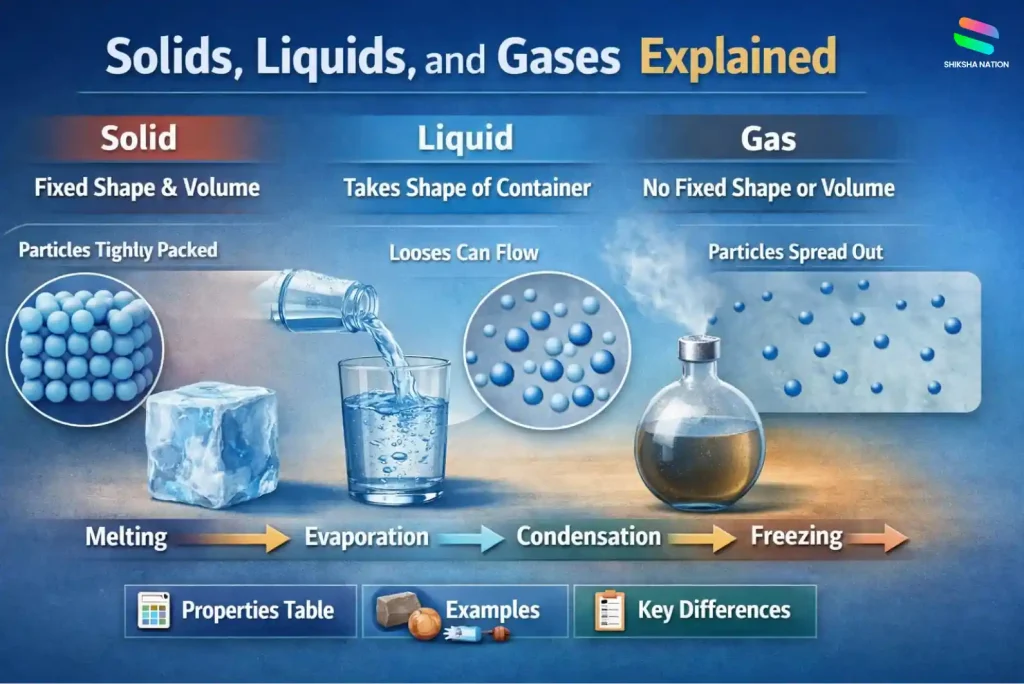
Solids, liquids and gases are the three main states of matter.
Solids have fixed shape and fixed volume, liquids have fixed volume but no fixed shape, and gases have neither fixed shape nor fixed volume.
This difference happens because of how particles are arranged and how they move.
You have seen this your whole life.
Ice is hard.
Water flows.
Air spreads everywhere.
But if someone asks why this happens, most students pause or just repeat definitions without understanding.
So instead of reading this like a chapter, understand solids liquids and gases properly. Once this is clear, most questions become easy automatically.

What are solids liquids and gases?
Solids, liquids and gases are the three main states of matter.
Solids have fixed shape and fixed volume, liquids have fixed volume but no fixed shape, and gases have neither fixed shape nor fixed volume.
This difference happens because of how particles are arranged and how they move.
Solids liquids and gases in short
Solid stays.
Liquid flows.
Gas spreads.
This one line is enough to recall the concept quickly in exam.
Properties of solids liquids and gases
| Property |
Solid |
Liquid |
Gas |
| Shape |
Fixed |
Takes shape of container |
No fixed shape |
| Volume |
Fixed |
Fixed |
Not fixed |
| Movement |
Almost no movement |
Slides slowly |
Moves freely |
| Space between particles |
Very less |
Medium |
Very high |
| Compressibility |
Very low |
Low |
High |
This table covers the main properties of solids liquids and gases and is enough for most direct questions.
Difference between solid liquid and gas
- Solid has fixed shape and fixed volume
- Liquid has fixed volume but changes shape
- Gas has no fixed shape and no fixed volume
The main difference between solid liquid and gas is particle spacing and movement.
What actually makes solids liquids and gases different
- In solids, particles are tightly packed and cannot move freely
- In liquids, particles are close but can slide over each other
- In gases, particles are far apart and move freely
This is the core concept behind all questions related to states of matter solids liquids gases.
Examples of solids liquids and gases
Common examples
Solids: stone, wood, ice, metal
Liquids: water, milk, oil, juice
Gases: oxygen, carbon dioxide, air, nitrogen
Kitchen examples
Solid: sugar, salt, rice
Liquid: water, oil, milk
Gas: steam
These are common examples of solids liquids and gases asked in exams.
Why gases are highly compressible
Gases are highly compressible because there is a large amount of empty space between their particles. When pressure is applied, particles come closer easily.
Change of states of matter
Solid to liquid: melting
Liquid to solid: freezing
Liquid to gas: evaporation
Gas to liquid: condensation
These changes connect all states of matter solids liquids gases.
Explain solids liquids and gases to kids
Solid is like students sitting in one place.
Liquid is like students moving slowly.
Gas is like students running everywhere.
Quick revision
- Solids have fixed shape and volume
- Liquids have fixed volume but no fixed shape
- Gases have neither fixed shape nor fixed volume
- Particle movement increases from solid to liquid to gas
FAQs about Solid, Liquid and Gas
Q. What are solids liquids and gases?
Solids, liquids and gases are three states of matter. Solids have fixed shape, liquids flow, and gases spread to fill space.
Q. What is the difference between solid liquid and gas?
Solid has fixed shape, liquid takes shape of container, and gas fills the entire space due to free particle movement.
Q. What are 5 examples of solids liquids and gases?
Solids: stone, wood, ice, metal, book
Liquids: water, milk, oil, juice, petrol
Gases: oxygen, nitrogen, air, carbon dioxide, helium
Q. How to explain solid liquid and gas to kids?
Solid means fixed, liquid means flow, and gas means spread. Simple examples like students sitting, walking and running can help.
Q. Why are gases more compressible than solids and liquids?
Because gases have large spaces between particles, so they can be compressed easily.
Q. What are common examples of gases?
Air, oxygen, carbon dioxide, LPG gas and water vapour are common examples.
Q. What are 5 solid and liquid examples in kitchen?
Solids: sugar, salt, rice, flour, spices
Liquids: water, oil, milk, tea, juice
Q. What is solid liquid and gas in one sentence?
Solids keep shape, liquids flow, and gases spread completely.