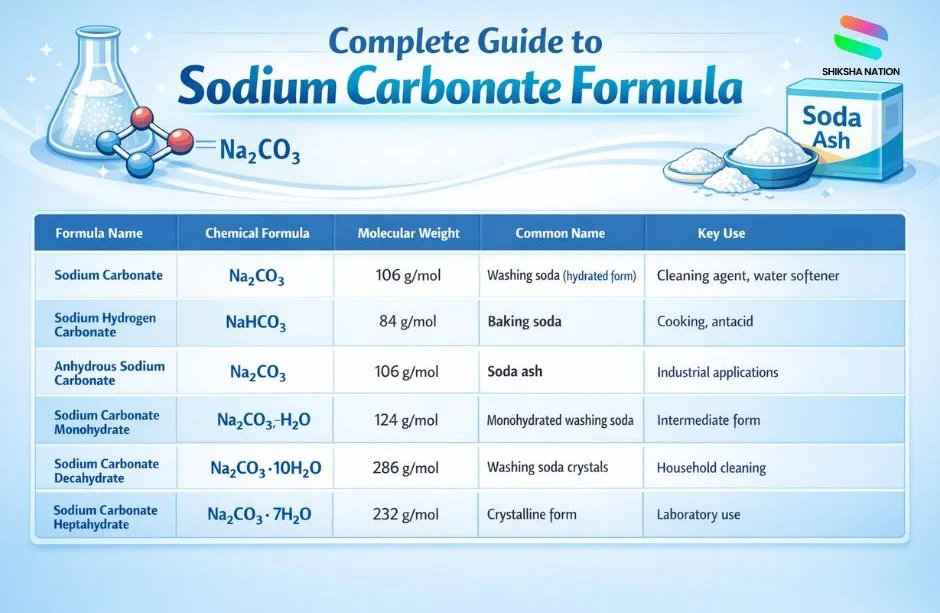
Sodium carbonate is one of the most important inorganic compounds in basic chemistry and industrial chemistry. The sodium carbonate formula is Na₂CO₃, and it is commonly known as washing soda or soda ash. In this complete guide on Sodium Carbonate Formula Complete Guide with All Chemical Formulas & Examples, students will understand the chemical composition, structure, properties, preparation method, and practical applications of this compound.
To build a clear conceptual base, it is also important to compare it with the sodium bicarbonate formula (NaHCO₃), which is a related compound but different in chemical behavior and uses. The topic of sodium carbonate formula formation explains how sodium carbonate is formed through reactions like the Solvay process and thermal decomposition of sodium bicarbonate.
We will also discuss the sodium carbonate formula molecular weight, which is 106 g/mol, and explain how to calculate sodium carbonate formula mass using atomic masses of sodium, carbon, and oxygen. In addition, students will learn about sodium carbonate equivalent weight, which is calculated based on its valency factor in acid-base reactions.
Understanding sodium carbonate uses in glass manufacturing, water softening, detergents, and laboratory experiments helps connect theory with real-life applications. This guide follows simple explanations, clear examples, and accurate chemical principles to support strong conceptual learning.

What is Sodium Carbonate?
Sodium carbonate is an inorganic compound commonly known as washing soda or soda ash. It’s a white, odorless powder that dissolves in water to form an alkaline solution.
Why it matters for students:
- Appears in CBSE Board, ICSE, and state board chemistry syllabuses
- Essential for understanding salts and chemical nomenclature
- Common in practical examinations and viva questions
- Foundation for learning about carbonates and bicarbonates
List of Sodium Carbonate Formula with Detailed Table
Here’s every formula related to sodium carbonate you need to know:
| Formula Name |
Chemical Formula |
Molecular Weight |
Common Name |
Key Use |
| Sodium Carbonate |
Na₂CO₃ |
106 g/mol |
Washing soda (hydrated form) |
Cleaning agent, water softener |
| Sodium Hydrogen Carbonate |
NaHCO₃ |
84 g/mol |
Baking soda |
Cooking, antacid |
| Anhydrous Sodium Carbonate |
Na₂CO₃ |
106 g/mol |
Soda ash |
Industrial applications |
| Sodium Carbonate Monohydrate |
Na₂CO₃·H₂O |
124 g/mol |
Monohydrated washing soda |
Intermediate form |
| Sodium Carbonate Decahydrate |
Na₂CO₃·10H₂O |
286 g/mol |
Washing soda crystals |
Household cleaning |
| Sodium Carbonate Heptahydrate |
Na₂CO₃·7H₂O |
232 g/mol |
Crystalline form |
Laboratory use |
Understanding Each Formula in Detail
Sodium Carbonate (Na₂CO₃)
Chemical Composition:
- 2 Sodium atoms (Na)
- 1 Carbon atom (C)
- 3 Oxygen atoms (O)
Important Points:
- Basic formula represents the anhydrous form
- Forms alkaline solutions in water
- pH range: 11-12 when dissolved
Sodium Hydrogen Carbonate (NaHCO₃)
Also called: Sodium bicarbonate, baking soda
Chemical Composition:
- 1 Sodium atom (Na)
- 1 Hydrogen atom (H)
- 1 Carbon atom (C)
- 3 Oxygen atoms (O)
Difference from Na₂CO₃:
- Contains one acidic hydrogen
- Less alkaline than sodium carbonate
- Releases CO₂ when heated
Anhydrous Sodium Carbonate (Na₂CO₃)
What “anhydrous” means: Without water molecules
Characteristics:
- Pure form without water of crystallization
- White powder form
- Highly hygroscopic (absorbs moisture from air)
- Used in industrial processes
Hydrated vs Anhydrous Forms
Understanding water of crystallization is crucial for exam questions.
General Formula Pattern: Na₂CO₃·nH₂O (where n = number of water molecules)
Comparison Table
| Form |
Formula |
Water Molecules |
Appearance |
Stability |
| Anhydrous |
Na₂CO₃ |
0 |
White powder |
Absorbs moisture |
| Monohydrate |
Na₂CO₃·H₂O |
1 |
White powder |
Moderately stable |
| Heptahydrate |
Na₂CO₃·7H₂O |
7 |
Crystalline |
Temperature sensitive |
| Decahydrate |
Na₂CO₃·10H₂O |
10 |
Clear crystals |
Effloresces in dry air |
Efflorescence: The process where hydrated crystals lose water and become powder when exposed to air.
Common Naming Variations
Students often get confused by different names for the same compound. Here’s clarification:
For Na₂CO₃:
- Sodium carbonate (IUPAC name)
- Washing soda (common name – when hydrated)
- Soda ash (industrial name – anhydrous)
- Sal soda (old name)
For NaHCO₃:
- Sodium hydrogen carbonate (IUPAC name)
- Sodium bicarbonate (traditional name)
- Baking soda (common name)
- Bread soda (regional name)
Step-by-Step Solved Examples
Example 1: Calculating Molecular Mass
Question: Calculate the molecular mass of sodium carbonate decahydrate.
Solution:
- Formula: Na₂CO₃·10H₂O
- Na: 2 × 23 = 46
- C: 1 × 12 = 12
- O (in carbonate): 3 × 16 = 48
- H₂O: 10 × 18 = 180
- Total = 46 + 12 + 48 + 180 = 286 g/mol
Example 2: Writing Correct Formula
Question: Write the chemical formula for sodium hydrogen carbonate and identify the elements present.
Solution:
- Formula: NaHCO₃
- Elements present:
- Sodium (Na) – 1 atom
- Hydrogen (H) – 1 atom
- Carbon (C) – 1 atom
- Oxygen (O) – 3 atoms
Example 3: Distinguishing Compounds
Question: What is the difference between Na₂CO₃ and NaHCO₃?
Solution:
- Na₂CO₃ (Sodium carbonate): Contains 2 Na atoms, no hydrogen, stronger base
- NaHCO₃ (Sodium hydrogen carbonate): Contains 1 Na atom, 1 H atom, weaker base
- NaHCO₃ decomposes on heating to form Na₂CO₃
Equation: 2NaHCO₃ → Na₂CO₃ + H₂O + CO₂
Common Mistakes to Avoid
Mistake 1: Wrong Number of Sodium Atoms
Incorrect: NaCO₃
Correct: Na₂CO₃
Why: Carbonate ion (CO₃²⁻) has -2 charge, needs 2 sodium ions (Na⁺)
Mistake 2: Confusing Carbonate and Bicarbonate
Wrong thinking: “Both have carbonate, so same formula”
Right approach: Check for hydrogen atom in bicarbonate (NaHCO₃)
Mistake 3: Ignoring Water of Crystallization
In exams: If question asks for “washing soda formula,” write Na₂CO₃·10H₂O
If asked for “sodium carbonate”: Write Na₂CO₃
Mistake 4: Incorrect Subscripts
Wrong: Na₂(CO₃)₂
Right: Na₂CO₃
Why: One carbonate group per formula unit
Mistake 5: Mixing Up Molecular Weights
- Na₂CO₃ = 106 g/mol
- NaHCO₃ = 84 g/mol (NOT 106)
Memory Tricks & Tips
Trick 1: The “2-1-3” Rule for Na₂CO₃
Remember: 2 sodiums, 1 carbon, 3 oxygens
Mnemonic: “Two Sodiums Carry Three Oxygen bags”
Trick 2: Bicarbonate = “Bi” + “Carbonate”
“Bi” suggests it’s between carbonic acid and carbonate
Formula has both Na AND H: NaHCO₃
Trick 3: Washing Soda Has 10 Waters
“Washing needs water” → 10H₂O
Na₂CO₃·10H₂O
Trick 4: Anhydrous Means “Dry”
“An-” = without, “hydrous” = water
Anhydrous form has NO water molecules
Trick 5: Molecular Weight Quick Check
- Na₂CO₃ ≈ 100 (actually 106)
- NaHCO₃ ≈ 80 (actually 84)
- Na₂CO₃·10H₂O ≈ 290 (actually 286)
Conclusion
Mastering sodium carbonate formulas is a fundamental step in your chemistry journey. Remember the key formulas:
- Sodium carbonate: Na₂CO₃
- Sodium hydrogen carbonate: NaHCO₃
- Anhydrous sodium carbonate: Na₂CO₃
- Washing soda (hydrated): Na₂CO₃·10H₂O
These compounds aren’t just theoretical concepts they’re part of everyday life, from the baking soda in your kitchen to the washing soda used for cleaning. Understanding their chemical formulas, structures, and differences will help you excel in exams and develop a deeper appreciation for chemistry.
Keep practicing formula writing, pay attention to subscripts, and always distinguish between carbonate and hydrogen carbonate. With the memory tricks and examples provided, you’re well-equipped to tackle any question on this topic confidently.
Frequently Asked Questions about Sodium Carbonate Formula
Q. What is the chemical formula of sodium carbonate?
The chemical formula of sodium carbonate is Na₂CO₃. It contains two sodium atoms, one carbon atom, and three oxygen atoms. In its common hydrated form (washing soda), it’s Na₂CO₃·10H₂O.
Q. What is sodium hydrogen carbonate formula?
Sodium hydrogen carbonate formula is NaHCO₃, also known as baking soda. It contains one sodium atom, one hydrogen atom, one carbon atom, and three oxygen atoms in each molecule.
Q. What is anhydrous sodium carbonate formula?
Anhydrous sodium carbonate has the formula Na₂CO₃ without any water molecules attached. It’s the pure, dry form commonly called soda ash, used in industrial applications and glass manufacturing.
Q. Is there a difference between sodium carbonate and sodium bicarbonate formulas?
Yes, sodium carbonate is Na₂CO₃ with two sodium atoms, while sodium bicarbonate is NaHCO₃ with one sodium and one hydrogen atom. Sodium bicarbonate is less alkaline and decomposes when heated.
Q. What is the formula of washing soda?
Washing soda is sodium carbonate decahydrate with formula Na₂CO₃·10H₂O. The “10H₂O” represents ten water molecules attached to each sodium carbonate unit, forming crystalline structure used for cleaning.
Q. How do you write the chemical formula of sodium hydrogen carbonate?
Write NaHCO₃ by combining one Na⁺ ion with one HCO₃⁻ (hydrogen carbonate) ion. Remember the hydrogen is part of the compound, making it different from regular carbonate (CO₃²⁻).
Q. What is sodium carbonate ka formula in Hindi medium exams?
Sodium carbonate ka formula (सोडियम कार्बोनेट का सूत्र) है Na₂CO₃। इसके जलयोजित रूप (धोने का सोडा) का सूत्र Na₂CO₃·10H₂O होता है। दोनों रूप परीक्षा में महत्वपूर्ण हैं।
Q. Why does sodium carbonate have subscript 2 for sodium?
Sodium carbonate needs subscript 2 because carbonate ion (CO₃²⁻) has a -2 charge. To balance this, we need two sodium ions (Na⁺), each with +1 charge, giving the formula Na₂CO₃.