

Imagine sitting in a science class, looking at a glass of water, and suddenly wondering, “Why is the sky blue? Why is the sea blue?” While most of us would just accept it as it is, one Indian scientist didn’t stop at just wondering. He questioned, experimented, and discovered something so groundbreaking that it brought India its first Nobel Prize in Science. That scientist was Sir Chandrasekhara Venkata Raman, or as we lovingly call him, Sir C.V. Raman.
For every student dreaming of making it big in science, for every parent encouraging their child to ask questions, and for every teacher inspiring young minds, Sir C.V. Raman’s life is a masterclass in curiosity, determination, and brilliance. His story proves that you don’t need fancy labs or foreign degrees to change the world you just need passion and persistence.
Let’s dive into the inspiring journey of India’s most celebrated physicist.
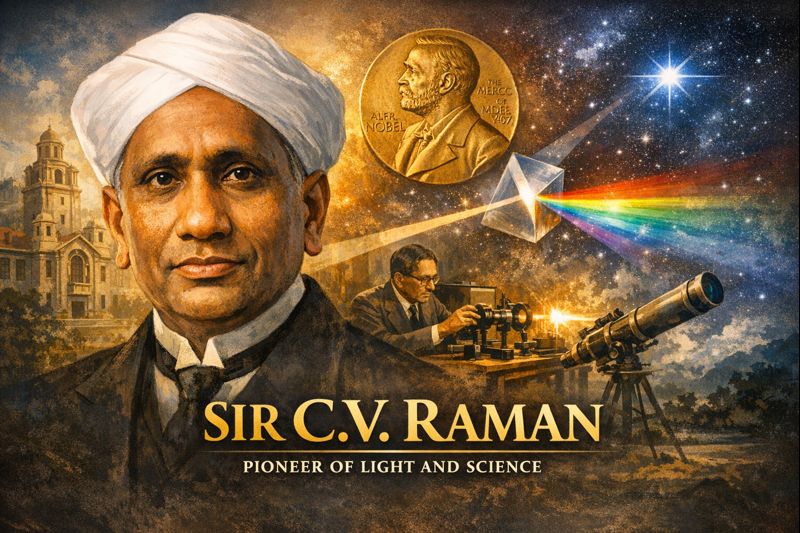
Who Was Sir C.V. Raman?
Sir Chandrasekhara Venkata Raman, born on November 7, 1888, was an Indian physicist who became the first Asian to win the Nobel Prize in Physics. He is best known for discovering the “Raman Effect,” a groundbreaking phenomenon in the scattering of light.
Quick Facts:
- Full Name: Chandrasekhara Venkata Raman
- Born: November 7, 1888, Tiruchirappalli, Tamil Nadu
- Died: November 21, 1970, Bangalore, Karnataka
- Famous For: Discovery of the Raman Effect (1928)
- Nobel Prize: Physics, 1930
- Field: Physics (Light Scattering, Acoustics, Optics)
C.V. Raman wasn’t just a scientist. He was a passionate educator, institution builder, and a proud Indian who proved that world-class research could happen on Indian soil.
Early Life and Education
Childhood in Tamil Nadu
C.V. Raman was born in a small town called Tiruchirappalli in Tamil Nadu. His father, R. Chandrasekhara Iyer, was a lecturer in mathematics and physics. Growing up in an academic environment, young Raman developed a love for learning early on.
Even as a child, Raman was brilliant. He would often sit with his father’s physics books and solve problems on his own. By age 11, he had already completed his school education.
Academic Excellence
Education Timeline:
| Year | Qualification | Institution |
|---|---|---|
| 1902 | Matriculation (Age 11) | Hindu High School, Visakhapatnam |
| 1904 | B.A. in Physics (First Rank, Gold Medal) | Presidency College, Madras |
| 1907 | M.A. in Physics (Highest Distinction) | Presidency College, Madras |
Raman wanted to study abroad like many other Indian scholars of his time. But due to health concerns and lack of scholarships, he couldn’t go. This setback didn’t stop him it fueled his determination to prove that India could produce world-class scientists.
Career Journey: From Government Job to Science Legend
Starting as a Finance Officer
After completing his M.A., Raman appeared for the Indian Finance Service exam and topped it. At just 19, he became an Assistant Accountant General in Kolkata (then Calcutta). It was a prestigious government job with a stable salary something every family would be proud of.
But Raman’s heart wasn’t in accounting. It was in science.
The Indian Association for Cultivation of Science (IACS)
While working his government job, Raman would spend every free moment at the Indian Association for Cultivation of Science (IACS) in Kolkata. He would wake up early, work on experiments before office hours, and return to the lab after work.
This passion and dedication were extraordinary. Imagine a student today balancing a full-time job and pursuing research in a small lab with limited resources. That was Raman’s life for 10 years.
Becoming a Professor
In 1917, Raman left his secure government job to become the first Palit Professor of Physics at the University of Calcutta. His family was shocked—why would anyone leave a stable job for uncertain academic work?
But Raman knew his calling. He wanted to dedicate his life to science.
The Raman Effect: Discovery That Changed Science
What is the Raman Effect?
The Raman Effect is a phenomenon in which light changes its wavelength when it passes through a transparent material like water, glass, or crystal. This scattering of light provides information about the molecular structure of the material.
When you shine light on a substance, most of it passes through or reflects back. But a tiny fraction changes color (wavelength). This change helps scientists understand what the substance is made of like a fingerprint for molecules.
The Journey to Discovery
In February 1928, while traveling by ship from India to England, Raman was mesmerized by the blue color of the Mediterranean Sea. He began experimenting with light scattering using simple equipment.
The Experiment:
- Raman used a prism, sunlight, and colored filters.
- He observed how light scattered when passing through different liquids.
- On February 28, 1928, he confirmed that light changes its wavelength when scattered.
This was the birth of the Raman Effect.
Why Was It Important?
Before the Raman Effect, scientists needed complex and expensive equipment to study molecules. Raman’s discovery made it easier and cheaper. Today, Raman Spectroscopy is used in:
- Medicine (detecting cancer cells)
- Chemistry (identifying unknown substances)
- Forensics (analyzing crime scene evidence)
- Archaeology (studying ancient artifacts)
Nobel Prize Win: India’s Proud Moment
On November 16, 1930, Sir C.V. Raman received the Nobel Prize in Physics for his work on the scattering of light and the discovery of the Raman Effect. He was the first Asian and the first non-white person to win a Nobel Prize in Science.
Historic Moment: When Raman received the news, he was in India. The entire nation celebrated. Schools and colleges held special assemblies. Newspapers printed his photo on the front page. For the first time, India had a homegrown Nobel laureate.
Raman attended the Nobel ceremony in Stockholm wearing a turban a symbol of his Indian identity. He was proud of his roots and wanted the world to see India’s brilliance.
The Nobel Lecture
In his Nobel lecture, Raman said: “The essence of science is independent thinking and hard work, not equipment.”
This message still inspires students worldwide.
Contributions to Indian Science
Sir C.V. Raman’s contributions went beyond the Raman Effect. He dedicated his life to building scientific institutions and mentoring young scientists.
Contributions:
- Indian Institute of Science (IISc), Bangalore:
- Served as Director from 1933 to 1937.
- Upgraded research facilities and attracted top talent.
- Raman Research Institute (RRI):
- Founded in 1948 in Bangalore.
- Still a premier research center in physics and astronomy.
- Indian Academy of Sciences:
- Founded in 1934 to promote scientific research in India.
- Mentorship:
- Trained hundreds of students, many of whom became leading scientists.
- Encouraged Indian students to pursue research instead of just government jobs.
- Promoting Indigenous Research:
- Proved that groundbreaking research could happen in India with limited resources.
Awards and Honors
Sir C.V. Raman received numerous awards and honors during his lifetime:
| Year | Award/Honor |
|---|---|
| 1924 | Fellow of the Royal Society, London |
| 1929 | Knighted by the British Government (became “Sir”) |
| 1930 | Nobel Prize in Physics |
| 1941 | Franklin Medal |
| 1954 | Bharat Ratna (India’s highest civilian award) |
| 1957 | Lenin Peace Prize |
Streets, institutions, and scholarships across India are named after him. The “Sir C.V. Raman ITI” and other technical institutes continue his legacy of scientific education.
Personal Life and Values
Family Life
C.V. Raman married Lokasundari Ammal in 1907. They had two sons, Chandrasekhar and Radhakrishnan. Despite his busy schedule, Raman was a devoted family man.
Core Values:
- Curiosity: He believed in questioning everything.
- Simplicity: He wore simple clothes, mostly white dhotis.
- Discipline: He worked 12-14 hours a day throughout his life.
- Patriotism: He refused to work abroad permanently, choosing to build science in India.
Famous Slogan of C.V. Raman:
“Ask the right question, and nature will reveal its secrets.”
This motto encourages students to be curious and persistent.
Legacy and Inspiration
Sir C.V. Raman passed away on November 21, 1970, but his legacy lives on.
Why He Still Matters:
- Inspiration for Students: His life proves that passion beats resources.
- Role Model for Indian Scientists: He showed that Indians can lead global science.
- Education Reform: His emphasis on research-based learning influences curricula today.
Every time a student looks through a microscope or questions why the sky is blue, they’re walking the path Raman paved.
National Science Day: Celebrating C.V. Raman
Why is February 28 a Science Day?
February 28 is celebrated as National Science Day in India to commemorate the discovery of the Raman Effect on February 28, 1928. The day aims to:
- Promote scientific thinking among students.
- Celebrate India’s achievements in science.
- Inspire young minds to pursue careers in research.
Activities on Science Day:
- School science exhibitions
- Quiz competitions
- Lectures by scientists
- Awards for young researchers
Life Lessons from Sir C.V. Raman
For Students:
- Curiosity is the First Step: Never stop asking “why?”
- Hard Work Beats Talent: Raman worked 12 hours a day for decades.
- Be Resourceful: He conducted world-class research with simple equipment.
- Believe in Yourself: He chose passion over a stable job and won.
For Parents and Educators:
- Encourage Questions: Don’t dismiss a child’s curiosity.
- Support Unconventional Paths: Not every child needs to be an engineer or doctor.
- Celebrate Learning, Not Just Marks: Raman valued understanding over memorization.
FAQs About Sir C.V. Raman
What is C.V. Raman famous for?
Sir C.V. Raman is famous for discovering the Raman Effect, a groundbreaking phenomenon in light scattering. This discovery won him the Nobel Prize in Physics in 1930, making him the first Asian Nobel laureate in science.
Why did Sir C.V. Raman get the Nobel Prize?
He received the Nobel Prize in Physics in 1930 for his work on the scattering of light and the discovery of the Raman Effect, which revolutionized molecular physics and spectroscopy.
Who was the first Indian scientist to win the Nobel Prize?
Sir C.V. Raman was the first Indian and the first Asian to win the Nobel Prize in Physics. He achieved this historic feat in 1930.
Who is the 1st Nobel Prize in Physics?
The first Nobel Prize in Physics was awarded to Wilhelm Conrad Röntgen in 1901 for discovering X-rays. However, C.V. Raman was the first Indian to receive this honor in 1930.
Why is February 28 a science day?
February 28 is celebrated as National Science Day in India because Sir C.V. Raman discovered the Raman Effect on this day in 1928, marking a historic achievement in Indian science.
Who is India’s best scientist?
While many scientists have contributed to India’s growth, Sir C.V. Raman is often regarded as one of the greatest due to his Nobel Prize and contributions to building Indian scientific institutions.
Who is the father of Physics in India?
Sir C.V. Raman is often called the “Father of Modern Physics in India” because of his pioneering research, institution building, and inspiration to generations of Indian physicists.
What was the slogan of CV Raman?
One of C.V. Raman’s famous slogans was: “Ask the right question, and nature will reveal its secrets.” He also believed that “independent thinking and hard work” were the essence of science.
Conclusion
Sir C.V. Raman’s life is a shining example of what happens when curiosity meets determination. From a small town in Tamil Nadu to the global stage at Stockholm, he proved that India could lead the world in science. His discovery of the Raman Effect didn’t just win him a Nobel Prize—it opened new doors for scientific research worldwide.
For students, his journey teaches that passion matters more than resources. For parents, it reminds them to nurture curiosity in their children. For educators, it reinforces the value of encouraging questions and independent thinking.
Every February 28, as we celebrate National Science Day, let’s remember Sir C.V. Raman not just as a scientist, but as a dreamer who dared to ask “why” and changed the world.