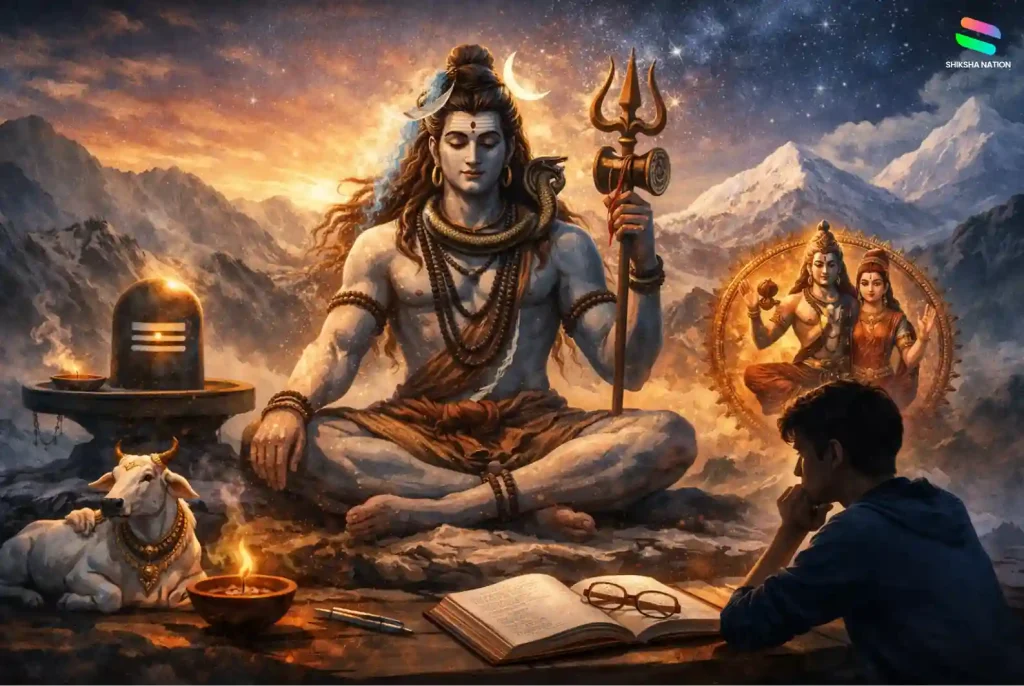
Why Shiva is Called the Destroyer?
A lot of students get confused here – why is Shiva called destroyer? It sounds negative, like something scary. But the actual shiva meaning is not about ending everything, it’s about making space for something better.
In the Trimurti, Brahma creates, Vishnu maintains, and Lord Shiva’s role is to transform. That “destruction” is more like clearing the old. Think of it like cleaning your study table before exams – those useless papers, distractions, random stuff, Once you remove them, things feel clearer, right?
Same idea.
Nature also works like this. Old leaves fall so new ones can grow. Even in your life – bad habits, overthinking, wasting time on reels, these need to go for you to improve.
So Shiva is not destroying life. He is removing what’s stopping growth.
Every Symbol of Shiva Has a Meaning
When you see pictures of Shiva God, it’s not just random styling. Every element has a meaning. The problem is – most places just list them, but don’t explain how they actually connect to life. Let’s fix that.
Third Eye – Awareness Beyond What You See
(shiva third eye meaning)
Shiva’s third eye represents deeper awareness – the ability to see truth beyond illusion. It’s not about physical vision, it’s about clarity.
Life connection: Like when you finally realise scrolling Instagram for hours is not “relaxing” it’s just avoiding work.
Trishul – Control Over Mind, Ego & Life
(trishul meaning shiva)
The trishul (trident) shows balance and control – mind, body, and ego. It also represents creation, preservation, and transformation.
Life connection: If your mind is distracted, ego is high, and routine is messy, nothing works properly.
Snake Around Neck – Fear is Under Control
(snake around shiva neck meaning)
The snake symbolises fear and danger. Shiva doesn’t remove it, he controls it.
Life connection: Fear of exams, failure, results – it won’t disappear, but you can learn to handle it.
Ganga on Head – Flow of Knowledge & Power
(ganga on shiva head meaning)
The Ganga flowing from Shiva’s hair shows controlled power and knowledge. Without control, even something good can become destructive.
Life connection: Too much information without focus = confusion (every student knows this).
Ash (Bhasma) – Reality of Life & Death
(shiva ash meaning)
Shiva’s body covered in ash reminds that everything material ends one day.
Life connection: Stressing over small things? In the long run, most of it won’t even matter.
Nandi – Discipline, Devotion & Focus
(nandi shiva meaning)
Nandi, the bull, represents patience, discipline, and loyalty. Always calm, always focused.
Life connection: Consistency beats motivation. Even 2 hours of daily study > random 10-hour bursts.
Famous Shiva Stories with Meaning
Shiva stories are not just mythology or old-time tales. Each story of Shiva God has a simple message hidden inside it. Once you understand that, things start making more sense.
Neelkanth – Why Shiva Drank Poison
(neelkanth story shiva)
During Samudra Manthan, a deadly poison came out that could destroy the whole world. No one was ready to take responsibility. Then Lord Shiva drank the poison to save everyone, but he held it in his throat, which turned blue. That’s why he is called Neelkanth.
Meaning: Sometimes you have to handle tough situations calmly instead of reacting instantly.
Shiva Tandava – The Dance of Creation & Destruction
(shiva tandava story)
Shiva performs the Tandava, a powerful cosmic dance. It represents both destruction and creation happening together. When something ends, something new begins. It’s not chaos, it’s balance.
Meaning: Life keeps changing, and resisting change only makes it harder.
Shiva & Parvati – Balance of Energy
(shiva and parvati story)
Shiva, the calm yogi, and Parvati, the active energy, together create balance. Alone, Shiva is stillness. With Parvati, there is creation, life, and movement. That’s why they are always shown as equals.
Meaning: Balance is everything. Too much pressure or too much laziness, both will mess things up.
If you think about it, these stories are not very far from student life. Pressure, confusion, change, balance Everything seems connected sometimes.
Shiva as Adiyogi: The First Yogi & Master of Meditation
Shiva is called Adiyogi, which simply means the first yogi. According to tradition, he was the one who shared the knowledge of yoga and meditation with the world. Not the gym-type yoga, but the real one which is about controlling your mind.
Shiva meditation is all about stillness. Sitting quietly, observing your thoughts, not reacting to everything. Sounds simple, but honestly, try sitting without your phone for 10 minutes. Not that easy.
That’s why many students connect with Shiva today. Too much distraction, too much pressure, constant overthinking. Sometimes you just want your mind to slow down.
Shiva represents that calm state. No noise, no rush. Just clarity.
Different Forms of Shiva Explained
Shiva is not shown in just one form. Different forms of Shiva represent different ideas. Once you understand the concept, it becomes very easy to remember.
Meditating Shiva – The Yogi
This is the most common form. Shiva sitting in deep meditation on Mount Kailash. Eyes closed, completely calm.
Concept: Total control over mind and emotions.
Life connect: When your mind is calm, even tough subjects feel manageable.
Nataraja – The Cosmic Dancer
In this form, Shiva is dancing. But it’s not just dance, it represents the cycle of creation and destruction happening in the universe.
Concept: Change is constant.
Life connect : Syllabus changes, exam patterns change, life moves on. You have to adapt.
Ardhanarishvara – Half Shiva, Half Shakti
Here, Shiva is shown as half male and half female. One side is Shiva, the other is Parvati.
Concept: Balance between strength and softness, logic and emotion.
Life connect: Only studying or only relaxing both won’t work. Balance is key.
Shivling – What It Actually Represents
Shivling is not a person-like form of Shiva. It is a symbol of energy and creation. It represents something beyond physical form.
Concept: Shiva as formless energy.
Life connect: Not everything important is visible. Focus, discipline, mindset – hese matter more than appearances.
What Shiva Actually Teaches Us
If you look beyond the stories and symbols, the real value of Shiva is in the lessons. That’s where students actually connect.
Detachment brings peace.
Shiva is not attached to luxury or distractions. He stays calm even in chaos.
In your life, overthinking results, comparing marks, worrying about others. This is what creates stress. Letting go a little actually helps.
Stillness gives clarity.
Shiva in meditation shows one thing clearly. When your mind is calm, decisions become easier.
Ever tried studying with a noisy mind? You read the same line 5 times and still don’t get it.
Simplicity creates freedom.
No fancy lifestyle, no show-off. Just focus.
Sometimes we complicate things too much. One simple routine done daily works better than big plans that never start.
Acceptance builds strength.
Shiva accepts everything, even poison.
In student life, not every result will be perfect. Accepting it and moving forward is real strength.
That’s the real shiva philosophy. Simple, but honestly not easy to follow.
Shiva God – Quick Facts
- Shiva God is part of the Trimurti
- Known as Mahadev, Bholenath, Shankar
- Role is transformation, not just destruction
- Third eye represents awareness
- Trishul shows balance of mind, body, ego
- Snake shows control over fear
- Lives on Mount Kailash
- Nandi is his vehicle
- Shivling represents energy and creation
- Major festival is Maha Shivratri
Final Thought
Shiva is Not Just a God, It’s a Way of Understanding Life. If you really think about it, Shiva God is not just someone to pray to. He represents balance, energy, and awareness in life. The calm mind, the ability to handle chaos, and the strength to accept change, all of this is part of lord Shiva philosophy.
Sometimes you feel lost, distracted, or under pressure. That’s where Shiva’s meaning connects. Stay calm, stay focused, and keep going.
Simple idea, but not that easy to follow.
FAQs – Real Questions People Actually Search About Shiva
Q. Shiva real hai ya mythology ka part hai?
Shiva is believed to be a real divine force in Hinduism, but most people understand him through stories and mythology. Think of Shiva less like a human figure and more like a powerful idea or energy that explains balance, change, and how life actually works.
Q. Shiva destroyer kyun kehte hain?
Shiva is called the destroyer because his role is to remove what is no longer needed. It’s not about ending everything, it’s about transformation. Like finishing one class and moving to the next, something has to end for something better to begin.
Q. Shivling ka actual meaning kya hai?
Shivling represents Shiva in a formless way. It is not a person-like image but a symbol of energy, creation, and the universe. Many people misunderstand it, but it actually shows that Shiva is beyond physical form and exists as a higher power.
Q. Shiva hamesha meditation me kyun hote hain?
Shiva is shown in meditation because he represents complete focus and inner control. When your mind is calm, you think clearly and make better decisions. Honestly, students know this feeling when they try to study but their mind just keeps wandering.
Q. Shiva aur Rudra same hain kya?
Shiva and Rudra are mostly considered the same, just different forms. Rudra is the intense, powerful side, while Shiva is calm and balanced. You can think of it like two moods of the same person, different expressions but the same identity underneath.