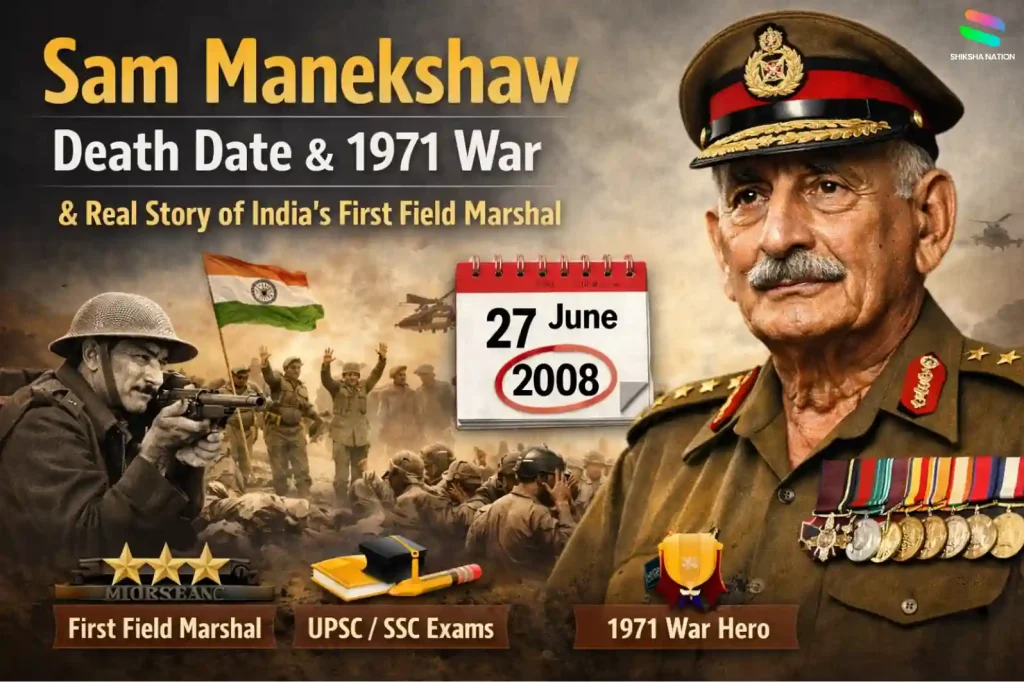
Why So Many Students Search “Sam Manekshaw Death Date”
Most students don’t search this because they don’t know the answer – they search because they’re confused between multiple similar things.
First confusion comes from the “Sam Bahadur” movie, where real events and cinematic scenes get mixed. Students often remember the story but not the exact factual detail like Sam Manekshaw’s death date.
Second, many mix up timelines. They clearly remember:
- 1971 war
- His role as Army Chief
but when it comes to when did Sam Manekshaw die, they either guess or confuse it with his retirement.
Third, during exams, questions are very direct. Even if you know everything about him, missing one fact like the date of death of Sam Manekshaw can cost marks.
So the real problem is not knowledge – it’s clarity and separation of facts.
Exam Importance of Sam Manekshaw (UPSC/SSC/School)
Sam Manekshaw is an important topic for UPSC, SSC, NDA, CDS, and school exams because questions are often fact-based and direct. Students are typically asked about his death date (27 June 2008), rank (first Field Marshal of India), role in the 1971 war, and major awards. In objective exams, even a small confusion between rank, position, or timeline can lead to negative marking. For descriptive answers, mentioning his leadership in the Bangladesh Liberation War adds value.
Sam Manekshaw in 60 Seconds – From Soldier to Field Marshal
Sam Manekshaw’s journey doesn’t start with fame – it starts with a bold decision. In 1932, he joined the first batch of the Indian Military Academy (IMA), Dehradun, choosing the army over a conventional career path. By 1935, he was commissioned into the British Indian Army, marking the beginning of a career that would span decades.
His first big test came during World War II in Burma. In a fierce battle, he was severely wounded by machine-gun fire while leading his men. Despite critical injuries, he survived – and for his courage, he was awarded the Military Cross, one of the highest recognitions for gallantry at the time. This wasn’t just bravery; it built his reputation as a leader who stayed in front, not behind.
Post-independence, he continued rising through the ranks, handling key military and strategic roles. But his defining moment came in 1971, when he served as the Chief of the Army Staff during the Indo-Pak war. Instead of rushing into conflict, he carefully prepared the army, ensuring timing, logistics, and strategy were in India’s favor.
The result? A decisive victory in just 13 days, leading to the creation of Bangladesh—one of the most significant military successes in Indian history.
In recognition of his leadership and service, he was promoted in January 1973 to the rank of Field Marshal, becoming the first Indian Army officer to receive this honour.
From a young cadet to India’s highest-ranking military officer – Sam Manekshaw’s journey is a masterclass in courage, patience, and strategic thinking.
The Real Reason He Became Famous (It’s Not Just the 1971 War)
Most people reduce Sam Manekshaw to one line – “1971 war hero.” That’s incomplete. His real recognition came from how he led, not just what he achieved.
First, his leadership decisions stood out. Before the 1971 war, he was asked if India was ready for immediate action. Instead of giving a politically convenient answer, he clearly explained that the army was not fully prepared – troops were not positioned, equipment was limited, and timing (monsoon) was against India. Saying “not ready” at that moment required courage, because it meant pushing back against pressure at the highest level.
Second, his strategic thinking changed the outcome of the war. He didn’t rush. He waited, prepared, trained forces, and only then executed a multi-directional plan. The result was not just victory, but a fast and decisive one, which is rare in military history.
Third, and most importantly, was his confidence in dealing with political leadership. He maintained professional clarity without crossing boundaries. He could disagree, but always with logic and responsibility. This balance is what made him trustworthy at the national level.
So, Sam Manekshaw wasn’t famous just because India won a war. He became iconic because he showed that clear thinking, preparation, and the ability to stand firm under pressure matter more than quick decisions.
What Happened in His Last Years? (Rarely Explained Part)
- After retiring from active service in 1973, Sam Manekshaw spent most of his later years in Coonoor/Wellington area of Tamil Nadu, close to the Defence Services Staff College where he had earlier served.
- His lifestyle in retirement remained relatively private, though he stayed connected with the military community and was widely respected by soldiers and senior officers.
- In his final years, his health gradually declined, mainly due to respiratory complications, which became more serious with age.
- He was admitted to the Military Hospital in Wellington, where he was under medical care during his last phase of life.
- On 27 June 2008, he passed away at the age of 94, due to complications arising from pneumonia.
- He was given military honours and laid to rest at the Parsi cemetery in Ooty (Udhagamandalam), Tamil Nadu, near his wife’s grave.
- Despite his stature, reports noted that his funeral did not receive the level of official representation typically expected for a leader of such national importance.
Exam Ready Facts (Revise in 30 Seconds)
- Full Name: Sam Hormusji Framji Jamshedji Manekshaw
- Birth: 3 April 1914, Amritsar, Punjab
- Death: 27 June 2008, Wellington, Tamil Nadu
- Age at Death: 94 years
- Rank: Field Marshal (First in India)
- Position Held: Chief of the Army Staff (1969-1973)
- Major Wars: World War II, Indo-Pak War 1971 (Bangladesh Liberation War)
- Nickname: “Sam Bahadur”
- Key Achievement: Led India to victory in 1971 war, resulting in creation of Bangladesh
- Awards: Military Cross, Padma Bhushan (1968), Padma Vibhushan (1972)
Quick tip: Remember 1914-2008 + 1971 war + First Field Marshal for exams.
Sam Bahadur Movie vs Real Life – What Students Should Know
- The movie “Sam Bahadur”, starring Vicky Kaushal, is based on the life of Sam Manekshaw, which is why searches like “Sam Manekshaw death date” suddenly increased after its release.
- The film captures major milestones like his army career, leadership in the 1971 war, and personality, but it is still a cinematic adaptation, not a documentary.
- In real life, events were more detailed and spread over decades – especially his World War II experience, strategic preparation before the 1971 war, and rise to Field Marshal, which are simplified in the film.
- Dialogues and certain scenes are dramatized for storytelling, so relying only on the movie can create confusion in factual topics like dates, ranks, and timelines.
- That’s why many students search factual queries after watching it – to separate real history from cinematic presentation.
Tip: Use the movie for understanding personality, but rely on facts for exams.
Is There Any Field Marshal in India Today?
No, India currently has no active Field Marshal.
- The rank of Field Marshal is a five-star, lifetime honorary rank, not a regular operational post.
- Total Field Marshals in India: Only two officers have ever been awarded this rank:
- Sam Manekshaw
- K. M. Cariappa
- Where does Sam Manekshaw stand?
- He was the first Indian Army officer to be promoted to Field Marshal in January 1973.
- His promotion was in recognition of his exceptional leadership, especially during the 1971 war.
- Unlike regular ranks, Field Marshals are not replaced or newly appointed frequently, which is why the position remains rare.
Timeline – Sam Manekshaw’s Life in One Glance
- 1914: Born in Amritsar, Punjab
- 1932-1935: Joined Indian Military Academy and commissioned into the army
- 1942: Displayed bravery in World War II; awarded Military Cross
- 1969: Became Chief of the Army Staff
- 1971: Led India to victory in Indo-Pak war (Bangladesh Liberation)
- 1973: Promoted to Field Marshal (first in India)
- 2008: Passed away in Wellington, Tamil Nadu
What We Can Learn from Sam Manekshaw (Simple but Powerful)
- Decision-making under pressure: He never rushed into war. He chose the right timing over emotional decisions, which directly impacted the outcome.
- Confidence with clarity: He was not afraid to speak the truth, even in front of top political leadership, but always backed it with logic and responsibility.
- Leadership by example: From World War II to 1971, he led from the front and earned the trust and loyalty of his soldiers, especially the Gorkhas.
- Calm in critical situations: Even during high-stakes moments, he maintained composure, which is essential for effective leadership.
His life shows that real success comes from clear thinking, preparation, and staying firm under pressure.
FAQs – About Sam Manekshaw
Q. When did Sam Manekshaw die?
Sam Manekshaw died on 27 June 2008 in Wellington, Tamil Nadu, India.
Q. What was Sam Manekshaw’s age at death?
He was 94 years old at the time of his death.
Q. Why is Sam Manekshaw called “Sam Bahadur”?
“Sam Bahadur” was a nickname given to him by soldiers, especially Gorkhas, where “Bahadur” means brave.
Q. Who was the first Field Marshal of India?
Sam Manekshaw was the first Field Marshal of India, promoted in January 1973.
Q. What role did Sam Manekshaw play in the 1971 war?
He served as the Chief of the Army Staff and led India’s military operations during the Indo-Pak war, which resulted in the creation of Bangladesh.
Q. Why was Sam Manekshaw famous?
He was known for his military leadership, strategic planning, and role in India’s victory in the 1971 war.
Q. How many bullets hit Sam Manekshaw?
During World War II, he was seriously wounded by multiple bullets while leading his troops in battle.
Q. Who was the second Field Marshal of India?
The second Field Marshal of India was K. M. Cariappa.
Q. Is “Sam Bahadur” based on a true story?
Yes, the film is based on the life of Sam Manekshaw, though some scenes are dramatized for cinematic presentation.