

Rajkumari Amrit Kaur was one of the most respected women leaders in Indian history and played a key role in building independent India. She is best known as the first Health Minister of India, a position she held during the early and challenging years after Independence.
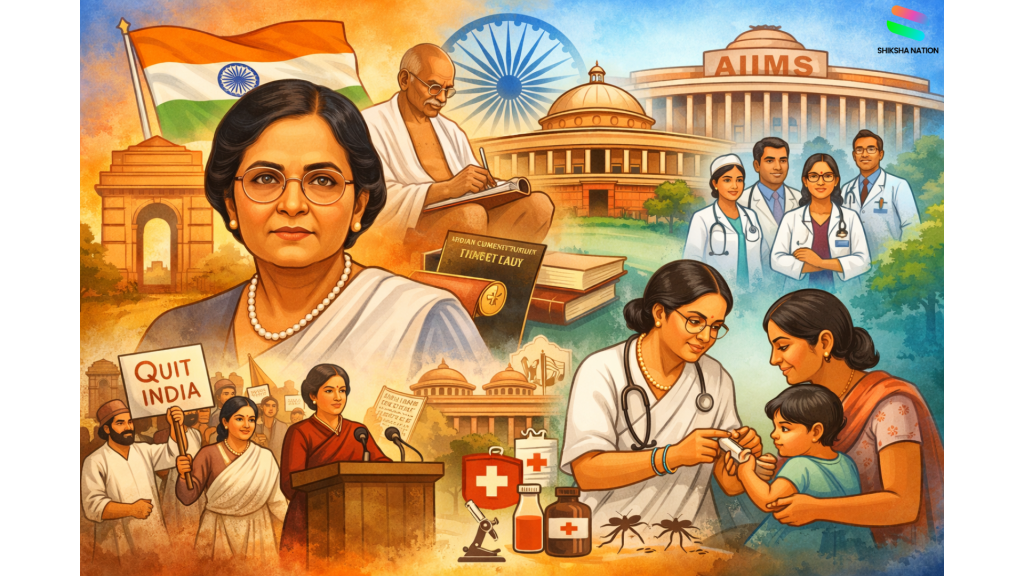
Born into a royal family, she chose a life of service over comfort. She actively took part in the Indian freedom struggle and worked closely with Mahatma Gandhi. Her contribution was not limited to politics; she focused strongly on public health, women’s rights, and social reform.
For students and parents, Rajkumari Amrit Kaur is an important name in History, Civics, and General Knowledge. Questions related to her life, role in the freedom movement, and contributions to India’s health system are often asked in school exams and competitive tests.
Who Was Rajkumari Amrit Kaur?
Rajkumari Amrit Kaur was a national leader, social reformer, and freedom fighter who played an important role in shaping modern India. Though she was born into a royal family, she is remembered not for her title but for her lifelong service to the nation.
She gave up a comfortable royal life and chose to work for the country during a time when very few women were active in public life. Her thinking was modern, practical, and deeply connected to the needs of ordinary people, especially women and children.
Rajkumari Amrit Kaur was closely associated with the Indian freedom movement and believed strongly in equality, education, and social justice. She worked with many national leaders and supported causes that helped build a fair society.
Today, she is remembered as one of the most influential women leaders of India, whose work went beyond politics and focused on nation-building. For students, her life shows how leadership is defined by service, not by birth or status.
Key Facts About Rajkumari Amrit Kaur (Exam Ready)
Quick revision points for students and parents preparing for exams:
- Born: 2 February 1887, Lucknow, Uttar Pradesh
- Died: 6 February 1964, New Delhi
- Major Roles:
- Freedom fighter during the national movement
- Member of the Constituent Assembly (1946–1950)
- Health Minister of India (1947–1957)
- Major Contributions:
- Strengthened public health system after Independence
- Led campaigns against tuberculosis and malaria
- Supported women’s education and social reform
- Institutions Linked to Her Work:
- Played a key role in the establishment of AIIMS (1956)
- Associated with national health and child welfare initiatives
For students, these points are useful for 1–2 mark questions and quick revision. Parents can use this section to help children remember facts clearly and accurately.
Early Life and Education of Rajkumari Amrit Kaur
Birth, Family Background, and Education Abroad
Rajkumari Amrit Kaur was born on 2 February 1887 in Lucknow, in a well-known aristocratic family. Her father belonged to the royal family of Kapurthala, which gave her a privileged and disciplined upbringing. From a young age, she was exposed to education, culture, and public thinking.
She was sent to England for her studies, where she received formal schooling and higher education. Studying abroad helped her develop independent thinking and a strong sense of social responsibility. She was deeply influenced by ideas of equality, discipline, and service.
In 1918, she returned to India and chose a different path from most royal women of that time. Instead of living a private life, she slowly moved towards public service and national work. This decision later connected her closely with the Indian independence movement, where she worked for the country and its people.
For students and parents, her early life shows how education can shape values and inspire meaningful service.
Role of Rajkumari Amrit Kaur in the Indian Independence Movement
Association with Mahatma Gandhi
Rajkumari Amrit Kaur became actively involved in the Indian independence movement after meeting Mahatma Gandhi in 1919. She was deeply influenced by his ideas of truth, simplicity, and non-violence. Soon, she decided to dedicate her life to national service.
She worked as Gandhi’s secretary for nearly 16 years, assisting him in correspondence, planning, and public work. During this time, she lived a simple life and followed Gandhian values strictly. Her close association with Gandhi shaped her thinking and strengthened her commitment to freedom and social equality.
For students, this shows how trust and dedication allowed her to work closely with one of India’s greatest leaders.
Participation in National Movements and Social Reforms
As a Rajkumari Amrit Kaur freedom fighter, she took part in major national movements led by the Congress. She was actively involved in the Civil Disobedience Movement (1930) and supported the Quit India Movement in 1942, for which she was imprisoned by the British government.
Along with political action, she worked strongly for social reform. She spoke against child marriage, purdah, and illiteracy among women. She also supported women’s education and equal rights at a time when such ideas were not widely accepted.
For parents and students, her role highlights how the freedom struggle was not only about independence, but also about building a just and equal society.
Rajkumari Amrit Kaur and the Constituent Assembly of India
Rajkumari Amrit Kaur was a respected member of the Constituent Assembly of India, which was formed in 1946 to frame the Constitution of independent India. She represented the United Provinces and took part in important debates that shaped the country’s future.
She strongly supported fundamental rights for all citizens. Rajkumari Amrit Kaur believed that equality before law, freedom of expression, and dignity of individuals were essential for a democratic nation. Her views reflected fairness and social balance.
She also argued in favour of universal franchise, meaning the right to vote for every adult citizen. At a time when many doubted people’s readiness for voting, she trusted common citizens and supported equal political rights.
On minority representation, she supported protection of minority rights within a united India. For students and parents, her role in the Assembly highlights how leaders worked carefully to build a Constitution based on equality, justice, and democratic values.
Rajkumari Amrit Kaur and the Constituent Assembly of India
Rajkumari Amrit Kaur was elected as a member of the Constituent Assembly of India in 1947, after India gained independence. The Assembly was responsible for drafting the Indian Constitution, and her presence added a strong voice for equality and social justice.
She clearly supported fundamental rights for every citizen. Rajkumari Amrit Kaur believed that freedom, dignity, and equal treatment were necessary for a healthy democracy. Her views focused on protecting common people, especially women and weaker sections.
She was also in favour of universal franchise, which meant giving voting rights to all adults. At a time when this idea was debated, she trusted the judgement of ordinary citizens and supported equal political participation.
On minority representation, she argued that minorities should feel secure and respected in independent India. For students and parents, her role shows how thoughtful leaders worked to create a fair and inclusive Constitution.
First Health Minister of Independent India
Who Was the First Health Minister of India?
Who was the first health minister of India?
The answer is Rajkumari Amrit Kaur. She was appointed as the Health Minister in 1947, soon after India became independent, and served in this role till 1957. She was the first woman to hold a Cabinet-level position in the central government.
At that time, India faced serious health problems such as poor sanitation, spread of diseases, and lack of medical facilities. Her appointment was important because she focused on building a strong public health system for the country.
For students, this question is frequently asked in History, Civics, and General Knowledge exams, making it an important fact to remember.
Key Health Reforms Under Her Leadership
As the first health minister of India, Rajkumari Amrit Kaur led many national health reforms. Some of her key efforts include:
- Nationwide campaigns to control tuberculosis and malaria
- Support for large-scale vaccination programmes to protect children
- Steps to improve medical education and public hospitals
- Focus on maternal and child health services
She also played a major role in strengthening India’s healthcare planning during the early years of independence. For parents and students, her work shows how strong leadership helped improve public health across the country.
Contribution of Rajkumari Amrit Kaur to AIIMS
One of the most lasting rajkumari amrit kaur contributions was her vision to improve medical education in India. In the early years after Independence, she felt that India needed a top-level institute for advanced medical training and research.
As Health Minister, she introduced the idea of a national medical institute in Parliament. In 1956, a law was passed that led to the formation of the All India Institute of Medical Sciences (AIIMS). This step marked an important phase in the AIIMS establishment history.
Her goal was not just to treat patients but to train skilled doctors within India. AIIMS was planned as a centre for high-quality education, research, and public service.
For students and parents, AIIMS stands today as a symbol of her long-term thinking. It shows how strong leadership in education and health can create institutions that benefit the nation for generations.
Why Rajkumari Amrit Kaur Is Important for Students
Rajkumari Amrit Kaur is important for students because her life and work are directly linked to Indian history after 1947. Her role as the first woman Cabinet minister and a national leader makes her a regular topic in school and competitive exams.
Her name often appears in CBSE and ICSE History and Civics, as well as in CUET and UPSC General Studies questions. Exams test her contribution to public health, Constitution-making, and institution building in independent India.
As one of the respected women leaders of India, she represents strong leadership, discipline, and service to the nation. For students, her journey shows how education and values can shape responsible leaders.
For parents, studying such leaders helps children understand nation-building beyond textbooks and develop respect for public service and integrity.
FAQ’s on Rajkumari Amrit Kaur
Q. Who was Rajkumari Amrit Kaur?
Rajkumari Amrit Kaur was a national leader, freedom fighter, and social reformer who played an important role in India after Independence. She was born in 1887 and worked closely with senior leaders during the freedom struggle. She is best remembered for her service to the nation and public welfare.
Q. Why is she called the first Health Minister of India?
She is called the first Health Minister of India because she was appointed to this post in 1947, when India became independent. She served in this role till 1957 and worked to strengthen the country’s health system during its early years.
Q. Was Rajkumari Amrit Kaur a freedom fighter?
Yes, Rajkumari Amrit Kaur was an active freedom fighter. She took part in the Indian independence movement and supported national campaigns led by Congress leaders. She was also imprisoned by the British government for her participation.
Q. What was her role in AIIMS?
She played a key role in planning a national medical institute for India. In 1956, her efforts helped lead to the establishment of AIIMS to improve medical education and research in the country.
Q. Did Rajkumari Amrit Kaur marry?
No, Rajkumari Amrit Kaur never married. She chose to dedicate her entire life to public service and national work, which is often highlighted in exam answers.