

Introduction
Picture this: You’re sitting in your math class, and your teacher asks, “How many prime numbers are there between 1 and 100?” Your mind goes blank. Or maybe you’re helping your child with homework, and they ask what makes a number “prime.” Understanding prime numbers isn’t just about passing exams—it’s about building a strong foundation in mathematics that will help students throughout their academic journey.
Prime numbers are the building blocks of mathematics, appearing everywhere from competitive exams to everyday problem-solving. Whether you’re a student preparing for tests, a parent supporting homework time, or an educator planning lessons, this complete guide will make prime numbers crystal clear and easy to remember.
What Are Prime Numbers?
A prime number is a natural number greater than 1 that has exactly two factors: 1 and itself. In simpler terms, you cannot divide it evenly by any other number except 1 and the number itself.
Examples:
- 7 is prime (factors: 1 and 7)
- 11 is prime (factors: 1 and 11)
- 9 is NOT prime (factors: 1, 3, and 9)
Key Points:
- 1 is NOT a prime number (it has only one factor)
- 2 is the only even prime number
- All other prime numbers are odd
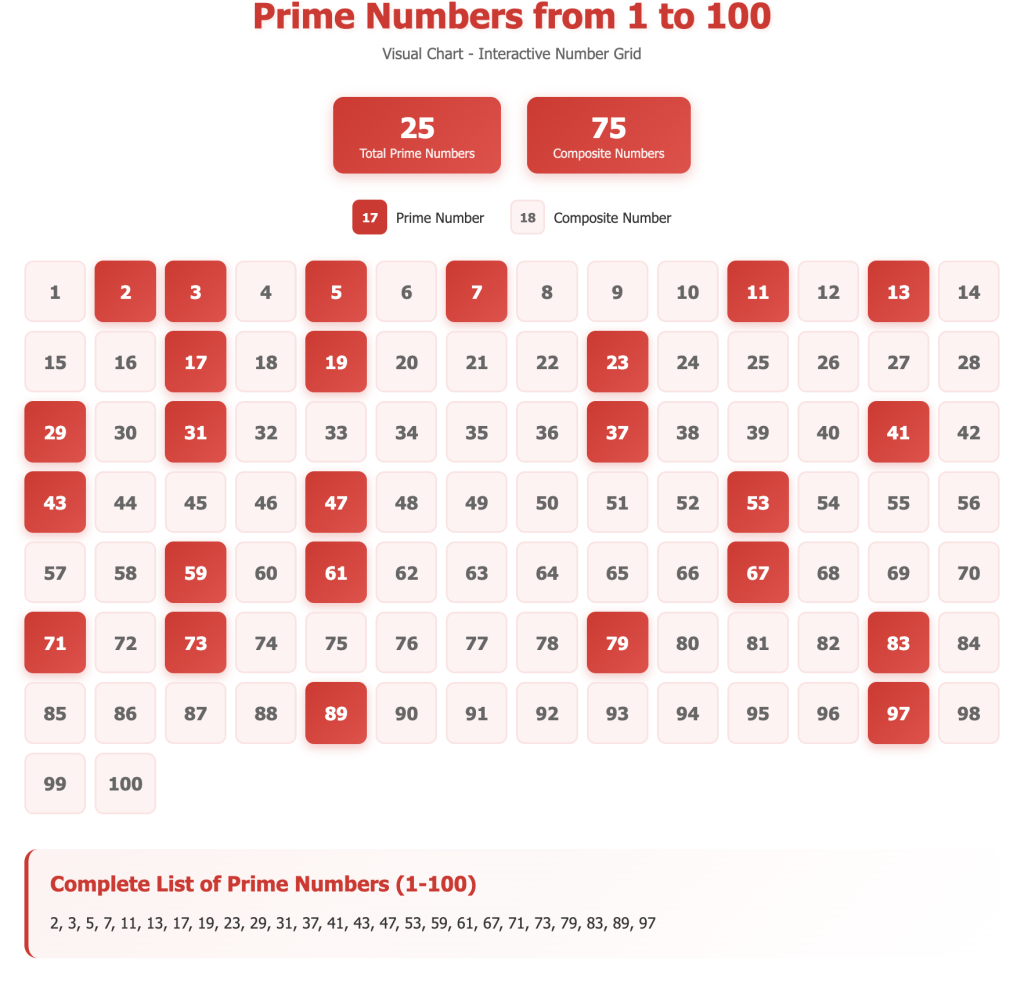
Complete List of Prime Numbers from 1 to 100
Here are all the prime numbers from 1 to 100, organized for easy memorization:
2, 3, 5, 7, 11, 13, 17, 19, 23, 29, 31, 37, 41, 43, 47, 53, 59, 61, 67, 71, 73, 79, 83, 89, 97
Organized by Tens:
| Range | Prime Numbers |
|---|---|
| 1-10 | 2, 3, 5, 7 |
| 11-20 | 11, 13, 17, 19 |
| 21-30 | 23, 29 |
| 31-40 | 31, 37 |
| 41-50 | 41, 43, 47 |
| 51-60 | 53, 59 |
| 61-70 | 61, 67 |
| 71-80 | 71, 73, 79 |
| 81-90 | 83, 89 |
| 91-100 | 97 |
How Many Prime Numbers Are There from 1 to 100?
There are exactly 25 prime numbers from 1 to 100.
This is a frequently asked exam question. Students often forget whether to count 1 or 2, so remember: start counting from 2 (the first prime) and end at 97 (the last prime below 100).
Quick Memory Tip: Notice that as numbers get larger, primes become less frequent. There are 4 primes in the first ten numbers but only 1 prime (97) in the 90s.
Understanding Co-Prime Numbers from 1 to 100
Co-prime numbers (also called relatively prime numbers) are two numbers whose only common factor is 1. Their greatest common divisor (GCD) is 1.
Important: Co-prime numbers don’t have to be prime themselves.
Examples of Co-Prime Numbers:
Co-prime pairs:
- (8, 15) – GCD = 1
- (25, 36) – GCD = 1
- (14, 25) – GCD = 1
NOT co-prime:
- (12, 18) – GCD = 6
- (15, 25) – GCD = 5
All Prime Numbers from 1 to 100 Are Co-Prime to Each Other
Since prime numbers have no common factors except 1, any two different prime numbers are automatically co-prime.
Example: 7 and 13 are co-prime (GCD = 1)
Easy Tricks to Identify Prime Numbers
Method 1: Division Test
To check if a number is prime, divide it by all prime numbers less than its square root. If none divide evenly, it’s prime.
Example: Is 37 prime?
- √37 ≈ 6
- Test primes less than 6: 2, 3, 5
- 37 ÷ 2 = 18.5 (not even)
- 37 ÷ 3 = 12.33… (not even)
- 37 ÷ 5 = 7.4 (not even)
- 37 is prime!
Method 2: Quick Elimination Rules
- Even numbers (except 2) are NOT prime
- Numbers ending in 5 (except 5) are NOT prime
- If digits sum to a multiple of 3, NOT prime (except 3)
Method 3: Memorization Groups
First 10 primes: 2, 3, 5, 7, 11, 13, 17, 19, 23, 29 Memorize this sequence—it appears in countless exam questions.
Common Mistakes Students Make
Mistake 1: Thinking 1 is Prime
Many students include 1 in their prime number list. Remember: prime numbers must have exactly TWO factors. 1 only has one factor (itself).
Mistake 2: Forgetting 2 is Prime
Some students skip 2 because they think “all primes are odd.” 2 is the only even prime number and must be included.
Mistake 3: Confusing Co-Prime with Prime
Just because two numbers are co-prime doesn’t mean they’re both prime numbers. (8, 15) are co-prime, but neither is prime.
Mistake 4: Not Checking Divisibility Properly
When testing larger numbers like 91, students often miss that 91 = 7 × 13, making it composite, not prime.
Real-Life Applications in Academics
In Competitive Exams
Questions about prime numbers appear in:
- Mathematics Olympiads
- SSC exams
- Banking exams
- SAT and ACT tests
In Higher Mathematics
Prime numbers form the foundation for:
- Number theory
- Cryptography
- Computer science algorithms
- Data security
In Daily Problem Solving
Understanding primes helps with:
- Simplifying fractions
- Finding LCM and HCF
- Solving word problems
- Pattern recognition
FAQs on Prime Numbers from 1 to 100
Q. What is the smallest prime number?
The smallest prime number is 2. It’s the only even prime number because all other even numbers can be divided by 2.
Q. How many prime numbers are between 1 and 50?
There are 15 prime numbers between 1 and 50: 2, 3, 5, 7, 11, 13, 17, 19, 23, 29, 31, 37, 41, 43, and 47.
Q. Is 51 a prime number?
No, 51 is not a prime number. It can be divided by 3 and 17 (51 = 3 × 17), so it has more than two factors.
Q. What are twin prime numbers?
Twin primes are pairs of prime numbers that differ by 2. Examples from 1 to 100 include (3, 5), (5, 7), (11, 13), (17, 19), (29, 31), (41, 43), (59, 61), and (71, 73).
Q. Why is 1 not considered a prime number?
By definition, prime numbers must have exactly two distinct factors: 1 and the number itself. Since 1 only has one factor, it doesn’t meet this requirement and is neither prime nor composite.
Q. What is the largest prime number from 1 to 100?
The largest prime number from 1 to 100 is 97. After 97, the next prime number is 101, which exceeds the 1 to 100 range.
Q. How do you find co-prime numbers quickly?
Two numbers are co-prime if their greatest common divisor (GCD) is 1. You can use the Euclidean algorithm or simply check if they share any common factors besides 1.
Q. Are all odd numbers prime?
No, not all odd numbers are prime. While all primes except 2 are odd, many odd numbers like 9, 15, 21, 25, and 27 are composite because they have factors other than 1 and themselves.
Conclusion
Understanding prime numbers from 1 to 100 is more than just memorizing a list it’s about recognizing patterns and building mathematical confidence. With 25 prime numbers to remember, you now have the complete guide, easy tricks, and clear explanations to master this essential topic.
Whether you’re solving homework problems, preparing for competitive exams, or helping someone else learn, knowing these primes opens doors to advanced mathematical concepts. Remember: 2 is the only even prime, 1 is not prime, and practice makes perfect.
Keep this guide handy, practice identifying primes regularly, and you’ll find that what once seemed challenging becomes second nature. Mathematics is not about memorization alone it’s about understanding patterns, and prime numbers are where that beautiful pattern begins.