

Introduction: A Classroom Moment We All Know
You’re writing an English exam. Everything is going well until a sentence appears:
“He brushed his – before bed.”
You pause.
Is it tooth? teeth? Something feels obvious, yet suddenly uncertain.
This tiny grammar doubt is more common than you think. Understanding the plural of tooth isn’t just about vocabulary it’s about confidence in writing, speaking, and exams. Let’s clear it up once and for all.
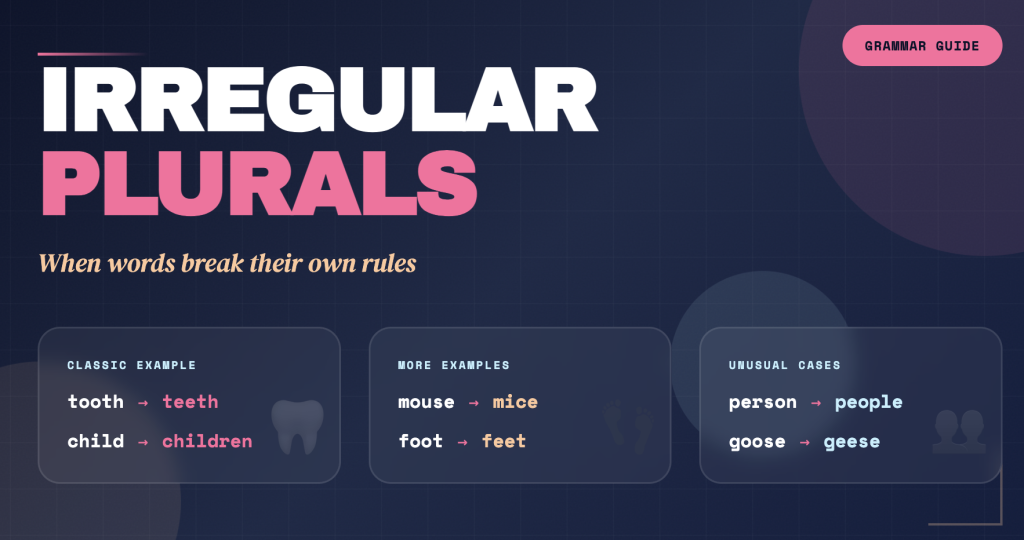
Table of Contents
-
- What Is the Plural of Tooth?
- Why Is the Plural of Tooth “Teeth”?
- Singular vs Plural: Tooth and Teeth
- Rules Behind Tooth → Teeth
- Examples in Sentences (School & Exam Based)
- Common Mistakes Students Make
- Easy Tricks to Remember Tooth and Teeth
- FAQs on Plural of Tooth
- Conclusion

What Is the Plural of Tooth?
The plural of tooth is teeth.
- Singular: tooth
- Plural: teeth
This means:
- One tooth → tooth
- More than one tooth → teeth
This is a direct answer and the only correct plural form in standard English.
Why Is the Plural of Tooth “Teeth”?
English doesn’t always follow simple “add -s” rules.
The word tooth belongs to a group of irregular nouns where the vowel sound changes in the plural form.
Examples:
- tooth → teeth
- foot → feet
- goose → geese
- man → men
This change comes from Old English, where vowel changes were common when forming plurals.
Singular vs Plural: Tooth and Teeth
| Singular | Plural |
| tooth | teeth |
| One tooth is aching | My teeth are aching |
| A baby has one tooth | Adults have 32 teeth |
Rule to remember:
If the number is one, use tooth.
If the number is more than one, use teeth.
Rules Behind Tooth → Teeth
Here’s the simple breakdown students should remember:
- Tooth is an irregular noun
- It does not add -s or -es
- The vowel oo changes to ee
There is no alternative plural form for tooth in modern English.
Examples in Sentences (School & Exam Based)
Classroom Examples
- The dentist checked my teeth during the school health camp.
- A child usually gets their first tooth around six months.
- We must brush our teeth twice a day.
Exam-Oriented Examples
- Incorrect: He brushed his tooths.
- Correct: He brushed his teeth.
- Incorrect: She has pain in her tooth. (when referring to many)
- Correct: She has pain in her teeth.
Common Mistakes Students Make
These errors are very common in exams and homework:
Adding “s” to tooth
- tooths
- teeth
Using tooth for plural meaning
- “My tooth are clean”
- “My teeth are clean”
Confusing tooth with count
- “He lost two tooth”
- “He lost two teeth”
Avoiding these mistakes can instantly improve grammar scores.
Easy Tricks to Remember Tooth and Teeth
Here are student-friendly memory tips:
The Sound Change Trick
- Tooth → oo
- Teeth → ee
If the sound becomes sharper, it’s plural.
The Number Trick
- One = tooth
- Many = teeth
Pattern Trick
If you remember foot → feet, tooth → teeth will feel natural.
Frequently Asked Questions about Plural of Tooth
Q. What is the plural of tooth?
The plural of tooth is teeth. It is an irregular noun and does not follow the regular “add s” rule used by most English nouns.
Q. Is “tooths” ever correct?
No, tooths is grammatically incorrect. The correct plural form is teeth, and “tooths” should never be used in exams or writing.
Q. Why doesn’t tooth become tooths?
Because tooth is an irregular noun. English inherited this form from Old English, where vowel changes were used instead of adding letters.
Q. When should I use tooth instead of teeth?
Use tooth only when referring to one single tooth. If there is more than one, always use teeth.
Q. Is teeth singular or plural?
Teeth is always plural. There is no singular form of teeth. The singular form is tooth.
Q. Are tooth and teeth commonly asked in exams?
Yes. Questions on singular and plural nouns, especially irregular ones like tooth/teeth, frequently appear in school exams and grammar tests.
Q. Are there other words like tooth and teeth?
Yes. Similar words include foot → feet, goose → geese, and man → men. These are irregular plurals with vowel changes.
Q. How can students remember tooth and teeth easily?
Students can remember the sound change: oo in tooth becomes ee in teeth. Associating it with foot/feet also helps memory.
Conclusion: Why This Small Word Matters
Understanding the plural of tooth may seem minor, but it builds strong grammar foundations. These small details improve exam performance, writing clarity, and spoken English confidence.
When students master simple irregular nouns like tooth → teeth, they stop second-guessing themselves and that confidence shows everywhere, from classrooms to competitive exams.
Keep learning, keep practicing, and remember: one tooth, many teeth and one step closer to perfect English.