

Introduction
Learning the planets name is one of the first steps in understanding our solar system. It is a common topic taught in primary classes and becomes more detailed by Class 6. Many students feel confused about the correct order of planets or how many planets are actually there, especially during exams or homework time.
This page is created for students, parents, and teachers who want clear and correct information without complex science terms. The explanation follows the school syllabus and focuses on helping children learn in a simple and logical way.
If you are looking for the planets name for Class 6, this guide will help you revise quickly and understand the topic better. Parents can also use this page to explain the concept easily at home and support their child’s learning with confidence.
What Are Planets? (Simple Explanation for Students)
Planets are large space objects that move around the Sun in a fixed path called an orbit. They do not have their own light, but they shine because they reflect sunlight. This idea is taught early in school so that students can understand how our solar system works.
The solar system planets name list includes only those bodies that follow clear scientific rules. A planet must move around the Sun, be almost round in shape, and clear other objects from its path. This is why only a fixed number of planets are counted today.
Key Features of Planets (Easy Points)
- Planets revolve around the Sun, not around the Earth
- They do not produce light like stars
- Each planet has a different size, surface, and temperature
For planets name for kids, parents can explain planets as “big balls in space” that move around the Sun in order. This simple idea helps children remember and understand the concept without feeling confused or scared of science.
Planets Name in Order (From the Sun)
The planets name in order is an important topic for school exams and daily revision. Many students lose marks because they remember the planet names but forget the correct sequence. Learning the order from the Sun makes the concept clear and logical.
Parents can help children by asking them to read the order aloud or revise using a table. This method works well for quick learning and long-term memory. Below is the correct list of planets names in order, starting from the planet closest to the Sun.
Table – Planets Name in Order
| Order from Sun | Planet Name (English) | Planet Name (Hindi) | One-line Fact |
| 1 | Mercury | बुध | Closest planet to the Sun |
| 2 | Venus | शुक्र | Hottest planet in the solar system |
| 3 | Earth | पृथ्वी | Only planet with known life |
| 4 | Mars | मंगल | Known as the Red Planet |
| 5 | Jupiter | बृहस्पति | Largest planet |
| 6 | Saturn | शनि | Famous for its rings |
| 7 | Uranus | अरुण | Rotates on its side |
| 8 | Neptune | वरुण | Farthest planet from the Sun |
This table shows the planets name in Hindi and English, making it easier for students to revise for exams. Parents can also use this list to test their child’s understanding at home in a simple and friendly way.
List of 8 Planets Name (Current Scientific Standard)
Many students and parents still ask whether there are 8 or 9 planets. According to today’s science and school textbooks, there are 8 planets name in our solar system. This list is followed by NCERT, CBSE, and ICSE for exams and classroom teaching.
Understanding this clearly helps students avoid mistakes in tests. Parents can also be confident that this is the correct and updated information to teach at home.
The Eight Planets Name
- Mercury
- Venus
- Earth
- Mars
- Jupiter
- Saturn
- Uranus
- Neptune
These eight planets name are counted because they move around the Sun, have a round shape, and follow a clear path in space. Learning this standard list helps students answer exam questions correctly and removes confusion during revision time.
Planets Name in English and Hindi
Many students understand concepts better when they learn in their mother tongue along with English. That is why knowing the planets name in Hindi is helpful, especially for younger classes and first-time learners. It also supports parents who explain lessons at home.
Schools usually teach planet names in English, but exams and oral tests may include Hindi terms as well. Learning the planets name in Hindi and English together reduces confusion and builds confidence.
Planets Name in English and Hindi (Easy Table)
| Planet Name (English) | Planet Name (Hindi) |
| Mercury | बुध |
| Venus | शुक्र |
| Earth | पृथ्वी |
| Mars | मंगल |
| Jupiter | बृहस्पति |
| Saturn | शनि |
| Uranus | अरुण |
| Neptune | वरुण |
Parents can ask children to read both names aloud during revision. This simple practice helps students remember planet names easily and perform better in school assessments and class discussions.
Planets Names with Pictures (Learning Aid)
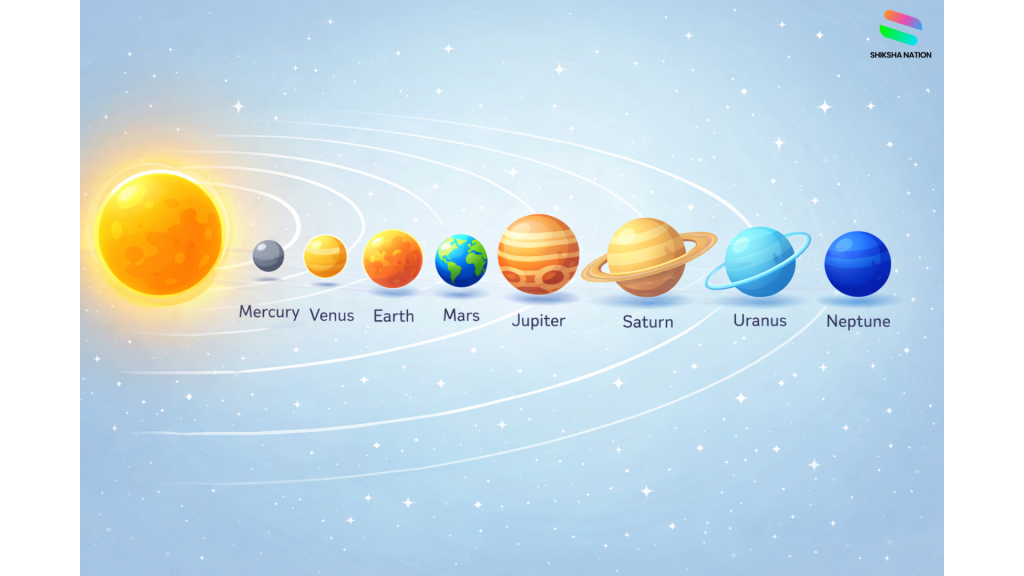
Learning becomes easier when students see what they are studying. Pictures help children connect planet names with their shape, size, and position in space. This method is especially useful for young learners and visual students.
Using planets names with pictures is also helpful while preparing worksheets, revision notes, or printable PDFs. A clear image helps students remember faster and reduces confusion during exams.
How Pictures Help Students Learn Better
- Improves memory and recall
- Makes revision interesting and less boring
- Helps parents explain topics without long explanations
Teachers and parents can ask students to point at the picture and say the planet name aloud. This simple activity builds confidence and supports better understanding in a short time.
Why Pluto Is Not Included in the Planets List
Many students and parents still ask why Pluto is missing when learning the all planets name list. Earlier, Pluto was taught as a planet, which is why older books and memories can cause confusion.
Scientists later studied Pluto in more detail and found that it does not fully match the rules used to define a planet. Because of this, Pluto was placed in a different group called a dwarf planet.
Simple Reasons Pluto Is Not a Planet Today
- It is very small compared to other planets
- It shares its space path with many other objects
- It does not clear its orbit completely
For exams and school learning, students should follow the current textbook standard. Parents can reassure children that leaving Pluto out is correct and based on scientific understanding, not a mistake.
Planets Name for Class 6 – Exam-Focused Notes
This section is specially written for planets name for Class 6 revision. It follows the school syllabus and focuses on what students are commonly asked in exams. Parents can use these points to help children revise quickly before tests.
Students should remember planet names in the correct order and understand basic facts. Writing clear and short answers helps in scoring better marks.
Easy Memory Trick (Order from the Sun)
My Very Educated Mother Just Served Us Noodles
(Mercury, Venus, Earth, Mars, Jupiter, Saturn, Uranus, Neptune)
This sentence helps students recall the planet order easily during exams.
One-Line Exam Points (Important)
- There are 8 planets in the solar system
- Planets move around the Sun in fixed paths
- Earth is the only planet known to support life
- Jupiter is the largest planet
- Mercury is the closest planet to the Sun
Parents can ask children to write these points in their own words. Regular short revision builds confidence and improves exam performance.
Frequently Asked Questions (FAQs)
Below are some common questions that students and parents ask while studying the planets name topic. These answers are written in a simple way to clear doubts quickly and support exam preparation.
Q. How many planets are there in the solar system?
There are 8 planets in the solar system. This is the number followed by school textbooks and exams. The solar system planets name list does not include Pluto today, so students should always write eight planets in answers.
Q. What is the correct planets name order for exams?
For exams, students should write the planet names starting from the Sun. Writing them in the correct order is important for full marks. Parents can help children practise this by asking them to repeat the order daily.
Q. Are there 8 or 9 planets?
Earlier, students were taught about 9 planets. Today, science follows the 8 planets rule. Pluto is now placed in a different category, so it is not counted in the main planets list for exams.
Q. Do Class 6 students need to remember planet order?
Yes, Class 6 students are expected to remember both the planets name and their order. This topic is important for tests, worksheets, and higher classes, so regular revision is helpful.