

Many students understand physics concepts but still lose marks because of one simple reason – symbol confusion. In exams, writing the wrong symbol or mixing two similar symbols can change the entire meaning of an answer. This is a common problem seen in Class 9-12 physics, especially during numericals and derivations.
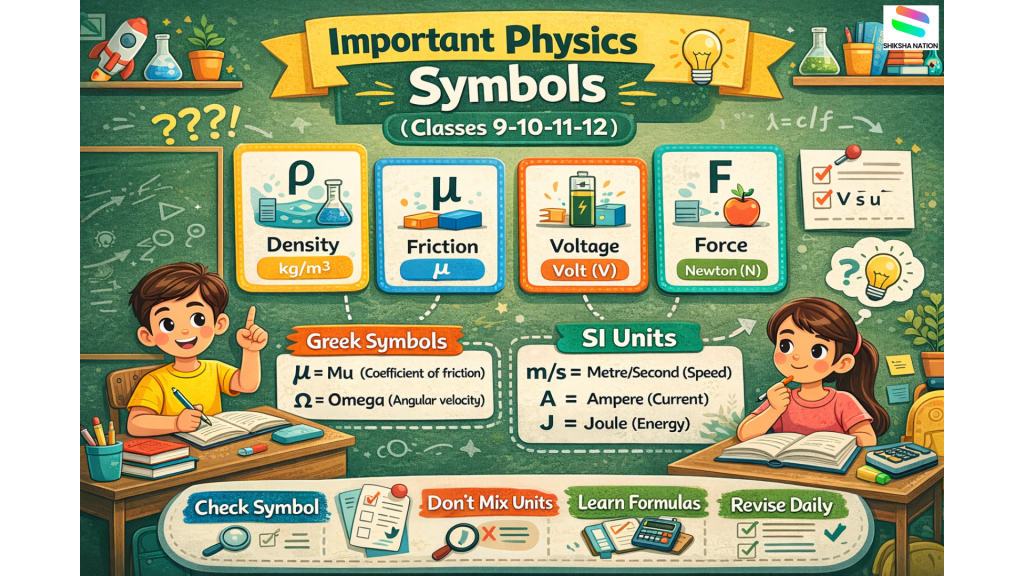
This guide focuses only on physics symbols that are actually used in school-level physics textbooks and exams. It explains symbols in a clear and student-friendly way, so learners know what each symbol stands for and where it is used.
You will find physics symbols and meanings explained with proper context, units, and examples that match board, JEE, and NEET patterns. This page does not include mathematical operators, programming signs, or advanced symbols used outside school physics.
For parents, this guide works as a quick reference during revision time. For students, it helps reduce mistakes, improve clarity, and write more accurate answers in exams.
Why Physics Symbols Matter in School Exams
Correct symbols mean correct answers
In school exams, physics symbols are not just signs — they carry meaning. Using a wrong symbol can make a correct method look incorrect to the examiner, especially in board exams where steps are checked carefully.
Important for numerical problems
In numericals, symbols help students organise given values and formulas clearly. Mixing symbols like v and u or P and p can lead to wrong substitutions and calculation errors, even if the formula is known.
Needed in derivations and theory questions
Derivations depend heavily on proper symbol usage. Examiners expect standard symbols while writing laws, formulas, and final results. Incorrect symbols can reduce marks in step-wise evaluation.
Helps parents during revision
For parents helping at home, understanding symbols makes revision smoother. When symbols are clear, it becomes easier to check answers, explain mistakes, and support the child before exams.
Common Physics Symbols Used in Class 9 & 10
In Class 9 and 10, most mistakes in physics happen not because students don’t know formulas, but because they mix up symbols. These physics symbols class 9 level concepts appear again and again in numericals, derivations, and MCQs.
Learning symbols along with their meaning and unit helps students write neat answers and avoid confusion during exams. Parents can also use these tables as a quick revision checklist before tests.

Motion & Force Symbols
These symbols are mainly used in Motion, Laws of Motion, and Gravitation chapters.
| Symbol | Meaning | Unit | Chapter |
| v | Final velocity | m/s | Motion |
| u | Initial velocity | m/s | Motion |
| a | Acceleration | m/s² | Motion |
| s | Distance or displacement | m | Motion |
| t | Time taken | s | Motion |
| F | Force | newton (N) | Laws of Motion |
| m | Mass of object | kilogram (kg) | Laws of Motion |
Student tip: Always write units with symbols in numericals.
Parent tip: Ask the child what each symbol stands for before solving sums.
Work, Energy & Power Symbols
These symbols are commonly tested in numericals and short-answer questions.
| Symbol | Meaning | Unit | Chapter |
| W | Work done | joule (J) | Work & Energy |
| E | Energy | joule (J) | Work & Energy |
| P | Power | watt (W) | Work & Energy |
| KE | Kinetic energy | joule (J) | Work & Energy |
| PE | Potential energy | joule (J) | Work & Energy |
Student tip: Do not confuse P (power) with p (pressure) from other chapters.
Parent tip: Help children revise symbols before exams to reduce silly mistakes.
Understanding these physics symbols and units early builds a strong base for Class 11 and 12 physics.
Physics Symbols Used in Class 11 Physics
Class 11 physics introduces many new chapters and symbols. Students often feel the subject has suddenly become difficult, but the real issue is not concepts – it is symbol overload. Knowing physics symbols class 11 level clearly helps students follow formulas, derivations, and numerical steps with confidence.
Many symbols in this class include Greek letters, which are widely used across mechanics, thermodynamics, and waves. Parents supporting revision should ensure students understand what each symbol represents before memorising formulas.
Mechanics Symbols
These symbols appear in Rotational Motion, Centre of Mass, and Gravitation.
| Symbol | Meaning | Unit | Chapter |
| ω | Angular velocity | rad/s | Rotational Motion |
| θ | Angular displacement | radian (rad) | Rotational Motion |
| τ | Torque | N·m | Rotational Motion |
| I | Moment of inertia | kg·m² | Rotational Motion |
| L | Angular momentum | kg·m²/s | Rotational Motion |
Student tip: Do not confuse ω (omega) with w (work).
Parent tip: Ask children to explain symbols in words, not just write formulas.
Thermodynamics Symbols
These symbols are commonly used in Thermodynamics and Thermal Physics.
| Symbol | Meaning | Unit | Chapter |
| Q | Heat energy | joule (J) | Thermodynamics |
| T | Temperature | kelvin (K) | Thermodynamics |
| ΔU | Change in internal energy | joule (J) | Thermodynamics |
| W | Work done by system | joule (J) | Thermodynamics |
Student tip: Always notice signs (+/–) with Q and W in numericals.
Parent tip: Help children revise symbol meanings before practising problems.
Waves & Oscillations Symbols
These symbols appear in Oscillations and Waves, where equations depend heavily on correct notation.
| Symbol | Meaning | Unit | Chapter |
| λ | Wavelength | metre (m) | Waves |
| ν | Frequency | hertz (Hz) | Waves |
| A | Amplitude | metre (m) | Oscillations |
| T | Time period | second (s) | Oscillations |
Student tip: Do not mix T (time period) with T (temperature) – context matters.
Parent tip: Revision charts of Greek symbols in physics help reduce exam stress.
Understanding these symbols early makes Class 11 physics less confusing and prepares students well for Class 12, JEE, and NEET.
Physics Symbols Used in Class 12 Physics
Class 12 physics is exam-focused and concept-heavy. Most questions in boards, JEE, and NEET involve multi-step numericals where correct symbol usage is essential. Many students lose marks not due to wrong concepts, but because they mix symbols or forget what a symbol represents. Learning physics symbols class 12 properly helps avoid these errors.
For parents, this stage is critical. Clear understanding of symbols allows better revision support at home and helps students stay confident during final exams.
Electricity & Magnetism Symbols
These symbols are used repeatedly in Current Electricity, Magnetism, and Electromagnetic Induction. They are also important for numerical accuracy.
| Symbol | Meaning | Unit | Chapter |
| V | Electric potential difference (voltage) | volt (V) | Current Electricity |
| I | Electric current | ampere (A) | Current Electricity |
| R | Electrical resistance | ohm (Ω) | Current Electricity |
| C | Capacitance | farad (F) | Electrostatics |
| L | Inductance | henry (H) | EMI |
| Φ | Magnetic flux | weber (Wb) | Magnetism |
| B | Magnetic field strength | tesla (T) | Magnetism |
Student tip: Always write symbols neatly. Capital I (current) should not look like l (small L).
Parent tip: Ask your child to explain each symbol before solving circuit numericals.
These physics symbols electricity topics are scoring areas but only when symbols and units are used correctly.
Modern Physics Symbols
Modern physics chapters look short but are very symbol-sensitive. One wrong symbol can change the entire answer.
| Symbol | Meaning | Unit | Chapter |
| h | Planck’s constant | J·s | Dual Nature |
| ℏ | Reduced Planck’s constant (h/2π) | J·s | Atomic Physics |
| E | Energy | joule (J) | Modern Physics |
| f | Frequency | hertz (Hz) | Dual Nature |
| c | Speed of light | m/s | Modern Physics |
Student tip: Do not confuse f (frequency) with v (velocity) used in other chapters.
Parent tip: Encourage revision using symbol-unit pairs instead of only formulas.
Why Class 12 Symbol Clarity Is Important
In Class 12 exams, answers are checked step-by-step. Even if the formula is correct, wrong symbols can reduce marks. Competitive exams also use standard notation, and any confusion slows down problem solving.
When students understand symbols clearly, they read questions faster, apply formulas correctly, and feel more confident. This clarity becomes a big advantage during long exams like boards, JEE, and NEET.
Strong command over Class 12 symbols also prepares students for higher studies, where physics notation becomes even more detailed and precise.
Important Greek Symbols in Physics (With Meaning)
Greek letters are used widely in physics to represent quantities that appear again and again across chapters. Many students feel confused when they first see these symbols, especially in Class 11 and 12. However, once meanings are clear, formulas become easier to understand and remember.
These greek symbols in physics are not random. Each symbol is linked to a specific physical quantity and is used in standard textbooks, board exams, and competitive exams like JEE and NEET. Learning them properly helps students avoid guesswork during exams.
For parents, Greek symbols often look unfamiliar. This section explains them in simple language so revision at home becomes smoother and less stressful.
Common Greek Symbols Used in Physics
| Symbol | Name | Common Meaning | Used In |
| α | Alpha | Angular acceleration | Rotational motion |
| β | Beta | Angle or particle speed ratio | Modern physics |
| γ | Gamma | Lorentz factor | Relativity |
| θ | Theta | Angular displacement | Mechanics |
| λ | Lambda | Wavelength | Waves |
| ω | Omega | Angular velocity | Rotational motion |
| ρ | Rho | Density | Properties of matter |
| σ | Sigma | Stress or surface charge density | Mechanics / Electrostatics |
| μ | Mu | Coefficient of friction / permeability | Mechanics / Magnetism |
Student tip: Always check the chapter to understand what the symbol represents.
Parent tip: Ask children to read the symbol name aloud while revising.
What Does μ (Mu) Represent in Physics?
The mu symbol in physics has more than one meaning, which often confuses students.
- Coefficient of friction
In mechanics, μ represents friction between two surfaces. It shows how rough or smooth the surfaces are. A higher value of μ means more friction. - Permeability (context note)
In magnetism, μ is used to represent magnetic permeability. It tells how a material responds to a magnetic field. Here, the meaning is completely different from friction.
Student tip: Never assume the meaning of μ without checking the chapter.
Parent tip: Encourage your child to link symbols with chapter names, not just formulas.
Understanding Greek symbols clearly reduces mistakes and builds confidence in physics problem-solving.
Physics Symbols and Their SI Units
In exams, writing the correct value is not enough. Marks are also given for units. Many students lose easy marks because they forget or mix units while writing answers. Learning physics symbols and units together helps avoid these common mistakes.
For parents, checking units is one of the simplest ways to help children during revision. If the unit is wrong, the final answer is usually marked incorrect, even if the steps are right.
Common Physics Symbols With SI Units
The table below shows frequently used physics symbols along with their standard SI units used in school exams.
| Symbol | Physical Quantity | SI Unit | Unit Symbol |
| v | Velocity | metre per second | m/s |
| a | Acceleration | metre per second squared | m/s² |
| F | Force | newton | N |
| m | Mass | kilogram | kg |
| W | Work | joule | J |
| P | Power | watt | W |
| I | Electric current | ampere | A |
| V | Potential difference | volt | V |
| R | Resistance | ohm | Ω |
| Q | Heat energy | joule | J |
Student tip: Always write the unit next to the final numerical answer.
Parent tip: Ask “What is the unit?” after every solved question.
Common Unit Mistakes That Cost Marks
Many mistakes happen due to small unit errors, especially in board exams.
- Writing kg instead of g without conversion
- Using cm/s when the question expects m/s
- Forgetting square or cube units like m/s²
- Writing J/s instead of watt (W)
- Mixing °C and K in temperature problems
Student tip: Convert all values to SI units before applying formulas.
Parent tip: During revision, focus more on units than speed.
Correct use of symbols with SI units improves accuracy, presentation, and overall physics scores.
Physics Symbols Used in Electricity & Circuits
Electricity chapters are scoring but also confusing. Many students mix up symbols while solving numericals or writing theory answers. Understanding physics symbols electricity clearly helps in applying formulas correctly and avoiding sign or unit mistakes in exams.
This section explains the meaning of symbols only. It does not cover circuit diagrams or drawing symbols, so students stay focused on calculations and concepts.
Common Electricity & Circuit-Related Symbols
These physics electricity symbols are frequently used in Class 10 and Class 12 chapters like Current Electricity, Electrostatics, and Magnetic Effects of Current.
| Symbol | Meaning | SI Unit | Used In |
| I | Electric current | ampere (A) | Current Electricity |
| V | Potential difference | volt (V) | Current Electricity |
| R | Electrical resistance | ohm (Ω) | Current Electricity |
| Q | Electric charge | coulomb (C) | Electrostatics |
| C | Capacitance | farad (F) | Capacitors |
| P | Electric power | watt (W) | Electrical Power |
| E | Electric field | volt per metre | Electrostatics |
Student tip: Write symbols clearly so I, l, and 1 do not look the same.
Parent tip: Ask children to explain what each symbol stands for before formula use.
Common Confusions Students Should Avoid
Small symbol mix-ups can lead to wrong answers.
- P (power) vs p (pressure)
- Q (charge) vs q (heat in thermodynamics)
- E (electric field) vs E (energy)
Student tip: Always check the chapter context before choosing a symbol.
Parent tip: Revision works better when symbols are linked to chapters.
Clear understanding of electricity symbols makes numerical practice faster and more accurate, especially in board and entrance exams.
Common Confusions Students Make With Physics Symbols
Many mistakes in physics exams happen not because concepts are wrong, but because symbols are mixed up. Teachers often see students losing easy marks due to small symbol errors. Clearing these confusions early improves accuracy and confidence.
This section explains the most common symbol mix-ups in a teacher-guided way, so students and parents know what to watch out for during revision.
v vs u (Velocity Confusion)
- u is used for initial velocity
- v is used for final velocity
Students often interchange them in equations of motion. This changes the result completely. Always check whether the object is starting or ending before choosing the symbol.
μ vs m (Friction vs Mass)
- μ (mu) represents coefficient of friction
- m represents mass of the object
These two look similar in handwriting. Writing μ clearly and saying its meaning while solving helps avoid mistakes.
P: Power vs Pressure
- P (power) is used in work and electricity chapters
- p (pressure) is used in mechanics and fluids
The same letter has different meanings in different chapters. Always link the symbol with the topic you are studying.
ω vs w (Angular vs Linear Meaning)
- ω (omega) is angular velocity
- w (work) is energy transferred
Students often confuse Greek omega with the English letter w. Writing symbols neatly and revising Greek letters reduces this problem.
Student tip: Pause for two seconds to check symbol meaning before writing formulas.
Parent tip: Ask “What does this symbol mean here?” during practice.
Avoiding these small errors can improve physics scores significantly.
How to Remember Physics Symbols Easily (Exam Tips)
Remembering symbols becomes easy when students stop memorising randomly and start using smart methods. These tips are commonly suggested by teachers to reduce exam-time confusion and improve speed.
Use Simple Mnemonics
Create short memory links for similar symbols.
For example, u = “used first” (initial velocity) and v = “value at end” (final velocity).
Small memory tricks help recall symbols quickly during exams.
Link Symbols With Chapters
Never learn symbols in isolation.
Associate each symbol with its chapter, like Q with heat or λ with waves.
This method helps students choose the correct symbol when questions change context.
Also Read : Physics symbols used in school exams
Associate Symbols With Units
Units act as reminders.
If you remember force is in newtons, the symbol F comes naturally.
Parents can help by asking children to say the unit along with the symbol.
Practise While Writing, Not Just Reading
Writing symbols during practice builds muscle memory.
Regular practice before exams reduces hesitation and careless errors.
Student tip: Revise symbols daily for 5 minutes instead of cramming once.
Parent tip: Short, regular revision works better than long study sessions.
FAQs on Physics Symbols
Q. Are physics symbols same in all boards?
Yes, most physics symbols are the same across CBSE, ICSE, and state boards because they follow standard textbooks and SI conventions. Symbols for quantities like force, velocity, current, and energy do not change. Small differences may appear in how answers are written, but symbol meaning remains the same. Parents can be assured that learning standard symbols works for all boards.
Q. Is it compulsory to write correct symbols in exams?
Yes. Writing correct symbols is important in both numericals and theory answers. Examiners check steps, formulas, and final answers using standard notation. If a symbol is wrong or unclear, marks can be reduced even when the idea is correct. Students should practise neat writing and correct symbol use regularly.
Q. Do NEET and JEE use the same physics symbols?
Yes. NEET and JEE use the same physics symbols taught in Class 11 and 12. Competitive exams follow NCERT-based notation. The difference is speed and accuracy. Knowing symbols well helps students read questions faster and avoid confusion during long exams.
Q. Can symbols change meaning in different chapters?
Yes, some symbols can represent different quantities depending on the chapter. This is a common source of confusion for students. For example, P can mean power in electricity and pressure in fluids. T can mean time period or temperature. Always read the question and identify the chapter context.