CBSE Official Notification on On-Screen Marking (PDF)
CBSE has released an official notification to clearly explain the introduction of on-screen marking. According to the notification, this system will be used for Class 12 board exam answer sheet evaluation starting from the 2026 examinations.
The board has clarified that the change is made to improve accuracy, reduce manual errors, and speed up the evaluation process. Teachers will check answers digitally using a secure system provided by CBSE.
- Important note for students and parents:
Class 10 answer sheets will continue to be checked in physical mode and are not part of on-screen marking for now.
For complete and authentic details, refer to the official document below:
Download: cbse-on-screen-marking-class-12-official-notification-2026
This official source helps students and parents trust the process and avoid rumours or misinformation.
What Is On-Screen Marking in CBSE?
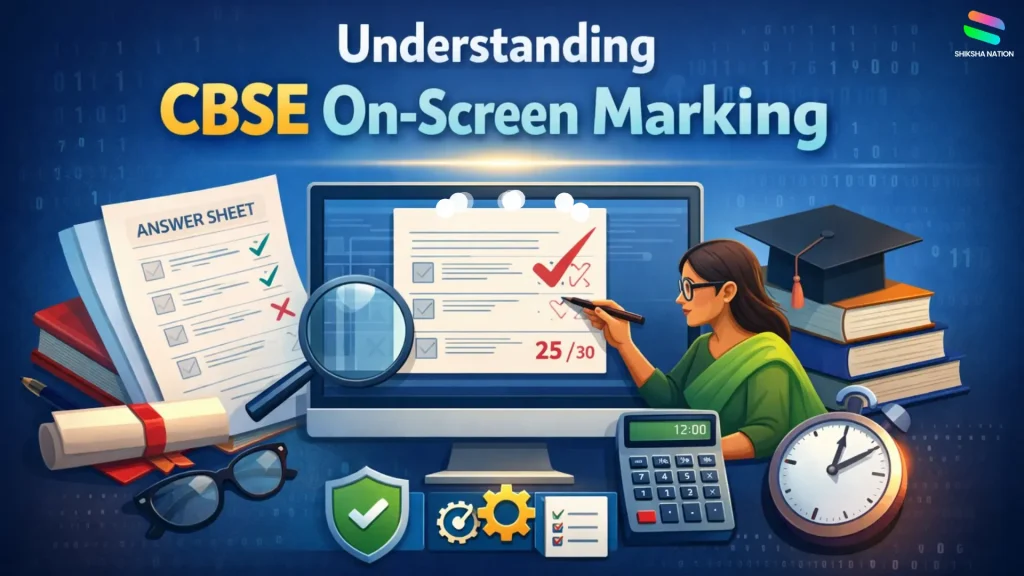
On-screen marking is a digital method used by CBSE to check board exam answer sheets. Under CBSE on screen marking Class 12, students’ written answer sheets are first scanned and then evaluated on a computer screen instead of paper.
This system is part of the CBSE digital evaluation system and is mainly introduced to make checking more accurate and organised. Teachers do not carry physical answer sheets. They check answers through a secure online system provided by CBSE.
How is it different from traditional checking?
In the earlier system:
- Teachers checked physical answer sheets with a pen
- Totalling of marks was done manually
- Physical movement of answer sheets was required
In on-screen marking:
- Answers are checked digitally on a screen
- Marks are added automatically by the system
- There is less chance of human calculation mistakes
For students and parents, this change means the checking process becomes more standardised, monitored, and less dependent on manual work.
Why CBSE Introduced the Digital Evaluation System
CBSE introduced digital evaluation to improve the overall CBSE board exam evaluation process. With a large number of students appearing every year, checking answer sheets accurately and on time became a challenge.
The board needed a system that reduces errors, speeds up evaluation, and maintains fairness for all students. This is where the new CBSE answer sheet checking system became important.
Problems in the Traditional Answer Sheet Checking System
The older method had several practical issues:
- Manual totalling sometimes led to calculation mistakes
- Physical movement of answer sheets increased risk of delay or damage
- Checking depended heavily on individual handling
- Rechecking and verification required extra time and manpower
From a parent’s point of view, these issues raised concerns about accuracy and result delays.
Benefits of On-Screen Marking for CBSE
The digital system helps CBSE manage evaluation better:
- Automatic addition of marks reduces human error
- Faster checking helps in timely result declaration
- Centralised monitoring improves consistency
- Less paperwork makes the process more organised
For students and parents, this means a smoother, more reliable evaluation experience.
How CBSE Checks Answer Sheets Using On-Screen Marking
Many students and parents want to clearly understand how CBSE checks answer sheets under the new digital system. Knowing each step helps remove fear and builds trust in the evaluation process.
CBSE follows a structured and monitored CBSE board exam checking method to make sure every answer sheet is evaluated fairly and carefully.
Step-by-Step CBSE Answer Sheet Evaluation Process
- Scanning of answer sheets
After the board exams are over, all written answer sheets are scanned securely. The physical copies are converted into digital format without changing any student response.
- Allocation to examiners
Once scanned, answer sheets are assigned to trained CBSE examiners through a central system. Examiners receive only the answers, not student identity, ensuring unbiased checking.
- Digital marking on screen
Teachers evaluate answers on a computer screen using marking guidelines provided by CBSE. Marks are given question-wise, just like traditional checking, but through digital tools.
- Automated totalling of marks
After marking, the system automatically adds the marks. This removes manual calculation errors and ensures accuracy in the final score.
From a parent’s view, this step-by-step process reduces mistakes and delays. For students, it means answers are checked in a controlled and standardised way, improving overall fairness and reliability.
Is CBSE On-Screen Marking Safe and Fair?
A common question among students and parents is is CBSE on screen marking safe. Any change in the evaluation system naturally raises doubts about accuracy, fairness, and transparency.
CBSE has added several checks to make sure the CBSE result evaluation process remains reliable and student-friendly.
How CBSE ensures safety and fairness
- Trained examiners only
Teachers are given proper training before they start digital checking. They follow clear marking guidelines, just like in physical evaluation.
- No manual totalling errors
Marks are added automatically by the system. This removes mistakes that can happen during hand calculation and improves accuracy.
- Monitoring and digital records
Every action during checking is recorded in the system. This creates a clear trail, making the process more transparent and accountable.
For parents, this system reduces the risk of human error and delays. For students, it ensures answers are checked in a controlled and standard way, without bias. Overall, on-screen marking focuses on accuracy, fairness, and trust.
Impact of On-Screen Marking on Students’ Marks
The biggest concern for students and parents is the impact of on screen marking on marks. Many fear that digital checking may change scores unfairly or affect performance.
In reality, on-screen marking does not change how answers are judged. The same marking scheme, step-wise marks, and examiner judgment are followed. Only the medium of checking has changed from paper to screen.
For parents, this means marks are less likely to suffer due to calculation mistakes. For students, it ensures answers are evaluated in a more consistent and controlled manner.
Will Marks Increase or Decrease Due to On-Screen Marking?
Marks do not automatically increase or decrease because of on-screen marking.
- Good answers are rewarded as per the marking scheme
- Incomplete or incorrect answers are marked accordingly
- Automatic totalling reduces chances of losing marks due to addition errors
Overall, marks depend on answer quality, not the evaluation method. On-screen marking mainly improves accuracy, not scores.
What Remains the Same for Students
Even with the new evaluation system, many important things remain unchanged for students. This helps reduce fear and confusion around board exams.
- Syllabus stays the same
CBSE has not changed the syllabus because of on-screen marking. Students should prepare exactly as per the prescribed curriculum.
- Exam pattern remains unchanged
Question paper format, marks distribution, and time duration are the same as before. There is no surprise element in the exam.
- Answer writing is still important
Clear explanation, proper steps, and correct presentation still matter. Examiners focus on content quality, not the mode of checking.
For parents, this means children do not need a new preparation strategy. For students, the focus should remain on understanding concepts and writing clear answers.
FAQ’s on “On Screen Marking CBSE”
Q. Is handwriting still important in on-screen marking?
Yes, handwriting is still important. Examiners see scanned copies of your answer sheets exactly as you write them. Clear, readable handwriting helps examiners understand answers easily. For students, neat writing supports better evaluation. Parents can be assured that presentation, spacing, and proper steps still matter during digital checking.
Q. Can examiners see the full answer sheet on screen?
Yes, examiners can view the complete answer sheet on their screen. They can scroll, zoom, and move between pages while checking. This allows them to review answers properly, just like physical checking. Students do not lose any advantage because the entire paper is visible during evaluation.
Q. Is rechecking or verification possible with on-screen marking?
Yes, rechecking and verification are still possible as per CBSE rules. Since answers are stored digitally, the system allows accurate review when required. For parents, this reduces worry about missing pages or lost answer sheets. The digital record makes the process more organised and traceable.
Q. Does on-screen marking affect result declaration time?
On-screen marking usually helps in faster evaluation. Automatic totalling and digital allocation reduce delays in checking. This can support timely result declaration. However, the final result date still depends on CBSE’s overall schedule. Students should not expect delays just because of digital checking.
Q. Is this system used in other boards or exams?
Yes, digital evaluation systems are already used in many competitive exams and international boards. CBSE has studied these models before adopting on-screen marking. For parents, this shows that the system is tested and reliable. CBSE has adapted it according to Indian board exam requirements.
Q. Can marks be changed or manipulated in digital checking?
No, marks cannot be changed easily. Every action taken by the examiner is recorded in the system. This creates accountability and reduces unfair practices. For students, this adds an extra layer of safety. Parents can trust that the evaluation follows strict digital controls.
Q. Should students change their exam preparation because of on-screen marking?
No change in preparation is needed. Students should focus on understanding concepts, writing clear answers, and following the syllabus. The checking method does not change what is expected in answers. Parents can guide children to prepare normally without extra stress about digital evaluation.