

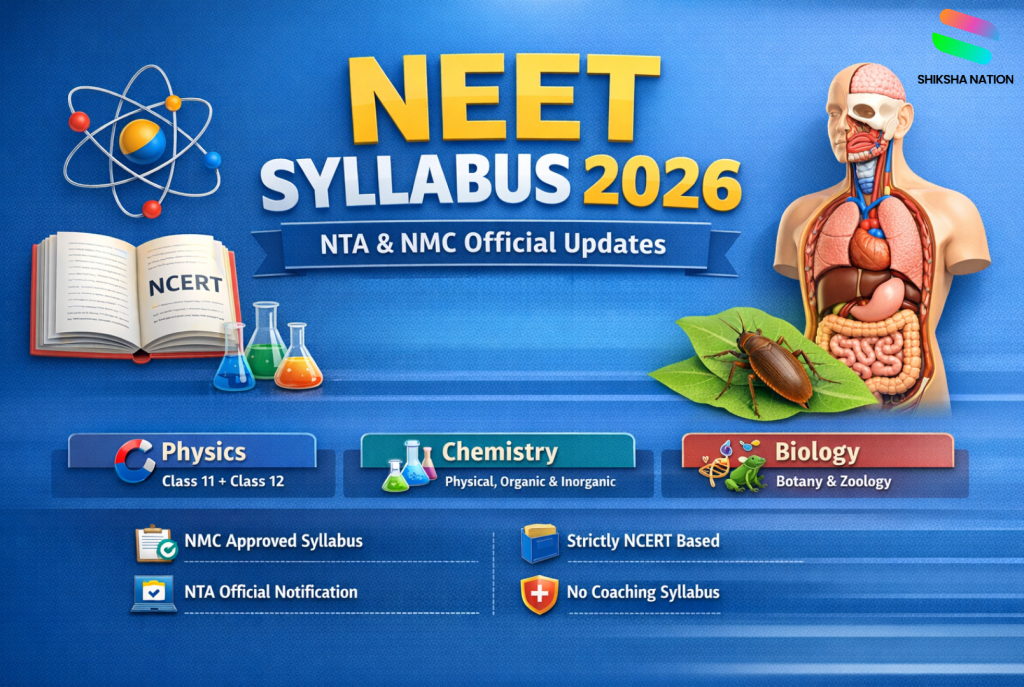
NEET Syllabus 2026 – Official Update by NTA & NMC
The neet syllabus 2026 is based only on official decisions taken by national medical education authorities. This syllabus is not created by coaching institutes or private platforms.
The syllabus for NEET UG 2026 has been finalised by the National Medical Commission (NMC) through its academic body, the Undergraduate Medical Education Board (UGMEB). Once approved, it is officially implemented by the National Testing Agency (NTA) for conducting the exam.
The neet 2026 syllabus by nta is strictly aligned with the Class 11 and Class 12 NCERT curriculum. All questions in the exam are framed from these topics only. No extra or removed chapters outside NCERT are considered valid.
Students should prepare only from the nta neet syllabus 2026 shared through official notices. Parents are advised to avoid syllabus lists circulated on social media or by coaching centres, as they often create confusion and unnecessary stress.
NEET 2026 Syllabus – Subject-Wise Overview
The neet ug syllabus 2026 is clearly divided into three core subjects that every medical aspirant must prepare. Understanding this structure helps students plan their study in the right order and helps parents track progress easily.
The neet exam syllabus 2026 includes Physics, Chemistry, and Biology. Biology is further divided into Botany and Zoology, and it carries the highest weight in the exam.
All subjects are covered from Class 11 and Class 12 levels only. This means students should focus on school-level concepts from NCERT textbooks instead of advanced or extra topics.
Knowing this subject-wise layout before going into detailed chapters makes preparation more organised and less stressful for both students and parents.
NEET 2026 Physics Syllabus (Class 11 & 12 – Unit Wise)
The physics neet syllabus 2026 is fully based on NCERT concepts from Class 11 and Class 12. Physics often feels difficult to students, so knowing the exact units helps in better planning and time management. Parents can also use this list to track whether preparation is on the right path.
Class 11 Physics Syllabus
The Class 11 part of the neet physics syllabus 2026 focuses on basic laws and foundations.
| Unit | Topics Included |
| Physical world & measurement | Units, dimensions, errors |
| Kinematics | Motion in a straight line, motion in a plane |
| Laws of Motion | Force, inertia, friction |
| Work, Energy & Power | Energy, work, collisions |
| Motion of system of particles & rigid body | Centre of mass, rotational motion |
| Gravitation | Laws of gravitation, satellites |
| Properties of bulk matter | Solids, liquids, elasticity |
| Thermodynamics | Heat, laws of thermodynamics |
| Behaviour of perfect gas & kinetic theory | Gas laws, kinetic theory |
| Oscillations & waves | SHM, sound waves |
Class 12 Physics Syllabus
Class 12 units are more application-based and scoring if concepts are clear.
| Unit | Topics Included |
| Electrostatics | Charges, electric field, potential |
| Current electricity | Ohm’s law, circuits |
| Magnetic effects of current & magnetism | Magnetic field, electromagnets |
| Electromagnetic induction & AC | EMI, alternating current |
| Electromagnetic waves | Spectrum basics |
| Optics | Ray optics, wave optics |
| Dual nature of radiation & matter | Photoelectric effect |
| Atoms & nuclei | Atomic models, radioactivity |
| Electronic devices | Semiconductors, logic gates |
Students should give regular time to numerical practice here. Parents can encourage concept clarity instead of rote learning.
Physics Practical & Experimental Skills
Experimental skills are an important but often ignored part of the syllabus.
| Area | Coverage |
| Measurements | Vernier calipers, screw gauge |
| Graphs & analysis | Interpretation of data |
| Error calculation | Accuracy and precision |
| Basic experiments | Based on NCERT labs |
These skills test understanding, not memory. Practising NCERT lab experiments helps students feel confident and improves accuracy in Physics questions.
NEET 2026 Chemistry Syllabus (Physical, Organic & Inorganic)
The chemistry neet syllabus 2026 is fully taken from NCERT textbooks of Class 11 and Class 12. Chemistry is divided into three clear parts, which makes planning easier for students and also helps parents understand where more practice is needed.
The neet chemistry syllabus 2026 includes theory as well as basic practical chemistry concepts, so students should not ignore lab-related topics.
Physical Chemistry
Physical Chemistry focuses on numerical-based and concept-driven topics. Regular practice is important here.
| Units Covered | Key Areas |
| Some basic concepts of chemistry | Mole concept, stoichiometry |
| Atomic structure | Bohr model, electronic configuration |
| Chemical thermodynamics | Enthalpy, laws of thermodynamics |
| Equilibrium | Chemical and ionic equilibrium |
| Redox reactions | Oxidation–reduction |
| States of matter | Gases and liquids |
| Solutions | Concentration, colligative properties |
| Electrochemistry | Cells, conductance |
| Chemical kinetics | Rate of reactions |
| Surface chemistry | Adsorption, catalysis |
Parents can support by ensuring regular numerical practice instead of memorising formulas.
Inorganic Chemistry
Inorganic Chemistry is mostly theory-based and closely linked with NCERT lines.
| Units Covered | Key Areas |
| Periodic table & periodicity | Trends and properties |
| Chemical bonding | Structure, hybridisation |
| Hydrogen | Properties and uses |
| s-block & p-block elements | General characteristics |
| d and f block elements | Transition elements |
| Coordination compounds | Nomenclature, bonding |
| Environmental chemistry | Pollution, control |
| General principles of metallurgy | Extraction of metals |
Reading NCERT word by word helps students score better in this section.
Organic Chemistry
Organic Chemistry is concept-based and improves with practice and revision.
| Units Covered | Key Areas |
| Basic organic chemistry | IUPAC, isomerism |
| Hydrocarbons | Alkanes, alkenes, alkynes |
| Haloalkanes & haloarenes | Reactions and uses |
| Alcohols, phenols & ethers | Preparation and reactions |
| Aldehydes, ketones & acids | Carbonyl chemistry |
| Amines | Nitrogen compounds |
| Biomolecules | Carbohydrates, proteins |
| Polymers & everyday chemistry | Applications |
Practising reactions regularly and revising NCERT examples helps students stay confident and reduces confusion during exams.
NEET 2026 Biology Syllabus (Botany & Zoology – Chapter Wise)
The neet biology syllabus 2026 carries the highest weight in the exam, which makes Biology the most important scoring subject for many students. The syllabus is strictly taken from NCERT Class 11 and Class 12, so reading NCERT line by line is very important. Parents should ensure students revise Biology regularly, as it is memory-intensive.
The biology neet syllabus 2026 is divided into Botany and Zoology, and both sections together form 50% of the total paper.
Botany Syllabus
Botany focuses on plant life, structure, and biological processes. Some chapters like Genetics and Ecology have high question weight.
| Unit / Chapter | Key Focus |
| Diversity in Living World | Classification, plant kingdom |
| Cell Structure & Function | Cell organelles, cell cycle |
| Plant Physiology | Photosynthesis, respiration, transport |
| Plant Growth & Development | Hormones, growth movements |
| Reproduction in Plants | Sexual and asexual reproduction |
| Genetics & Evolution | Mendel’s laws, inheritance |
| Biotechnology | Principles, applications |
| Ecology & Environment | Ecosystem, biodiversity, conservation |
| Structural Organisation in Plants | Morphology and anatomy |
| Biomolecules | Proteins, carbohydrates, enzymes |
Students should read NCERT diagrams and examples carefully, as many Biology questions are directly picked from these lines.
Zoology Syllabus
Zoology mainly covers human body systems and animal biology. Human Physiology is the highest-weight area in NEET.
| Unit / Chapter | Key Focus |
| Structural Organisation in Animals | Tissues, anatomy |
| Animal Kingdom | Classification and features |
| Human Physiology | Digestion, respiration, circulation, excretion |
| Human Reproduction & Health | Reproductive systems, health issues |
| Genetics & Evolution | Molecular genetics, evolution |
| Human Health & Disease | Immunity, common diseases |
| Biotechnology | Tools and applications |
| Biology in Human Welfare | Food production, microbes |
| Ecology & Environment | Environmental issues |
For students, regular revision is essential because Biology questions are concept-based but memory-driven. Parents can help by encouraging daily short revisions instead of last-minute studying.
A strong command over NCERT Biology can significantly improve overall NEET score and confidence.

Has the NEET Syllabus Changed for 2026?
Many students and parents are searching online about the neet updated syllabus 2026 due to mixed information on social media. This section clears the doubt using only official sources.
As per the latest notice released by the National Medical Commission (NMC), the neet latest syllabus 2026 is finalised and shared through official channels. The syllabus followed by NTA is based on this approved document only.
There is no unofficial or coaching-made syllabus considered valid for NEET. The term neet new syllabus 2026 is often used online, but any real change is announced only through NMC and implemented by NTA.
Students should prepare confidently using the official syllabus. Parents are advised to rely only on NMC and NTA updates and avoid rumours that create unnecessary pressure or confusion.
Where to Check the Official NEET 2026 Syllabus PDF
Students and parents often look for the neet syllabus 2026 pdf to verify topics directly from official sources. It is always better to check the syllabus from a trusted and verified place.
The neet syllabus 2026 pdf by nta official website is already shared and explained in detail in our NEET Exam Pattern 2026 guide. To avoid confusion and duplicate versions, we have kept all official reference documents in one place.
What you should do:
- Visit our NEET Exam Pattern 2026: Paper Structure & Marking page
- Check the official syllabus PDF linked there
- Use it only for reference, not for last-minute changes
For parents, this approach ensures clarity and avoids misinformation. For students, it helps focus on preparation instead of searching multiple websites for the same document.
How to Use NEET Syllabus 2026 for Smart Preparation
Using the syllabus correctly can save a lot of time and reduce stress during preparation. Instead of studying everything, students should follow a syllabus-first approach.
Start by breaking the neet syllabus 2026 chapter wise and marking completed, pending, and weak chapters. This gives clarity on what needs more attention and what only needs revision.
Next, do proper NCERT mapping. Every chapter should be studied directly from NCERT books. Diagrams, examples, and in-text questions are very important, especially for Biology and Chemistry.
Students in early preparation should focus strongly on the class 11 neet syllabus 2026. These basics decide how well Class 12 topics are understood later.
Simple preparation tips:
- Study only what is mentioned in the syllabus
- Revise regularly instead of rushing new topics
- Use mock tests to check syllabus coverage
Parents can help by tracking syllabus progress and supporting a steady routine rather than pushing long study hours.
Also read: NEET 2026 Exam Details: Date, Eligibility, Syllabus & Registration
NEET Syllabus 2026 FAQs (Student & Parent Doubts)
Below are common questions asked by students and parents about the syllabus. These answers are based on official guidance and written in simple language for clarity.
Q. Is cockroach included in NEET syllabus 2026?
Yes. Topics related to cockroach come under the Animal Kingdom chapter of NCERT Biology. Since NEET questions are framed strictly from NCERT, this topic is part of the neet ka syllabus 2026 and should not be skipped.
Q. Is the NEET syllabus same for Hindi medium students?
Yes. The syllabus is exactly the same for English and Hindi medium students. Only the language of the question paper changes. Concepts, chapters, and question difficulty remain identical for all students.
Q. Is Class 11 syllabus more important or Class 12?
Both are important. Roughly half of the paper is based on Class 11 topics and the other half on Class 12. Strong basics from Class 11 help students understand Class 12 topics better.
Q. Who decides the NEET syllabus – NTA or NMC?
This is a common confusion. The syllabus is finalised by NMC through its academic board, while NTA only conducts the exam using that syllabus. Students should always trust official notices.
Q. Can coaching institutes add extra topics to the syllabus?
No. Coaching institutes do not have the authority to add or remove chapters. Only the nta neet syllabus 2026 shared through official sources is valid for the exam.
Q. Is the NEET syllabus different from NCERT books?
No. NEET syllabus is fully based on NCERT Class 11 and 12 textbooks. Students should study directly from NCERT instead of relying only on guide books.
Q. Should students read NCERT line by line for Biology?
Yes. Many Biology questions are picked directly from NCERT lines, diagrams, and examples. Careful reading improves accuracy and confidence.
Q. Can parents track syllabus progress at home?
Yes. Parents can check whether chapters are completed as per syllabus and encourage regular revision instead of last-minute studying.
Q. Is there any separate syllabus for droppers?
No. Droppers follow the same syllabus as fresh students. Only preparation strategy changes.
Q. Where should students check official syllabus updates?
Students and parents should check only NTA and NMC official websites for syllabus updates and ignore social media rumours.