
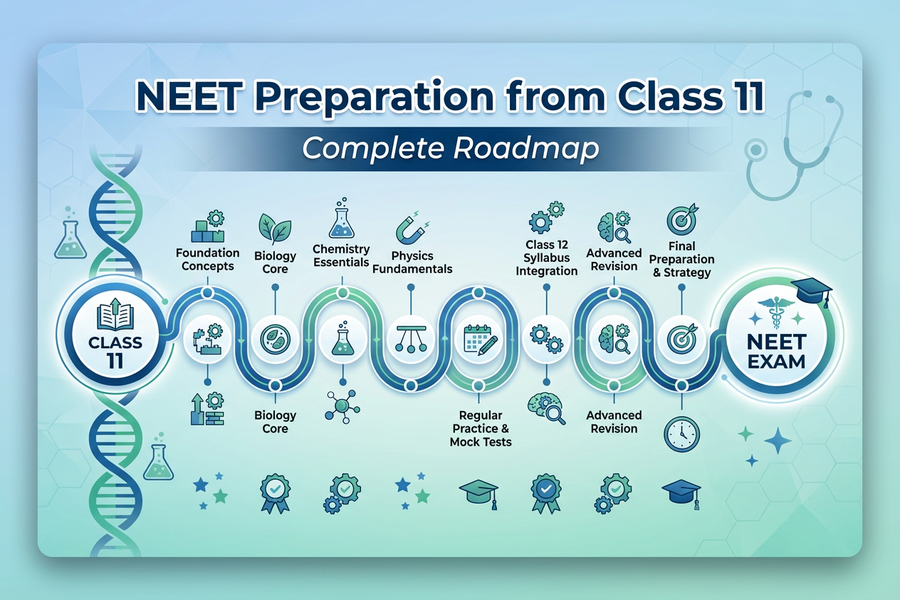

Preparing for NEET is a long journey, and starting early makes a massive difference. Class 11 is the perfect time to begin your NEET preparation because the syllabus forms the base of almost 50–60% of the NEET questions. When students start preparing from Class 11, they get more time to strengthen concepts, practise questions, and build the discipline needed for a competitive exam like NEET.
In this complete roadmap, you will learn how to prepare for NEET from Class 11, what strategy to follow, which books to use, and how to balance boards with NEET study. This guide is simple, practical, and designed for long-term success.

Why Start NEET Preparation in Class 11?
Starting NEET preparation in Class 11 gives you more than enough time to understand concepts deeply instead of rushing at the last minute. The NEET syllabus is huge, and many chapters in physics, chemistry, and biology require consistent practice.
Here’s why Class 11 is the ideal starting point:
-
Class 11 topics form the foundation for Class 12 chapters.
-
NEET questions are concept-based, not formula-based, so early clarity helps.
-
You get two full years for preparation, revision, and mock tests.
-
Students who start in Class 11 score higher in NEET on average.
-
You can build strong NCERT reading habits from the beginning.
With more time, less stress, and better conceptual understanding, scoring 650+ becomes much easier when preparation starts early.
Understand the NEET Syllabus from Day One
Before beginning your preparation, understand the NEET syllabus properly. The syllabus for both Class 11 and Class 12 is divided into three subjects:
Physics (Class 11 Topics)
-
Physical World
-
Units and Measurements
-
Motion in a Straight Line
-
Motion in a Plane
-
Laws of Motion
-
Work, Energy and Power
-
System of Particles and Rotational Motion
-
Gravitation
-
Mechanical Properties of Solids and Fluids
-
Thermodynamics
-
Oscillations and Waves
Chemistry (Class 11 Topics)
-
Some Basic Concepts of Chemistry
-
Structure of Atom
-
Classification of Elements & Periodicity
-
Chemical Bonding
-
States of Matter
-
Thermodynamics
-
Equilibrium
-
Redox
-
Organic Chemistry – Basic Principles
-
Hydrocarbons
Biology (Class 11 Topics)
-
Diversity in the Living World
-
Structural Organisation in Animals and Plants
-
Cell: Structure and Functions
-
Plant Physiology
-
Human Physiology
Knowing what to study reduces confusion and makes planning easier.
Build Your NEET Strategy for Class 11
A clear strategy helps you stay consistent throughout the year. Here is a reliable, topper-approved strategy for Class 11 NEET preparation:
1. Stick to NCERT Books First
NCERT is the backbone of NEET, especially for biology. Many students make the mistake of jumping to reference books too early. In Class 11, start with NCERT, understand every line, and solve the questions at the end of each chapter.
2. Make a Strong Timetable
A timetable helps you stay focused and manage both school and NEET prep. Your daily routine should include:
-
4–5 hours of focused NEET study
-
2 hours for school homework and board-related work
-
1–2 hours of revision or question practice
Keep your timetable realistic, not overloaded.
3. Focus on Concept Building
NEET is a conceptual exam. Physics needs clarity, chemistry needs understanding, and biology needs retention. Use visual diagrams, flowcharts, and real-life examples to understand concepts deeply.
4. Practise MCQs Daily
Solving MCQs is essential. Make it a habit to solve:
-
50 Biology questions
-
30 Chemistry questions
-
20–30 Physics questions
This improves comprehension and speed.
5. Revise Weekly
Revision is key. Make a weekly plan to revise everything you studied during the week. Without revision, Class 11 topics become difficult to manage in Class 12.
How to Study Each Subject Effectively
Physics Strategy
Physics is often the toughest subject for NEET aspirants. To score well:
-
Understand concepts first before solving numericals.
-
Practise sample problems regularly.
-
Keep a separate notebook for formulas and revise it daily.
-
Do not skip basic chapters like Units & Dimensions—they help everywhere.
Chemistry Strategy
Chemistry becomes easier when studied with proper planning:
Physical Chemistry:
-
Practise numericals daily.
-
Understand formula derivations.
Organic Chemistry:
-
Learn reaction mechanisms.
-
Keep short notes of reactions and named reactions.
Inorganic Chemistry:
-
Focus on NCERT only.
-
Read line by line and revise frequently.
Biology Strategy
Biology carries 50% of NEET’s total marks, so treat it with priority:
-
Read NCERT Biology daily.
-
Highlight important lines for revision.
-
Make your own handwritten notes.
-
Practise diagrams regularly.
-
Revise Class 11 Biology multiple times before entering Class 12.
Balancing Class 11 School Boards and NEET
Balancing boards and NEET is possible when you follow the right approach.
Most Class 11 NEET chapters are included in the school curriculum. So, if you study well for NEET, your board exams automatically improve.
Here’s how to balance both:
-
Use NCERT as the base for both boards and NEET.
-
Study school chapters and NEET chapters together.
-
Write short notes for board answers.
-
Focus on diagrams and definitions for biology boards.
-
Solve past years’ board papers monthly.
With smart planning, both goals can be achieved together.
Common Mistakes to Avoid During Class 11 NEET Preparation
Many Class 11 NEET aspirants make avoidable mistakes that cost them marks in the long run. Avoid these:
-
Ignoring NCERT for reference books
-
Not revising regularly
-
Leaving Class 11 chapters for Class 12
-
Studying without solving MCQs
-
Spending too much time on social media
-
Not giving enough attention to Physics basics
-
Skipping tests due to fear of scoring low
Avoiding these mistakes will help you build a stress-free preparation journey.
Best Books for NEET Preparation from Class 11
Here are the recommended books:
Physics
-
NCERT Class 11 Physics Parts 1 & 2
-
HC Verma Vol 1
-
DC Pandey Objective Physics
Chemistry
-
NCERT Chemistry 11
-
OP Tandon for Physical Chemistry
-
MS Chauhan for Organic Chemistry
Biology
-
NCERT Biology Class 11
-
MTG NCERT at Your Fingertips (Biology)
These books help you improve both theory and MCQ-solving skills.
Importance of Mock Tests and Practice Papers
Mock tests are crucial because they help you:
-
Improve accuracy
-
Build exam temperament
-
Analyse weak chapters
-
Increase speed
-
Learn time management
Start taking one test every two weeks in Class 11 and one test every week by the end of the year.
Last 3-Month Strategy Before Entering Class 12
Before moving to Class 12, revise your Class 11 syllabus thoroughly.
-
Revise all important concepts from NCERT.
-
Solve chapter-wise MCQs again.
-
Identify weak areas and fix them.
-
Take at least 6–8 full syllabus tests.
This will make your transition into Class 12 much smoother.
Conclusion
Starting NEET preparation from Class 11 is one of the smartest decisions a student can make. With a strong foundation, consistent practice, and the right study plan, scoring 650+ in NEET becomes achievable. Follow this roadmap—focus on NCERT, build concepts, solve MCQs every day, revise weekly, and take regular mock tests.
If you maintain discipline throughout Class 11, you will enter Class 12 with confidence and clarity. The early start gives you an advantage that thousands of students miss.
Also Read: ChatGPT Exam Prep: Safe and Smart Ways to Study Better