
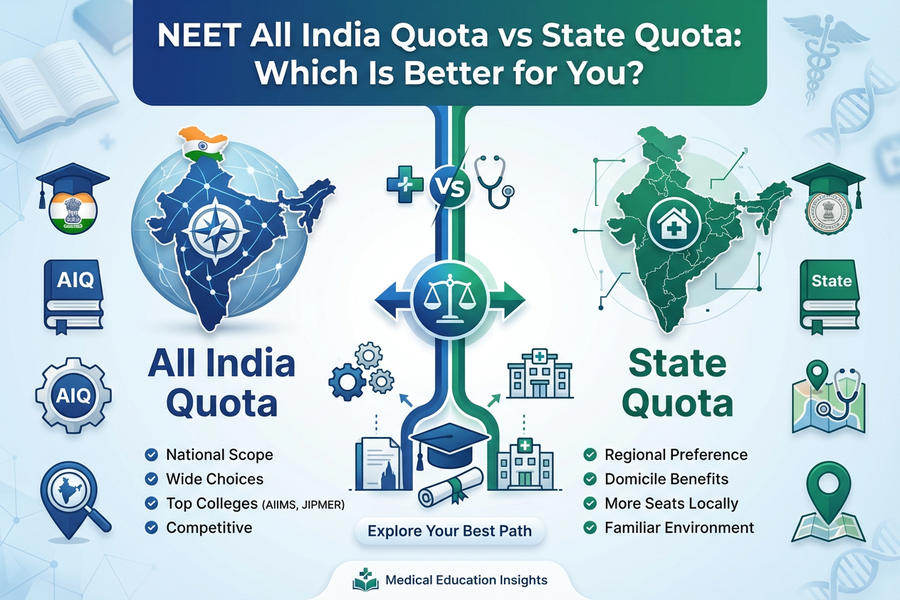

Introduction: Understanding NEET All India Quota vs State Quota
When NEET counselling begins every year, the first major confusion students face is the difference between NEET All India Quota vs State Quota. These two quotas determine how seats are distributed, how cut-offs change, and how your admission chances increase or decrease. Because of this, understanding both quotas clearly is essential before you make any decisions during counselling. In this guide, you will learn exactly how each quota works, what advantages they offer, and which one can help you secure a government MBBS seat based on your NEET score.

NEET All India Quota vs State Quota: Basic Difference Explained
The most important difference between NEET All India Quota and State Quota is how seats are divided. Under the All India Quota (AIQ), 15% of all government MBBS and BDS seats are made available to students from any state. This means a student from Kerala can get a seat in Delhi, and a student from Rajasthan can get a seat in Odisha. AIQ counselling is conducted by the Medical Counselling Committee (MCC), and competition is extremely high because the entire country participates.
On the other hand, the State Quota (SQ) covers 85% of MBBS seats in each state. These seats are specifically reserved for students who hold domicile in that state. Each state conducts its own counselling process and sets its own rules regarding documents, reservations, and cut-offs. The number of seats available under the State Quota is much larger, which often makes it easier to secure a seat compared to AIQ.
According to the official MCC guidelines, AIQ counselling includes Round 1, Round 2 and a mop-up round for deemed universities.
In short:
- AIQ = 15% nationwide seats
- SQ = 85% seats for state students only
This simple difference shapes your entire admission strategy.
Seat Allocation: How NEET All India Quota vs State Quota Seats Are Distributed
Under AIQ, government colleges across India allocate exactly 15% of their seats for national-level admission. Colleges under exceptions such as some institutions in Jammu & Kashmir do not participate in AIQ. AIIMS and JIPMER seats are also filled through AIQ counselling since NEET became the single entrance exam.
Under the State Quota, each state reserves 85% of its government seats exclusively for domiciled students. For example, if Maharashtra has around 5,000 government MBBS seats, then approximately 4,250 seats fall under the State Quota, while 750 seats fall under AIQ.
This huge difference in seat numbers is one of the main reasons why students often have better chances under the State Quota.
Admission Chances in NEET All India Quota vs State Quota
One of the most important questions students ask is which option gives them better chances. In reality, the answer depends on your NEET marks, your state, and your category.
For high-scoring students, AIQ offers incredible opportunities. They can secure seats in top colleges across the country, including central universities and high-ranked state colleges. Competition is tough, but students above a certain score range still get strong chances.
For average scorers, the state quota is almost always better. States with many medical colleges such as Tamil Nadu, Rajasthan, Bihar, UP, Karnataka, and Maharashtra frequently have lower State Quota cut-offs than AIQ cut-offs. Because the competition is limited to students of one state, the closing ranks tend to be more achievable.
Students from states with very few government medical colleges may find AIQ more helpful because it opens the door to many more options across India.
Cut-Off Trends for NEET All India Quota vs State Quota
Cut-offs are one of the biggest reasons why students prefer one quota over another. AIQ cut-offs are generally higher since seats are fewer and competition is national. For the general category, recent AIQ closing ranks for MBBS have been around 18,000–22,000.
In comparison, state quota cut-offs differ dramatically across states. States with many medical colleges have lower cut-offs; states with limited seats have higher cut-offs. For example, students with marks around 560–590 might secure a government seat under the State Quota in a seat-rich state but might not stand a chance in smaller states.
This variation makes it essential for students to analyse their state’s seat count and previous year cut-offs.
Choosing Between NEET All India Quota and State Quota Based on Your Score
Choosing the right quota becomes much easier when you consider your NEET marks. Here is a realistic guideline:
- 650+ marks: Excellent chances in both quotas; AIQ may give access to top colleges nationwide.
- 600-640 marks: The state quota is usually better; AIQ seats may still be possible but are not guaranteed.
- 550-590 marks: State Quota offers the best chances; AIQ MBBS seats become very limited.
- Below 520 marks: the state quota becomes crucial; AIQ for MBBS is almost impossible.
If your state has many seats, the state quota becomes more favourable. If your state has very few seats, applying through AIQ becomes more important.
Other Factors to Consider When Comparing NEET All India Quota vs State Quota
While scores and cut-offs matter, several additional factors can influence your decision:
Domicile Benefit
The state quota gives strong advantages to domiciled students. Categories such as OBC, SC, ST, and EWS receive specific reservations, increasing the likelihood of admission.
Fees and Bond Rules
Fees for government seats are similar in both quotas, but some states offer lower fees for their own residents. Bond and service requirements may differ state by state, especially for state quota students.
Distance and Convenience
Studying in your home state often means less travel, easier support from family, and familiar surroundings. AIQ may require you to relocate to another state.
Internship and Job Preference
Some states prefer their own medical graduates for internships or future government recruitment. This can benefit State Quota students long-term.
Summary: What’s Better – NEET All India Quota or State Quota?
After comparing NEET All India Quota vs State Quota, it is clear that both systems have their own strengths. For most students, the State Quota provides better chances because it offers more seats and benefits domicile candidates. AIQ is best suited for high scorers and students from states with limited medical seat availability.
The smartest approach is to participate in both AIQ and State Quota counselling if you are eligible. This maximises your opportunities and prevents you from missing out on good colleges.