

Converting between millimeters (mm) and feet (ft) is a fundamental skill in mathematics, engineering, construction, and everyday measurements. This comprehensive guide provides complete conversion formulas, detailed tables, and practical examples to help students master metric-to-imperial unit conversions with confidence.
Understanding these conversions is essential for international projects, academic studies, and real-world applications where both measurement systems are used. This guide covers linear measurements, area conversions, and volume calculations with accuracy and clarity.
Basic Relationship
Fundamental Conversion Factor:
- 1 foot = 304.8 millimeters
- 1 millimeter = 0.00328084 feet
This relationship forms the foundation for all conversions between millimeters and feet, whether dealing with length, area, or volume measurements.
Complete Conversion Table: All MM to Feet Related Conversions
Table 1: Linear Conversions (Length)
| Conversion Type | Formula | Example | Result |
|---|---|---|---|
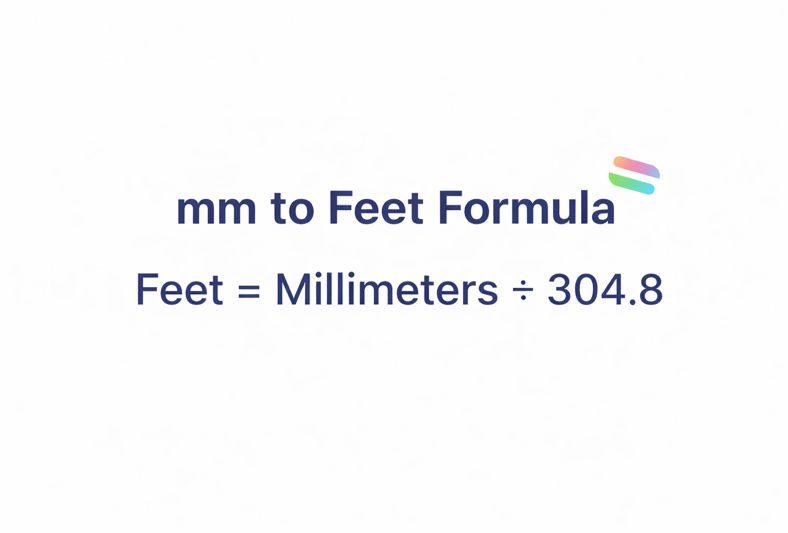
| MM to Feet | Feet = MM ÷ 304.8 | 1000 mm ÷ 304.8 | 3.281 ft |
| Feet to MM | MM = Feet × 304.8 | 5 ft × 304.8 | 1524 mm |
| MM to Feet and Inches | Feet = MM ÷ 304.8, then separate whole feet and remaining inches | 1500 mm ÷ 304.8 | 4 ft 11.055 in |
| Feet and Inches to MM | MM = (Feet × 304.8) + (Inches × 25.4) | (6 ft × 304.8) + (3 in × 25.4) | 1905.4 mm |
| Inches to MM</td | MM = Inches × 25.4 | 10 in × 25.4 | 254 mm |
| MM to Inches | Inches = MM ÷ 25.4 | 500 mm ÷ 25.4 | 19.685 in |
Table 2: Area Conversions (Square Measurements)
| Conversion Type | Formula | Example | Result |
|---|---|---|---|
| Square MM to Square Feet | Sq Ft = Sq MM ÷ 92,903.04 | 100,000 mm² ÷ 92,903.04 | 1.076 ft² |
| Square Feet to Square MM | Sq MM = Sq Ft × 92,903.04 | 5 ft² × 92,903.04 | 464,515.2 mm² |
| MM to Square Feet (Linear to Area) | Not directly convertible – requires two dimensions | N/A | N/A |
Table 3: Volume Conversions (Cubic Measurements)
| Conversion Type | Formula | Example | Result |
|---|---|---|---|
| Cubic MM to Cubic Feet | Cu Ft = Cu MM ÷ 28,316,846.592 | 50,000,000 mm³ ÷ 28,316,846.592 | 1.766 ft³ |
| Cubic Feet to Cubic MM | Cu MM = Cu Ft × 28,316,846.592 | 3 ft³ × 28,316,846.592 | 84,950,539.776 mm³ |
Quick Reference Conversion Tables
Table 4: Common MM to Feet Conversions
| Millimeters | Feet | Feet and Inches |
|---|---|---|
| 100 mm | 0.328 ft | 0 ft 3.937 in |
| 250 mm | 0.820 ft | 0 ft 9.843 in |
| 500 mm | 1.640 ft | 1 ft 7.685 in |
| 750 mm | 2.461 ft | 2 ft 5.528 in |
| 1000 mm | 3.281 ft | 3 ft 3.370 in |
| 1500 mm | 4.921 ft | 4 ft 11.055 in |
| 2000 mm | 6.562 ft | 6 ft 6.740 in |
| 2500 mm | 8.202 ft | 8 ft 2.425 in |
| 3000 mm | 9.843 ft | 9 ft 10.110 in |
| 5000 mm | 16.404 ft | 16 ft 4.850 in |
Table 5: Common Feet to MM Conversions
| Feet | Millimeters | Meters |
|---|---|---|
| 1 ft | 304.8 mm | 0.3048 m |
| 2 ft | 609.6 mm | 0.6096 m |
| 3 ft | 914.4 mm | 0.9144 m |
| 4 ft | 1219.2 mm | 1.2192 m |
| 5 ft | 1524 mm | 1.524 m |
| 6 ft | 1828.8 mm | 1.8288 m |
| 7 ft | 2133.6 mm | 2.1336 m |
| 8 ft | 2438.4 mm | 2.4384 m |
| 9 ft | 2743.2 mm | 2.7432 m |
| 10 ft | 3048 mm | 3.048 m |
Detailed Step-by-Step Conversion Methods
How to Calculate MM to Feet
Method:
- Take the measurement in millimeters
- Divide by 304.8
- The result is your measurement in feet
Example Calculation: Convert 2500 mm to feet:
- Calculation: 2500 ÷ 304.8 = 8.202 feet
- Answer: 2500 mm = 8.202 ft
Practical Tip: For quick mental approximation, divide by 300 (instead of 304.8) for a close estimate.
How to Convert MM to Feet and Inches
Method:
- Divide millimeters by 304.8 to get total feet
- Separate the whole number (complete feet)
- Multiply the decimal portion by 12 to get inches
Example Calculation: Convert 1750 mm to feet and inches:
- Step 1: 1750 ÷ 304.8 = 5.741 feet
- Step 2: Whole feet = 5 feet
- Step 3: 0.741 × 12 = 8.892 inches
- Answer: 1750 mm = 5 feet 8.892 inches (or approximately 5′ 8⅞”)
How to Calculate MM to Square Feet
Important Note: Direct linear-to-area conversion is mathematically impossible. You need area measurements on both sides.
Correct Method:
- Convert the area from square millimeters to square feet
- Divide the area in square millimeters by 92,903.04
- The result is your area in square feet
Example Calculation: Convert 250,000 mm² to square feet:
- Calculation: 250,000 ÷ 92,903.04 = 2.691 ft²
- Answer: 250,000 mm² = 2.691 square feet
How to Convert MM to Square Feet (Area Conversion)
For Rectangle or Square Surfaces:
- Measure both dimensions in millimeters (length and width)
- Calculate area: Length (mm) × Width (mm) = Area (mm²)
- Divide the area by 92,903.04
- Result is area in square feet
Example Calculation: Convert a surface measuring 3000 mm × 2000 mm to square feet:
- Step 1: Area = 3000 × 2000 = 6,000,000 mm²
- Step 2: 6,000,000 ÷ 92,903.04 = 64.583 ft²
- Answer: A 3000 mm × 2000 mm surface = 64.583 square feet
Alternative Method (Convert dimensions first):
- Convert length to feet: 3000 ÷ 304.8 = 9.843 ft
- Convert width to feet: 2000 ÷ 304.8 = 6.562 ft
- Multiply: 9.843 × 6.562 = 64.583 ft²
Understanding Key Conversion Factors
Why 304.8?
The number 304.8 comes from the international definition of a foot:
- 1 foot = 12 inches
- 1 inch = 25.4 millimeters (exactly)
- Therefore: 1 foot = 12 × 25.4 = 304.8 millimeters
Why 92,903.04?
For area conversions:
- 1 square foot = 1 ft × 1 ft = 304.8 mm × 304.8 mm = 92,903.04 mm²
Why 28,316,846.592?
For volume conversions:
- 1 cubic foot = 1 ft × 1 ft × 1 ft = 304.8 mm × 304.8 mm × 304.8 mm = 28,316,846.592 mm³
Common Applications and Real-World Examples
Construction and Architecture
- Floor plans often use millimeters for precision
- Building codes may require feet for room dimensions
- Material specifications need accurate conversions
Example: A door frame measuring 2134 mm in height converts to 7 feet (standard door height).
Manufacturing and Engineering
- Mechanical parts designed in metric need imperial conversions
- International projects require dual-system documentation
- Quality control measurements must maintain accuracy
Example: A component with a 50 mm diameter equals 1.969 inches or 0.164 feet.
Interior Design
- Furniture dimensions converting between measurement systems
- Room layouts in international projects
- Material calculations for flooring and wallpaper
Example: A carpet measuring 3000 mm × 4000 mm equals 9.84 ft × 13.12 ft or approximately 129 square feet.
Common Mistakes to Avoid
- Confusing Linear and Area Measurements: You cannot directly convert millimeters (length) to square feet (area). Always ensure you’re comparing like units.
- Rounding Too Early: Wait until the final answer before rounding to maintain accuracy throughout calculations.
- Forgetting to Square the Conversion Factor: When converting area, use 92,903.04 (not 304.8). When converting volume, cube the conversion factor.
- Mixing Measurement Types: Keep track of whether you’re working with length, area, or volume throughout your calculation.
- Calculator Entry Errors: Double-check that you’ve entered the correct conversion factor, especially with large numbers for area and volume.
Practice Problems with Solutions
Problem 1: Convert 4500 mm to feet
- Solution: 4500 ÷ 304.8 = 14.764 feet
Problem 2: Convert 8 feet 6 inches to millimeters
- Solution: (8 × 304.8) + (6 × 25.4) = 2438.4 + 152.4 = 2590.8 mm
Problem 3: Convert 500,000 mm² to square feet
- Solution: 500,000 ÷ 92,903.04 = 5.382 ft²
Problem 4: A room measures 5000 mm by 6000 mm. What is the area in square feet?
- Solution: (5000 ÷ 304.8) × (6000 ÷ 304.8) = 16.404 × 19.685 = 322.917 ft²
Frequently Asked Questions about mm to feet
How to Calculate MM to Feet?
To calculate mm to feet, divide the millimeter value by 304.8. The formula is: Feet = Millimeters ÷ 304.8. For example, 1000 mm ÷ 304.8 = 3.281 feet. This conversion factor is based on the international standard where 1 foot equals exactly 304.8 millimeters. For quick estimates, you can divide by 300, though this will be slightly less accurate.
How to Convert MM to Feet?
Converting mm to feet involves a simple division process. Take your measurement in millimeters and divide it by 304.8 to get feet. If you need feet and inches, separate the whole number (feet) and multiply the decimal portion by 12 to get inches. For instance, 2000 mm ÷ 304.8 = 6.562 feet, which equals 6 feet and 6.74 inches (0.562 × 12 = 6.74).
How to Calculate MM to Square Feet?
To calculate mm to square feet, you must start with an area measurement in square millimeters (mm²), not linear millimeters. Divide the square millimeter value by 92,903.04 to get square feet. The formula is Square Feet = Square Millimeters ÷ 92,903.04. For example, 100,000 mm² ÷ 92,903.04 = 1.076 square feet. Note that you cannot directly convert linear mm to square feet without additional dimensions.
How to Convert MM to Square Feet?
Converting mm to square feet requires measuring both dimensions of an area. First, calculate the area in square millimeters by multiplying length × width (both in mm). Then divide by 92,903.04 to convert to square feet. Alternatively, convert each dimension to feet first (divide each by 304.8), then multiply the results. For a surface 4000 mm × 3000 mm: Method 1: (4000 × 3000) ÷ 92,903.04 = 129.167 ft². Method 2: (4000 ÷ 304.8) × (3000 ÷ 304.8) = 13.123 × 9.843 = 129.167 ft².
What is the difference between MM to feet and MM to square feet?
MM to feet is a linear conversion measuring length or distance, while MM to square feet is an area conversion measuring surface. Linear conversions use a division factor of 304.8, while area conversions require dividing by 92,903.04 (the square of 304.8). You cannot convert a single linear measurement directly to area without a second dimension.
Why do we divide by 304.8 instead of a round number?
The number 304.8 comes from the international standard definition of units. Since 1 inch equals exactly 25.4 mm and 1 foot equals 12 inches, we get 12 × 25.4 = 304.8 mm per foot. This ensures consistent, accurate conversions worldwide.
Can I use 300 instead of 304.8 for quick calculations?
Yes, dividing by 300 gives a reasonable approximation for quick mental math, but the result will be about 1.6% less accurate. For academic work, engineering, or construction, always use 304.8 for precision.
How accurate should my conversions be?
For academic purposes, round to 2-3 decimal places. In construction and engineering, follow industry standards (typically 1/16 inch or 1 mm precision). Always maintain full precision during calculations and round only the final answer.
Conclusion
Mastering millimeter-to-feet conversions is essential for students pursuing careers in engineering, architecture, construction, and related fields. This comprehensive guide provides all necessary formulas, tables, and methods to accurately convert between these measurement systems for linear, area, and volume calculations.
By understanding the fundamental conversion factors (304.8 for length, 92,903.04 for area, and 28,316,846.592 for volume) and following the step-by-step methods outlined in this guide, students can confidently tackle any mm-to-feet conversion problem with accuracy and precision.
Remember to always check your work, use the correct conversion factor for the type of measurement (length, area, or volume), and maintain precision throughout your calculations. With practice, these conversions will become second nature, enabling you to work seamlessly across both metric and imperial measurement systems.