What is Methane?
Methane is the simplest hydrocarbon and the main component of natural gas. It consists of one carbon atom bonded to four hydrogen atoms. It’s colorless, odorless, and highly flammable.
Why it matters for students:
- Foundation for understanding organic chemistry
- Frequently appears in board exams and competitive tests
- Helps explain bonding, molecular geometry, and nomenclature
List of Methane Formulas with Details
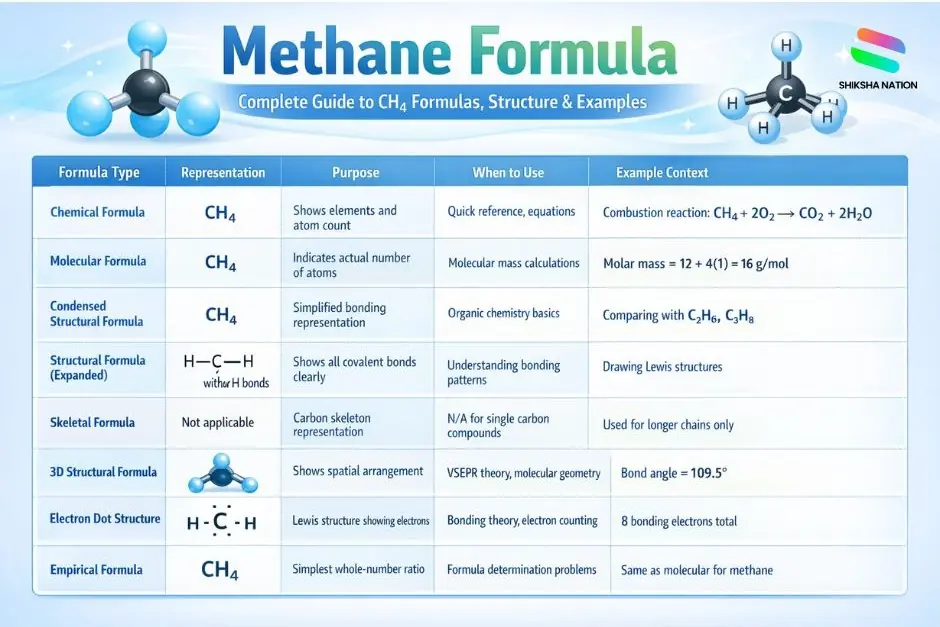
Here’s every formula representation of methane you’ll encounter in academics:
| Formula Type |
Representation |
Purpose |
When to Use |
Example Context |
| Chemical Formula |
CH₄ |
Shows elements and atom count |
Quick reference, equations |
Combustion reaction: CH₄ + 2O₂ → CO₂ + 2H₂O |
| Molecular Formula |
CH₄ |
Indicates actual number of atoms |
Molecular mass calculations |
Molar mass = 12 + 4(1) = 16 g/mol |
| Condensed Structural Formula |
CH₄ |
Simplified bonding representation |
Organic chemistry basics |
Comparing with C₂H₆, C₃H₈ |
| Structural Formula (Expanded) |
H—C—H with four H bonds |
Shows all covalent bonds clearly |
Understanding bonding patterns |
Drawing Lewis structures |
| Skeletal Formula |
Not applicable |
Carbon skeleton representation |
N/A for single carbon compounds |
Used for longer chains only |
| 3D Structural Formula |
Tetrahedral geometry representation |
Shows spatial arrangement |
VSEPR theory, molecular geometry |
Bond angle = 109.5° |
| Electron Dot Structure |
Lewis structure showing electrons |
Depicts valence electrons |
Bonding theory, electron counting |
8 bonding electrons total |
| Empirical Formula |
CH₄ |
Simplest whole-number ratio |
Formula determination problems |
Same as molecular for methane |
Methane Chemical Formula Explained
Formula: CH₄
The chemical formula tells us:
- C = 1 carbon atom
- H₄ = 4 hydrogen atoms
- Total atoms = 5
Why this formula?
Carbon has 4 valence electrons and needs 4 more to complete its octet. Each hydrogen needs 1 electron. Four hydrogens share electrons with one carbon, creating four single covalent bonds.
Points:
- Molecular weight: 16 g/mol
- Belongs to alkane family (CₙH₂ₙ₊₂)
- Saturated hydrocarbon (only single bonds)
Methane Molecular Formula
Formula: CH₄
The molecular formula represents the actual number of atoms in one molecule of methane.
Breakdown:
- 1 molecule of methane contains exactly 1 carbon and 4 hydrogen atoms
- No multiple molecules are represented
- Used in stoichiometric calculations
Application in calculations:
To find the number of atoms in 2 moles of CH₄:
- Carbon atoms = 2 × 6.022 × 10²³ = 1.204 × 10²⁴
- Hydrogen atoms = 2 × 4 × 6.022 × 10²³ = 4.818 × 10²⁴
Methane Structural Formula
The structural formula shows how atoms are bonded together.
Expanded Structural Formula:
What it shows:
- Each line (—) represents a single covalent bond
- All four C—H bonds are clearly visible
- Carbon is centrally located
Condensed structural formula: Simply written as CH₄
Bond information:
- 4 single C—H bonds
- Each bond shares 2 electrons
- Total of 8 bonding electrons
Methane Formula Structure (3D Geometry)
Methane has a tetrahedral three-dimensional structure.
Geometric features:
| Property |
Value |
Explanation |
| Molecular geometry |
Tetrahedral |
Four bonds arranged symmetrically |
| Bond angle |
109.5° |
Angle between any two C—H bonds |
| Hybridization |
sp³ |
One s and three p orbitals mix |
| Symmetry |
Perfect tetrahedral |
All H atoms equidistant from C |
| Polarity |
Nonpolar |
Symmetrical charge distribution |
Why tetrahedral?
According to VSEPR (Valence Shell Electron Pair Repulsion) theory, the four bonding pairs arrange themselves to minimize repulsion, forming a tetrahedron.
Visual representation: Imagine carbon at the center with four hydrogens at the corners of a triangular pyramid.
Methanal vs Methane: Common Confusion Cleared
Important: Methanal and methane are completely different compounds!
| Property |
Methane |
Methanal |
| Formula |
CH₄ |
CH₂O or HCHO |
| Common name |
Methane |
Formaldehyde |
| Chemical family |
Alkane (hydrocarbon) |
Aldehyde |
| Functional group |
None |
Carbonyl group (C=O) |
| State at room temp |
Gas |
Gas (usually dissolved) |
| Use |
Fuel, natural gas |
Preservative, disinfectant |
| Structure |
Tetrahedral, all single bonds |
Contains C=O double bond |
Memory tip: Methane = fuel you burn. Methanal (formaldehyde) = preserves specimens in biology labs.
Why the confusion?
Both names sound similar and both contain carbon and hydrogen, but methanal has oxygen and belongs to a different chemical family entirely.
Methane Solved Examples
Example 1: Calculate the molecular mass of methane
Solution:
- Molecular formula: CH₄
- Atomic mass of C = 12 u
- Atomic mass of H = 1 u
- Molecular mass = 12 + (4 × 1) = 12 + 4 = 16 u
Answer: 16 g/mol
Example 2: How many hydrogen atoms are in 0.5 moles of CH₄?
Solution:
- 1 molecule of CH₄ contains 4 H atoms
- 1 mole of CH₄ contains 4 moles of H atoms
- 0.5 moles of CH₄ contains 0.5 × 4 = 2 moles of H atoms
- Number of H atoms = 2 × 6.022 × 10²³ = 1.204 × 10²⁴ atoms
Answer: 1.204 × 10²⁴ hydrogen atoms
Example 3: Draw the electron dot structure of methane
Solution:
Or showing all electrons:
- Carbon contributes 4 electrons
- Each hydrogen contributes 1 electron
- Total = 8 bonding electrons (4 pairs)
- Carbon achieves octet; each hydrogen achieves duplet
Example 4: What is the empirical formula of methane?
Solution: The empirical formula shows the simplest whole-number ratio of atoms.
For CH₄:
This ratio is already in its simplest form.
Answer: CH₄ (empirical formula = molecular formula)
Common Mistakes Students Make
Mistake 1: Confusing methane with methanal
- Wrong: Writing CH₂O when asked for methane
- Correct: Methane is CH₄; methanal is CH₂O
Mistake 2: Drawing linear structure
- Wrong: Drawing H—C—H—H—H in a straight line
- Correct: Methane is tetrahedral, not linear
Mistake 3: Incorrect bond angles
- Wrong: Assuming 90° or 120° bond angles
- Correct: All H—C—H angles are 109.5°
Mistake 4: Wrong hybridization
- Wrong: Writing sp² hybridization
- Correct: Carbon in methane is sp³ hybridized
Mistake 5: Calling it an unsaturated hydrocarbon
- Wrong: Classifying CH₄ as unsaturated
- Correct: Methane has only single bonds (saturated)
Tips & Memory Tricks
Trick 1: Remember the formula “Methane = Most simple = CH₄ (1 Carbon, 4 Hydrogens)”
Trick 2: Tetrahedral geometry Think of a pyramid with a triangular base = 4 corners = 4 hydrogens around 1 carbon
Trick 3: Alkane family pattern
- Methane: CH₄ (C₁)
- Ethane: C₂H₆ (C₂)
- Propane: C₃H₈ (C₃)
- Formula: CₙH₂ₙ₊₂
Trick 4: Sp³ hybridization = 4 bonds sp³ = 1s + 3p = 4 orbitals = 4 bonds = tetrahedral
Trick 5: Methane vs Methanal
- Methane = Alkane (ends in -ane)
- Methanal = ALdehyde (ends in -al)
Conclusion
Understanding methane formulas goes beyond memorizing CH₄. You’ve now learned every representation from the simple chemical formula to the complex 3D tetrahedral structure and how each serves a unique purpose in chemistry.
- Methane’s chemical formula is CH₄
- It has tetrahedral geometry with 109.5° bond angles
- Don’t confuse methane (CH₄) with methanal (CH₂O)
- The molecular and empirical formulas are identical for methane
- Carbon is sp³ hybridized in methane
Whether you’re solving numerical problems, drawing structures, or explaining bonding patterns, these formulas form the foundation of organic chemistry. Practice drawing the structural formula, understanding the geometry, and applying these concepts in combustion reactions and molecular calculations.
FAQs about Methane Formula
Q. What is the chemical formula of methane?
The chemical formula of methane is CH₄, consisting of one carbon atom covalently bonded to four hydrogen atoms. It’s the simplest and first member of the alkane family of hydrocarbons.
Q. What is the molecular formula of methane?
The molecular formula of methane is CH₄, indicating exactly one carbon atom and four hydrogen atoms per molecule. This gives methane a molecular mass of 16 g/mol.
Q. How do you write the structural formula of methane?
The structural formula shows carbon at the center with four single bonds extending to four hydrogen atoms in a tetrahedral arrangement: H—C—H with bonds shown in all directions.
Q. What is the difference between methane and methanal?
Methane (CH₄) is an alkane hydrocarbon used as fuel, while methanal (CH₂O or HCHO), also called formaldehyde, is an aldehyde containing oxygen used as a preservative.
Q. What is the 3D structure of methane?
Methane has a tetrahedral 3D structure with the carbon atom at the center and four hydrogen atoms at the corners, forming bond angles of 109.5° between any two C—H bonds.
Q. Is the empirical formula of methane the same as its molecular formula?
Yes, for methane both are CH₄. The empirical formula shows the simplest ratio (1:4), which is already the actual number of atoms in the molecule.
Q. What type of bonds are present in methane?
Methane contains four single covalent bonds (sigma bonds) between carbon and hydrogen atoms. Each bond is formed by sharing two electrons, making methane a saturated hydrocarbon.
Q. What is the hybridization of carbon in methane?
Carbon in methane undergoes sp³ hybridization, where one 2s orbital mixes with three 2p orbitals to form four equivalent sp³ hybrid orbitals arranged tetrahedrally.