

Introduction
Imagine standing in your Malayalam literature class, hearing your teacher recite verses so beautiful they give you goosebumps. The words flow like a gentle river, painting pictures of Kerala’s lush landscapes, philosophical depths, and cultural richness. That’s the magic of Mahakavi G. Sankara Kurup a poet whose words transformed Malayalam literature forever.
For every student preparing for competitive exams, every literature enthusiast diving into Kerala’s cultural heritage, and every parent wanting their child to understand the giants of Indian literature, knowing about G. Sankara Kurup is essential. He wasn’t just Kerala’s first Jnanpith Award winner; he was a bridge between classical traditions and modern sensibilities, a voice that brought Malayalam poetry to national prominence.
This article will take you through the life, works, and legacy of this literary maestro in the simplest way possible perfect for your exams, assignments, or just expanding your knowledge about one of India’s greatest poets.
Who Was G. Sankara Kurup?
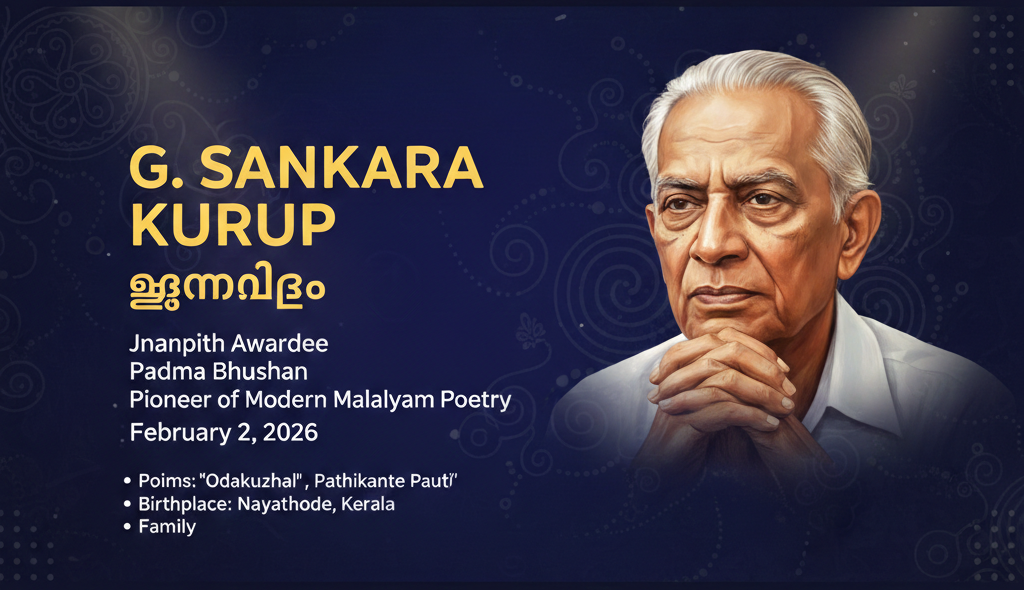
G. Sankara Kurup, fondly called Mahakavi (The Great Poet), was a towering figure in Malayalam literature. Born on June 3, 1901, he became the first recipient of the prestigious Jnanpith Award from Kerala in 1965.
Fact about G. Sankara Kurup:
- Full Name: Govindan Sankara Kurup
- Born: June 3, 1901, in Nayathode, Kerala
- Died: February 2, 1978
- Recognition: Mahakavi (Great Poet)
- Major Achievement: First Keralite to win Jnanpith Award (1965)
- Literary Movement: Romantic and Neo-Romantic Malayalam Poetry
Think of him as Kerala’s answer to Rabindranath Tagore a poet who didn’t just write verses but painted emotions, philosophy, and nature into literary masterpieces. His poetry combines classical Sanskrit influences with modern sensibilities, making it accessible yet profound.
Why Students Should Know About Him
- Exam Relevance: Appears in Malayalam literature syllabi, PSC exams, and competitive tests
- Cultural Understanding: Represents Kerala’s literary golden age
- Inspirational Figure: Shows how dedication to art can bring national recognition
- Language Mastery: His works are perfect examples of Malayalam’s poetic richness
Early Life and Birth Place
G. Sankara Kurup Birth Place: Nayathode village in Alappuzha district, Kerala.
Nayathode was a small, serene village surrounded by paddy fields, coconut groves, and backwaters the quintessential Kerala landscape that would later inspire countless verses in his poetry. Growing up in this natural beauty, young Sankara Kurup developed an early love for nature and observation.
Childhood Influences
His childhood was marked by:
- Traditional Kerala Culture: Exposure to Kathakali, classical music, and temple festivals
- Sanskrit Education: Early training in Sanskrit literature and classical texts
- Natural Surroundings: The backwaters, monsoons, and village life deeply influenced his imagery
- Family Values: A household that valued education and cultural traditions
Imagine a young boy sitting by the backwaters, watching the sunset paint the sky orange and purple, storing these images in his mind images that would later become verses touching millions of hearts.
Educational Journey and Career
Academic Background
G. Sankara Kurup received his education during the early 20th century when Kerala was witnessing a cultural renaissance:
- Early Education: Traditional Sanskrit and Malayalam education
- Higher Studies: Studied at Maharaja’s College, Ernakulam
- Academic Focus: Sanskrit literature, Malayalam language, and classical studies
Professional Career
Unlike many poets who struggled financially, Sankara Kurup had a stable career:
Teaching Career:
- Worked as a Malayalam and Sanskrit teacher
- Taught at various institutions across Kerala
- Influenced generations of students through classroom interactions
Government Service:
- Served in Kerala’s education department
- Worked in administrative positions related to language and culture
- Contributed to curriculum development
This dual role teacher by profession, poet by passion gave him unique insights into both classical traditions and contemporary needs. He understood what students needed to learn and what readers needed to feel.
G. Sankara Kurup Family Background
Family Details
Parents:
- Father: Govindan Nair (a respected figure in the local community)
- Mother: Kuttiyamma (traditional Kerala household manager)
Spouse:
- Married to Kamalakshi Amma
- Supportive partnership that allowed him creative freedom
Children:
- Had several children who continued the family’s cultural values
- Family maintained privacy despite his literary fame
Traditional Nair Family Values
Coming from a Nair family in Kerala meant:
- Strong connection to Malayalam language and culture
- Exposure to temple traditions and rituals
- Respect for classical arts and literature
- Community-oriented lifestyle
The stability of his family life provided the emotional foundation for his creative work. Unlike poets who drew inspiration from personal turmoil, Sankara Kurup’s poetry often reflected contentment, philosophical depth, and aesthetic appreciation.
Literary Contributions and Writing Style
What Made His Writing Special?
G. Sankara Kurup revolutionized Malayalam poetry by blending:
Classical Elements:
- Sanskrit poetic meters and structures
- Mythological references and philosophical themes
- Traditional imagery from Kerala’s culture
Modern Sensibilities:
- Contemporary themes and social awareness
- Personal emotional expression
- Accessible language without compromising depth
His Unique Style
Characteristics of Sankara Kurup’s Poetry:
| Element | Description |
|---|---|
| Language | Rich Malayalam with Sanskrit influences |
| Imagery | Heavy use of nature—rain, rivers, mountains, sunset |
| Theme | Romantic, philosophical, nationalistic |
| Meter | Classical Malayalam and Sanskrit meters |
| Tone | Contemplative, aesthetic, emotionally rich |
Think of reading his poetry like watching a beautiful Malayalam movie every word is carefully chosen, every image perfectly placed, creating an experience that’s both intellectual and emotional.
G. Sankara Kurup Famous Poems in Malayalam
Odakkuzhal – The Bamboo Flute
Why It’s Famous: This is THE poem that won him the Jnanpith Award. Written in 1950, it’s considered one of Malayalam literature’s finest achievements.
Theme:
- Uses the bamboo flute as a metaphor for life’s journey
- Explores human emotions, nature, and philosophy
- Celebrates Kerala’s natural beauty
Student Note: If you’re studying for exams, Odakkuzhal is mandatory reading. It appears in most Malayalam literature question papers.
Viswadarshanam
A philosophical poem exploring the universe and humanity’s place in it. Think of it as Kerala’s poetic answer to deep existential questions.
Naalam Vattom
Explores the cyclical nature of life and time perfect for understanding how classical philosophy meets modern poetry.
Other Notable Works
- Pathikante Pattu: About a traveler’s journey
- Ottakkuzhal: Another masterpiece with flute imagery
- Mahakavi G. Sankara Kurup Kavithakal: Collection of his best verses
Real Classroom Example
Imagine your teacher asking: “What makes Odakkuzhal special?”
Odakkuzhal uses the bamboo flute as a central metaphor to explore life’s philosophical questions while maintaining beautiful lyrical quality. The poem combines classical Malayalam poetic traditions with modern themes, making it accessible yet profound. Its vivid imagery of Kerala’s nature rain, rivers, and landscapes—creates an emotional connection while delivering deeper philosophical messages.
Complete List of G. Sankara Kurup Poems
Major Poetry Collections
Published Works:
- Odakkuzhal – 1950 – His magnum opus
- Viswadarshanam – Philosophical exploration
- Pathikkante Pattu – Traveler’s songs
- Masterpieces – Compilation of best works
- Naalam Vattom – Cyclical time exploration
Individual Famous Poems
- Manimukalil Ninnu
- Sooryakanthi
- Konnappaana
- Prematharangam
- Manassile Pattu
- Vaaranam Ayiram
Poetry Themes
Nature Poems:
- Monsoon descriptions
- Backwater imagery
- Mountain landscapes
- Seasonal changes
Philosophical Poems:
- Life and death
- Time and existence
- Human purpose
- Spiritual seeking
Romantic Poems:
- Love and longing
- Beauty appreciation
- Emotional expression
- Aesthetic celebrations
The Historic Jnanpith Award Achievement
What is the Jnanpith Award?
The Jnanpith Award is India’s highest literary honor, equivalent to a literary Nobel Prize. Established in 1961 by the Bharatiya Jnanpith organization, it recognizes outstanding contributions to Indian literature.
G. Sankara Kurup’s Historic Win
- Year: 1965
- Recognition: For his poetry collection
- Odakkuzhal Significance: First person from Kerala to receive this national honor
Why This Award Matters
Historical Context:
- 1961: Jnanpith Award established
- 1965: Only fifth award ceremony
- Malayalam Language: First recognition for Malayalam literature at this level
- Kerala Pride: Put Malayalam poetry on India’s national literary map
The Selection Process
The Jnanpith Award jury considered:
- Literary excellence and innovation
- Contribution to language development
- Impact on readers and other writers
- Consistency and quality of work
- Cultural significance
Sankara Kurup’s Odakkuzhal met all criteria brilliantly, showcasing Malayalam poetry’s richness to a national audience.
Real-Life Impact Story
After winning the Jnanpith Award, Sankara Kurup became a household name beyond Kerala. Students in North India started learning about Malayalam literature, translations increased, and Malayalam poetry received unprecedented attention. It was like winning an Olympic gold medal but for literature.
Padma Bhushan and Other Honors
Complete List of Awards
| Award | Year | Given By | Significance |
|---|---|---|---|
| Jnanpith Award | 1965 | Bharatiya Jnanpith | Highest literary honor |
| Padma Bhushan | 1966 | Government of India | Third highest civilian award |
| Kerala Sahitya Akademi Award | Multiple times | Kerala Sahitya Akademi | State recognition |
| Soviet Land Nehru Award | 1967 | Soviet Writers’ Union | International recognition |
| Mahakavi Title | 1958 | Kerala Government | Honorary title |
What is Padma Bhushan?
G. Sankara Kurup Padma Bhushan recognition came in 1966, just a year after his Jnanpith Award. The Padma Bhushan is India’s third-highest civilian honor, awarded for distinguished service.
Why He Received It:
- Exceptional contribution to Malayalam literature
- Elevating regional language literature nationally
- Inspiring cultural and linguistic pride
- Dedication to literary excellence
Other Recognition
- Honorary Doctorates: From various universities
- Literary Memorials: Named after him in Kerala
- Curriculum Inclusion: His works became mandatory study material
- Translations: His poems translated into multiple Indian and international languages
Impact on Malayalam Literature
Before Sankara Kurup
Malayalam poetry was:
- Largely classical and traditional
- Less accessible to common readers
- Limited national recognition
- Fewer modern themes
After Sankara Kurup
Malayalam poetry became:
- Balanced between classical and modern
- More emotionally relatable
- Nationally and internationally recognized
- Rich with contemporary themes while respecting tradition
His Influence on Other Poets
Direct Influence:
- Inspired the next generation of Malayalam poets
- Showed that regional language literature could achieve national recognition
- Proved that maintaining classical roots while embracing modernity was possible
Contemporary Comparison: While ONV Kurup (O.N.V. Kurup, not related) became famous for his revolutionary and people’s poetry, G. Sankara Kurup remained the aesthetic and philosophical pillar of Malayalam literature.
Educational Impact
In Classrooms Today:
- Mandatory in Malayalam literature curriculum (Class 8-12)
- Featured in competitive exam syllabi (PSC, banking, teaching exams)
- Used in language teaching for vocabulary and style
- Standard reference for understanding Malayalam poetic tradition
Example Exam Question: “Compare the poetic styles of G. Sankara Kurup and modern Malayalam poets. How did Sankara Kurup bridge classical and contemporary traditions?”
Related Biography:
Frequently Asked Questions about G. Sankara Kurup
Who was G. Sankara Kurup?
G. Sankara Kurup was a legendary Malayalam poet known as Mahakavi, who became the first person from Kerala to win the prestigious Jnanpith Award in 1965. Born in 1901 in Nayathode, he revolutionized Malayalam poetry by blending classical traditions with modern sensibilities. His most famous work, Odakkuzhal, remains a masterpiece of Indian literature.
Who won the first Jnanpith Award in Kerala?
G. Sankara Kurup won the first Jnanpith Award from Kerala in 1965 for his exceptional poetry collection Odakkuzhal. This historic achievement brought national recognition to Malayalam literature and established Kerala’s strong literary tradition on India’s cultural map. He remains an iconic figure in Indian literary history.
What are G. Sankara Kurup’s most famous poems in Malayalam?
G. Sankara Kurup’s most famous poems include Odakkuzhal (The Bamboo Flute), which won him the Jnanpith Award, Viswadarshanam (philosophical exploration), Pathikkante Pattu (traveler’s songs), and Naalam Vattom. These poems showcase his mastery over Malayalam language, rich imagery of Kerala’s nature, and deep philosophical themes that resonate with readers across generations.
When did G. Sankara Kurup receive the Padma Bhushan?
G. Sankara Kurup received the Padma Bhushan, India’s third-highest civilian honor, in 1966 just one year after his Jnanpith Award. This recognition from the Government of India acknowledged his distinguished contribution to Malayalam literature and his role in elevating regional language literature to national prominence.
Where was G. Sankara Kurup born?
G. Sankara Kurup was born on June 3, 1901, in Nayathode village in Alappuzha district, Kerala. This small village surrounded by backwaters, paddy fields, and coconut groves deeply influenced his poetry. The natural beauty of Kerala’s landscape became a recurring theme in his literary works throughout his career.
What is the main theme of Odakkuzhal?
Odakkuzhal uses the bamboo flute as a central metaphor to explore life’s philosophical questions, human emotions, and nature’s beauty. The poem combines aesthetic appreciation with deep contemplation about existence, time, and human purpose. Written in 1950, it represents the perfect balance between classical Malayalam poetic traditions and modern literary sensibilities.
केरल में ज्ञानपीठ पुरस्कार के प्रथम विजेता कौन थे?
जी. शंकर कुरुप केरल से ज्ञानपीठ पुरस्कार के प्रथम विजेता थे। उन्हें यह सम्मान 1965 में उनके काव्य संग्रह ‘ओडक्कुझल’ के लिए प्राप्त हुआ। महाकवि के नाम से प्रसिद्ध, उन्होंने मलयालम साहित्य को राष्ट्रीय और अंतर्राष्ट्रीय स्तर पर पहचान दिलाई और भारतीय साहित्य में केरल की मजबूत साहित्यिक परंपरा को स्थापित किया।
What is ONV’s most famous poem?
ONV (O.N.V. Kurup, full name Ottaplakkal Neelakandan Velu Kurup) is a different poet from G. Sankara Kurup. ONV’s most famous poems include “Akam” (The Interior), “Ujjivanam,” and “Bhumikkoru Charamageetham” (A Swan Song for Earth). ONV won the Jnanpith Award in 2007 and is known for progressive, people-oriented poetry, while G. Sankara Kurup focused on romantic and philosophical themes.
Conclusion
Mahakavi G. Sankara Kurup wasn’t just a poet he was a cultural bridge connecting Kerala’s classical literary heritage with modern India’s literary landscape. His journey from a small village in Nayathode to becoming India’s first Jnanpith Award winner from Kerala inspires every student who dreams of achieving excellence.
Need to remember for students:
- Excellence Matters: Sankara Kurup’s dedication to perfecting his craft brought him national recognition
- Roots and Wings: He respected classical traditions while embracing modern themes—a lesson in balanced growth
- Regional Pride: He proved regional language literature could compete at the highest national levels
- Lifelong Learning: From teaching classrooms to winning Padma Bhushan, he never stopped creating and contributing
Whether you’re preparing for Malayalam literature exams, PSC tests, or simply exploring Kerala’s rich cultural heritage, understanding G. Sankara Kurup’s contributions is essential. His poetry continues to inspire, his awards mark historic achievements, and his legacy reminds us that language, culture, and dedication can create immortal art.
When you read his poems, you’re not just studying literature you’re connecting with Kerala’s soul, understanding nature’s beauty through a master’s eyes, and appreciating how words can transcend time and touch hearts across generations.
Shiksha Nation: Your trusted partner in making education accessible, engaging, and enriching for every student across India.