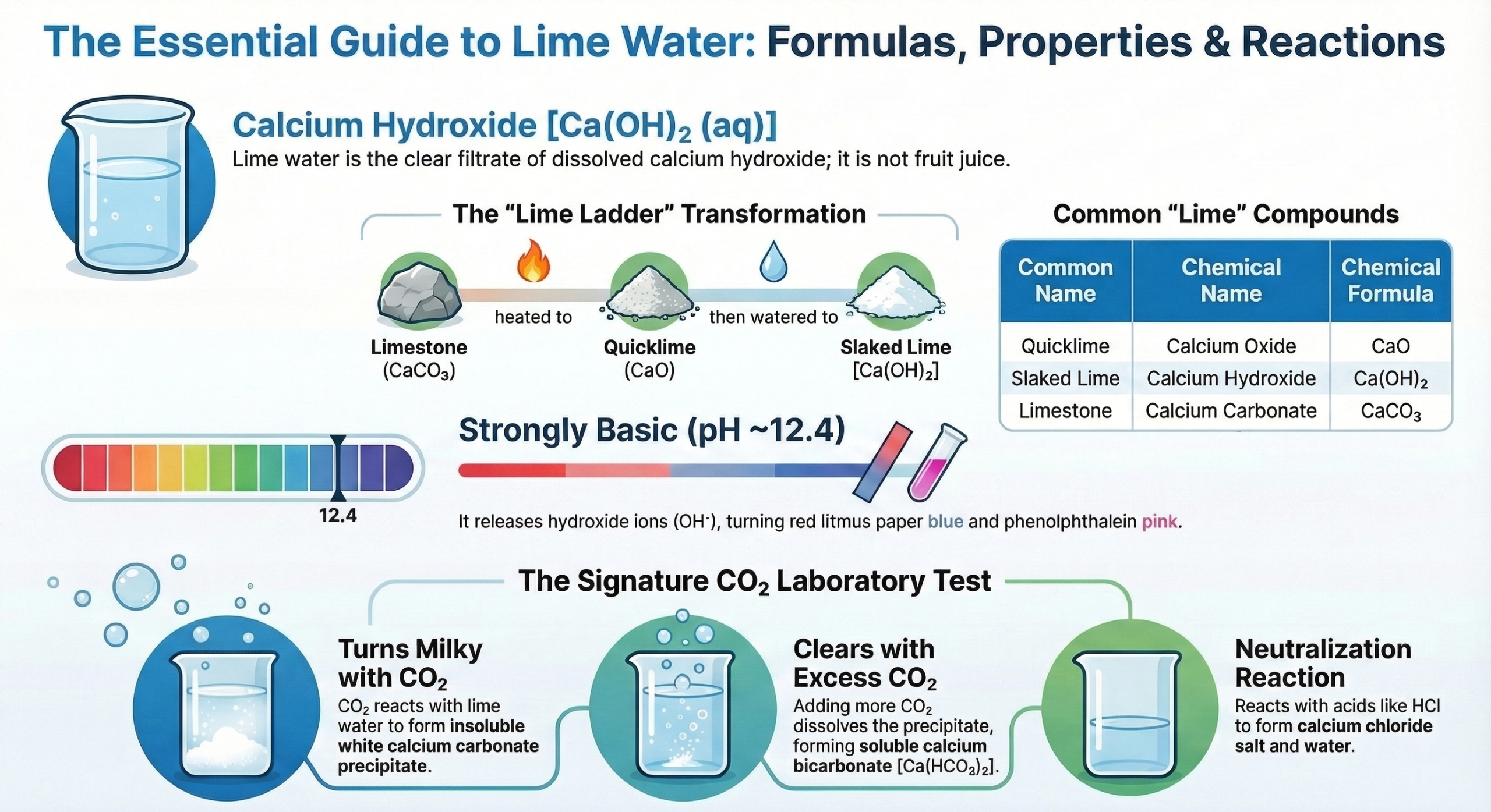
What Is Lime Water?
Lime water is a clear, colourless aqueous solution made by dissolving calcium hydroxide [Ca(OH)₂] in water. It is prepared by adding excess calcium hydroxide to distilled water, filtering out the undissolved solid, and collecting the clear solution.
In simple terms: lime water = water + dissolved Ca(OH)₂.
Point: Lime water is NOT the same as lemon/lime juice. The word “lime” here refers to calcium compounds, not the fruit.

The Chemical Formula of Lime Water
The chemical formula of lime water is Ca(OH)₂ dissolved in H₂O.
When written in solution form: Ca(OH)₂ (aq)
This means calcium hydroxide is the solute, and water (H₂O) is the solvent. The solution itself does not have a single molecular formula since it is a mixture, but the active compound the one responsible for all chemical properties is:
| Name |
Formula |
| Lime Water (solution) |
Ca(OH)2 (aq) |
| Solute (Calcium Hydroxide) |
Ca(OH)2 |
| Solvent (Water) |
H2O |
Breaking Down the Formula: Ca(OH)₂
- Ca = Calcium (atomic number 20, alkaline earth metal)
- O = Oxygen
- H = Hydrogen
- (OH)₂ = Two hydroxide ions, each carrying a -1 charge
- Overall charge of Ca²⁺ + 2(OH⁻) = neutral compound
Chemical Name of Lime Water
The chemical name of lime water (and of the active compound in it) is Calcium Hydroxide.
Other accepted chemical names used in textbooks:
- Calcium Dihydroxide
- Slaked Lime (common/industrial name)
- Hydrated Lime (used in construction)
- Caustic Lime (older terminology)
Tip: If asked “What is the chemical name of lime water?”, always write Calcium Hydroxide. If asked for the formula, write Ca(OH)₂.
Difference between Quicklime vs. Slaked Lime vs. Lime Water
One of the most common sources of confusion in chemistry is distinguishing between quicklime, slaked lime, and lime water. Here is a clear comparison:
| Compound |
Common Name |
Chemical Formula |
Appearance |
How It Is Made |
| Calcium Oxide |
Quicklime |
CaO |
White solid powder |
By heating limestone (CaCO3) at high temp |
| Calcium Hydroxide |
Slaked Lime |
Ca(OH)2 |
White solid powder |
CaO + H2O → Ca(OH)2 |
| Calcium Hydroxide Solution |
Lime Water |
Ca(OH)2 (aq) |
Clear colourless liquid |
Dissolving Ca(OH)2 in water, then filtering |
| Calcium Carbonate |
Limestone / Chalk |
CaCO3 |
White solid rock |
Natural mineral |
| Calcium Bicarbonate |
Calcium Hydrogen Carbonate |
Ca(HCO3)2 |
Only in solution |
Lime water + excess CO2 |
Formula Table to Related all Lime Formulas
This is the master reference table. It covers every formula related to lime water that appears in school and university exams:
| Formula Name |
Formula |
Explanation |
Variables |
Example Use Case |
| Lime Water |
Ca(OH)2 (aq) |
Aqueous solution of calcium hydroxide |
Ca=Calcium, O=Oxygen, H=Hydrogen |
Testing for CO2 gas in lab |
| Slaked Lime Formula |
Ca(OH)2 |
Solid calcium hydroxide powder |
Same as above |
Used in whitewash, mortar |
| Quicklime Formula |
CaO |
Calcium oxide — anhydrous base |
Ca=Calcium, O=Oxygen |
Industrial cement production |
| Slaking of Lime |
CaO + H2O → Ca(OH)2 |
Reaction of quicklime with water |
Exothermic reaction, releases heat |
Making slaked lime from quicklime |
| Limestone Formula |
CaCO3 |
Calcium carbonate mineral |
Ca, C, O atoms |
Chalk, marble, limestone rock |
| Calcination of Limestone |
CaCO3 → CaO + CO2 |
Heating limestone to form quicklime |
High temp required (>840°C) |
Cement and lime kiln industry |
| Lime Water + CO2 (milky) |
Ca(OH)2 + CO2 → CaCO3 + H2O |
Turns lime water milky/cloudy |
CaCO3 = white precipitate |
Standard CO2 lab test |
| Lime Water + Excess CO2 |
CaCO3 + CO2 + H2O → Ca(HCO3)2 |
Milky solution clears again |
Soluble Ca(HCO3)2 forms |
Explains clearing of milky lime water |
| Lime Water + HCl |
Ca(OH)2 + 2HCl → CaCl2 + 2H2O |
Neutralization reaction |
CaCl2 = calcium chloride salt |
Acid-base neutralization problems |
| Lime Water + H2SO4 |
Ca(OH)2 + H2SO4 → CaSO4 + 2H2O |
Reaction with sulfuric acid |
CaSO4 = gypsum/calcium sulfate |
Desulfurization of flue gas |
| Lime Water + SO2 |
Ca(OH)2 + SO2 → CaSO3 + H2O |
Reaction with sulfur dioxide |
CaSO3 = calcium sulfite |
Pollution control / flue gas cleaning |
| Lime Water + Cl2 |
2Ca(OH)2 + 2Cl2 → Ca(OCl)2 + CaCl2 + 2H2O |
Forms bleaching powder |
Ca(OCl)2 = calcium hypochlorite |
Bleaching powder preparation |
| Dissociation in Water |
Ca(OH)2 → Ca2+ + 2OH- |
Ionization in aqueous solution |
Partial dissociation (slightly soluble) |
Explains basic nature of lime water |
| Calcium Bicarbonate |
Ca(HCO3)2 |
Soluble compound in lime water + excess CO2 |
HCO3- = bicarbonate ion |
Temporary hardness of water |
| Limewater pH Formula |
pH = 14 + log[OH-] |
Calculating basicity of lime water |
[OH-] = hydroxide ion concentration |
Calculating pH of 0.02M Ca(OH)2 soln |
Step by Step Formulas How Lime Water Is Prepared
Step 1: Obtain Calcium Hydroxide (Slaked Lime)
Start with quicklime (CaO). Add water to slake it:
CaO + H2O → Ca(OH)2 [Slaking Reaction — exothermic]
Step 2: Dissolve in Water
Add the calcium hydroxide powder to distilled water. Ca(OH)₂ is only slightly soluble (~1.5 g/L at 25°C). Only a small amount dissolves.
Ca(OH)2 (s) ⇌ Ca2+ (aq) + 2OH- (aq) [Dissolution equilibrium]
Step 3: Filter
Filter the mixture to remove the undissolved Ca(OH)₂. The clear filtrate is lime water.
Step 4: Verify
Bubble CO₂ gas through the clear solution. If it turns milky, lime water is confirmed.
Ca(OH)2 (aq) + CO2 (g) → CaCO3 (s) + H2O (l) [Milky = CaCO3 precipitate]
Is Lime Water Acidic or Basic?
Lime water is BASIC (alkaline) in nature. This is one of the most commonly tested exam facts.
Why Lime Water Is Basic – The Scientific Explanation
When calcium hydroxide dissolves in water, it dissociates to release hydroxide ions (OH⁻):
Ca(OH)2 → Ca2+ + 2OH-
The presence of OH⁻ ions makes the solution basic. The pH of lime water is approximately 12.4 (for a saturated solution at 25°C), well above 7.
| Property |
Value / Description |
| Nature of Lime Water |
Basic (Alkaline) |
| pH of Lime Water (saturated) |
~12.4 at 25°C |
| pH of Dilute Lime Water |
Between 8 and 12, depending on concentration |
| Ions Responsible for Basicity |
OH- (Hydroxide ions) |
| Indicator Colour (Litmus) |
Turns red litmus paper BLUE |
| Indicator Colour (Phenolphthalein) |
Turns PINK/MAGENTA |
| Reaction with Acids |
Neutralisation forms salt and water |
| Reaction with CO2 |
Turns milky forms CaCO3 precipitate |
Quick Summary of Acid/Base
- Lime water + acid → salt + water (neutralisation)
- Lime water + CO₂ → milky/white precipitate (CaCO₃)
- Lime water turns red litmus blue (confirms alkaline nature)
- Lime water does NOT turn blue litmus red (it is not acidic)
Reactions of Lime Water — Important Chemical Equations
Reaction 1: With Carbon Dioxide (CO₂) — The Most Important Test
Ca(OH)2 (aq) + CO2 (g) → CaCO3 (s) + H2O (l)Result: Lime water turns MILKY (white precipitate of CaCO3 forms)
Reaction 2: With Excess CO₂ — Clearing of Milky Solution
CaCO3 (s) + CO2 (g) + H2O (l) → Ca(HCO3)2 (aq)Result: Milky solution turns CLEAR again (soluble calcium bicarbonate forms)
Reaction 3: With Hydrochloric Acid (HCl)
Ca(OH)2 (aq) + 2HCl (aq) → CaCl2 (aq) + 2H2O (l)
Reaction 4: With Sulfuric Acid (H₂SO₄)
Ca(OH)2 (aq) + H2SO4 (aq) → CaSO4 (s) + 2H2O (l)Note: CaSO4 (gypsum) is slightly soluble — may form a precipitate
Reaction 5: With Sulfur Dioxide (SO₂)
Ca(OH)2 (aq) + SO2 (g) → CaSO3 (s) + H2O (l)Application: Removing SO2 from industrial flue gases to reduce acid rain
Reaction 6: With Chlorine Gas (Cl₂) — Making Bleaching Powder
2Ca(OH)2 + 2Cl2 → Ca(OCl)2 + CaCl2 + 2H2OProduct: Bleaching powder [Ca(OCl)2 + CaCl2 mixture]
Reaction 7: With Ammonium Salts
Ca(OH)2 + 2NH4Cl → CaCl2 + 2NH3 + 2H2OApplication: Lab preparation of ammonia gas
Solved Examples
Question: What is the chemical formula of lime water?
Solution:
- Lime water is an aqueous solution of calcium hydroxide.
- Calcium is in Group 2 of the periodic table → valency = 2 (Ca²⁺)
- Hydroxide ion = OH⁻ (valency = 1)
- To balance: Ca²⁺ needs two OH⁻ ions → Ca(OH)₂
Answer: Ca(OH)₂ (aq) Chemical Name: Calcium Hydroxide
Question: When CO₂ is passed through lime water, what happens? Write the equation.
Solution:
Ca(OH)2 (aq) + CO2 (g) → CaCO3 (s) + H2O (l)Observation: Lime water turns milky/white because insoluble CaCO3 precipitate forms.
Question: If excess CO₂ is passed through milky lime water, what do you observe?
Solution:
CaCO3 (s) + CO2 (g) + H2O (l) → Ca(HCO3)2 (aq)Observation: The milky solution turns CLEAR again because soluble Ca(HCO3)2 is formed.
Question: The concentration of OH⁻ in lime water is 0.02 M. Calculate the pH.
Solution:
- pOH = -log[OH⁻] = -log(0.02) = -log(2 × 10⁻²) = 2 – log2 = 2 – 0.301 = 1.699
- pH = 14 – pOH = 14 – 1.699 = 12.3
Answer: pH ≈ 12.3 (strongly basic)
Question: Write and balance the reaction between lime water and dilute HCl.
Solution:
Ca(OH)2 + 2HCl → CaCl2 + 2H2OCheck: Ca: 1=1 ✓ O: 2=2 ✓ H: 4=4 ✓ Cl: 2=2 ✓ (Balanced)
Common Student Mistakes
| Mistake |
Incorrect Version |
Correct Version |
Why Students Make This Error |
| Confusing quicklime and slaked lime |
Ca(OH)2 = quicklime |
CaO = quicklime; Ca(OH)2 = slaked lime |
Both are ‘lime’ compounds |
| Writing formula without brackets |
CaOH2 |
Ca(OH)2 |
Brackets show two OH groups as a unit |
| Thinking lime water is acidic |
Lime water is acidic |
Lime water is BASIC (pH ~12.4) |
Confusing ‘lime’ fruit with lime the mineral |
| Forgetting (aq) in solution formula |
Ca(OH)2 |
Ca(OH)2 (aq) for lime water |
Not distinguishing solid from solution |
| CO2 test — wrong product stated |
Lime water + CO2 → CaO + H2O |
Lime water + CO2 → CaCO3 + H2O |
Mixing up reactants and products |
| Not writing 2 in 2HCl |
Ca(OH)2 + HCl → CaCl + H2O |
Ca(OH)2 + 2HCl → CaCl2 + 2H2O |
Forgetting to balance the equation |
Memory Tricks & Tips
Trick 1: The Lime Ladder
Remember the progression from rock to solution:
- CaCO₃ (Limestone) — ROCK (calcium carbonate)
- CaO (Quicklime) — HEAT IT — calcium oxide
- Ca(OH)₂ (Slaked Lime) — ADD WATER — calcium hydroxide (solid)
- Ca(OH)₂ (aq) (Lime Water) — DISSOLVE IN WATER — aqueous solution
Trick 2: The CO₂ Test Mnemonic
“Lime goes MILKY with CO₂… then CLEARS with excess.”
- Milky = CaCO₃ forms (white precipitate)
- Clears = Ca(HCO₃)₂ forms (soluble — dissolves the precipitate)
Trick 3: Remembering the Formula Ca(OH)₂
“Calcium Always Holds 2 OHs” — Ca always pairs with two hydroxide groups because its valency is +2.
Trick 4: Basic or Acidic?
“Lime = Alkaline” — both words have the letter ‘A’. Lime water is always Alkaline.
Trick 5: Writing the Correct Formula
CaO = no H (no water yet) → quicklime. Ca(OH)₂ = H is present (water was added) → slaked lime / lime water.
Frequently Asked Questions about Lime Water Formula
Q. What is the chemical formula of lime water?
The chemical formula of lime water is Ca(OH)₂. Lime water is an aqueous solution of calcium hydroxide. The solute is Ca(OH)₂ (calcium hydroxide), and the solvent is H₂O (water). In solution notation, it is written as Ca(OH)₂ (aq).
Q. What is the chemical name of lime water?
The chemical name of lime water is Calcium Hydroxide. Its other accepted names include calcium dihydroxide, slaked lime, hydrated lime, and caustic lime. The IUPAC name is calcium dihydroxide. In everyday academic and exam contexts, calcium hydroxide is the standard accepted answer.
Q. Is lime water acidic or basic?
Lime water is basic (alkaline), not acidic. When Ca(OH)₂ dissolves in water, it releases hydroxide ions (OH⁻), which increase the pH above 7. The pH of saturated lime water is approximately 12.4 at 25°C. It turns red litmus paper blue, confirming its basic nature.
Q. What is the formula of slaked lime water?
Slaked lime has the formula Ca(OH)₂. It is a solid white powder formed when quicklime (CaO) reacts with water: CaO + H₂O → Ca(OH)₂. When dissolved in water, this solid becomes lime water. The formula remains Ca(OH)₂ whether in solid (slaked lime) or dissolved (lime water) form.
Q. What is quicklime formula vs. slaked lime formula?
Quicklime is CaO (calcium oxide) — a white solid formed by heating limestone (CaCO₃). Slaked lime is Ca(OH)₂ (calcium hydroxide) formed when water is added to quicklime: CaO + H₂O → Ca(OH)₂. Lime water is simply slaked lime dissolved in water, giving Ca(OH)₂ (aq).
Q. Why does lime water turn milky when CO₂ is passed through it?
Lime water turns milky because CO₂ reacts with Ca(OH)₂ to form calcium carbonate (CaCO₃), which is an insoluble white solid: Ca(OH)₂ + CO₂ → CaCO₃ + H₂O. The white precipitate of CaCO₃ makes the solution appear cloudy or milky. This reaction is used as the standard lab test for CO₂.
Q. What happens when excess CO₂ is bubbled into milky lime water?
When excess CO₂ is passed, the milky lime water clears again. This is because the insoluble CaCO₃ reacts with more CO₂ and water to form soluble calcium bicarbonate: CaCO₃ + CO₂ + H₂O → Ca(HCO₃)₂. Ca(HCO₃)₂ is soluble, so the white precipitate dissolves and the solution becomes clear again.
Q. What is the molar mass of Ca(OH)₂?
The molar mass of Ca(OH)₂ is 74 g/mol, calculated as: Ca = 40 g/mol, O = 16 g/mol × 2 = 32 g/mol, H = 1 g/mol × 2 = 2 g/mol. Total = 40 + 32 + 2 = 74 g/mol. This is used in stoichiometry calculations involving lime water reactions.
Conclusion
Understanding the lime water formula is not just about memorising Ca(OH)₂. It is about grasping the entire lime chemistry family from limestone (CaCO₃) all the way to lime water (Ca(OH)₂ aq) — and knowing how each compound transforms into the next.
Here is a final summary of the most important points:
| Concept |
Answer |
| Chemical formula of lime water |
Ca(OH)2 (aq) |
| Chemical name of lime water |
Calcium Hydroxide |
| Lime water — acidic or basic? |
BASIC (alkaline), pH ~12.4 |
| Quicklime formula |
CaO |
| Slaked lime formula |
Ca(OH)2 |
| Limestone formula |
CaCO3 |
| CO2 test with lime water |
Turns MILKY → Ca(OH)2 + CO2 → CaCO3 + H2O |
| Excess CO2 with lime water |
Turns CLEAR again → CaCO3 + CO2 + H2O → Ca(HCO3)2 |
| Molar mass of Ca(OH)2 |
74 g/mol |
Chemistry becomes much less scary when you understand the “why” behind each formula. Lime water is one of the most elegant examples of how a simple compound calcium hydroxide connects geology (limestone), industry (cement), environmental science (CO₂ testing), and everyday chemistry (pH and neutralisation).
You now have every formula, reaction, and concept you need to tackle any exam question on lime water with confidence. Keep practising the equations, and you will find they become second nature.
Remember: Ca(OH)2 is lime water. It is BASIC. It turns milky with CO2. And it forms the bridge between quicklime (CaO) and limestone (CaCO3). Master this family of compounds, and lime water questions will never trip you up again.