Lakes in India – A Basic Geography Overview

What Defines a Lake in Geography
In lakes of india geography, a lake is defined as a still or slow-moving water body that is fully surrounded by land. Lakes can be formed naturally or created by humans, and they may contain fresh, salty, or mixed water. Unlike flowing water bodies, lakes usually remain in one place for a long time.
For students, this definition helps in identifying lakes correctly in maps and textbook questions. Parents can see this as a foundation concept that supports future geography learning.
How Lakes Are Different from Rivers
- Lakes store water, while rivers carry water from one place to another
- Lakes have no fixed direction of flow
- Rivers flow continuously and usually end in seas or lakes
Understanding this difference avoids common exam mistakes and builds clear geographic thinking.
Classification of Lakes in India
In Indian geography, lakes are classified based on the type of water they contain and how they are formed. This classification helps students understand why different lakes look, behave, and support life differently. Instead of memorising names, students are expected to know how lakes are grouped and why.
For school exams, classification-based questions are common because they test basic concepts. Parents can think of this topic as helping students develop logical thinking in geography, not just factual learning.
One of the most important and easiest categories to understand is freshwater lakes.
Freshwater Lakes in India
Freshwater lakes in India are lakes that contain very low amounts of salt. The water in these lakes is mostly suitable for drinking, farming, fishing, and daily use after basic treatment. These lakes are usually fed by rivers, rainwater, or melting snow.
Freshwater lakes matter because they:
- Support agriculture and nearby villages
- Provide drinking water in many regions
- Help maintain local climate and biodiversity
A well-known example is Wular Lake, located in Jammu and Kashmir. It is the largest freshwater lake in India and plays an important role in flood control and fisheries. Because of its size and importance, it is often mentioned in school textbooks and exams.
For students, remembering freshwater lakes is easier when they connect them to use and location, not just names. Parents can encourage children to link such lakes with real-life water needs, which improves understanding and long-term recall.
Saltwater and Brackish Water Lakes in India
Many students get confused between saltwater and brackish water lakes, so it is important to understand the difference clearly. Saltwater lakes in India contain high amounts of salt, mainly because water evaporates and leaves salt behind. These lakes are not suitable for drinking but are useful for salt production.
A common example is Sambhar Lake in Rajasthan. It is India’s largest inland saltwater lake and is well known for salt manufacturing. This lake is often asked about in school exams because of its clear saltwater nature.
On the other hand, a brackish water lake in India contains a mix of fresh water and sea water. Such lakes are usually found near coastal areas and are also called lagoons. Lagoons form where rivers meet the sea, but the water movement is limited.
Chilika Lake in Odisha and Pulicat Lake along the Tamil Nadu–Andhra Pradesh coast are famous brackish water lakes. These lakes support fishing and migratory birds. For students, remembering the location and water type helps avoid exam confusion. Parents can guide children to compare saltwater and brackish lakes side by side for better clarity.
Largest Lake in India – Clear Explanation
Students often feel confused when asked about the largest lake in india because different answers appear in different sources. For school-level geography, the correct and safe answer is Chilika Lake. This clarity is important to avoid mistakes in exams.
Chilika Lake is located in Odisha and is the largest lake in India by surface area. It is a coastal lake and contains brackish water, which means it has a mix of fresh and salt water. Because of its large size and clear geographic identity, textbooks and teachers commonly refer to it as the largest lake in the country.
The confusion usually happens when students mix freshwater lakes with all types of lakes. In school exams, unless the question clearly mentions “freshwater,” students should write Chilika Lake as the answer.
For parents, guiding children to read the question carefully – especially the words used – can make a big difference. Understanding this concept once helps students answer confidently without second-guessing.
Largest Freshwater Lake in India
The largest freshwater lake in india is Wular Lake, located in Jammu and Kashmir. This lake contains fresh water and is mainly fed by the Jhelum River along with rainfall. Because it holds fresh water, it plays an important role in daily life and the local environment.
Wular Lake helps in controlling floods, supports fishing, and provides water for nearby communities. It is also important for birds and other living organisms. In school geography, this lake is often asked to test whether students understand the difference between freshwater and other types of lakes.
For students, remembering Wular Lake as the largest freshwater lake avoids confusion in exams. Parents can help by explaining that “freshwater” always points to Wular, not coastal lakes.
Largest Salt Water Lake in India
The largest salt water lake in india is Sambhar Lake, located in Rajasthan. The water of this lake has a high salt content due to strong evaporation in the region.
Sambhar Lake is well known for salt production and is an important economic resource. It is also a regular exam topic because it clearly represents a salt water lake. Students should link Sambhar Lake with salt and Rajasthan to recall it easily.
Smallest and Other Important Lakes of India
When students search for the “smallest lake,” they often find different answers, which can be confusing. In school geography, NCERT does not fix one official smallest lake for India. So, instead of memorising risky facts, students should focus on important lakes of india that are commonly asked in exams.
Geography exams usually test lakes based on location, type, or special features, not size alone. This is why learning major examples is more useful than chasing smallest or rare records. Parents can guide students to prioritise exam-safe information.
Some major lakes of india that are frequently taught include:
- Dal Lake (Jammu & Kashmir) – famous for tourism and houseboats
- Loktak Lake (Manipur) – known for floating vegetation
- Vembanad Lake (Kerala) – important for backwaters and transport
- Kolleru Lake (Andhra Pradesh) – supports farming and wildlife
These lakes are important because they help students understand regional geography and map-based questions. Instead of memorising long lists, students should connect each lake with one clear reason. This method improves recall and reduces exam pressure.
Top 10 Lakes in India (Easy Revision Table)
For quick revision before exams, students often look for the top 10 lakes in india. A table format helps in remembering names, locations, and importance without confusion. Parents can also use such tables to help children revise in a short time.
The list of lakes in india below focuses only on lakes that are commonly taught in school geography and are safe for exam answers.
| Lake Name |
State |
Type |
Why Important |
| Chilika Lake |
Odisha |
Brackish |
Largest lake in India by area; coastal lagoon |
| Wular Lake |
Jammu & Kashmir |
Freshwater |
Largest freshwater lake in India |
| Sambhar Lake |
Rajasthan |
Saltwater |
Largest inland salt lake; salt production |
| Pulicat Lake |
Tamil Nadu / Andhra Pradesh |
Brackish |
Important coastal lagoon and fishing area |
| Vembanad Lake |
Kerala |
Brackish |
Key part of Kerala backwaters |
| Loktak Lake |
Manipur |
Freshwater |
Known for floating vegetation |
| Dal Lake |
Jammu & Kashmir |
Freshwater |
Famous tourist lake and local livelihood |
| Kolleru Lake |
Andhra Pradesh |
Freshwater |
Supports farming and bird life |
| Upper Lake |
Madhya Pradesh |
Freshwater |
Main water source for Bhopal |
| Pangong Lake |
Ladakh |
Brackish |
High-altitude lake, map-based questions |
Students should focus on one key feature per lake instead of memorising long details. This approach improves accuracy in exams. Parents can encourage children to revise this table regularly, especially before geography tests, to build confidence and clarity.
Natural and Artificial Lakes of India
In Indian geography, lakes are also grouped based on how they are formed. Some lakes develop naturally over time, while others are created by humans for specific needs. This classification helps students understand the purpose and origin of different lakes, which is often tested in school exams.
For parents, this topic is useful because it teaches children to think logically about geography instead of just memorising names.
Natural Lakes of India
Natural lakes of india are formed due to natural processes such as movements of the earth, river action, or changes in land shape. These lakes exist without human construction and usually support local plants, animals, and human life.
Examples of natural lakes include lakes formed by tectonic activity, river flooding, or coastal processes. Such lakes play an important role in climate balance, water storage, and biodiversity. Students should remember that natural lakes are part of the earth’s natural system.
Artificial (Man-Made) Lakes of India
Artificial lakes of india are created by humans, mostly by building dams across rivers. These lakes are mainly used for water supply, irrigation, electricity generation, and flood control.
Man-made lakes are important for development and urban needs. For students, the key point is to link artificial lakes with human use and planning, which makes exam answers clearer and more accurate.
Lakes of India for Class 9 Students (NCERT Focus)
For lakes of india class 9, the NCERT syllabus expects students to understand lakes as part of India’s drainage and physical features. The focus is not on memorising every lake, but on knowing types of lakes and key examples.
In important lakes of india class 9, students should clearly remember:
- Difference between freshwater and saltwater lakes
- One example for each lake type
- Location of major lakes on the map
Questions are usually direct and concept-based. Reading the question carefully helps in choosing the correct answer. Parents can support students by encouraging short daily revision instead of last-minute learning. Clear understanding reduces exam stress and improves confidence.
Key Exam Facts on Lakes of India
These one-line facts help students answer quickly and accurately in exams:
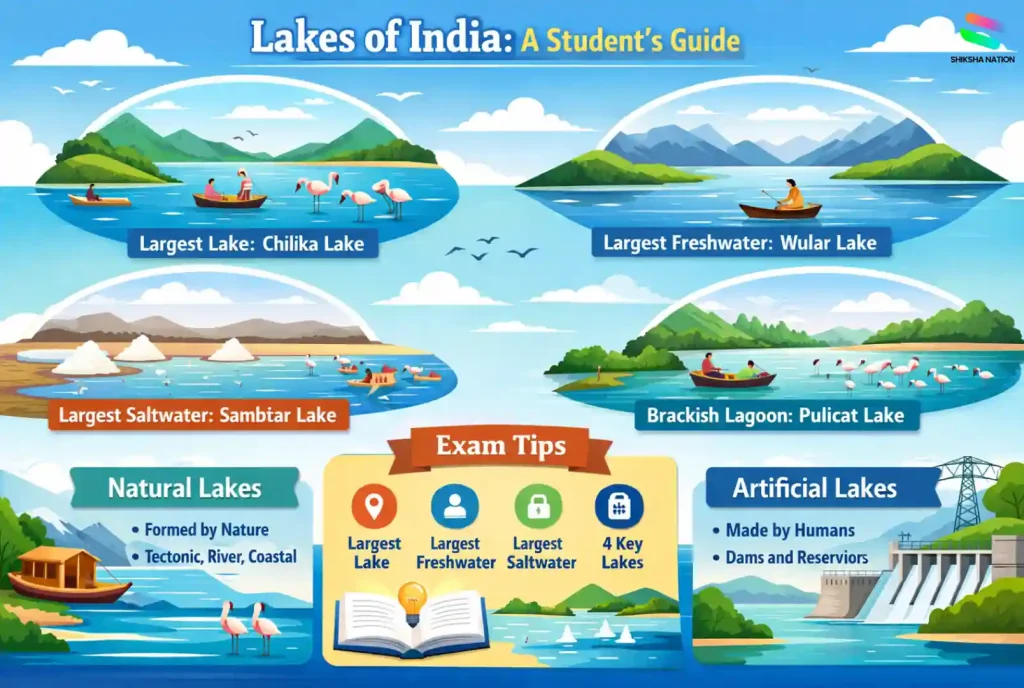
- Name the largest lake in india: Chilika Lake
- Largest freshwater lake: Wular Lake
- Largest salt water lake: Sambhar Lake
- Coastal brackish lake example: Pulicat Lake
- Floating vegetation lake: Loktak Lake
Students should revise these facts regularly to improve memory. Parents can turn these into short oral questions at home, which helps students recall answers easily during exams.
Frequently Asked Questions on Lakes of India
Q. Which is the largest lake in India?
The answer to which is the largest lake in india depends on how the question is framed in school exams. For general geography questions, the correct and commonly accepted answer is Chilika Lake. It is the largest lake in India when measured by surface area. Chilika Lake is located in Odisha and is a coastal lake. It contains brackish water, which is a mix of fresh and salt water. In most school-level exams, students are expected to write this answer unless the question clearly mentions “freshwater.”
Q. What is the largest freshwater lake in India?
When the question is what is the largest freshwater lake in india, the correct answer is Wular Lake. This lake is located in Jammu and Kashmir and contains fresh water. Wular Lake plays an important role in flood control and supports fishing and local livelihoods. Students should clearly link the word “freshwater” with Wular Lake to avoid confusion during exams. This clarity is especially helpful in one-mark questions.
Q. Is Chilika Lake the largest lake in India?
Yes, chilika lake is the largest lake in india by surface area. It is a brackish water lake and is found along the eastern coast of India. Because of its large size, it is often mentioned in geography textbooks. The confusion usually arises when students mix up freshwater lakes with all types of lakes. In school exams, Chilika Lake is the safest answer for the largest lake unless the question specifies otherwise.
Q. Is Wular Lake the largest freshwater lake in India?
Yes, wular lake is the largest freshwater lake in india. It contains fresh water and is different from coastal or saltwater lakes. This fact is regularly tested in school exams. Students should remember that Wular Lake is linked with freshwater and inland location. Parents can help by revising such paired facts regularly.
Q. Name four important lakes of India
When asked to name four important lakes of india, students can confidently write:
- Chilika Lake
- Wular Lake
- Sambhar Lake
- Dal Lake
These lakes are important due to their size, location, or exam relevance. Writing well-known examples helps students score marks without risk.
Conclusion
Lakes are an important part of India’s geography and everyday life. Instead of memorising long lists, students should focus on understanding types, locations, and uses of lakes. This approach makes learning easier and reduces exam pressure.
When concepts are clear, answering questions becomes more confident and accurate. Parents can support students by encouraging regular revision and helping them connect geography topics with real-life examples.
Learning about lakes is not just for exams. It helps students understand how water supports people, nature, and development across India. With a clear base, students are better prepared for higher classes and future geography topics.