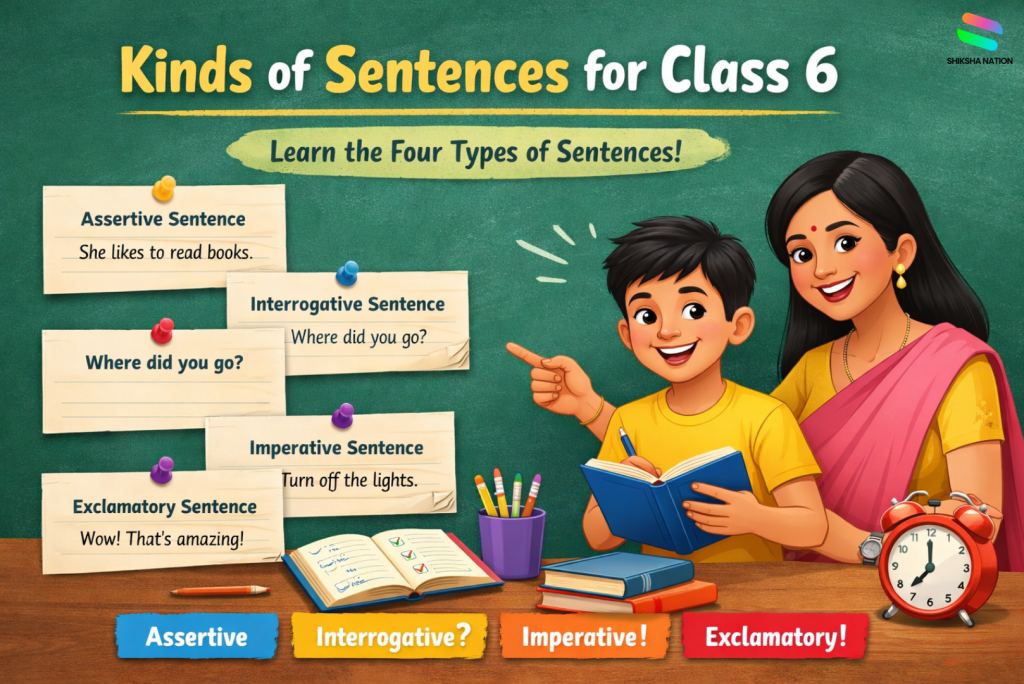
What Are the Kinds of Sentences? (Quick Recap)
In English, sentences are grouped based on the work they do. Some sentences give information, some ask questions, some give orders, and some show strong feelings. These groups are called kinds of sentences.
Class 6 students often get confused because the sentence may look simple, but its purpose is different. That is why a quick recap helps before starting practice.
You do not need to remember long rules. If you understand why a sentence is written, you can identify its kind easily in exams. This short recap will help students feel confident before moving to the worksheets, and parents can also revise the concept quickly while helping at home.
The Four Types of Sentences in English
There are four types of sentences that students learn in Class 6 English.
An assertive sentence (also called declarative) tells us something.
Example: The sun rises in the east.
An interrogative sentence asks a question and usually ends with a question mark.
Example: Where are you going?
An imperative sentence gives an order, request, or advice.
Example: Please close the door.
An exclamatory sentence shows strong feelings like happiness, surprise, or anger.
Example: What a beautiful day!
These basics are enough to start a types of sentences worksheet for class 6 without confusion.
Download Kinds of Sentences Worksheet for Class 6 (PDF)
This worksheet is available in a printable PDF format, which makes it easy to use at home or in the classroom. Students can write answers neatly and revise the topic without needing a screen.
The kinds of sentences worksheet for class 6 pdf is helpful for homework, extra practice, and quick revision before tests. Parents and teachers can also keep a printed copy to guide children during study time. The layout is simple and clear, so students can focus on learning without confusion.
Download the PDF – Kinds of Sentences Worksheet for Class 6 (With Answers)
Kinds of Sentences Worksheet for Class 6
This kinds of sentences worksheet for class 6 is made to match school exam patterns. The questions focus on identification and basic understanding, which are commonly asked in tests.
The worksheets are suitable for both CBSE and ICSE students. They are useful for daily practice, homework, and quick revision, and parents can easily use them to support learning at home.
Worksheet 1 – Identify the Kind of Sentence
Instructions for Students
Read each sentence carefully and decide its type. Write whether it is Assertive, Interrogative, Imperative, or Exclamatory. This activity helps you identify kinds of sentences correctly, which is important for Class 6 exams.
- The teacher explained the lesson clearly.
- What time does the school assembly start?
- Please complete your homework before dinner.
- How exciting this match is!
- My sister studies in Class 6.
- Can you help me with this question?
- Close the window quietly.
- What a wonderful drawing you have made!
- We will visit our grandparents this weekend.
- Why are you feeling upset today?
Parents can ask the child to read each sentence aloud before answering. These sentences exercises for class 6 improve both understanding and confidence during revision.
Worksheet 2 – Choose the Correct Type
Instructions for Students
Read each sentence and choose the correct option. Tick the right answer. This English grammar worksheet class 6 follows the same pattern used in school exams and helps students practise carefully.
- Please sit quietly in the classroom.
a) Assertive b) Interrogative c) Imperative d) Exclamatory
- What a tall building this is!
a) Assertive b) Interrogative c) Imperative d) Exclamatory
- Rohit plays cricket every evening.
a) Assertive b) Interrogative c) Imperative d) Exclamatory
- Where did you keep my notebook?
a) Assertive b) Interrogative c) Imperative d) Exclamatory
- Do your work neatly and on time.
a) Assertive b) Interrogative c) Imperative d) Exclamatory
Parents can ask children to explain why they chose an option. This small habit improves understanding and exam confidence.
Worksheet 3 – Write Your Own Sentences
Instructions for Students
Now it is time to write sentences on your own. This activity helps you think and apply what you have learned. Write one sentence for each kind in your notebook or worksheet space.
- Write one assertive sentence that gives information.
- Write one interrogative sentence that asks a question.
- Write one imperative sentence that gives advice or an order.
- Write one exclamatory sentence that shows strong feeling.
Teachers often check this type of question to see if students really understand the concept. Parents can encourage children to speak the sentence aloud first and then write it. This simple practice improves clarity, writing confidence, and exam performance.
Answers to Kinds of Sentences Worksheet (Class 6)
Answer Key with Explanation
This section gives the correct answers with simple reasons. Students should compare their responses and understand why a sentence belongs to a certain group. Parents can use this part to clear small doubts during home practice.
In the first worksheet, sentences that state a fact or give information are assertive sentences. For example, when a sentence only tells something and does not ask or command, it comes under this type.
Sentences that ask a question are interrogative sentences. They usually begin with words like what, why, where, or end with a question mark, which makes their purpose clear.
Sentences that give orders, requests, or advice are called imperative sentences. Even polite requests belong to this group because they tell someone to do something.
Sentences that show strong feelings such as joy, surprise, or anger are exclamatory sentences. These sentences often end with an exclamation mark and express emotion.
These explanations cover the four types of sentences taught in Class 6. This kinds of sentences worksheet for class 6 with answers is meant to help students learn from mistakes, not just check scores. Understanding the reason behind each answer builds long-term confidence in English grammar.
How Parents Can Help Class 6 Students Practice Sentences
Parents play an important role in helping children understand grammar in a simple way. You do not need to know complex rules to support your child.
Start with oral practice at home. Ask your child to speak one sentence of each type while talking normally, such as during meals or study time. This makes learning feel natural and less stressful.
Use daily examples from real life. For example, turn instructions into commands, questions into interrogative sentences, and happy moments into exclamatory sentences. This helps children connect grammar with everyday language.
Encourage your child to explain why a sentence belongs to a certain type. Even if the answer is not perfect, this habit builds thinking skills and confidence.
Regular short practice works better than long study hours. Calm support at home helps students perform better in class and exams.
FAQs on Kinds of Sentences for Class 6
Q. How many kinds of sentences are there in Class 6?
In Class 6 English, students learn four main kinds of sentences. These are assertive, interrogative, imperative, and exclamatory. Schools focus on these basic types so that students can understand sentence purpose clearly before moving to higher classes.
Q. Are assertive and declarative sentences the same?
Yes, both words are used for the same type of sentence. An assertive or declarative sentence simply gives information or states a fact. Teachers may use either term in class or exams, so students should not get confused by the name.
Q. Are kinds of sentences important for exams?
Yes, this topic is regularly tested in school exams. Questions may ask students to identify the sentence type, choose the correct option, or write their own examples. A clear understanding helps students score easy marks.
Q. How can my child improve sentence identification?
Regular practice is the best way. Ask your child to read sentences aloud and think about what the sentence is doing. Parents can also discuss simple sentences during daily conversations, which improves accuracy and confidence over time.