

Imagine sitting in your Hindi literature class, and your teacher recites a doha so powerful that it makes you question everything you thought you knew about life, religion, and society. That’s the magic of Kabir Das a 15th-century poet whose words still echo in classrooms, textbooks, and hearts across India.
Whether you’re preparing for your board exams, working on a school project, or simply curious about one of India’s greatest spiritual poets, understanding Kabir Das isn’t just about scoring marks. It’s about connecting with a voice that spoke for the common people, challenged social barriers, and taught lessons that remain relevant even today.
This guide will take you through everything you need to know about Kabir Das his life, his famous dohe, his philosophy, and why he continues to inspire millions of students, teachers, and seekers worldwide.
Who Was Kabir Das?
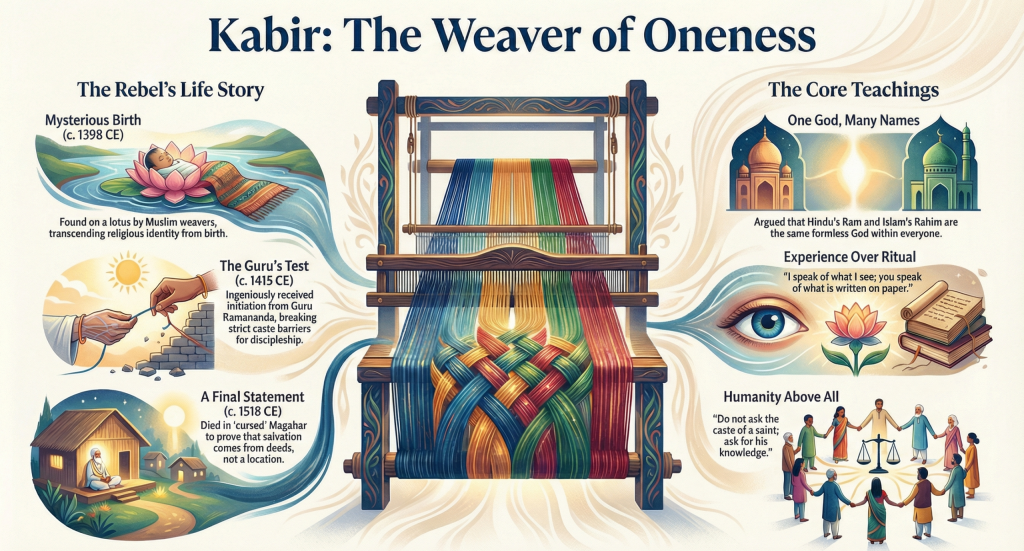
Kabir Das was a 15th-century Indian mystic poet and saint whose verses transcended religious boundaries. Born into a Muslim weaver family, Kabir became one of India’s most influential voices in the Bhakti movement.
Kabir Das short biography:
- Born: Around 1398–1440 CE (exact date debated)
- Died: Around 1448–1518 CE (believed to be 1518)
- Birthplace: Varanasi (Kashi), Uttar Pradesh
- Occupation: Weaver (Julaha)
- Literary Contribution: Dohe, Sakhi, Shabads
- Movement: Bhakti Movement
- Philosophy: Unity of God, rejection of rituals, social equality
Kabir didn’t belong to any formal religion. He criticized both Hinduism and Islam for their rituals and orthodoxy, preaching instead a formless, omnipresent God accessible to everyone.
Kabir Das Ka Jivan Parichay (Life Biography)
Early Life and Family Background
Kabir Das was born in Varanasi, one of India’s holiest cities. According to popular belief, he was found as an infant by a Muslim weaver couple, Niru and Nima, near a lotus pond called Lahar Tara.
Family Details:
- Foster Father: Niru (a weaver)
- Foster Mother: Nima
- Profession: Continued weaving throughout his life
- Marital Status: Married to Loi; had two children Kamal (son) and Kamali (daughter)
Despite being illiterate, Kabir became one of the most quoted poets in Indian literature. His oral compositions were later compiled by his disciples.
Spiritual Guru
Kabir considered the famous saint Ramananda as his spiritual guru. According to legend, since Ramananda wouldn’t accept a Muslim disciple, Kabir lay on the steps of a ghat where Ramananda walked every morning. When the saint accidentally stepped on him and uttered “Ram,” Kabir claimed this as his initiation mantra.
Death and the Legend
Kabir passed away in Maghar (near Gorakhpur, Uttar Pradesh) around 1518 CE. According to legend, after his death, both Hindus and Muslims claimed his body. When they lifted the cloth covering him, they found only flowers half of which were cremated by Hindus and half buried by Muslims.
This story symbolizes Kabir’s lifelong message: God is one, and religious divisions are human-made.
Birth and Early Life Controversy
The exact birth details of Kabir Das remain mysterious and debated among historians.
Three Main Theories:
- Divine Birth Theory: Some believe Kabir was born to a Brahmin widow who abandoned him out of social shame
- Adopted Child Theory: Most accepted version found and raised by Muslim weaver couple
- Natural Birth Theory: Some scholars believe he was born naturally to Niru and Nima
When Was Kabir Das Born and Died?
- Birth: Approximately 1398 CE (some sources say 1440)
- Death: Approximately 1518 CE
- Lifespan: Around 120 years (though this is debated)
The exact dates are uncertain because Kabir lived in an era before widespread record-keeping.
Kabir Das’s Teachings and Philosophy
Kabir’s teachings were revolutionary for medieval India. He spoke directly to common people in their own language.
Core Principles:
1. One God, Many Names Kabir believed in a formless, universal God beyond religious labels.
“Allah Ram ke pind paraan, tinhe roop ek pachhaana” (Allah and Ram are the same essence; recognize the one form in all)
2. Rejection of Rituals He criticized empty rituals, idol worship, pilgrimages, and religious orthodoxy.
3. Social Equality Kabir opposed the caste system and believed all humans are equal before God.
4. Inner Purity Over External Practices He emphasized meditation, honest living, and self-realization over external religious practices.
5. Guru’s Importance Kabir placed great emphasis on having a true spiritual teacher (guru).
Relevance for Students Today:
- Critical Thinking: Question blind faith and superstitions
- Equality: Treat everyone with respect regardless of background
- Honesty: Live truthfully and work hard
- Simplicity: Focus on genuine learning, not just marks or show-off
Famous Kabir Das Dohe with Meanings
Kabir’s dohe (couplets) are famous for their simple language and profound wisdom. Here are some of the most popular ones you’ll find in textbooks:
Doha 1: On the Importance of the Guru
बड़ा भया तो क्या भया, जैसे पेड़ खजूर। पंथी को छाया नहीं फल लागे अति दूर॥
Meaning: What’s the use of being tall like a date palm tree? It gives no shade to travelers, and its fruits are too high to reach. (Message: Real greatness lies in being useful to others, not just in status or height)
Student Connection: Like scoring high marks but not sharing knowledge with classmates who struggle.
Doha 2: On Unity of God
कबीरा खड़ा बाज़ार में, मांगे सबकी खैर। न काहू से दोस्ती, न काहू से बैर॥
Meaning: Kabir stands in the marketplace wishing well for everyone, neither making special friendships nor creating enmities. (Message: Universal goodwill and neutrality)
Student Connection: Being helpful to all classmates without forming exclusive groups or rivalries.
Doha 3: On Time Management
काल करे सो आज कर, आज करे सो अब। पल में परलय होएगी, बहुरि करेगा कब॥
Meaning: What you plan to do tomorrow, do today; what you plan to do today, do now. If destruction comes in a moment, when will you do it again? (Message: Don’t procrastinate)
Student Connection: Perfect advice for students who delay exam preparation until the last minute!
Doha 4: On True Knowledge
पोथी पढ़ि पढ़ि जग मुआ, पंडित भया न कोय। ढाई आखर प्रेम का, पढ़े सो पंडित होय॥
Meaning: Reading books doesn’t make you truly wise; one who learns the two-and-a-half letters of “love” becomes truly learned. (Message: Compassion and love matter more than bookish knowledge)
Student Connection: Academic knowledge is important, but kindness and empathy make you truly educated.
Doha 5: On Self-Reflection
बुरा जो देखन मैं चला, बुरा न मिलिया कोय। जो दिल खोजा आपना, मुझसे बुरा न कोय॥
Meaning: I went looking for bad people but found none; when I searched my own heart, I found no one worse than myself. (Message: Focus on self-improvement, not criticizing others)
Student Connection: Instead of blaming teachers or classmates for poor marks, examine your own study habits first.
Kabir Das Books and Literary Works
Kabir never wrote himself, as he was illiterate. His disciples compiled his oral teachings.
Major Compilations:
1. Bijak
- Most authentic collection of Kabir’s verses
- Contains Sakhis, Shabads, and Ramainis
- Preserved by the Kabir Panth sect
2. Kabir Granthavali
- Compiled by scholars
- Extensive collection of dohas and poems
- Used widely in academic study
3. Anurag Sagar
- Contains Kabir’s spiritual dialogues
- Focuses on creation and soul journey
4. Guru Granth Sahib
- Sikh holy book contains over 500 verses by Kabir
- Shows his influence across religious traditions
Books for Students:
- Kabir Ke Dohe (Hindi textbooks)
- Songs of Kabir (English translation by Rabindranath Tagore)
- The Weaver’s Songs: The Life and Poetry of Kabir by Vinay Dharwadker
Language and Style of Kabir
What Language Did Kabir Das Speak?
Kabir wrote in Sant Bhasha (also called Sadhukkadi), a mixture of:
- Hindi
- Braj Bhasha
- Awadhi
- Rajasthani
- Punjabi
- Khadi Boli
This linguistic mix made his poetry accessible to common people across North India.
Literary Characteristics:
- Simple vocabulary: No complex Sanskrit words
- Direct messaging: No abstract philosophy
- Use of metaphors: Everyday examples like weaving, markets, rivers
- Oral tradition: Meant to be sung and heard, not just read
- Rhythmic patterns: Easy to memorize
Why This Matters for Students:
Kabir’s simple language proves you don’t need fancy words to express powerful ideas. Your essays and answers should be clear and direct, not unnecessarily complicated.
Kabir Das’s Religious Views
Did Kabir Das Believe in God?
Yes, Kabir strongly believed in God, but not in the way organized religions presented.
Kabir’s God:
- Formless (Nirguna)
- Beyond name and form
- Not confined to temples or mosques
- Accessible through devotion and righteous living
- Not requiring intermediaries or rituals
Did Kabir Worship Ram?
Yes, but Kabir’s “Ram” was not the historical prince of Ayodhya. For Kabir, “Ram” represented the formless, universal divine consciousness.
He used the name “Ram” because it was familiar to people, but he equally referenced “Allah,” “Rahim,” and “Khuda.”
Is Kabir in the Quran?
No, Kabir Das is not mentioned in the Quran. This is sometimes confused because:
- Kabir was raised Muslim
- He referenced Islamic concepts
- His teachings aligned with Sufi mysticism
But Kabir lived 800+ years after the Quran was revealed, so there’s no mention of him in Islamic scripture.
How Kabir is Viewed Today
Academic Recognition:
- Core part of Hindi and Indian literature syllabi
- Studied from middle school through university
- Featured in CBSE, ICSE, and state board textbooks
Cultural Impact:
- Music: His shabads are sung by classical and folk artists
- Films: Kabir has been portrayed in movies and documentaries
- Social Reform: Quoted by leaders fighting caste discrimination
- Spiritual Movements: The Kabir Panth continues his teachings
Modern Relevance:
Kabir’s messages about equality, questioning authority, and finding truth are perfect for today’s generation facing:
- Social media echo chambers
- Religious polarization
- Educational pressure
- Identity confusion
Global Reach:
- Translated into English, French, German, and other languages
- Studied in universities worldwide
- Influenced poets like Rabindranath Tagore
Common Mistakes Students Make About Kabir Das
Mistake 1: Confusing Kabir with Other Bhakti Saints
Wrong: Mixing up Kabir with Tulsidas, Surdas, or Mirabai
Right: Each saint has unique characteristics:
- Tulsidas: Wrote Ramcharitmanas in Awadhi
- Surdas: Focused on Krishna bhakti
- Kabir: Criticized both Hindu and Muslim orthodoxy
Mistake 2: Thinking Kabir Was Hindu or Muslim
Wrong: Labeling Kabir as exclusively Hindu or Muslim
Right: Kabir transcended religious boundaries and criticized both traditions equally
Mistake 3: Memorizing Dohas Without Understanding
Wrong: Cramming dohas just to write in exams
Right: Understand the meaning and context; teachers award more marks for interpretation than mere reproduction
Mistake 4: Ignoring Historical Context
Wrong: Studying Kabir’s poetry in isolation
Right: Understanding the medieval period’s rigid caste system and religious conflicts helps explain why his words were revolutionary
Mistake 5: Using Only Literal Translations
Wrong: Taking metaphors literally
Right: Kabir used symbols (weaver’s loom = life’s journey; thread = soul’s connection to God)
Study Tips for Kabir Das in Exams
For Hindi Literature Exams:
1. Learn 5-7 Core Dohas Thoroughly
- Memorize the original text
- Know the meaning
- Understand the message
- Relate to contemporary life
2. Create a Timeline
- Approximate birth and death
- Historical period context
- Connection to Bhakti movement
3. Prepare Comparison Points
- Kabir vs. Tulsidas
- Nirguna vs. Saguna bhakti
- Sant tradition vs. mainstream Hinduism
4. Practice Long Answers
- Life biography (200-250 words)
- Philosophy and teachings (200-250 words)
- Literary contributions (150-200 words)
For General Knowledge:
- Birth and death places
- Guru’s name
- Major works
- Famous dohas
- Religious philosophy
FAQs About Kabir Das
Q. Who was Kabir Das?
Kabir Das was a 15th-century Indian mystic poet and saint who preached social equality, criticized religious orthodoxy, and believed in a formless universal God. Born in a Muslim weaver family in Varanasi, he became a leading voice in the Bhakti movement through his powerful dohas and shabads.
Q. When was Kabir Das born and died?
Kabir Das was approximately born around 1398-1440 CE and died around 1518 CE in Maghar, Uttar Pradesh. The exact dates are debated among historians due to limited historical records from that period, but most scholars accept his lifespan covered the 15th and early 16th centuries.
Q. What language did Kabir Das speak?
Kabir Das spoke and composed in Sant Bhasha (also called Sadhukkadi), which was a mixture of Hindi, Braj Bhasha, Awadhi, Rajasthani, Punjabi, and Khadi Boli. This linguistic blend made his poetry accessible to common people across North India, regardless of their regional language.
Q. Did Kabir Das believe in God?
Yes, Kabir Das firmly believed in God but as a formless, universal divine presence beyond religious labels. He rejected idol worship, rituals, and religious boundaries, instead preaching that the same God is called Ram, Allah, Rahim, or Khuda by different people, and is accessible through devotion and righteous living.
Q. Which is the famous poem of Kabir?
Kabir’s most famous works are his dohas (couplets), particularly “Bura jo dekhan main chala” and “Pothee padh padh jag mua.” His compilation “Bijak” containing Sakhis, Shabads, and Ramainis is considered his most authentic literary work, preserved by the Kabir Panth community.
Q. How is Kabir viewed today?
Today, Kabir is celebrated as one of India’s greatest spiritual poets and social reformers. His verses are core parts of school syllabi, sung by musicians, quoted by social activists, and studied globally. His messages of equality, critical thinking, and unity remain relevant for modern challenges like religious polarization and social discrimination.
Q. Did Kabir worship Ram?
Yes, but Kabir’s “Ram” was not the mythological prince of Ayodhya. For Kabir, Ram represented the formless, universal consciousness beyond names and forms. He used “Ram” as a familiar term for the divine, but equally referenced Allah and other names, emphasizing that all point to the same ultimate reality.
Q. What are Kabir Das’s most important teachings?
Kabir’s core teachings include: belief in one formless God beyond religious divisions, rejection of empty rituals and orthodoxy, social equality and opposition to caste discrimination, importance of a true spiritual guru, emphasis on inner purity over external practices, and honest living through one’s profession while pursuing spiritual growth.
Conclusion
Kabir Das wasn’t just a poet he was a revolutionary who used words as weapons against injustice, inequality, and blind faith. Living in an era of rigid social hierarchies, he dared to say what others only whispered.
For you as a student, Kabir’s life teaches valuable lessons beyond textbooks:
- Authenticity matters more than status (he remained a weaver despite fame)
- Education comes from wisdom, not just degrees (he was illiterate but profoundly learned)
- Question everything respectfully (critical thinking is essential)
- Live your values (don’t just memorize them for exams)
Whether you’re preparing for board exams, working on a Hindi project, or genuinely curious about India’s spiritual heritage, Kabir Das offers timeless wisdom wrapped in simple, memorable verses.
As Kabir himself would say:
“साधो, ये मुरदों का गाँव। पीर मरे पैगम्बर मरे, मरे सकल जहान। राजा मरे परजा मरे, मरे वैद, भगवान। चंदा मरे सूरज मरे, मरे धरम आकाश। सब कुछ मरे सिर्फ़ एक सच्चा, जो अपने भीतर बास॥”
Everything perishes empires, prophets, even the sun and moon—but the truth within you remains eternal.