
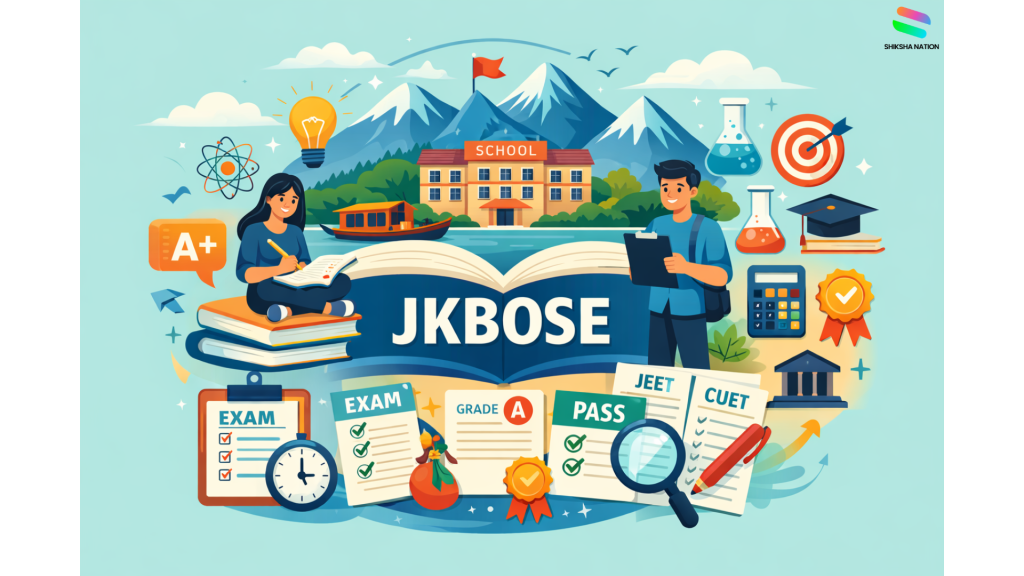
The jk bose, officially known as the Jammu and Kashmir Board of School Education (JKBOSE), is the state-level education board responsible for conducting school examinations and regulating academic standards in Jammu and Kashmir. It oversees secondary and higher secondary education and plays a key role in shaping students’ academic journeys from middle school to board classes.
This guide is written for Classes 6-12 students and their parents who want clear, reliable information about jkbose without confusion or rumours. Whether you are preparing for Class 10 or Class 12 board exams, understanding how the board works helps in planning studies better and avoiding unnecessary stress.
In this article, we explain what JKBOSE is, how its examination system and syllabus are structured, how results and evaluation work, and whether JKBOSE is recognized outside Jammu and Kashmir. Parents will also find clarity on board credibility, school affiliation, and future academic options.
The aim is not to compare boards or create fear, but to provide practical guidance based on how JKBOSE functions in reality. By the end, students and parents should have a clear picture of the board and know what truly matters for academic progress under JKBOSE.
What is JKBOSE?
The jk bose, formally called the Jammu and Kashmir Board of School Education, is the main authority responsible for school education in the Union Territories of Jammu & Kashmir and Ladakh. It functions as an autonomous board under the administration of the Government of Jammu and Kashmir and plays a central role in regulating school-level academics.
JKBOSE was established in 1965 with the objective of creating a structured and uniform education system for the region. Over the years, the board has evolved to manage a large network of affiliated schools and to ensure that academic standards are maintained across different districts and zones.
Full Form of JKBOSE
JKBOSE stands for Jammu and Kashmir Board of School Education. It is a government-recognised board that conducts public examinations and issues certificates that are valid for higher education across India.
Role of the JKBOSE Board
The board is responsible for designing syllabi, selecting textbooks, conducting Class 10 and Class 12 examinations, declaring results, and managing evaluation and revaluation processes. It also grants affiliation to schools and regularly monitors their academic and administrative functioning.
Areas Covered by JKBOSE
JKBOSE operates across Jammu, Kashmir, and Ladakh, ensuring that students from different regions follow a common and regulated education framework. This helps students and parents trust the credibility and acceptance of JKBOSE education beyond the region.
History and Background of JKBOSE
The jkbose was established in 1965 to bring structure and consistency to school education in the region. Before its formation, schools followed different academic patterns, which created confusion for students during exams and higher education admissions.
The board was formed to create a uniform syllabus, common examinations, and a recognised certification system for school students. This helped ensure that students from different districts were evaluated using the same academic standards.
Why JKBOSE Was Created
The main purpose behind setting up JKBOSE was to regulate secondary and higher secondary education under one authority. For parents, this meant better accountability of schools, and for students, it ensured that their academic performance was measured fairly.
How JKBOSE Has Evolved Over Time
Over the years, JKBOSE has adapted to changes in the education system by improving syllabus design, exam procedures, and evaluation methods. It has expanded its reach to cover a large number of schools and continues to update its processes to meet current academic needs.
This gradual evolution has helped JKBOSE remain relevant and dependable for students planning their academic future.
Classes and Education Levels Under JKBOSE
The JKBOSE education system mainly focuses on secondary and higher secondary schooling, which are the most important academic stages for students. These levels decide subject choices, career direction, and eligibility for future studies.
Secondary Education – Class 10
The jkbose class 10 examination marks the completion of secondary education. It tests students on core subjects and builds a strong academic foundation. For parents, this stage helps in understanding the student’s strengths before choosing streams in higher classes.
Higher Secondary Education – Class 12
The jkbose class 12 level is the final stage of school education under the board. Students appear for board exams in chosen streams such as Science, Commerce, or Arts. These results are crucial for college admissions and national entrance exams.
Importance of JKBOSE Board Exams
Board examinations under JKBOSE ensure uniform assessment for all students. They act as a recognised academic benchmark, giving students valid certification and helping parents track academic readiness for higher education.
JKBOSE Syllabus and Curriculum Structure
The jkbose syllabus is designed to provide students with clear subject knowledge while keeping learning practical and structured. It aims to prepare students not only for board examinations but also for higher education and competitive exams.
JKBOSE follows a subject-wise curriculum that includes languages, Mathematics, Science, Social Science, and stream-specific subjects at the higher secondary level. The content is organised in a step-by-step manner so that students can understand concepts gradually as they move to higher classes.
For parents, the syllabus offers clarity on what their child is expected to learn during the academic year. For students, it acts as a roadmap that helps in planning studies, revision, and exam preparation in an organised way.
The board periodically reviews the syllabus to keep it relevant and balanced. While the focus remains on core concepts, practical understanding and application-based learning are also encouraged, especially in science subjects.
Is JKBOSE Syllabus Based on NCERT?
The JKBOSE syllabus is largely aligned with NCERT textbooks, particularly for subjects like Physics, Chemistry, Mathematics, and Biology. This alignment helps students who are preparing for JEE, NEET, and CUET, as these exams are mainly based on NCERT concepts.
However, some topics may be arranged differently or explained in a simpler format. Students preparing for competitive exams are advised to use NCERT books along with JKBOSE-prescribed materials to ensure full coverage.
Overall, this alignment supports smooth academic progression beyond school education.
JKBOSE Examination System Explained
The jkbose examination system is designed to test students on their understanding of concepts, not just memory. It follows a structured approach so that students across different regions are evaluated using the same academic standards.
Board examinations are mainly conducted for Class 10 and Class 12, while internal assessments support regular learning throughout the year. For parents, this system provides clarity on how a student’s final performance is calculated.
Exam Pattern and Question Paper Structure
JKBOSE question papers are prepared strictly according to the prescribed syllabus. Papers usually include a mix of short answer, long answer, and numerical or application-based questions, depending on the subject.
This pattern allows students to score marks through clear concepts and proper presentation. It also helps parents understand that marks depend on understanding, not guesswork or shortcuts.
Internal Assessment and Board Exams
Apart from final board exams, JKBOSE includes internal assessments conducted by schools. These may involve class tests, assignments, and practical work, especially in science subjects.
The marks from internal assessments are combined with board exam scores to arrive at the final result. This system encourages students to stay consistent in their studies and reassures parents that one exam alone does not define the student’s full academic effort.
JKBOSE Evaluation Process and Marking
The jkbose evaluation process is designed to ensure that students are assessed in a fair and balanced manner. Answer sheets are checked by trained examiners who follow official marking guidelines issued by the board.
For students, this means marks are awarded based on clarity of concepts and correct method, not just the final answer. Parents can be assured that evaluations are done in a controlled and standardised way.
How Answer Sheets Are Checked
Each answer sheet is evaluated subject-wise using a fixed marking scheme. Examiners check whether the student has understood the question and applied the correct approach.
In numerical and science subjects, proper steps and working are given importance. This helps students score marks even if the final answer has small errors.
Step-wise Marking and Transparency
JKBOSE follows step-wise marking, where marks are divided across different parts of an answer. Diagrams, explanations, and logical flow are also considered where applicable.
To maintain transparency, the board allows students to apply for rechecking or revaluation if they are not satisfied with their marks. This system builds trust among students and parents by reducing the chances of unfair evaluation.
JKBOSE Results – What Students and Parents Should Know
The jkbose results reflect a student’s academic performance after completing the examination process. These results are officially released by the board after careful evaluation and verification of answer sheets.
For parents, understanding how results are prepared helps in avoiding confusion or unnecessary stress. For students, results are an outcome of both exam performance and internal assessment.
How JKBOSE Results Are Declared
The Jammu Kashmir Board of School Education result is prepared after all answer scripts are checked and marks are compiled subject-wise. The board follows a standard process to ensure accuracy before making results official.
Once declared, results are used as formal academic records for future admissions and documentation.
Meaning of Marks and Pass Criteria
Marks indicate how well a student has understood the subjects during the academic year. To pass, students must secure the minimum required marks set by the board in each subject.
Different subjects may have theory and practical components, and students need to meet the pass criteria in both where applicable.
Why JKBOSE Results Matter Academically
JKBOSE results play an important role in stream selection, college admissions, and eligibility for competitive exams. They serve as recognised proof of academic achievement for both students and parents planning future education steps.
JKBOSE Revaluation and Rechecking Process
The jkbose revaluation facility is provided to students who feel that their marks do not reflect their actual performance. It is an official process that allows students to seek a review of their evaluated answer sheets.
This option helps parents and students address genuine concerns without panic or assumptions of error.
When Revaluation Is Allowed
Revaluation is usually permitted after the declaration of results, within a fixed application period set by the board. Students can apply only for specific subjects where they believe marks may have been missed.
It is important to follow board guidelines carefully while applying to avoid rejection.
Rechecking vs Revaluation – What Is the Difference?
Rechecking involves verifying whether all answers have been checked and marks totalled correctly. Revaluation, on the other hand, includes a fresh review of the answer script based on the marking scheme.
Marks may increase, decrease, or remain unchanged after revaluation.
Practical Advice for Students
Students should opt for revaluation only if they are confident about their performance. Parents should guide students to use this option calmly, as it is meant for correction, not guaranteed score improvement.
JKBOSE Affiliation and School Recognition
JKBOSE affiliation means that a school is officially approved by the board to teach students under its academic system. Only affiliated schools are allowed to follow the JKBOSE syllabus and present students for board examinations.
For parents, checking a school’s affiliation status is important before admission, as it ensures the school meets required education standards.
How Schools Get Affiliated
Schools must apply to JKBOSE and fulfil specific conditions related to infrastructure, qualified teachers, academic facilities, and student safety. The board reviews these details before granting affiliation.
Regular inspections and documentation help the board confirm that schools continue to follow academic and administrative rules.
Quality Control and Academic Standards
JKBOSE maintains quality by monitoring affiliated schools through periodic checks. Schools that do not meet standards may receive warnings or face action as per board guidelines.
Why Affiliation Matters to Parents
Affiliation ensures that a child’s education and certificates are valid and recognised. It gives parents confidence that the school follows a regulated system and that students will not face issues during board exams or higher education admissions.
Is JKBOSE Recognised Across India?
The jk bose is a government-recognised education board, and its certificates are accepted by universities and colleges across India. Students who complete Class 10 or Class 12 under JKBOSE are eligible to apply for higher education without facing board-related restrictions.
For parents, this recognition provides assurance that their child’s education is valid beyond the state level.
University and College Recognition
JKBOSE certificates are accepted by central, state, and private universities in India. Admissions are usually based on eligibility criteria, not on the board name, which keeps opportunities open for students.
Eligibility for National Entrance Exams
Students from JKBOSE are eligible to appear for national-level exams such as JEE, NEET, and CUET. As long as subject requirements are met, the board does not limit exam eligibility.
Migration to Other Boards
If families shift locations, students can migrate from JKBOSE to other boards following official transfer procedures. This flexibility helps parents manage education continuity during relocation.
JKBOSE Official Website and Student Support
The jkbose official website,https://jkbose.nic.in, is the primary source of authentic information released by the board. It is meant to help students, parents, and schools stay updated on academic matters without relying on unofficial sources.
For parents, the website offers clarity on board-related announcements. For students, it acts as a reliable reference point during important academic stages.
Purpose of the Official Website
The official website is used to publish notices related to examinations, results, revaluation, syllabus updates, and school affiliation. It ensures that information reaches all stakeholders in a transparent manner.
Information Available for Students and Parents
Students can find exam-related instructions, academic guidelines, and downloadable documents. Parents can access circulars, board policies, and general updates that affect school education.
Safe Usage Guidance
Users should rely only on the official website for board information and avoid third-party links that claim instant results or shortcuts. This helps prevent confusion, misinformation, and data misuse.
JKBOSE (FAQs)
Q. Is JKBOSE harder than CBSE?
JKBOSE is not harder or easier than CBSE; it is different in structure and approach. The level of difficulty depends more on preparation and concept clarity than on the board itself. Students who study regularly can perform well under any board.
Q. Can JKBOSE students crack NEET or JEE?
Yes, students from JKBOSE are fully eligible for NEET and JEE. Since the syllabus is largely aligned with NCERT, students who focus on core concepts and use NCERT books can prepare effectively for these exams.
Q. Is the JKBOSE syllabus updated regularly?
The jkbose syllabus is reviewed and updated from time to time to keep it relevant. While changes may not happen every year, the board ensures that important academic requirements are covered properly.
Q. Should parents worry about JKBOSE board credibility?
No. jk bose is a government-recognised board, and its certificates are accepted across India. Colleges and universities consider eligibility criteria, not board names, during admissions.
Q. Are JKBOSE results accepted by all universities?
Yes, jkbose results are accepted by central, state, and private universities in India. Students can apply for higher education without facing board-related restrictions.
Q. Does JKBOSE follow NCERT textbooks?
JKBOSE follows NCERT textbooks for many subjects, especially in Science and Mathematics. However, students should also refer to board-prescribed materials for complete coverage.
Q. How are marks calculated in JKBOSE exams?
Marks are awarded based on written exams and internal assessments where applicable. The board follows a standard evaluation process to ensure fairness for all students.
Q. Can students shift from JKBOSE to CBSE or other boards?
Yes, students can move from JKBOSE to another board if required. The transfer depends on school policies and completion of formal documentation.
Q. Is revaluation worth applying for in JKBOSE?
Revaluation should be considered only if a student strongly feels that marks do not reflect actual performance. It is meant for correction, not for guaranteed improvement.
Q. What should students focus on to score well in JKBOSE exams?
Students should focus on understanding concepts, writing clear answers, and following the prescribed syllabus. Consistent study and proper revision matter more than the board itself.