

JEE Preparation Strategy for Droppers Targeting IIT
A drop year can be the turning point in your journey to IIT. Many top rankers succeed during their drop year because they follow a clear, disciplined and targeted approach. With the right JEE preparation strategy for droppers targeting IIT, you can transform your weaknesses into strengths and achieve the rank you always wanted. This guide is designed to give you a complete roadmap—covering study plans, mindset, mistakes to avoid and subject-wise strategies.
Droppers already have a major advantage: familiarity with the syllabus, exam pattern and previous errors. With smarter planning and consistent effort, cracking JEE becomes highly achievable.

Why a Drop Year Helps JEE Aspirants Targeting IIT
A drop year works in your favour if approached with the right mindset. Without school distractions, you get more time, flexibility and focus. Many students mature after Class 12 and understand concepts more deeply. A drop year gives you:
-
Clear understanding of what went wrong earlier
-
A stronger foundation
-
More time for practice
-
Opportunity to follow personalised study plans
-
A second chance to score higher in both JEE Main and Advanced
Instead of feeling pressured, view this year as a strategic opportunity.
Understanding Past Mistakes Before Restarting JEE Preparation
Before jumping into books again, take a day to analyse your previous attempt. Most droppers fail earlier because of:
-
Lack of time management
-
Weak basics
-
Overconfidence or underconfidence
-
Inconsistent practice
-
Not solving enough MCQs
-
Poor test analysis
-
Too many distractions
-
Following wrong study material
-
Stress and exam fear
Write down your mistakes. Your new preparation strategy must correct all of them.
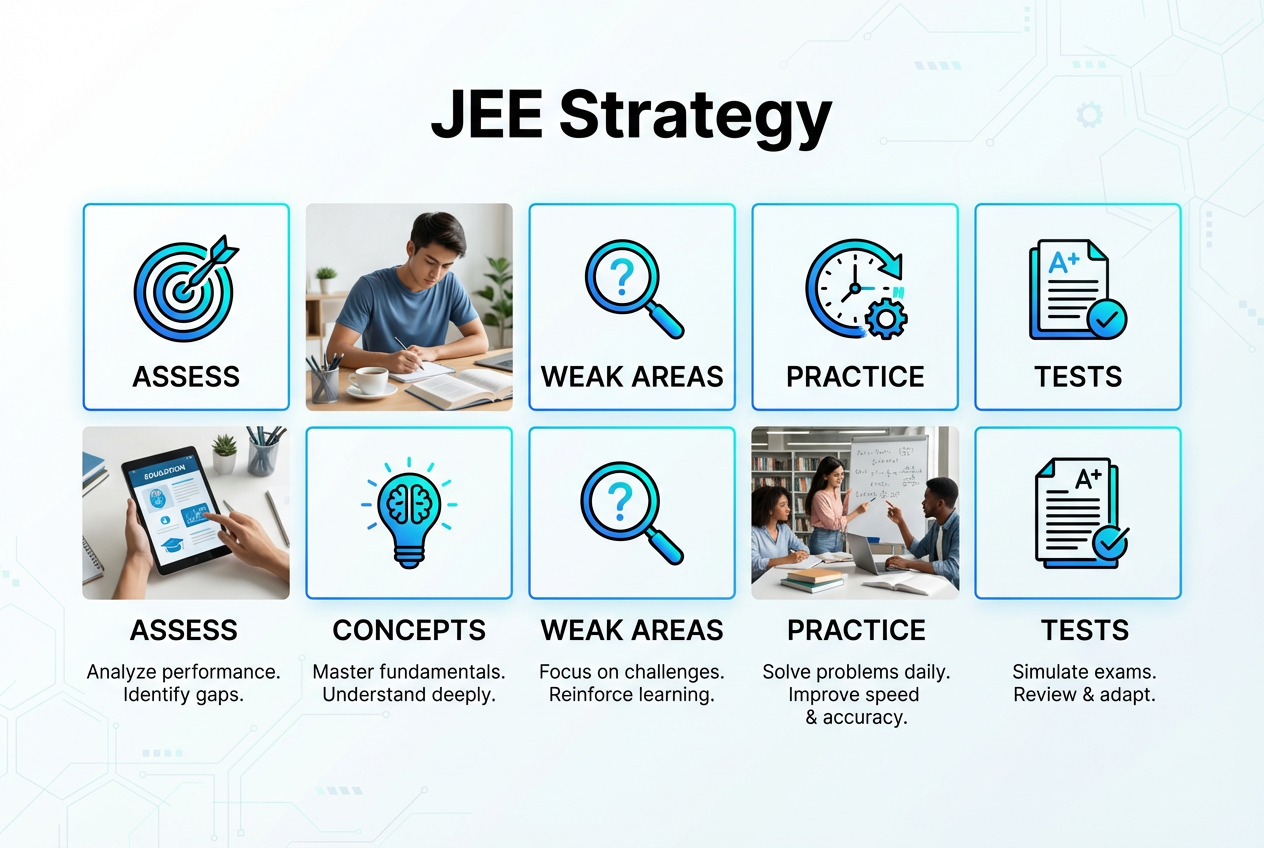
Core JEE Preparation Strategy for Droppers Targeting IIT
This is your main framework. If followed correctly, it guarantees steady improvement.
1. Strengthen basics in the first 3–4 months
Rebuild your foundation before moving to advanced questions.
2. Maintain a fixed number of questions daily
40–50 problems per subject help build speed and accuracy.
3. Solve previous year’s questions consistently
PYQs reveal exact patterns of JEE Main and Advanced.
4. Take mock tests regularly
Start with 1 test/week and increase gradually to 3–4 per week.
5. Analyse every test deeply
Test analysis prevents repeating the same errors.
Consistency beats everything. Even moderate study hours done regularly give huge results.
Study Plan for JEE Droppers Aiming for IIT
This is the ideal 12-month roadmap many toppers follow.
Months 1–4: Concept Building Phase
-
Revise fundamental concepts
-
Complete NCERT for Chemistry
-
Strengthen weak chapters
-
Build proper notes
Months 5–8: Practice & Application Phase
-
Solve coaching modules
-
Attempt advanced-level questions
-
Begin full-length mock tests
-
Solve topic-wise PYQs
Months 9–12: Revision & Test Series Phase
-
Take 3–4 mock tests weekly
-
Work on time management
-
Practice mixed question sets
-
Revise error notebooks and formulas daily
If you stick to this plan honestly, your chances of securing an IIT seat increase significantly.
Subject-Wise JEE Strategy for IIT Aspirants
Every subject requires a different approach. Here’s how droppers can master each one.
Physics
Physics is concept-based, and many students struggle with problem-solving speed.
Do this:
-
Use HC Verma for concepts
-
Solve DC Pandey for practice
-
Maintain a formula sheet
-
Spend time understanding derivations
-
Strengthen mechanics and modern physics
Practise numericals daily — physics improves only through problem-solving.
Chemistry
Chemistry is the highest scoring section if prepared correctly.
Physical Chemistry:
Practise numericals and revise formulas regularly.
Organic Chemistry:
Learn mechanisms and reaction behaviour. Use NCERT + Solomon’s for reference.
Inorganic Chemistry:
Focus heavily on NCERT. Read it 5–7 times.
Mathematics
Maths needs accuracy and speed.
Follow this pattern:
-
Solve 60–80 questions daily
-
Focus on calculus, algebra and coordinate geometry
-
Time yourself during practice
-
Solve a mix of easy, medium and difficult problems
JEE Maths rewards consistent practice more than anything.
Daily Schedule for JEE Droppers Preparing for IIT
Here’s a practical timetable you can personalise:
-
7:00 – 9:00 AM: Physics concepts
-
9:15 – 12:00 PM: Maths practice
-
12:00 – 1:00 PM: Break
-
1:00 – 3:00 PM: Chemistry theory
-
3:15 – 5:00 PM: Chemistry questions
-
6:00 – 7:00 PM: Revision or PYQs
-
8:00 – 10:00 PM: Mock test / advanced practice
Adjust this based on your strengths and weaknesses.
Common Mistakes JEE Droppers Must Avoid While Targeting IIT
Avoiding mistakes is just as important as studying well.
-
Switching books too often
-
Not analysing mock tests
-
Too much screen time
-
Comparing with friends
-
Studying without breaks
-
Sleeping irregular hours
-
Ignoring mental health
-
Avoiding JEE Advanced preparation
Droppers lose rank mostly due to inconsistency or stress — not lack of intelligence.
Revision Strategy for JEE Aspirants Taking a Drop Year
A strong revision plan decides your final score.
Daily revision:
30–40 minutes of formula revision.
Weekly revision:
Revise 2–3 previously studied chapters.
Monthly revision:
Take one full syllabus test and check your accuracy.
Error notebook revision:
Rewrite every mistake from mocks and PYQs.
This eliminates errors permanently.
Final JEE Preparation Tips for Students Targeting IIT
-
Maintain your health — sleep 7 hours
-
Avoid negativity
-
Keep your study desk clean
-
Trust your strategy
-
Take mock tests seriously
-
Don’t chase motivation — chase consistency
-
Remember: a drop year doesn’t define you; your effort does
Conclusion
With a smart JEE preparation strategy for droppers targeting IIT, any dedicated student can secure a top rank. Your drop year is a second chance — use it wisely, stay focused and follow a structured routine. With discipline, strong revision and consistent tests, your dream IIT seat is absolutely within reach.
Also Read: Common Mistakes Students Make While Preparing for IIT