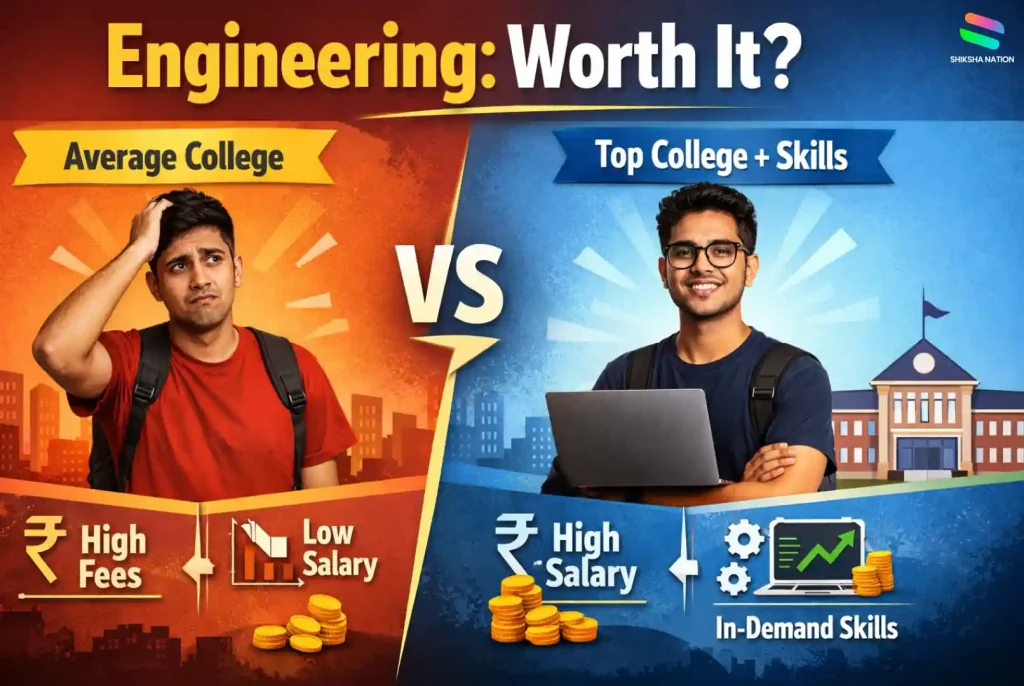
What Does “Engineering Worth It” Actually Mean?
“Engineering worth it” means whether the time, money, and effort you invest in a BTech or engineering degree give you a strong return in terms of career growth, salary, and long-term stability.
In simple terms, it is not just about getting a degree – it is about what you gain after those 4 years. This is why the question “is engineering a good career in 2026 India” cannot be answered with a simple yes or no. It depends on outcomes, not just the course.
To evaluate this properly, students and parents should look at three key factors:
- Return on Investment (ROI):
Compare total fees (₹5-20 lakh in many colleges) with expected starting salary. For example, a ₹10 lakh degree with a ₹3 LPA job has low ROI.
- Career Growth Opportunities:
Does the field offer growth in the next 5-10 years? Branches like Computer Science may grow faster than some traditional branches.
- Stability and Job Security:
Are there consistent job opportunities, or is placement uncertain? This varies heavily between top colleges and average private colleges.
For example, an IIT student with strong coding skills may see high ROI and growth, while a student from a low-tier college without skills may struggle even after graduation.
So, “worth it” is not about engineering as a degree – it is about the outcome you can realistically achieve based on your choices and effort.
Engineering in India 2026 – Current Reality
Engineering in India in 2026 is a mix of opportunity and imbalance. While top colleges continue to offer strong placements and growth, a large number of students from average colleges face limited job opportunities. This gap defines the real future of engineering in India 2026.
The engineering scope in India after 12th is still wide, but outcomes are highly dependent on where and how you study.
Key ground realities you should understand:
- Huge number of colleges, uneven quality:
India has thousands of engineering colleges, but only a small percentage (IITs, NITs, top private colleges) consistently deliver good placements.
- High competition for top institutes:
Lakhs of students prepare for JEE every year, but only a small fraction get into top-tier colleges. This creates a sharp divide in career outcomes.
- Placement gap is very real:
Top colleges may offer ₹10-25 LPA packages, while many Tier 3 colleges see average salaries around ₹2-5 LPA – or even no placements for some students.
- Skills matter more than degree:
Companies now prefer candidates with practical skills (coding, problem-solving, projects) over just a degree certificate.
- AI and tech shifts are changing demand:
Fields like Computer Science, AI, Data Science are growing, while some traditional roles are becoming less stable.
- Urban vs rural exposure gap:
Students from Tier 1 cities often have better access to internships and guidance compared to Tier 2/3 areas.
For example, two students doing the same BTech – one from a top NIT with internships, and another from a low-tier college without skills – can end up with completely different career paths.
In short, engineering in 2026 is not “one path fits all.” It is a highly outcome-dependent career choice, where college, branch, and skills together decide your future.
Is Engineering Oversaturated in India?
Engineering is not completely oversaturated, but it is overcrowded at the average level.
- Too many graduates → limited quality jobs
- High competition for top roles
- Low demand for low-skilled engineers
Reality:
Engineering is still valuable for skilled students, but risky for those who rely only on the degree.
Engineering Placement Reality in India
Engineering placement reality in India varies sharply by college tier.
| College Tier |
Placement Rate |
Avg Salary |
| IITs / Top NITs |
80-95% |
₹10-25 LPA |
| Good Private Colleges |
60-80% |
₹4-10 LPA |
| Average Colleges |
30-60% |
₹2-5 LPA |
- Top colleges offer strong opportunities
- Average colleges often struggle with placements
- Many students depend on off-campus jobs
Based on recent placement trends, college choice + skills matter more than the degree itself.
Engineering ROI in India (Fees vs Salary vs Time)
Engineering ROI in India means comparing three things clearly: total fees you invest, salary you earn after graduation, and time taken to recover that investment. This is one of the most practical ways to decide whether engineering is a smart choice in 2026.
Many students focus only on getting admission, but the real question is: Will this degree pay off financially? The engineering salary in India 2026 varies widely, so ROI also changes based on college and skills.
Average Engineering Fees in India
Engineering fees depend heavily on the type of college:
- IITs / NITs: ₹8-12 lakh (total 4 years)
- Good private colleges: ₹10-20 lakh
- Average private colleges: ₹6-12 lakh
Additional costs like hostel, coaching, and study materials can increase the total investment.
Salary Range (Tier-wise Colleges)
Your starting salary depends more on college tier and skills than the degree itself:
- Top colleges (IITs/NITs): ₹10-25 LPA
- Mid-tier colleges: ₹4-10 LPA
- Average colleges: ₹2-5 LPA
For example, a student from a Tier-1 college with coding skills may start at ₹12 LPA, while another from a lower-tier college may struggle to cross ₹3 LPA.
Break-even Analysis (ROI)
The break-even point shows how long it takes to recover your education cost.
| College Tier |
Fees |
Avg Salary |
ROI Time |
| IITs / Top NITs |
₹8-12 lakh |
₹10-25 LPA |
1-2 years |
| Good Private Colleges |
₹10-20 lakh |
₹4-10 LPA |
2-4 years |
| Average Colleges |
₹6-12 lakh |
₹2-5 LPA |
3-6+ years |
Key Insight:
- High ROI = lower fees + higher salary
- Low ROI = high fees + low placement
Based on placement trends, engineering ROI in India is excellent for top colleges, moderate for good private colleges, and risky for average colleges.
Before choosing engineering, students should realistically estimate their college tier, expected salary, and skill level – not just follow the crowd.
Engineering Jobs Future in India
Engineering jobs future in India is changing quickly, mainly due to technology shifts and the impact of AI on engineering jobs. The demand for engineers is not decreasing, but the type of skills companies expect is evolving.
In 2026, companies are not just hiring degree holders—they are hiring problem-solvers who can work with new technologies. This means students who adapt will still find strong opportunities.
Here are the key trends shaping the future:
- AI and automation are replacing repetitive tasks:
Basic coding or routine engineering work is becoming automated
- Demand for advanced skills is increasing:
Skills like AI, data science, cybersecurity, and cloud computing are growing fast
- Core branches are also evolving:
Mechanical, Civil, and Electrical engineers now need software and analytical skills
- Startup and tech ecosystem growth:
More opportunities are coming from startups, not just big companies
- Global competition:
Indian engineers are now competing with talent worldwide through remote jobs
For example, a Computer Science student who learns AI tools and builds projects will have better opportunities than someone who only relies on college syllabus.
Which Engineering Branches Have Future in 2026?
Choosing the right branch is critical for long-term growth. The best engineering branches for future 2026 are those aligned with technology and industry demand:
- Computer Science & Engineering (CSE) – High demand in software, AI, startups
- Artificial Intelligence & Data Science – Fastest growing field
- Information Technology (IT) – Strong placement opportunities
- Electronics & Communication (ECE) – Important for telecom, embedded systems
- Electrical Engineering – Growing with EV and renewable energy sectors
Key Insight:
No branch is “bad,” but future success depends on how well your skills match industry needs.
Based on current trends, engineering remains a good option – but only for students who are ready to continuously learn and upgrade their skills.
When Engineering Is Worth It?
Engineering is worth it in 2026 when certain clear conditions are met. The degree gives strong results only when it is supported by the right college choice, skills, and career intent.
If you are asking “should I do engineering in 2026?”, the answer is yes – only if the following conditions apply to you:
- You can get into a good college (Tier 1 or strong Tier 2):
Colleges with consistent placements and industry exposure significantly improve outcomes
- You are ready to build skills beyond the syllabus:
Learning coding, tools, internships, or projects is essential, not optional
- You have interest in problem-solving or technical work:
Engineering requires logical thinking and continuous learning, not just theory
- You choose the right branch based on demand:
Fields like CSE, AI, and Data Science currently offer better opportunities
- You are financially prepared for the investment:
High fees make sense only if placement potential justifies the cost
- You are open to adapting with industry changes:
Technology evolves fast, so learning cannot stop after graduation
For example, a student who joins a decent college, learns coding, builds projects, and does internships can secure a good job even without IIT.
Key Insight:
Engineering works best for students who treat it as a skill-building journey, not just a degree.
When Engineering Is NOT Worth It
Engineering is not worth it in 2026 when the expected outcomes – skills, salary, and career growth – do not match the time and money invested. This is especially important for students who follow the path without clarity.
If you are wondering “is engineering worth it for average students in India?”, the honest answer is: it may not be, if these conditions apply:
- You are joining a low-tier college with weak placements:
Colleges with poor industry connections often result in limited job opportunities
- You plan to rely only on the degree, not skills:
In today’s market, a degree alone is not enough to get a good job
- You are choosing engineering due to pressure, not interest:
Lack of interest can lead to low performance and fewer career options
- You are investing high fees without clear ROI:
Spending ₹10-15 lakh for a ₹2-3 LPA job creates financial stress
- You are not ready to adapt to changing technology:
Fields are evolving quickly, especially with AI and automation
- You ignore alternative career options:
Courses like BCA, design, or skill-based paths may offer better outcomes for some students
For example, a student from an average private college who does not build practical skills may struggle with placements and depend on low-paying or unrelated jobs.
Key Insight:
Engineering becomes risky when it is treated as a “safe default option” instead of a planned career decision based on skills, college quality, and long-term goals.
Engineering vs Other Career Options (2026 Comparison)
Engineering is not the only option after 12th science. In 2026, students have multiple career paths, and choosing the right one depends on interest, budget, and long-term goals. This is why comparing engineering vs other options is important before making a decision.
Many students ask “engineering vs BCA which is better?” The answer depends on what kind of career you want and how you plan to build skills.
Engineering vs BCA / BSc / Skill-Based Careers
Here is a clear comparison to understand the differences:
| Factor |
Engineering (BTech) |
BCA / BSc |
Skill-Based Courses |
| Duration |
4 years |
3 years |
6 months – 2 years |
| Fees |
High (₹6-20 lakh) |
Moderate (₹2-6 lakh) |
Low-Moderate |
| Focus |
Technical + theory |
Basic + applied |
Practical skills |
| Job Readiness |
Depends on skills |
Needs further specialization (MCA, etc.) |
Faster entry into jobs |
| Salary Range |
₹2-25 LPA |
₹2-8 LPA |
₹3-15 LPA (skill-based) |
| Risk Level |
Medium-High |
Medium |
Skill-dependent |
Key Insight:
Engineering offers strong long-term growth, but alternatives can provide faster and more cost-effective entry into careers, especially in tech and digital fields.
Career Options After 12th Science Without Engineering
There are several strong alternatives to engineering after 12th science:
- BCA (Bachelor of Computer Applications):
Good option for students interested in coding and IT without heavy physics/math focus
- BSc (IT, Data Science, Biotechnology):
Suitable for students interested in research or specialized fields
- Design & Creative Fields:
UI/UX design, animation, graphic design (high demand in digital economy)
- Skill-Based Careers:
Digital marketing, web development, data analytics
- Professional Courses:
NDA, Merchant Navy, or other government exams
For example, a student who learns web development through a skill-based course can start earning earlier compared to someone completing a 4-year degree without practical skills.
Key Insight:
Engineering is a strong option, but not the only path. The best choice depends on your interest, financial situation, and willingness to build real-world skills.
Private vs Government Engineering Colleges (Reality Check)
Choosing between private and government colleges is one of the most important decisions in engineering. The difference directly affects fees, placements, exposure, and overall ROI.
In India, the gap is not just about ownership – it is about quality, competition level, and outcomes. Understanding private vs government engineering colleges in India helps avoid costly mistakes.
Key Differences at a Glance
| Factor |
Government Colleges (IITs, NITs, State) |
Private Colleges |
| Fees |
Lower (₹1-5 lakh approx.) |
Higher (₹6-20 lakh) |
| Admission |
Competitive exams (JEE, state exams) |
Entrance + direct admission |
| Placements |
Strong, especially top colleges |
Highly variable |
| Faculty & Peer Group |
Generally strong |
Depends on college |
| Exposure |
Better industry connections |
Limited in many colleges |
| ROI |
High in most cases |
Depends on placement quality |
What This Means for Students
- Government colleges offer better ROI:
Lower fees + higher average salary make them financially safer
- Private colleges are not equal:
Top private colleges (like BITS, VIT) offer good outcomes, but many average colleges struggle with placements
- Admission difficulty is higher in government colleges:
Requires strong preparation for JEE or state exams
- Private colleges need extra effort from students:
You must focus more on skills, internships, and networking
For example, a student in an NIT may get structured placement support, while a student in an average private college may need to rely on off-campus opportunities.
Key Insight:
If you can get a good government college, it is usually the safer and smarter choice. If choosing a private college, select carefully based on placement record, faculty, and industry exposure, not just infrastructure.
Succeeding in engineering in 2026 depends more on skills than just the degree. Companies now expect students to be job-ready, which means practical knowledge, not just theory.
The skills required for engineering jobs in 2026 are a mix of technical ability, problem-solving, and adaptability. Students who focus on these early have a clear advantage during placements.
Core Skills You Need
- Technical Skills (Branch-specific):
Coding for CSE/IT, core concepts for Mechanical/Civil, circuit knowledge for Electrical/ECE
- Programming & Tools:
Languages like Python, Java, or C++, along with tools like Git, Excel, or basic AI tools
- Problem-Solving Ability:
Ability to think logically and solve real-world problems, not just exam questions
- Project Building:
Practical projects (apps, models, research work) show real skills to recruiters
- Internship Experience:
Industry exposure helps you understand how work actually happens
Essential Soft Skills
- Communication Skills:
Clear speaking and writing improve interview performance
- Adaptability:
Technology changes fast, so learning new tools is important
- Teamwork and Collaboration:
Most jobs require working in teams, not individually
For example, a student who learns Python, builds 2 – 3 projects, and completes internships will have better chances than someone who only focuses on college exams.
Key Insight:
Engineering success is no longer degree-based – it is skill-based. Students who actively build skills alongside their studies are more likely to get good jobs, regardless of college tier.
Final Decision Framework – Should YOU Choose Engineering?
Choosing engineering in 2026 should be a clear, logic-based decision, not a default choice. If you are asking “is engineering worth it in 2026 India for me?”, you need to evaluate your situation using simple but practical checks.
This section helps you make that decision step by step.
Quick Self-Assessment Questions
Ask yourself these honestly before deciding:
- Do I have genuine interest in technical subjects or problem-solving?
- Can I realistically get into a decent college (through JEE or state exams)?
- Am I willing to build skills beyond college syllabus (coding, projects, internships)?
- Is my family financially comfortable with the fees involved?
- Do I understand alternative career options, or am I choosing blindly?
If most answers are “yes,” engineering can be a strong option. If not, you should pause and rethink.
Decision Tree (Yes/No Path)
Follow this simple path to get clarity:
- Do you have interest in engineering-related work?
→ No → Explore alternatives (BCA, design, skill-based careers)
→ Yes → Move to next step
- Can you get a good college (Tier 1 / strong Tier 2)?
→ No → Consider ROI carefully before investing
→ Yes → Move to next step
- Are you ready to build skills actively during college?
→ No → Engineering may not give good results
→ Yes → Move to next step
- Are you okay with continuous learning (especially with AI impact)?
→ No → Risk of outdated skills
→ Yes → Engineering is a good choice
Example:
A student from a Tier 2 city who joins a decent college, learns coding, and does internships can build a strong career – even without IIT.
Final Insight:
Engineering is worth it only when your interest, college, and skill-building effort align together.
FAQs About Engineering in 2026
Q1. Is engineering still a safe career option in 2026 India?
Engineering is still a safe career option in 2026 India, but only for students who build strong skills alongside their degree. Top branches and colleges offer good placements, while average outcomes depend on effort. Safety now comes from skills, not just the degree.
Q2. Can I get a good job after engineering from a private college?
Yes, you can get a good job after engineering from a private college if you focus on skills, internships, and projects. Placement quality varies by college, so students often rely on off-campus opportunities. Skills like coding, communication, and problem-solving play a major role.
Q3. What happens if I don’t get IIT or NIT – should I still do engineering?
You can still do engineering without IIT or NIT, but you must evaluate college quality and ROI carefully. A good Tier 2 college with strong placements can still offer good outcomes. If the college is weak, consider alternatives or focus heavily on skill-building.
Q4. How much can I earn after BTech in India in 2026?
Engineering salary in India in 2026 ranges from ₹2 LPA to ₹25 LPA depending on college, branch, and skills. Top institutes offer higher packages, while average colleges have lower starting salaries. Growth depends on continuous learning and industry-relevant skills.
Q5. Is engineering better than BCA or BSc in 2026?
Engineering is better than BCA or BSc only if you get good ROI and build strong skills. BCA or BSc can be better for students who want lower fees and faster entry into jobs. The right choice depends on career goals and learning approach.
Q6. Is engineering oversaturated in India right now?
Engineering is not fully oversaturated, but there is high competition at the average level. There are many graduates, but fewer skilled professionals. Based on placement trends, skilled engineers still have strong demand, while low-skilled graduates face difficulty.
Q7. How do I choose the right engineering branch in 2026?
Choose an engineering branch based on interest, industry demand, and future growth. Branches like CSE, AI, and Data Science currently offer better opportunities. As per current trends, combining interest with market demand leads to better career outcomes.
Q8. What are the best alternatives to engineering after 12th science?
Strong alternatives to engineering include BCA, BSc (IT/Data Science), design courses, and skill-based careers like digital marketing or data analytics. These options often require less investment and can offer faster job entry if skills are developed properly.
Q9. Should I drop a year for JEE or choose another career?
Dropping a year for JEE is worth it only if you have a realistic chance of improving your rank significantly. Based on exam trends, improvement requires disciplined preparation. If not, choosing a good alternative college or career path may be a better decision.
Q10. What skills are most important for engineering jobs in 2026?
The most important skills for engineering jobs in 2026 include programming, problem-solving, communication, and adaptability. Companies prefer practical skills over theoretical knowledge. Students who build projects and gain internship experience have better placement chances.